 IGUANIFY
Ship a 4 Episode Pilot: Episodic Content for Brand Marketers

Episodic content turns ads into recurring audience assets. Done right, it raises retention and brand favorability more reliably than one-off ads, because viewers come back for the story, not the pitch. Success hinges on two things: whether episode-to-episode retention holds up, and whether your distribution plan gives the series room to build an audience over time rather than disappearing after one post.
TL;DR:
- Episodic content ensures viewers return for subsequent episodes, increasing retention and brand loyalty over time, especially with characters and story arcs.
- Short-form microdramas excel at discovery and testing, while long-form serialized series provide depth and foster recurring viewer engagement; podcasts suit trust-building and niche audiences.
- Retention from episode one to episode two is the clearest indicator of success, with drop-off rates highlighting narrative or format issues before scaling.
- Automated episode production tools like Iguanify enable fast, consistent output with full rights retention, making rapid testing and scaling feasible for brands.
- Launch a four-episode pilot to assess retention curves and audience engagement before committing to larger episodic series, ensuring alignment across legal, marketing, and rights teams.
Table of Contents
- Why episodic content works: benefits and strategic value
- Formats and platforms: which episodic forms suit which goals
- Storytelling and episode design to maximize retention
- Production and scaling: models, cadence, rights, and cost drivers
- Measurement and KPIs: how to tell if your series is working
- Examples and tactical takeaways from branded episodic series
- Operational perspective from Iguanify and Leonard on executing episodic production
- When to commit to episodic programming
- Iguanify: an option to produce episodes quickly and maintain continuity
- Sources
- FAQ
Why episodic content works: benefits and strategic value
A single ad gets one shot at attention. A series gets several, and each episode gives you another reason to reach the same viewer, build familiarity, and move them from curious to loyal. That repeated contact is what strengthens long-term engagement and, over time, customer lifetime value: you’re not buying a new audience every month, you’re growing the one you already have.
The category is scaling fast. The U.S. microdrama market is projected to reach $1.5 billion in 2026, and brands are moving budget toward serialized formats as a result.
- Recurring characters and plots give audiences a reason to return, unlike a campaign that ends when the media buy does.
- Emotional investment in a story carries over into emotional investment in the brand behind it.
- A built audience becomes a retargeting pool: people who watched deeper into a series are higher-intent than cold prospects.
Younger audiences are already asking for this. More than half of 13 to 39-year-olds, 56%, say they want brands to make microseries as ad content, and nearly as many say they’d buy from brands that create entertaining content.
Formats and platforms: which episodic forms suit which goals
Format choice should follow your goal, not the other way around. Short-form microdrama (90 seconds or under, built for TikTok, Reels, or Shorts) wins on discovery: the algorithm rewards completion and rewatch, so hook strength matters more than production polish. Serialized long-form on YouTube buys you depth: longer runtimes let you build character arcs and brand integration that a 60-second cut can’t hold. Podcasts sit furthest from entertainment and closest to persuasion, suited to brands selling trust or expertise rather than a product moment.
- Choose short-form microdrama when the goal is reach, discovery, or testing a premise cheaply.
- Choose serialized long-form when you want depth, repeat viewership, and room for brand weave.
- Choose podcast series when the sell is credibility, education, or a niche community.
For runtime specifics by platform, our episode length guide for shorts breaks down caps and pacing by channel.
Storytelling and episode design to maximize retention
Retention is won or lost in the first ten seconds and the last five. The Unskippable Labs experiment found that longer ad cuts can lift view-through rate and favorability, while shorter cuts tend to drive higher recall, which means your format choice should match whether you want to be remembered or watched to the end. Either way, the brand needs to appear early: leaving it until the final beat risks losing viewers who drop off before they ever connect the story to you.
- Open each episode with a one-line reminder of the stakes so new and returning viewers can follow instantly.
- Plant a small, unresolved question that only pays off in a later episode.
- Close on a variable cliffhanger: a partial answer now, a bigger one later, so the ending feels like a reward, not a tease.
- Keep character continuity tight. A recognizable face and voice across episodes is what makes a series feel like a series.
- Weave the brand into the plot, not around it. Product as prop or setting beats product as interruption.
Pro Tip: Write the cliffhanger before you write the episode. If you can’t state the next question the viewer will have, the episode doesn’t have one yet.
Production and scaling: models, cadence, rights, and cost drivers
Three paths get you to episodic content, and each buys you something different. Batch filming with an in-house crew gives you creative control but demands scheduling and editing overhead for every episode. A studio or agency partnership buys speed and polish but usually means sharing or licensing rights. Automated episodic production, the newest option, buys you continuity and turnaround without a crew, since the system generates recurring characters and full episodes from a script.
- Pilot: 4 episodes to test premise and hook strength before committing further.
- Test window: 4 to 8 weeks is enough to read early retention and decide whether to continue.
- Season: 8 to 12 episodes once the pilot proves the format holds an audience.
Episode-to-episode retention is the clearest early signal of whether a format is working, and a steep drop after episode one usually points to a narrative problem rather than a distribution one, according to reporting on YouTube’s shift toward microdrama formats.
Before you scale, lock down who owns the footage, the characters, and the right to repost across platforms. A step-by-step guide to producing TikTok drama series walks through the production and rights questions worth settling before episode one ships.
Measurement and KPIs: how to tell if your series is working
The retention curve from episode one to episode two tells you more than any single view count. A sharp drop means the hook or the payoff failed, not that the audience is wrong for the format.
- Episode-to-episode retention: the percentage of episode one viewers who return for episode two and beyond.
- View-through rate: how much of each episode gets watched, a proxy for pacing and hook strength.
- Brand lift: favorability and recall, tracked separately since they respond to different creative choices.
- Downstream conversion: site visits, follows, or purchases attributed to the series, not just the single episode.
Prioritize favorability when the goal is loyalty, and recall when the goal is awareness. Run an early brand lift read after your pilot’s first two or three episodes rather than waiting for the full season to finish.
| Metric | What it tells you | When to prioritize it |
|---|---|---|
| Episode-to-episode retention | Whether the story holds an audience | Always, as the first health check |
| View-through rate | Pacing and hook strength | Short-form discovery goals |
| Brand favorability | Emotional connection to the brand | Loyalty and long-term engagement goals |
| Brand recall | Immediate name recognition | Awareness and launch campaigns |
Examples and tactical takeaways from branded episodic series
The format rewards a tight tactic more than a big budget. A few patterns show up again and again in series that hold an audience.
- Social-first microdrama with a cliffhanger-led hook: opens mid-scene with no setup, forcing viewers to watch the next episode to understand what just happened.
- Serialized YouTube drama with a recurring cast: leans on character familiarity, so later episodes earn higher completion than the pilot even without new promotion.
- Podcast series with a brand-adjacent expert host: builds trust gradually, trading reach for a narrower but more persuadable audience.
- Short-form series distributed natively per platform: republishes the same story beats with platform-specific pacing rather than one cut dropped everywhere.
Our YouTube Shorts drama roundup and TikTok series launch checklist both show how distribution choice changes which tactic pays off. Packaging and unboxing content can extend a series’ story world into the physical product itself, a tactic covered in Packwire’s piece on branded unboxing.
Operational perspective from Iguanify and Leonard on executing episodic production
Running episodic content well is a production problem as much as a creative one. Continuity breaks, batching slows down, and rights get murky the moment more than one person touches the footage. Automated episodic production exists to remove those friction points: generating consistent recurring characters across episodes and keeping ownership with the creator rather than splitting it across a production chain.
- Check whether the tool maintains character consistency across episodes, not just within one.
- Confirm you retain full rights to exported episodes before you commit a season’s budget.
- Ask how fast a pilot batch of 4 episodes can go from script to publishable file.
Pro Tip: Treat your first 4 episodes as a research project, not a launch. The goal is a retention reading, not a viral moment.
When to commit to episodic programming

Episodic content is the right long-term play when your brand has a story that benefits from repetition: a product, a mission, or a community that gets more interesting the longer someone pays attention. A one-off campaign still wins when you need a single moment of reach, a launch spike, or a message that doesn’t need a second episode to land.
Before committing, check that marketing, legal, and whoever owns distribution are aligned on cadence and rights. Run a 4-episode pilot, read the retention curve, and let that decide whether to scale.
— Leonard
Iguanify: an option to produce episodes quickly and maintain continuity
If your pilot proved the format works but your team doesn’t have a production crew, Iguanify is built for exactly that gap. It produces fully realized episodes from a single line of script, keeping the same cast consistent across every episode so continuity never becomes the thing that breaks your series.
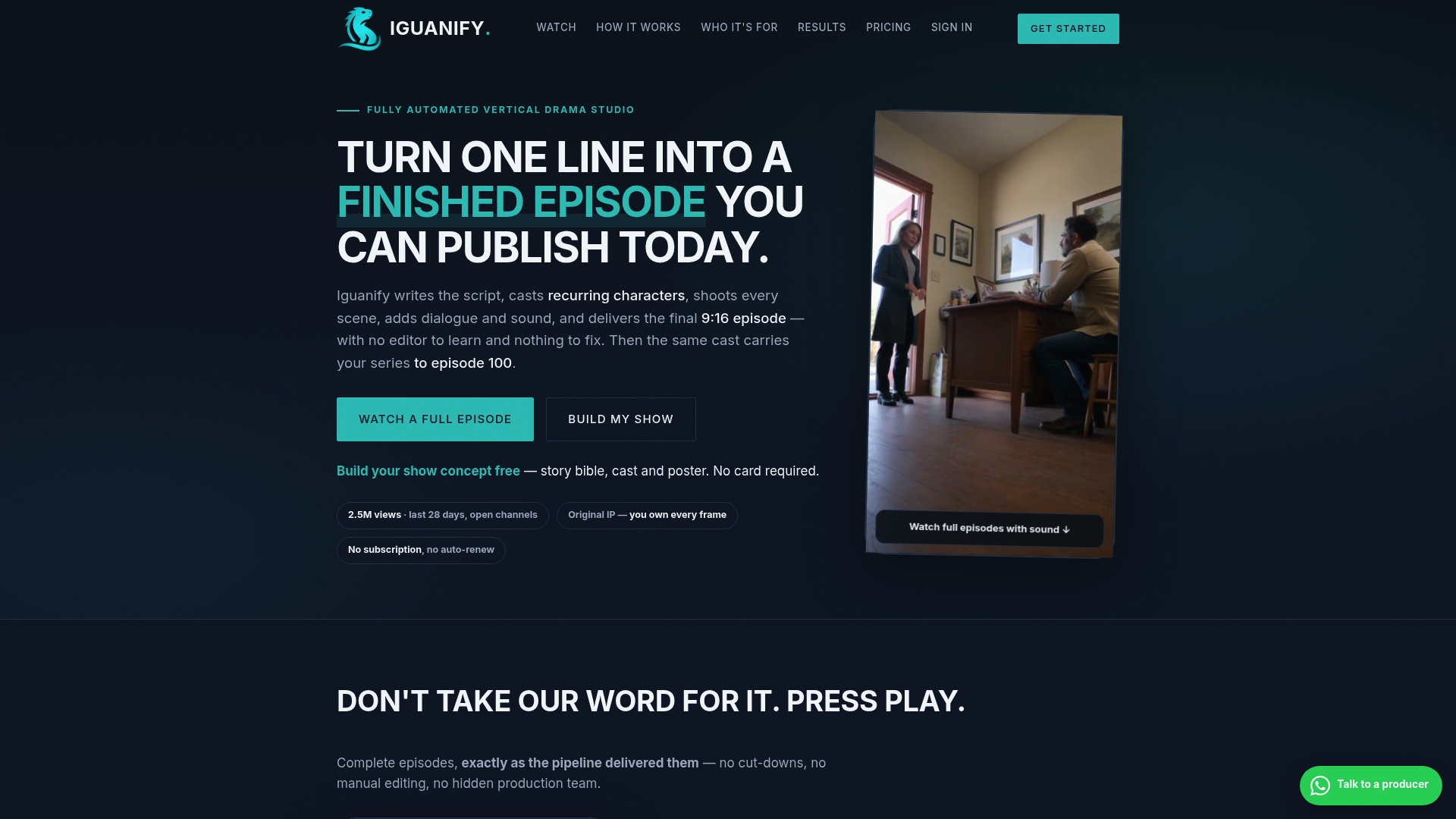
- Replaces the editing and crew step entirely: episodes come out ready to publish on TikTok, YouTube, or Instagram.
- Keeps character continuity automatically, the production problem that sinks most ad-hoc episodic attempts.
- Gives creators full rights to what gets produced, with no need to renegotiate ownership later.
A Standard episode or Pilot runs $34.99 one-off per episode, with Creator, Season, Studio, and Slate packages built for teams scaling past a pilot. It’s a fit when you want to test a premise fast without hiring a crew first. If you’re ready to see what a pilot looks like, the AI Micro Drama Generator is the place to start building your cast and first episode.
Sources
- Omdia press: Microdramas overtake streamers on mobile engagement
- Unskippable Labs: The impact of ad length on brand lift (Think with Google)
- Campaign US: The $1.5B rise of the branded microdrama
- Fast Company: YouTube and the microdrama craze (episode retention emphasis)
FAQ
What is the 3-7-27 rule in branding?
Definitions of this rule vary across marketing sources, and no primary source in this article defines it. Rather than guess at a figure, treat any version you encounter with caution and confirm it against a named source before applying it.
What is the 70-20-10 rule in content marketing?
The commonly cited version splits content into 70% proven formats, 20% new variations on what works, and 10% experimental ideas. It’s a useful rough guide for balancing an episodic series between safe formats and creative risk, though it isn’t tied to a specific study in this article.
What are some examples of brand content?
Branded episodic content spans social-first microdramas with cliffhanger hooks, serialized YouTube dramas built around a recurring cast, and podcast series hosted by a brand-adjacent expert. Each trades reach for depth differently, and the right example depends on whether your goal is discovery or loyalty.
What is the 3-3-3 rule in marketing?
As with similar informal rules, there’s no single agreed definition backed by a primary source, so treat any claimed version skeptically. If you come across it, check the original source before using it to plan a series.
How much does it cost to produce an episodic series with Iguanify?
A Standard episode or Pilot costs $34.99 one-off per episode, with Creator, Season, Studio, and Slate packages available for larger productions. Pricing for those larger packages is available on request through Iguanify’s product page.