 IGUANIFY
What Is AI Episodic Video, and How Do You Publish One Fast?

AI episodic video means AI-produced serialized short-form episodes, often called micro-dramas, delivered ready to publish on TikTok, YouTube, and Instagram. Deloitte defines micro-series as bite-sized scripted content built for mobile-first, vertical viewing. Your fastest path to a pilot: write a one-line premise, lock an episode length (short episodes of about one to two minutes work well), and run a small previsualized test before committing to a full season. Platforms like Iguanify are built to take you from that single line of script to a finished, consistently cast episode without a production team.
Key Takeaways
Serialized AI episodic video succeeds when creators pair a tight series bible with a platform that preserves character identity and guarantees content ownership.
| Point | Details |
|---|---|
| Define before you generate | Lock a one-line premise, core cast, and episode cadence before touching any production tool. |
| Test small first | Run 2 to 5 pilot episodes and track completion rate and retention spikes before scaling to a season. |
| Guard character continuity | Require persistent character IDs and a verification loop to prevent identity drift across episodes. |
| Verify ownership terms | Confirm master file export rights and a no-training clause before producing a single episode. |
| Iguanify handles the pipeline | Iguanify turns a single script line into a captioned, vertically exported episode with a persistent cast and full ownership. |
Table of Contents
- How Does the AI Episodic Video Production Workflow Work?
- How Do You Plan a Micro-Series From a Single Idea?
- How Do You Keep Characters Consistent Across Episodes?
- Should You Test Episodes Before Producing a Full Season?
- What’s the Best Way to Publish and Distribute Episodes?
- What IP and Ownership Terms Should You Verify First?
- What Features Should You Require From an Episodic AI Platform?
- How Does Iguanify Fit This Workflow?
- When Does a Micro-Series Beat a Single-Shot Campaign?
- Get Your First Episode Produced This Week
- Sources
How Does the AI Episodic Video Production Workflow Work?
A real episodic AI platform doesn’t just generate a clip. It routes your premise through specialized agents, each handling a distinct job the way a small studio would divide labor across a producer, a storyboard artist, and a director of photography.
- Creative-producer agent: turns your premise into a series bible and script structure, mapping out characters, tone, and episode beats.
- Storyboard agent: breaks the script into scenes and builds a shot list, deciding what the camera sees and when.
- DOP/technical routing agent: picks the right generation model, sets render parameters, and manages identity persistence across shots.
- Verification/QA agent: checks frames for continuity errors and triggers regeneration loops when a character’s face or wardrobe drifts.
The flow runs premise, then storyboard, then character setup, then multi-shot generation, then verification, then vertical export. This structure is what industry commentary on agentic production pipelines points to as the reason solo creators can now output multi-episode drama that used to require a full crew.
Pro Tip: Require a persistent “character ID” for every recurring cast member, and insist your platform runs a verification loop before final export. Skip this, and you’ll notice your lead actor’s face subtly shifting by episode three, the number one complaint creators have about generic AI video tools.
How Do You Plan a Micro-Series From a Single Idea?
A producible series bible starts small. Before you touch a generation tool, nail down five things: your one-line premise, two or three core characters, a hook for each episode, a season-length arc, and a cadence you can actually sustain.
- One-line premise (the elevator pitch a viewer gets in the first three seconds)
- Core characters with a name, motivation, and visual description for each
- Episode hooks, one per episode, that create a reason to watch the next
- A season arc, even a loose one, so episode ten pays off something from episode one
- Cadence and timing, typically daily or every other day for algorithmic platforms
Test with 2 to 5 pilot episodes before committing to a full season. That’s enough to see whether your hook actually holds attention.
| Series Bible Element | What It Should Contain |
|---|---|
| Character sheets | Name, appearance, voice, and core motivation for each recurring character |
| Lookbook | Reference stills defining wardrobe, setting, and color palette |
| Tone guide | Pacing, genre conventions, and dialogue style notes |
| Episode blueprint | Hook, conflict, and cliffhanger for each planned episode |

How Do You Keep Characters Consistent Across Episodes?
Write for the machine the way you’d write a shot list for a cinematographer: short beats, explicit visual prompts, camera notes, and continuity cues that spell out what stays the same between scenes.
- Break each episode into short beats (one action or emotional turn per beat, not a full paragraph)
- Write visual prompts that describe the character’s appearance every time they reappear, not just once
- Add camera notes (close-up, wide shot, pan) so the storyboard agent has something to work with
- Flag continuity cues explicitly: “same jacket as episode 1,” “same apartment set”
Preserving identity across shots relies on more than a good prompt. Research on multi-shot video generation shows that training-free methods using query injection and flow-based techniques can hold a character’s identity steady across scenes while still allowing natural motion, rather than freezing the character into a stiff, repeated pose.
Pro Tip: Ask whether your platform runs a two-pass generation and verification strategy. One pass for motion, one pass checking identity against a reference image. This balances the tension between “looks like the same person” and “doesn’t look like a mannequin.”
Platforms that skip this step are the reason viewers can spot AI drama from a mile away. Consistent identity is what separates a series from a string of disconnected clips, a distinction covered in more detail in Iguanify’s breakdown of continuity issues in single-prompt tools.
Should You Test Episodes Before Producing a Full Season?
Yes, and cheaply. Before you spend a full production budget, previsualize with animatics, a single-shot proof of concept, or a compact two to three episode pilot batch.
- Animatics or static storyboards to confirm the premise reads clearly in seconds
- A single-shot proof to test whether the visual style matches your tone guide
- A 2 to 3 episode pilot batch posted live to gauge real audience response
Track completion rate, retention spikes in the first 3 to 10 seconds, follow rate after an episode ends, and comment sentiment. Research on micro-drama production documents that creators commonly use exactly this kind of audience feedback loop to decide which storylines to keep developing and which to cut. If your pilot doesn’t hold retention past the first ten seconds, iterate the hook before you scale to a full season.
What’s the Best Way to Publish and Distribute Episodes?
Vertical format and short runtime aren’t optional on swipe-based platforms. Aim for 60 to 90 second episodes formatted for TikTok, Instagram Reels, and YouTube Shorts, since that’s the runtime these algorithms are built to reward.
Cadence matters as much as length. Daily releases build habit-forming viewership, while multi-week batch drops work better if you’re building anticipation for a season finale or launching alongside a marketing push. Whichever you choose, your first frame needs to stop a scroll instantly, since viewers decide to keep watching within the first second or two.
- Design a strong first frame and thumbnail that reads clearly even at small size.
- Add burned-in captions and subtitles for sound-off viewing, which covers a large share of mobile audiences.
- Tag each episode with a consistent series title so platform algorithms and viewers can find the next installment.
- Cross-post trimmed clips to secondary platforms to drive traffic back to the full episode.
- Reserve a small paid promotion budget to seed your first batch of episodes once the pilot proves retention.
Format specifics differ slightly by platform. Getting TikTok’s exact crop and size requirements right avoids the awkward cropping that kills a well-shot scene.
What IP and Ownership Terms Should You Verify First?
Before you produce a single episode, read the platform’s terms for four specific things: who owns the master files, whether the platform claims any training rights over your content, whether you can export raw assets, and what rights apply to any third-party music or voice you use.
- Confirm you retain full ownership of exported master files, not just a hosted preview
- Look for an explicit no-training clause, or at minimum, a clearly limited-use provision
- Verify you can export raw, editable assets, not just a compressed final render
- Check licensing terms for any stock music or voice used in production
Guidance on AI copyright and ownership makes the case plainly: creators need to verify platforms aren’t quietly claiming broad rights to reuse their work for training future models.
Pro Tip: Export and back up your master assets after every episode, not just at the end of a season. A platform outage or account issue shouldn’t cost you your entire IP.
What Features Should You Require From an Episodic AI Platform?
Not every AI video tool is built for series work. The features that actually matter split into two buckets: what determines quality, and what determines speed.
- Persistent character identities that hold up across dozens of shots, not just two or three
- Multi-shot generation with storyboard-to-shot mapping built in
- Auto captions and vertical export as default outputs, not paid add-ons
- Full asset export, including raw masters you can archive independently
- Revision and regeneration controls so you can fix a bad frame without redoing a scene
| Evaluation Dimension | What “Good” Looks Like |
|---|---|
| Identity fidelity | Characters stay recognizable across an entire season, not just one episode |
| Speed to publish | Script to finished episode in hours, not weeks |
| Export options | Raw master files included, no paywall on ownership |
| Ownership guarantees | Explicit terms confirming you hold full rights to produced content |
Operationally, you also want a project-level asset library, reusable episode templates, batch export for dropping a full week of content at once, and publishing integrations that push straight to your platforms. Analytics hooks that surface retention and follow-rate data matter too, since that’s what tells you whether episode four needs a rewrite.
How Does Iguanify Fit This Workflow?
Iguanify was built around this exact checklist. It expands a single line of script into a full series bible, generates a persistent cast that holds its look across every episode, and exports vertical, caption-ready video without a separate editing pass.
Common use cases include producing a pilot batch to test a premise, rolling out a full season once the pilot proves retention, and using auto-captioning to localize a series for a second market without reshooting anything. Because production runs on a one-time credit purchase rather than a subscription, you can scale spend to match what’s actually working.
Pro Tip: Start with a pilot pack of 2 to 3 episodes instead of buying a full season upfront. Use free show concept and cast generation to validate your premise before spending a single credit, then scale once retention data backs the idea.
When Does a Micro-Series Beat a Single-Shot Campaign?
Serialized AI video earns its budget when you have an audience-first idea that benefits from an ongoing story, when you’re testing a concept before investing in bigger IP, or when a community wants to follow a narrative over time. It’s the wrong tool for a single-message ad or a one-off explainer. Those need one strong shot, not a season. Resource allocation should follow the format: don’t spend a season’s worth of planning on a message that only needed thirty seconds.
Get Your First Episode Produced This Week
Iguanify is the alternative to hiring a production crew for your first micro-series: instead of casting, shooting, and editing over weeks, you write one line of script and get a finished, captioned episode with a consistent cast, ready to post. Ownership stays with you from the first frame, including full export rights to your master assets.
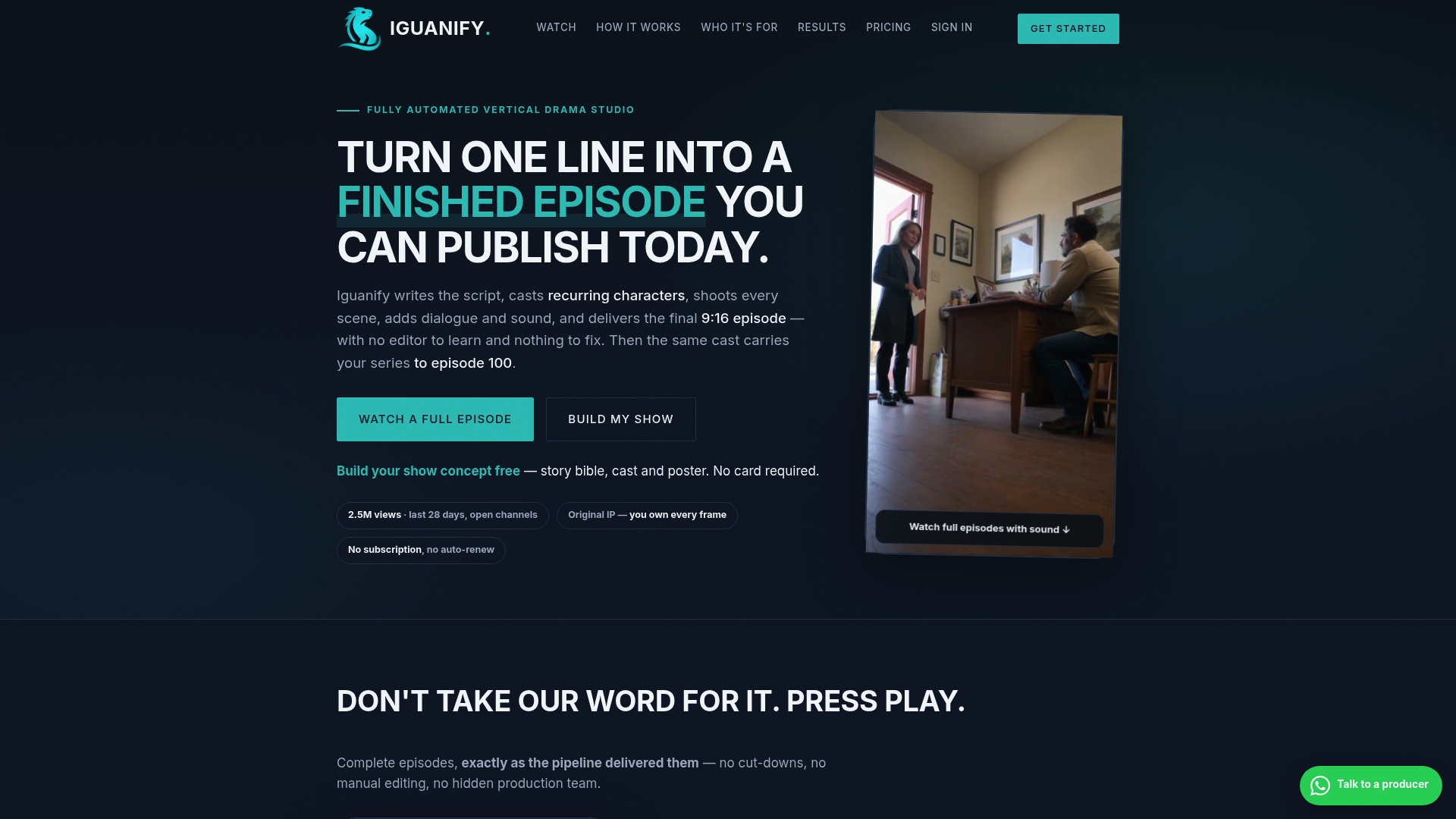
Getting started costs nothing upfront. Iguanify offers free show concept and cast generation before you spend a single credit, so you can see your characters and premise brought to life before committing to a pilot pack. Once you’re happy with the concept, a pilot pack typically delivers your first two or three episodes fast enough to test retention within the same week you started. From there, scaling to a full season is a matter of buying more credits, not renegotiating a contract. If you’re ready to turn your premise into a finished episode, start with the AI drama generator and see your first cast come together today.
Sources
- Short-form video series | Deloitte Insights
- Audience in the Loop: Viewer Feedback-Driven Content Creation in Micro-drama Production on Social Media | Proceedings of the 2026 CHI Conference on Human Factors in Computing Systems
- Video Storyboarding (arXiv)