 IGUANIFY
TikTok Video Size for Serialized Drama Creators
Export a 1080 × 1920 MP4 (H.264/AAC), 9:16 vertical, as your single master file. That one decision maximizes reach on TikTok, survives platform re-encoding without visible artifacts, and gives you an asset you can post directly to Instagram Reels and YouTube Shorts without a second export. For AI-assisted episodic production, Iguanify outputs episodes in this format by default, which means your technical baseline is already covered before you touch an upload queue.
Two numbers to keep in your workflow:
- Recommended resolution: 1080 × 1920 px, 9:16 aspect ratio — TikTok’s native format
- Mobile file-size caps: ~72 MB on Android, ~287.6 MB on iOS — your export bitrate and episode length must fit within these if you upload from a phone
Square (1:1) and landscape (16:9) formats are accepted, but TikTok displays them with black bars and deprioritizes them algorithmically compared with native vertical. For a serialized drama where every episode needs consistent reach, that penalty adds up fast.
Table of Contents
- What exact specs should you use for TikTok video dimensions?
- How do TikTok upload limits affect your episode files?
- Export presets that produce upload-ready TikTok masters
- How to build a repeatable production workflow for episodic vertical drama
- What creators need to know about content ownership and music rights
- How to size and position captions and overlay text in the vertical frame
- Key Takeaways
- Why the 1080 × 1920 standard is simpler than most creators think
- Produce your TikTok episodes without the export headache
- Useful sources for staying current on TikTok specs
What exact specs should you use for TikTok video dimensions?
Resolution and aspect ratio
The primary export target is 1080 × 1920 px at 9:16. Minimum fallbacks exist — 720 × 1280 and 540 × 960 are technically accepted — but treat them as emergency floors, not production targets. A 1080p master gives you headroom for recompression and on-screen text without visible quality loss.
File format and codec
MP4 with H.264 video and AAC audio is the safest choice across every upload method and third-party scheduler. MOV works, but MP4 is cleaner for batch exports and scheduler compatibility.
Frame rate
TikTok accepts 23–60 fps. Use 30 fps for dialogue-heavy drama scenes; switch to 60 fps only for fast action sequences where motion blur at 30 fps would read as soft.
Bitrate
Target 5–10 Mbps for 1080p. Below ~2 Mbps, quality degrades noticeably after TikTok’s re-encode. Above 10 Mbps, you’re adding file size without a visible quality gain on mobile screens.
Color profile and brightness
Export in Rec.709 or sRGB. Check skin tones and shadow detail on an actual phone before publishing — extreme brightness lifts that look fine on a calibrated monitor often clip after re-encode.
Safe zones
Keep all key text and graphics within the middle ~65% of the vertical frame. TikTok’s UI overlays — username, caption, share buttons — eat the bottom and sides.
Pro Tip: Exporting at 4K triggers aggressive server-side downscaling to 1080p, which can introduce more visible artifacts than a clean 1080p export would. Stick to 1080 × 1920 as your output canvas.
How do TikTok upload limits affect your episode files?
| Upload method | Max file size | Practical note for episodic creators |
|---|---|---|
| Android mobile | ~72 MB | Limits you to short episodes at moderate bitrate; compress or split |
| iOS mobile | ~287.6 MB | Workable for most 2–4 minute episodes at 8 Mbps |
| Web uploader | — | Best path for longer masters or high-bitrate exports |
Video length limits
TikTok currently supports up to 10 minutes for in-app and web uploads. For serialized drama, a practical runtime of 2–5 minutes per episode balances completion rate with story depth. Teasers cut to 15–34 seconds drive discovery; full episodes live on your profile.
Quick fixes when uploads fail or quality drops
- Compress with two-pass H.264 at a lower target bitrate (try 5 Mbps)
- Split longer episodes into two parts if mobile upload is required
- Switch to the desktop web uploader for any master over 200 MB
- Re-export audio as AAC 48 kHz if the upload rejects the file
Pro Tip: Test every new episode format on a private staging account first. Check the autoplay thumbnail, UI overlay collisions, and perceived sharpness before publishing to your main channel.
Export presets that produce upload-ready TikTok masters
Premiere Pro
- Codec: H.264; Format: MP4
- Frame size: 1080 × 1920; Frame rate: 30 fps
- Bitrate encoding: VBR 2-pass; Target: 8 Mbps, Max: 10 Mbps
- Audio: AAC, 48 kHz, Stereo, 320 kbps
Final Cut Pro
- Share → Export File → Format: Video and Audio
- Codec: H.264; Resolution: 1080 × 1920 (custom)
- Quality: High; Audio: AAC 48 kHz
DaVinci Resolve (Deliver page)
- Format: MP4; Codec: H.264
- Resolution: 1080 × 1920; Frame rate: 30 fps
- Encoding: Restrict to 8,000 kbps (2-pass where available)
- Audio codec: AAC; Sample rate: 48 kHz
FFmpeg command-line (two-pass)
ffmpeg -i input.mp4 -vf "scale=1080:1920:force_original_aspect_ratio=decrease,pad=1080:1920:(ow-iw)/2:(oh-ih)/2" \
  -c:v libx264 -b:v 8M -pass 1 -an -f null /dev/null && \
ffmpeg -i input.mp4 -vf "scale=1080:1920:force_original_aspect_ratio=decrease,pad=1080:1920:(ow-iw)/2:(oh-ih)/2" \
  -c:v libx264 -b:v 8M -pass 2 -c:a aac -ar 48000 -b:a 320k output_tiktok.mp4
Pre-upload validation checklist
- Confirm resolution is exactly 1080 × 1920
- Verify file size fits your upload method’s cap
- Check codec is H.264 video + AAC audio (use MediaInfo or VLC)
- Play back on a phone and confirm safe-zone text is visible
- Confirm cover image is centered and readable in the profile grid crop
How to build a repeatable production workflow for episodic vertical drama
A consistent pipeline prevents the most common episodic problem: episode 7 looking nothing like episode 1 after TikTok compression.
Numbered workflow per episode
- Lock a canonical 9:16 storyboard and series bible before any AI generation begins — character placement, framing, and lighting references go here.
- Generate or produce the episode using your AI tool; output a single 1080 × 1920 MP4 master as the canonical file.
- Create derivatives from that master: a 15–34 second teaser, a subtitled version with burned-in captions, and a cover image at 1080 × 1920 with centered text.
- Apply a standardized filename convention:
ShowName_S01E03_Master_1080x1920.mp4. - Upload the full master via the web uploader; schedule teasers for the days before release using your scheduling tool.
For scheduling strategy, Iguanify’s guide on scheduling TikTok posts covers upload windows and cadence for serialized releases. Standardizing exports and metadata across a season also unlocks faster scheduling and reduces upload errors. A fast video production workflow matters most when you’re releasing weekly.
Pro Tip: Apply a single LUT to every scene in a season and bake it into the export. TikTok’s compression shifts color slightly, so a consistent grade going in means consistent color coming out — episode to episode.
What creators need to know about content ownership and music rights
Owning your episodes means nothing if a music claim mutes the audio mid-series. Iguanify’s platform is built so creators retain full ownership of the episodes they produce, but music licensing is a separate responsibility.
- Use original scores, cleared library tracks, or royalty-free music licensed for commercial use on social platforms.
- Keep cue sheets and license records for every track — if a claim hits, you need documentation to dispute it quickly.
- Prefer instrumental stems under dialogue so audio clarity isn’t compromised if a track gets flagged.
Pro Tip: For serialized drama, commission or license a short theme sting under 15 seconds. It builds show identity, reduces rights friction compared with a full licensed track, and plays well under TikTok’s audio discovery system.
How to size and position captions and overlay text in the vertical frame
Captions are where most episodic creators lose viewers — not because the story is weak, but because text is unreadable or hidden behind TikTok’s UI. The bottom 20% and top 10% of the frame are high-risk zones for UI collisions; keep all subtitle text above the bottom 20% and below the top 10%.
Font size matters more on mobile than it does in your editing timeline. A safe minimum is around 40–50pt at 1080 × 1920 resolution; anything smaller becomes illegible on a 6-inch screen. Use high-contrast text — white with a dark drop shadow or semi-transparent background bar — so captions read across both bright outdoor scenes and dark interior shots.
For burned-in captions on episodic drama, center-align dialogue subtitles in the lower-center safe zone. Avoid placing character name labels or episode titles at the very top of the frame, where TikTok’s progress bar and back button sit. Test caption placement on at least two different phone screen sizes before locking the template for a season.
Key Takeaways
Your 1080 × 1920 MP4 (H.264/AAC) master is the single most important production decision for consistent TikTok reach and minimal upload friction across a full episodic season.
| Point | Details |
|---|---|
| Resolution and codec | Export 1080 × 1920 MP4 (H.264/AAC) at 5–10 Mbps and 30 fps (60 fps for action). |
| Safe zone and color | Keep key visuals within the middle 65% of the frame and export in Rec.709 color profile. |
| Upload method | Use the web uploader for masters over 200 MB; mobile caps are ~72 MB (Android) and ~287.6 MB (iOS). |
| Teaser versions | Cut 15–34 second teasers from the master for discovery; keep the full episode for profile and cross-posting. |
| Iguanify | Iguanify outputs finished 1080 × 1920 episodes from a single script, with creator ownership built in. |
Why the 1080 × 1920 standard is simpler than most creators think
Most of the technical anxiety around TikTok specs comes from the wrong starting point: creators trying to adapt horizontal footage or mixed-format projects into a vertical feed. When you build for 9:16 from the first frame, the spec stops being a constraint and becomes a production shortcut.
The 4K upload temptation is real, but the math doesn’t favor it. TikTok recompresses everything to 1080p on playback, and a 4K-to-1080 downscale on their servers often produces more visible artifacts than a clean 1080p two-pass H.264 export from your own machine. You’re paying in file size and upload time for a quality penalty, not a gain.
For serialized drama specifically, the bigger risk isn’t resolution — it’s inconsistency across episodes. A season where episode 1 looks sharp and episode 6 looks washed out loses audience trust faster than a slightly lower bitrate would. Standardize the LUT, the export preset, and the caption template once, then repeat it. That discipline is what separates a show from a collection of clips.
Produce your TikTok episodes without the export headache
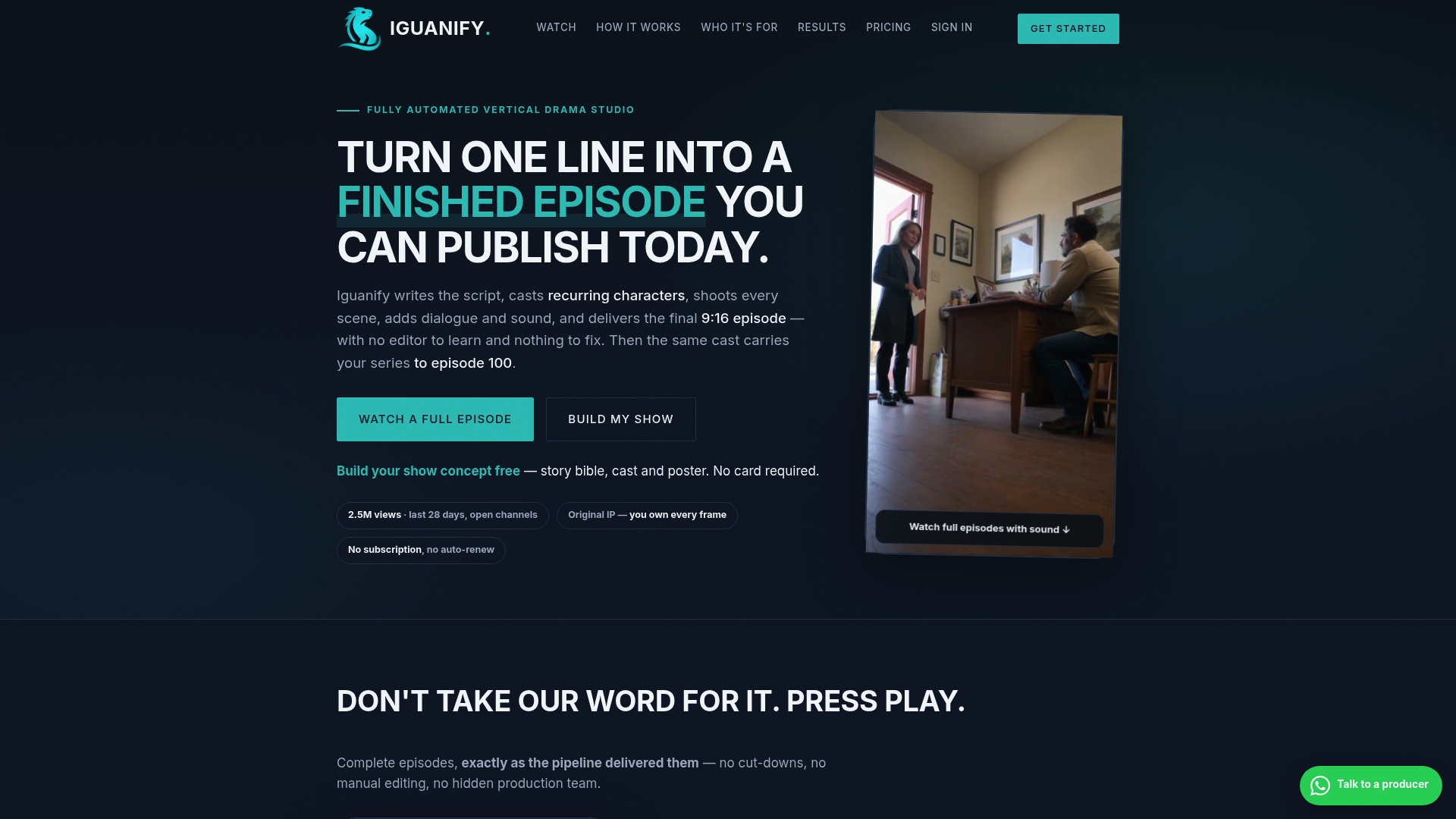
Most creators spend more time troubleshooting exports than writing scripts. Iguanify flips that ratio. You bring the premise; Iguanify handles scriptwriting, character consistency, dialogue, sound, and delivers a finished 1080 × 1920 vertical episode ready to upload — no editing suite required.
Specific benefits for episodic creators:
- Automatic 1080 × 1920 vertical output, matched to TikTok’s native format
- Consistent characters across every episode in a season
- Built-in cover image generation sized for the profile grid
- Full creator ownership of every episode produced — your IP, your rights
- One-time credit purchase; no recurring fees
Start your first episode at iguanify.com/ai-drama-generator, or explore how to build a full series from scratch at the faceless drama channel guide.
Useful sources for staying current on TikTok specs
TikTok’s upload limits and length caps have changed multiple times and will change again. Bookmark these and check them before starting a new season.
- TikTok video size guide (ManyChat) — covers recommended dimensions, aspect ratios, and cross-platform reuse; check when starting a new series or posting format.
- TikTok video size (Descript) — detailed file-size limits by upload method and codec guidance; verify Android/iOS caps here when mobile upload fails.
- TikTok video sizes (RecurPost) — frame rate, bitrate, and length limit details; useful for export preset validation.
- TikTok video size guide (Screensnap) — safe-zone specifics and caption placement; check when updating your caption template.
- TikTok platform specs (xroadstudio) — cross-platform spec comparison for TikTok, Reels, and Shorts in one place.
For vertical storytelling strategy beyond the technical specs, the TikTok brand storytelling guide covers creative framing that supports reach for serialized formats. Use the TikTok web uploader for any master over 200 MB, and always run a test upload on a staging account before publishing a new episode to your main channel.