 IGUANIFY
Best HeyGen Alternatives for Episodic AI Video in 2026

What are the best HeyGen alternatives for serialized AI video?
The strongest HeyGen alternatives for episodic AI video production in 2026 are ngram, Synthesia, D-ID, Vidnoz, and Iguanify. Each solves a different piece of the serialized content puzzle, so the right pick depends on whether your bottleneck is character continuity, workflow automation, enterprise compliance, or budget.
Here is how each one stacks up at a glance:
- ngram: Best for business teams turning raw source material (PDFs, URLs, decks, screen recordings) into branded episodic videos through an agentic chat workflow that plans before it renders.
- Synthesia: Best for enterprise training and internal communications. A majority of Fortune 100 companies use it, and it carries SOC 2 and ISO 27001 compliance on all plans.
- D-ID: Best for developers who need to embed conversational AI avatars inside custom apps via an API-first architecture rather than a no-code studio.
- Vidnoz: Best for creators testing workflows before spending money. Its free tier is among the most generous available, with no credit card required.
- Iguanify: Best for solo creators and small teams producing full serialized drama episodes with consistent characters, automated from a single premise to a published episode.
The core problem with most of these tools, including HeyGen itself, is that they generate clips, not episodes. Character continuity across scenes is the technical challenge that separates a clip factory from a real episodic production system.
Table of Contents
- How do these platforms compare on features, pricing, and workflow?
- How do you choose the right platform for a serialized AI video project?
- What makes Iguanify different for episodic content creators?
- What do user reviews say about reliability across these platforms?
- What are the real limitations of each platform?
- Key Takeaways
- What most comparisons get wrong about AI video tools
- Iguanify produces full episodes, not just clips
How do these platforms compare on features, pricing, and workflow?
The differences between these platforms run deeper than a feature checklist. Workflow type is the real dividing line.
| Platform | Primary focus | Workflow type | Character continuity | Security | Pricing model |
|---|---|---|---|---|---|
| ngram | Business video from source material | Agentic chat | Limited | Not publicly listed | Plan-based |
| Synthesia | Enterprise training and comms | All-in-one studio | Avatar consistency | SOC 2, ISO 27001 | — |
| D-ID | Interactive conversational avatars | API-first | Moderate | Enterprise-grade | Free trial + paid tiers |
| Vidnoz | General avatar video | All-in-one studio | Basic | Not publicly listed | Free tier + paid plans |
| Iguanify | Serialized episodic drama | End-to-end automated | Full cast continuity | Not publicly listed | One-time credit packs |
A few things worth calling out:
- ngram’s agentic workflow means you feed it a prompt, a PDF, or a URL, and it builds a storyboard before rendering. That planning step reduces wasted renders on serialized projects.
- Synthesia’s compliance posture is the reason enterprise L&D teams choose it. SOC 2 and ISO 27001 coverage from the entry plan is a genuine differentiator over most alternatives.
- D-ID’s API depth makes it the default for engineering teams embedding avatars in products. It is not the right tool if you want a no-code studio experience.
- Vidnoz’s free tier lets you create up to 2 minutes of video per day, with access to over 1,900 avatars and more than 6,300 templates, all without a credit card.
- Iguanify operates on one-time credit packs with no monthly subscription, which matters when you are producing a season of episodes and need predictable costs.
Costs on credit-based platforms escalate quickly once you add premium avatars, translation, or high-volume output. That is the pattern that pushes episodic creators to look for alternatives with clearer pricing in the first place.
Pro Tip: Before committing to any platform, map your per-episode production volume against the credit math. A plan that looks affordable at one video per week can become expensive at five episodes per week.
How do you choose the right platform for a serialized AI video project?
Matching the tool to your actual production job is more important than chasing the longest feature list. Buyers who compare tools serving fundamentally different use cases waste time and budget before they even produce a single episode.
Ask yourself these questions before you shortlist:
- Do you need character continuity across episodes? If your series has recurring characters, you need a platform that locks avatar appearance across scenes. Most general-purpose tools do not do this reliably.
- What is your workflow starting point? If you start from a script, an avatar studio works. If you start from a premise or a rough idea, you need a platform that handles scriptwriting as part of the pipeline.
- What is your publishing cadence? A creator posting three episodes per week needs faster turnaround than someone publishing monthly. Agentic production workflows that automate script-to-video pipelines reduce cycle times significantly for high-cadence creators.
- What does your budget look like per episode? Subscription models favor consistent low volume. One-time credit packs favor burst production or seasonal releases.
- Do you need enterprise security? If you are producing for a brand or agency, SOC 2 or ISO 27001 compliance may be a procurement requirement.
Validate your shortlist with a free trial or a small test project before committing. Vidnoz’s free tier is a low-risk starting point for workflow testing. Synthesia and D-ID both offer free trials with enough output to evaluate avatar quality and rendering speed.
What makes Iguanify different for episodic content creators?
Iguanify is built specifically for the problem most AI video tools ignore: producing a full episode, not just a clip, with the same characters showing up consistently in every scene.

The production pipeline is fully automated. You submit a premise, and Iguanify generates the series bible, recurring cast, script, dialogue, sound design, and final episode output ready for TikTok, YouTube, or Instagram. No manual editing. No production team required.
Key advantages for serialized creators:
- Full cast continuity: The same characters appear across every episode of a series, preserving viewer immersion and storytelling flow.
- End-to-end automation: From a single line of script to a finished, publishable episode without intermediate editing steps.
- Content ownership: You own the IP. Every episode produced belongs to you, with full rights to distribute and monetize.
- No subscription lock-in: Credit packs mean you pay for what you produce, not a monthly seat fee that runs whether you are publishing or not.
- Multi-platform output: Episodes are formatted for vertical and horizontal distribution across major platforms without reformatting.
For a creator building a serialized drama channel, the difference between a clip tool and Iguanify is the difference between assembling furniture piece by piece and receiving it built. The AI micro-drama format is growing fast on short-form platforms, and consistency of character is what keeps audiences coming back episode after episode.
What do user reviews say about reliability across these platforms?
Reliability patterns across these platforms are consistent enough to plan around. Synthesia draws praise for predictable output quality and enterprise-grade stability, which is why large organizations standardize on it. The trade-off is that its voice engine can sound slightly mechanical compared to newer tools, and rendering is slower than some competitors.
D-ID earns strong marks from developer teams for API reliability and real-time avatar performance. Creators using it for no-code studio work sometimes find the interface less intuitive than avatar-first platforms.
Vidnoz gets positive feedback for its free tier generosity, though creators scaling to paid plans report that the feature gap between free and paid is noticeable. ngram’s agentic workflow is praised by business teams for reducing back-and-forth on script revisions, though it is less tested for narrative drama production.
Interactive and conversational video features are increasingly expected in 2026, particularly for training and communications use cases, and platforms that lack them are starting to feel dated to enterprise buyers.
What are the real limitations of each platform?
Every platform has a ceiling. Knowing where it is saves you from discovering it mid-production.
- ngram: Strong for business content from source material, but not purpose-built for narrative drama or serialized storytelling. Character continuity across episodes is not a core feature.
- Synthesia: Slower rendering and a voice engine that can sound formal rather than natural. Lip-synced translation is locked to enterprise pricing, which puts it out of reach for independent creators.
- D-ID: Requires technical comfort to get full value from the API. The no-code interface is functional but not as polished as avatar-first studios. Not designed for episodic narrative production.
- Vidnoz: The free tier is genuinely useful for testing, but scaling up reveals limitations in avatar customization and output consistency. Not built for serialized drama.
- Iguanify: Focused specifically on serialized episodic drama. Creators needing corporate training videos, interactive quizzes, or SCORM exports will find it is not the right tool for those jobs.
The honest summary: no single platform does everything well. The mistake is treating these tools as interchangeable when they are built for different production jobs.
Key Takeaways
For episodic AI video creators, the platform that matches your production workflow beats the one with the longest feature list every time.
| Point | Details |
|---|---|
| Character continuity is the key criterion | Most avatar tools generate clips; only purpose-built platforms maintain consistent characters across a full series. |
| Workflow type drives the decision | Agentic, API-first, and all-in-one studios serve fundamentally different production jobs. |
| Credit math matters at scale | Costs escalate quickly on credit-based platforms when adding premium avatars or high-volume output. |
| Synthesia leads on enterprise compliance | SOC 2 and ISO 27001 coverage from the entry plan makes it the default for governed training programs. |
| Iguanify automates full episode production | From premise to published episode with consistent cast, no editing team, and one-time credit pricing. |
What most comparisons get wrong about AI video tools
The vendor-driven comparison problem is real. Industry experts advise skepticism toward competitor analyses produced by vendors themselves, and for good reason: the top search results for “HeyGen competitors” in 2026 are written by Synthesia, D-ID, and other platforms with a direct interest in how the comparison lands.
What gets lost in those comparisons is the production job question. A creator building a 20-episode drama series on TikTok has almost nothing in common with an L&D team producing compliance training. Treating them as the same buyer leads to recommendations that fit neither.
The platforms worth watching in 2026 are the ones investing in agentic workflows, where the tool plans and executes the full production pipeline rather than waiting for human direction at every step. That shift matters most for episodic creators, because the bottleneck is not rendering speed. It is the overhead of maintaining continuity, managing a cast, and keeping a production cadence without a team behind you.
One-size-fits-all thinking is the biggest risk in this category. The right tool is the one that fits your actual production job, not the one with the most impressive demo reel.
Iguanify produces full episodes, not just clips
If you have been comparing avatar tools and finding that none of them quite solve the continuity problem, that is because most of them were not built to. They generate clips. Iguanify produces complete episodes.
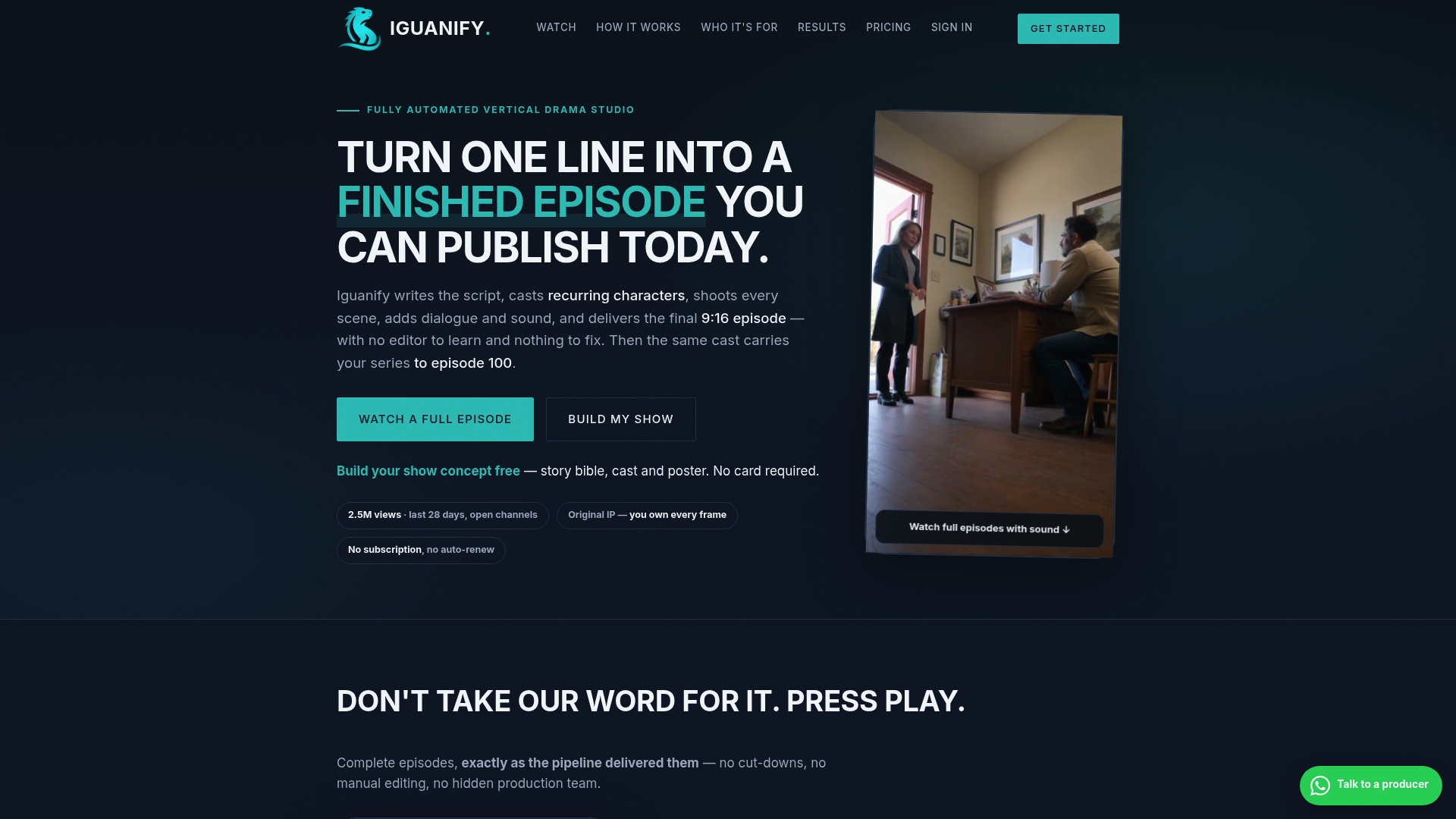
For creators building a serialized drama channel on TikTok, YouTube, or Instagram, Iguanify handles the entire production pipeline: series bible, recurring cast, script, dialogue, sound, and final episode output, all from a single premise. You own every episode you produce. No subscription, no editing team, no continuity headaches between episodes.
If you are ready to build a series rather than a clip library, start your first episode and see your cast come to life before you spend a dollar.