 IGUANIFY
Episode Length for Shorts: The Creator’s Runtime Guide

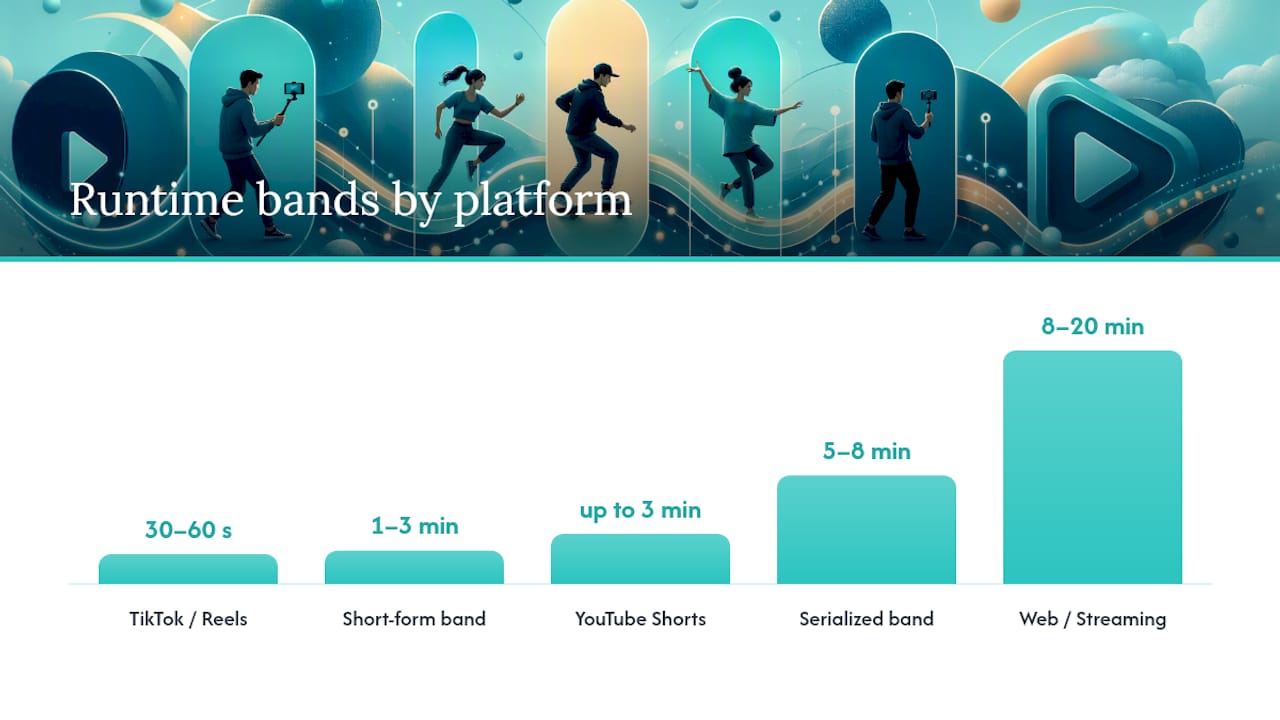
For episodic shorts, the right runtime depends on your platform and story type. Use these four bands as your starting point:
- Micro-shorts: 15–60 seconds (TikTok, YouTube Shorts, Instagram Reels)
- Short-form episodes: 1–3 minutes (platform series, social drama, comedy)
- Long-shorts / anthology: 8–20 minutes (streaming, franchise extensions, web series)
- Festival-aware shorts: Under 40 minutes per the AMPAS definition, but aim for under 15 minutes to make programming easier
Pick the band that matches your primary distribution platform and story complexity, then use the decision checklist in Section 7 to lock in your exact duration. Platform limits, audience attention windows, and festival programming pressure are the three forces that shape every one of these bands.
Pro Tip: If you are unsure where to start, default to the shorter end of your chosen band for your pilot episode. Shorter is easier to test, cheaper to reshoot, and far more forgiving if the pacing is off.
Key Takeaways
Matching episode length to your platform’s sweet spot and story type is the single highest-leverage decision in short-form episodic production.
| Point | Details |
|---|---|
| Four runtime bands | Micro-shorts (15–60s), short-form episodes (1–3min), long-shorts (8–20min), festival-aware (under 40min per AMPAS). |
| Platform sweet spots | YouTube Shorts peaks at 50–60 seconds; TikTok and Reels perform best under 60 seconds despite higher ceilings. |
| Festival rule | AMPAS caps shorts at 40 minutes, but films under 10 minutes are far easier for programmers to place. |
| Genre shifts completion rates | Matching runtime to genre can shift completion and binge rates by 15–25 percentage points, per Reelytics data. |
| Iguanify for episodic production | Iguanify automates series continuity and delivers finished vertical episodes at your chosen runtime without manual editing. |
Table of Contents
- What episode length for shorts actually works on each platform?
- How story type determines the right short video duration
- Festival and programmer considerations that affect your runtime
- Practical episode structure templates by runtime
- Production and continuity tips for episodic shorts
- A quick decision checklist to pick your final episode length
- Real series runtimes that prove the recommendations
- Tools and workflows that speed up episodic short production
- The tradeoffs nobody talks about when picking a runtime
- Iguanify produces finished episodes at your chosen runtime
- Sources
What episode length for shorts actually works on each platform?
Platform limits are not suggestions. They are hard ceilings that determine whether your episode even appears in the feed, and the gap between the ceiling and the sweet spot is wider than most creators expect.
| Platform | Max Length | Typical High-Performing Band | Notes |
|---|---|---|---|
| YouTube Shorts | 3 minutes | 50–60 seconds | Average Short runs 30–40 seconds |
| TikTok | 10 minutes | 30–60 seconds | Shorter clips dominate completion metrics |
| Instagram Reels | 90 seconds | 30–60 seconds | Reels over 60s see lower reach on average |
| Streaming / Web | No hard cap | 8–20 minutes | Narrative depth justifies longer runtimes |
| Festival circuit | ≤40 min (AMPAS) | Under 10 minutes | Programmer preference drives practical limit |
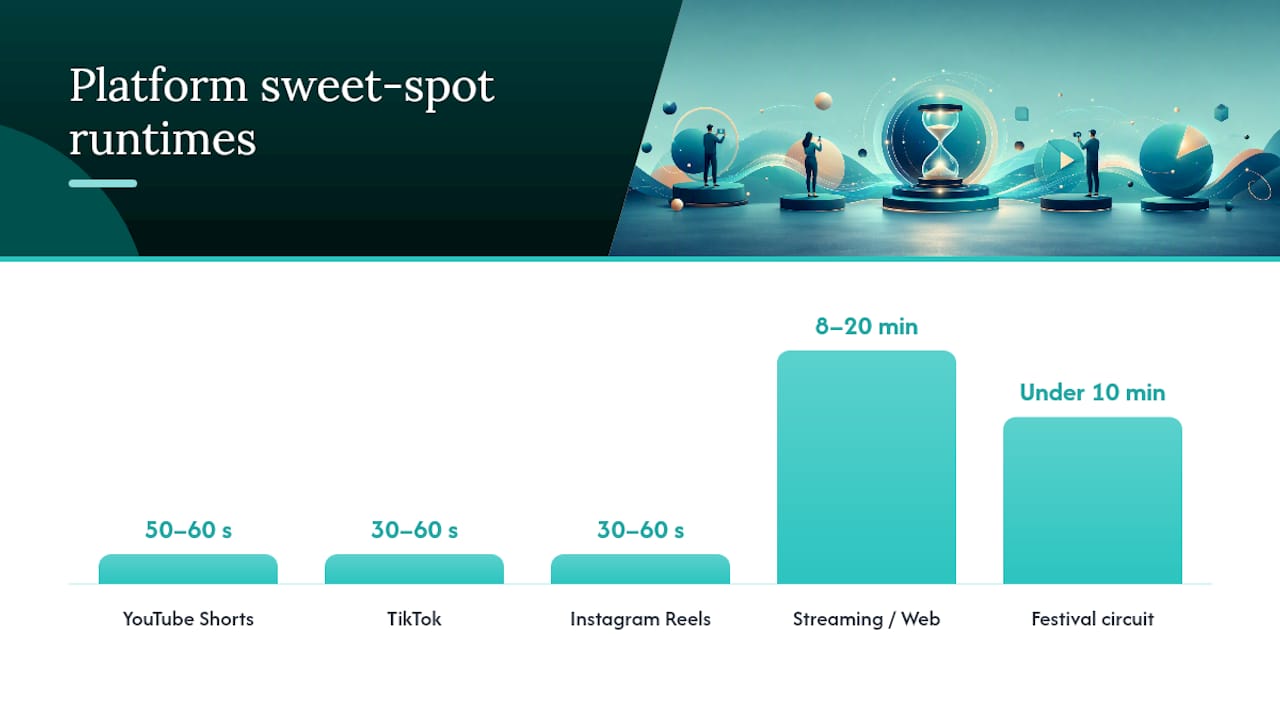
YouTube Shorts expanded its maximum to three minutes in late 2024, yet the average Short still runs around 30–40 seconds, and the strongest-performing band for many creators sits at 50–60 seconds. That gap tells you something: the algorithm rewards completion, and a shorter clip is far easier to watch all the way through.
TikTok allows up to 10 minutes, but most viral content clusters well under 60 seconds. Reels on Instagram cap at 90 seconds, though the platform’s reach data consistently favors clips in the 30–60 second window. For episodic drama on social platforms, this means your story structure has to be tight enough to deliver a satisfying beat inside a single minute.
Streaming and web-series contexts operate by different rules. When you are not competing for feed real estate, narrative depth earns its runtime. That is where the 8–20 minute band becomes viable.
- Match your first-episode runtime to the platform’s sweet spot, not its maximum.
- For multi-platform releases, produce a short cut (under 60 seconds) and a long cut (3–8 minutes) from the same shoot.
- Music copyright windows on TikTok and Reels can affect monetization above certain lengths; check current platform policies before locking your edit.
Pro Tip: Post your pilot at the shorter end of the platform’s sweet spot. If episode-to-episode retention is strong, you have earned the right to go slightly longer in episode 3 or 4.
How story type determines the right short video duration
Runtime is not a production decision. It is a story decision. The type of story you are telling has a natural length, and fighting that length always shows up in pacing.
Reelytics’ genre-specific benchmarks show measurable differences in completion and binge rates when creators match runtime to genre: comedy performs best around 60 seconds, thriller around 80 seconds, and romance around 120 seconds. Using the optimal length for a genre can shift completion and binge rates by roughly 15–25 percentage points compared to a mismatched runtime.
Here is how common story types map to runtime bands:
- Gag / punchline (15–45 seconds): Setup, subversion, payoff. Every second past the punchline bleeds energy. Think single-joke sketch or visual gag.
- Character vignette (45–90 seconds): One moment that reveals character. No plot required, just a clear emotional beat.
- Single twist or reveal (1–3 minutes): Two-act structure: establish the world, flip it. Works for thriller micro-episodes and social drama.
- Multi-beat drama (3–8 minutes): Room for a proper three-act arc with a complication and resolution. Romance and serialized drama live here.
- Short-form anthology (8–20 minutes): Self-contained story with a full emotional arc. Requires a strong hook in the first 90 seconds or viewers drop.
Comedy is the most punished genre for over-running. A joke that lands at 45 seconds becomes awkward at 90. Romance and emotional drama, by contrast, need time to breathe; rushing a relationship beat to hit a 60-second target usually kills the payoff. Thriller sits in the middle: tension builds with time, but a micro-thriller can work if the reveal is strong enough to carry the whole piece.
Pro Tip: Write your script first, then time a read-aloud. If the natural read lands inside your target band, you are in good shape. If it runs long, cut a beat rather than speeding up the delivery.
Festival and programmer considerations that affect your runtime
The Academy of Motion Picture Arts and Sciences defines a short film as any motion picture with a running time of 40 minutes or less, including credits. That is the formal ceiling for awards eligibility. In practice, most festivals set their own, much tighter limits.
Festival programmers consistently favor shorter films since scheduling is a logistics problem. A 90-minute screening block can fit nine 10-minute films or four 20-minute films. The programmer who needs to balance a block will almost always choose the shorter film when quality is comparable. Films under 8–10 minutes are widely described as the easiest to place, and guides for short-film writers consistently recommend the 5–10 minute range for strong festival traction.
Shorter films under a moderate runtime are much easier to program and are highly favored by festival programmers who need to fill varied screening blocks.
The practical consequence: if festival submission is part of your release strategy, design your story to land cleanly under 10 minutes. A 12-minute short is not disqualified, but it costs you flexibility. A 22-minute short, even a brilliant one, will be passed over for blocks where it simply does not fit.
- Target under 10 minutes for the widest festival access.
- If your story genuinely needs 12–18 minutes, submit to festivals with dedicated mid-length blocks.
- Always include a clean credits sequence; AMPAS counts it toward the 40-minute cap.
- Check each festival’s specific runtime ceiling before submitting; many cap at 15 or 20 minutes regardless of AMPAS rules.
Pro Tip: Cut a festival version and a platform version of the same episode. Trim the festival cut to under 10 minutes by removing one subplot or compressing the second act. You keep the story; you gain programming flexibility.
Practical episode structure templates by runtime
These templates give you a beat-by-beat blueprint for six common runtime targets. Use them as an edit sheet or a script outline.
-
30-second micro-short
- 0–5s: Hook (visual or line that stops the scroll)
- 5–20s: Core action or joke setup
- 20–28s: Payoff or punchline
- 28–30s: Logo / end card Cut if running long: Trim the setup. The hook and payoff are non-negotiable.
-
60-second episode
- 0–5s: Hook
- 5–25s: Establish situation and character want
- 25–50s: Complication or escalation
- 50–58s: Resolution or cliffhanger
- 58–60s: End card Cut if running long: Remove one line of dialogue from the complication beat.
-
90-second episode
- 0–8s: Hook
- 8–35s: World and character setup
- 35–70s: Rising tension or emotional beat
- 70–85s: Turn or reveal
- 85–90s: Tag or cliffhanger Cut if running long: Compress the setup; viewers on social platforms tolerate very little exposition.
-
2–3 minute episode
- 0–10s: Hook
- 10–40s: Act 1 — situation established, stakes clear
- 40–100s: Act 2 — complication, character decision
- 100–160s: Act 3 — consequence or cliffhanger
- 160–180s: End card and series branding Cut if running long: Trim Act 2 dialogue; keep the character decision moment intact.
-
5–8 minute episode
- 0–20s: Cold open or recap hook
- 20–90s: Act 1 — full scene establishing episode conflict
- 90–240s: Act 2 — two or three escalating beats
- 240–420s: Act 3 — climax and partial resolution
- 420–480s: Tag scene or cliffhanger into next episode Cut if running long: Remove the weakest Act 2 beat entirely rather than trimming all three.
-
10–15 minute anthology episode
- 0–30s: Cold open (in medias res)
- 30–180s: Act 1 — full world and character establishment
- 180–540s: Act 2 — two-scene complication with a midpoint turn
- 540–780s: Act 3 — climax, emotional payoff
- 780–900s: Denouement and series tag Cut if running long: Compress the denouement; end on the emotional peak rather than after it.
Viewers who see it coming have time to feel the tension; viewers who miss the last few seconds still got the hook.*
Production and continuity tips for episodic shorts
Choosing a runtime is step one. Keeping that runtime consistent across a season is where most solo creators lose time and money.
A series bible is the single most valuable document you can write before shooting. It does not need to be long. One page covering character names, visual style, recurring locations, and episode structure is enough to prevent the continuity errors that cost you hours in the edit. If you are producing vertical episodic drama, lock your aspect ratio (9:16 for TikTok and Reels, 16:9 for YouTube standard) before you shoot a single frame.
Batch shooting is the most efficient way to maintain consistent pacing across episodes. When your target runtime is 1–3 minutes, a single shoot day can realistically cover 4–6 episodes if you script them to share locations and wardrobe. Longer episodes in the 8–15 minute range typically need their own shoot days, which changes your cost-per-episode math significantly.
- Write all scripts for a season before shooting any of them. This lets you spot continuity gaps early.
- Use a shot-list template that maps directly to your beat structure so every episode gets the same coverage.
- Lock wardrobe and props per character in a reference sheet with photos. Continuity errors in short-form drama are more visible than in long-form because viewers rewatch episodes.
- Export presets: save a platform-specific export preset for each distribution target so you are not manually adjusting settings per episode.
- Build a small buffer of completed episodes before your first post. Two or three episodes in reserve lets you maintain a posting cadence even when production slows.
Pro Tip: When producing many 1–3 minute episodes rapidly, record all dialogue for a character in a single session rather than across multiple days. Voice consistency is one of the hardest continuity issues to fix in post, and batching it costs almost nothing extra.
A quick decision checklist to pick your final episode length
Work through these steps in order. Each one narrows your range until you have a specific runtime target.
-
Define your primary platform. Where will this series live first? TikTok and Reels push you toward 30–60 seconds. YouTube Shorts supports up to 3 minutes. A web series or streaming release opens the 8–20 minute band. Your platform is the first filter.
-
Define your story complexity. Is this a gag, a vignette, a two-act drama, or a serialized thriller? Match your story type to the runtime bands in Section 3. If your story needs more beats than your platform’s sweet spot allows, either simplify the story or choose a longer-form platform.
-
Check your festival targets. If you plan to submit to festivals, your runtime needs to fit under 10 minutes for the widest programming access. If festival submission is not a priority, skip this filter.
-
Shoot and post a pilot at the shorter end of your target band. If your target is 1–3 minutes, launch at 90 seconds. Measure completion rate and episode-to-episode retention after your first three episodes.
-
Adjust based on data. If completion is strong and viewers are clicking through to the next episode, you can expand slightly. If completion drops off before the midpoint, cut the runtime, not the story beats — tighten the pacing instead.
Comedy pilot example: Platform is TikTok. Story is a recurring gag series. Target band is 30–60 seconds. Pilot launches at 40 seconds. After five episodes, completion is high and shares are growing. Episode 6 tests 55 seconds with an extra beat. Retention holds. The series settles at 45–55 seconds per episode.
Serialized thriller example: Platform is YouTube (standard, not Shorts). Story needs three acts per episode. Target band is 5–8 minutes. Pilot launches at 5 minutes. Retention data shows viewers dropping at the 4-minute mark in episodes 2 and 3. The team trims Act 2 by 45 seconds. Episodes 4 onward run at 4:15 and retention improves.
Real series runtimes that prove the recommendations
Two produced series illustrate opposite ends of the short-episode spectrum and show why the recommended bands exist.
Star Trek: Short Treks ran episodes at roughly 8–18 minutes. These were franchise-adjacent anthology pieces designed to expand the Star Trek universe between main-series seasons. The runtime gave writers enough room for a complete character arc or a self-contained story with emotional weight. At 8 minutes, an episode could deliver a single strong scene with a meaningful turn. At 18 minutes, it could carry a full two-act structure. The flexibility within that band was intentional: each episode was sized to its story, not to a fixed slot.
Shorty McShorts’ Shorts averaged 4–5 minutes per episode. As a comedic anthology series, it needed enough time for a setup and a payoff but not so much that a single weak joke could sink the whole episode. The 4–5 minute window is a practical sweet spot for network-friendly comedy blocks: long enough to feel like a complete piece, short enough to stack several in a single programming slot.
| Series | Runtime Band | Format | Why It Worked |
|---|---|---|---|
| Star Trek: Short Treks | 8–18 minutes | Franchise anthology | Narrative depth justified longer runtime; streaming context removed platform ceiling |
| Shorty McShorts’ Shorts | 4–5 minutes | Comedy anthology | Compact enough for block programming; long enough for a full comedic arc |
The lesson from both: runtime was a deliberate creative and distribution decision, not a default. Short Treks would not have worked at 90 seconds; the stories needed room. Shorty McShorts’ would have dragged at 15 minutes; the comedy needed to land and exit quickly.
Tools and workflows that speed up episodic short production
A consistent production workflow matters as much as the right runtime. Without one, each episode becomes its own production problem rather than a repeatable unit.
The core workflow for episodic shorts breaks into four components:
- Script and beat planning: Use a beat-sheet template (the ones in Section 5 work as starting points) to script every episode before any production begins. Tools like Final Draft or Fade In handle standard screenplay formatting; for short-form episodic work, a simple Google Doc beat sheet is often faster.
- Vertical framing presets: Lock a 9:16 frame preset in your editing software before episode one. Changing aspect ratio mid-season creates continuity problems that are expensive to fix.
- Batch export pipelines: Set up a single export preset per platform and save it. Batch editing for episodic content cuts per-episode export time significantly once you have more than three episodes in a season.
- Metadata templates: Write your episode title format, description template, and tag list once, then copy and adjust per episode. Consistent metadata helps platform algorithms understand your series as a connected catalog.
For creators producing serialized drama, character consistency across episodes is the hardest technical problem to solve manually. Iguanify automates series continuity at the production level: the platform generates recurring characters, maintains their visual consistency across episodes, and produces finished vertical episodes from a script premise without requiring a separate editing pass. That removes the most time-consuming part of episodic short production for solo creators.
Pro Tip: Build a reusable intro sequence of 3–5 seconds and an outro of 3–5 seconds for your series. Render them once and drop them into every episode. This alone saves 20–30 minutes of edit time per episode across a full season.
The tradeoffs nobody talks about when picking a runtime
Most runtime guides tell you to match your platform’s sweet spot and call it done. That is correct as far as it goes. But the more interesting question is what you are trading away when you make that choice.
Choosing a 45-second runtime for TikTok maximizes reach and completion. It also means your story can never be more than a single beat. You can build a loyal audience on single-beat comedy or single-beat drama, but you cannot build narrative depth. Viewers who want to know what happens next will not find it in a 45-second episode. That is not a flaw in the format; it is the format’s nature. Know what you are choosing.
Going the other direction, a 12-minute anthology episode gives you room for real character work. It also costs more to produce, takes longer to edit, and will be passed over by festival programmers who need to fill a 90-minute block. The creative ambition is real, but so is the distribution friction.
The creators who navigate this best tend to do one thing: they test small first. A pilot season of six 60-second episodes costs a fraction of six 10-minute episodes and tells you whether an audience exists for your premise before you invest in longer production. If the audience shows up, you have earned the right to expand. If they do not, you have lost very little.
Starting smaller is not a compromise. It is the most honest test of whether your idea works.
Iguanify produces finished episodes at your chosen runtime
Deciding on the right episode length is only half the problem. Producing a consistent series at that length, week after week, without a production team, is where most solo creators stall.
Iguanify handles the full production chain from a single script premise: series bible creation, recurring cast generation, dialogue, sound, and a finished vertical episode ready to post on TikTok, YouTube, or Instagram. You own the IP outright. There is no editing pass required and no continuity work to manage manually.
For creators who have decided on their runtime and want to move straight into production, the AI drama generator lets you produce a pilot episode from a premise without a production team or a long-term commitment. Credits are purchased per episode or per season pack. Generate your show concept and cast for free before you buy anything.
Sources
- Ideal Episode Length by Genre: Data-Backed Benchmarks | Reelytics
- How Long Can YouTube Shorts Be? Data-Backed Length Guide (2026)
- What Length Should My Short Film Be for Film Festivals? – Utah Film Festival
- Short film - Wikipedia