 IGUANIFY
Runway Alternatives for Episodic Storytelling in 2026

What are the best runway alternatives for episodic storytelling?
End-to-end AI production platforms are the strongest runway alternatives available to creators today. Rather than stitching together a half-dozen disconnected tools, these platforms handle scriptwriting, character generation, dialogue, sound, and final episode delivery inside a single workflow. The result is faster output, consistent characters across every episode, and content you actually own.
Iguanify is the expert-recommended platform in this category. It takes a single premise and produces a fully realized serialized drama, complete with a series bible, recurring cast, poster, and vertical video output ready for TikTok or YouTube, without requiring a production team or editing software.
Key features that set end-to-end platforms apart from basic tools like runway:
- Character consistency across every episode in a series, not just a single clip
- Automated scriptwriting from a one-line premise to full episode dialogue
- Integrated sound and voice generation built into the production pipeline
- Series bible creation to maintain story continuity at scale
- Vertical format output optimized for TikTok, YouTube Shorts, and Instagram Reels
- Full IP ownership so you keep the rights to everything produced
Table of Contents
- Why do traditional episodic workflows create production bottlenecks?
- What features does a scalable episodic production tool need?
- How does Iguanify transform episodic production from start to finish?
- What formats are replacing the traditional runway model?
- What do real episodic projects using these tools look like?
- How do runway alternative solutions compare across key production criteria?
- How do you integrate a runway alternative into your existing pipeline?
- What does switching to a runway alternative actually cost?
- What skills does your team need to use these platforms effectively?
- Key Takeaways
- The episodic AI production shift is bigger than most creators realize
- Iguanify produces your full series, not just your next clip
Why do traditional episodic workflows create production bottlenecks?
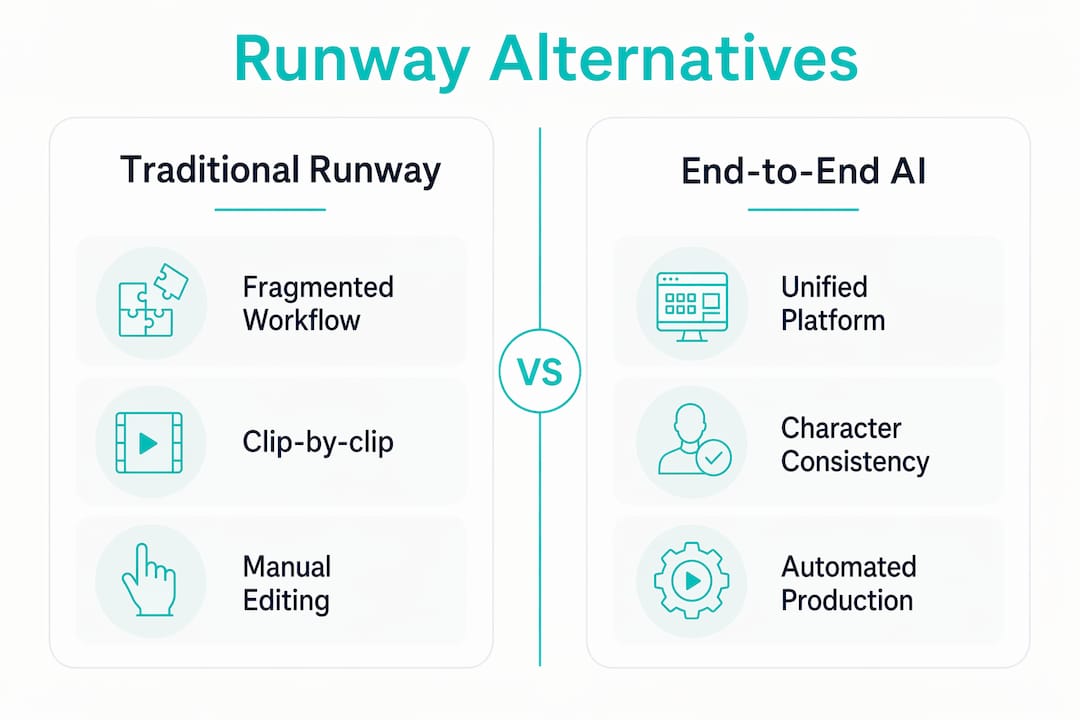
The core problem with conventional approaches, including prompt-to-video models, is fragmentation. You generate a clip, export it, import it into an editor, manually match the character’s face to the previous episode, add audio separately, and repeat. Each step introduces inconsistency and eats time.
Standalone AI video models are insufficient for episodic drama production because they were built for single-clip generation, not serial storytelling. They have no native concept of a recurring character, a story arc, or a series bible. Creators who try to force episodic workflows onto these tools end up rebuilding context from scratch with every new episode.
Common production hurdles with traditional runway-style workflows:
- No persistent character memory between sessions or episodes
- Manual audio syncing and dialogue editing after video generation
- Slow iteration cycles when a scene needs to be re-shot
- No built-in publishing pipeline to social platforms
- High editing overhead that scales badly as episode count grows
Industry analysis consistently points to workflow bottlenecks, not AI model quality, as the primary production limitation for creators working at scale.
What features does a scalable episodic production tool need?
Choosing among tools like runway means evaluating whether a platform was actually designed for serial content. Generation quality matters, but it is secondary to workflow architecture. A tool that produces beautiful single clips but cannot remember your lead character’s face from one episode to the next is not a viable episodic solution.
The features that genuinely matter for scalable episodic content:
- Series bible management to lock in story world, tone, and character relationships
- Recurring cast generation with consistent visual identity across episodes
- End-to-end automation from script input to finished video output
- Native sound and dialogue integration without external audio tools
- Platform-ready formatting for vertical and horizontal outputs
- User content ownership with no platform lock-in on your IP
Creators who prioritize workflow integration over isolated generation quality consistently produce more episodes, faster, with less rework.
How does Iguanify transform episodic production from start to finish?
Iguanify automates the entire episodic production process from a single script input to a finished, publishable episode. You bring the idea; Iguanify builds the series bible, generates the cast, writes the dialogue, produces the video, and delivers it ready to post. No editing software. No production team.
The platform’s character consistency engine is what separates it from runway gen-3 alternatives and other clip-based generators. Your lead character looks the same in episode one as in episode twelve. That continuity is what keeps viewers coming back and what makes serialized drama viable on short-form platforms.
Key Iguanify capabilities:
- One-line premise to full episode production with no intermediate steps
- Consistent recurring characters maintained automatically across a full series
- Real-time production and instant delivery so you can post on a regular cadence
- Integrated sound, dialogue, and music generated within the platform
- Full IP ownership with commercial rights to every episode you produce
- Direct publishing workflow for TikTok, YouTube, and Instagram
Pro Tip: Use Iguanify’s free show concept and cast generation before committing to a purchase. You can validate your premise and see your characters before spending a credit, which makes it much easier to commit to a full season.
What formats are replacing the traditional runway model?
The shift away from traditional runway-style production is happening across several formats, each solving a different piece of the episodic content problem.
Vertical drama series are the fastest-growing format. Platforms like TikTok and YouTube Shorts reward consistent posting cadences, and AI-produced vertical episodes fit that rhythm without the overhead of a traditional shoot. Iguanify’s AI micro-drama generator is purpose-built for this format.
Faceless drama channels remove the creator from the frame entirely, letting the story carry the audience. This model works particularly well for creators who want to build IP without on-camera presence. The faceless drama channel approach has grown significantly as AI production quality has improved.

ReelShort-style episodic content follows a cliffhanger-per-episode structure that drives high completion rates and return viewership. The format is proven on dedicated short drama apps and is now migrating to mainstream social platforms.
What do real episodic projects using these tools look like?
The clearest signal that runway alternatives work comes from creators who have moved from clip-based tools to end-to-end platforms and measured the difference in output volume and consistency.
A solo creator producing a vertical drama series on TikTok faces a specific challenge: posting three to five episodes per week while maintaining character and story continuity. With a prompt-to-video tool, that cadence requires hours of manual editing per episode. With Iguanify, the same creator inputs a premise, selects a cast, and receives finished episodes ready to post. The production bottleneck shifts from editing to ideation, which is where creative energy belongs.
The benefits of AI video creation for this workflow are concrete: faster turnaround, consistent visual identity, and the ability to produce a full season’s worth of content in the time it previously took to produce a handful of clips.
How do runway alternative solutions compare across key production criteria?
Not every alternative to runwayml serves the same use case. The table below maps the major solution categories against the criteria that matter most for episodic production.
| Solution type | Character consistency | Series bible support | End-to-end automation | Best for |
|---|---|---|---|---|
| Prompt-to-video generators | None | None | No | Single creative clips |
| AI avatar platforms | Partial | No | No | Spokesperson/training video |
| Video editing AI tools | No | No | No | Post-production only |
| End-to-end episodic platforms | Full | Yes | Yes | Serialized drama series |
End-to-end platforms like Iguanify are the only category that addresses all three episodic requirements simultaneously. Pay-per-use pricing models, as opposed to monthly subscriptions, also make them more cost-effective for creators producing content in bursts rather than continuously.
How do you integrate a runway alternative into your existing pipeline?
The practical path to adoption depends on where your current bottleneck sits. If you are already using a script-to-video workflow, the transition is straightforward: replace the generation and editing steps with a single platform input. If you are starting from scratch, the integration is even simpler.
A workable three-step approach:
- Audit your current workflow and identify where you spend the most time. For most creators, it is character rebuilding and audio editing.
- Run a pilot season of three to five episodes on the new platform before migrating your full content calendar.
- Establish a publishing cadence based on the platform’s delivery speed, then build your audience expectations around that schedule.
For creators new to AI video production without editing skills, end-to-end platforms remove the steepest part of the learning curve entirely.
What does switching to a runway alternative actually cost?
Pricing models vary significantly across the category. Subscription-based tools charge monthly regardless of output volume, which penalizes creators who produce in seasonal bursts. Credit-based and one-time purchase models align cost directly with production volume.
Iguanify uses a one-time purchase model for episode and season production packs, with no recurring fees. You can generate your show concept and cast for free before buying, so there is no cost to validate your idea. That structure suits creators who want to produce a full season, take a break, and return without carrying a monthly overhead.
The real cost comparison is not just the platform fee. Factor in the editing time you eliminate, the tools you no longer need to subscribe to, and the episodes you can produce per dollar spent.
What skills does your team need to use these platforms effectively?
The skill requirement for end-to-end AI production platforms is lower than most creators expect. You do not need video editing experience, audio engineering knowledge, or a background in production. The core skill is storytelling: the ability to write a compelling premise, develop characters with clear motivations, and structure episodes with hooks and cliffhangers.
For teams moving from traditional production, the adjustment is primarily conceptual. You are shifting from directing a shoot to directing a story. Prompt writing improves with practice, and most platforms provide enough feedback in the output to guide iteration quickly.
Key Takeaways
End-to-end AI production platforms are the only runway alternatives that fully address character consistency, series bible management, and automated output for episodic storytelling at scale.
| Point | Details |
|---|---|
| Workflow fragmentation is the core problem | Prompt-to-video tools lack episodic features; bottlenecks come from workflow gaps, not generation quality. |
| Character consistency is non-negotiable | Without persistent character identity across episodes, serialized drama cannot hold an audience. |
| End-to-end automation changes the math | Replacing fragmented tools with one platform cuts editing overhead and accelerates publishing cadence. |
| Cost model matters as much as features | One-time purchase pricing suits episodic burst production better than flat monthly subscriptions. |
| Iguanify covers the full episodic stack | From premise to published episode, Iguanify automates scriptwriting, cast, sound, and delivery with full IP ownership. |
The episodic AI production shift is bigger than most creators realize
The conversation around runway alternatives tends to focus on generation quality: which tool produces sharper video, more realistic motion, better lip sync. That framing misses the actual problem. For episodic storytelling, the bottleneck has never been the quality of a single clip. It has been the impossibility of maintaining a coherent story world across dozens of episodes without a full production team.
What AI platforms like Iguanify actually represent is a structural change in who can produce serialized drama. The format has always required resources that excluded solo creators and small teams. End-to-end automation removes that barrier without lowering the storytelling standard. The creators who will build the most durable audiences on TikTok and YouTube in the next few years are not the ones with the best cameras. They are the ones who figured out how to produce a consistent, compelling series at volume. That is a workflow problem, and it now has a real solution.
Iguanify produces your full series, not just your next clip
Most runway alternatives solve one part of the episodic problem. Iguanify solves all of it. You input a premise, and the platform produces a complete series bible, a recurring cast, episode scripts, dialogue, sound, and finished vertical video ready to post on TikTok or YouTube. No editing. No subscriptions. No production team required. You own every episode outright.
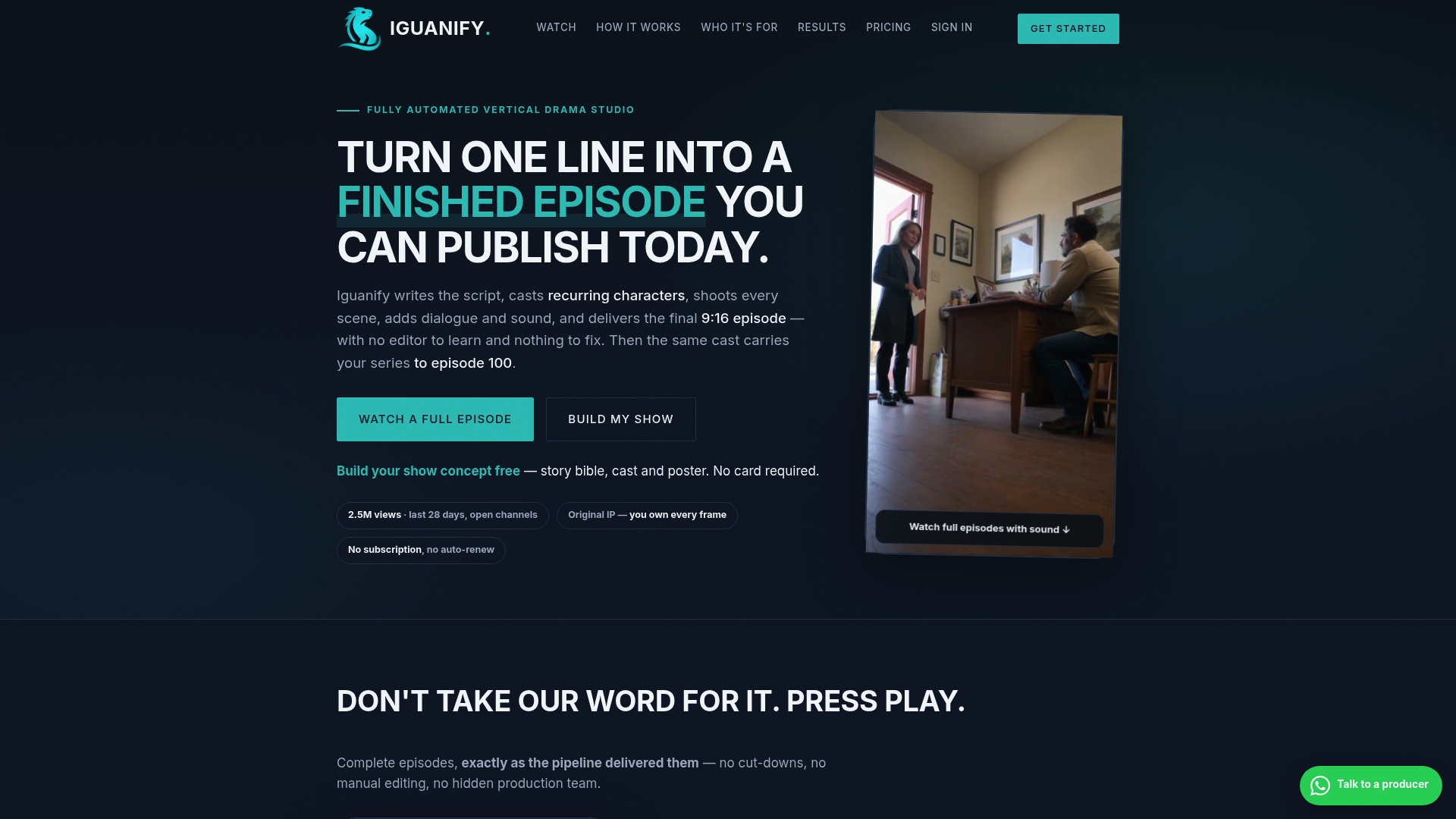
For creators who want to build a drama channel, launch a serialized story, or simply produce more episodes without burning out on post-production, Iguanify is the direct path from idea to published content. The AI drama generator lets you generate your show concept and cast for free before you commit to a single credit. Start there, see your characters, and decide if the story is worth telling.