 IGUANIFY
Ship a 4 Episode Reels Test: Instagram Reels Series Ideas for Creators

Yes, you can build a repeatable Instagram Reels series starting this week. Pick one format from the categories below, name it, and commit to shipping four episodes before you judge whether it’s working. This article gives you a categorized idea bank, a launch checklist built around the two-word naming rule and a 4-episode test, low-effort production shortcuts, and the benchmarks to know if it’s paying off. If manual editing is the bottleneck, tools like Iguanify can automate the repetitive parts without breaking character continuity between episodes.
TL;DR:
- Choosing simple, repeatable formats like myth-busting or quick tips helps ensure your series remains engaging for at least six episodes.
- Consistent naming, cover design, and release schedule are essential to build recognition and retain audience interest over multiple episodes.
- Batch filming and reusing templates or clips can significantly reduce production time and prevent burnout while maintaining series quality.
- Tracking saves, completion rates, repeat views, and comment-to-DM conversions after each episode guides whether to continue, pivot, or retire the series.
- Using AI tools to generate full episodes from scripts enables creators to scale series without extensive editing or additional production resources.
Table of Contents
- What Are the Best Instagram Reels Series Ideas?
- How Do You Plan and Launch a Reels Series?
- How Can You Produce a Series Without Burning Out?
- What Gets a Series More Saves and DMs?
- How Do You Know If Your Series Is Working?
- Why Series Beat One-Off Reels for the Long Game
- Turn One Script Into a Full Reels Series Without the Edit Bay
- Sources
- FAQ
What Are the Best Instagram Reels Series Ideas?
The strongest series ideas share one trait: they’re easy to repeat without running out of material by episode six. Below are creative Instagram reel concepts grouped by format, each with a quick execution note, a sample two-word series name, and a CTA you can copy directly.
Recurring hook formats
These work because the opening frame is identical every time, which trains your audience to recognize the episode in a second or two.
- “Myth Buster” — Open with “Everyone thinks X, but…” and correct one misconception in your niche per episode. CTA: “Comment MYTH for the full breakdown in your DMs.”
- “3 Things” — Deliver exactly three fast tips on a single narrow topic, no more, no less. CTA: “Save this before you forget tip #2.”
- “Ask Me” — Answer one recurring audience question per episode, sourced from your comments or DMs. CTA: “Send your question and I’ll answer it next episode.”
Challenge and story-arc formats
Story arcs borrow from serialized TV: each episode ends on an open loop that only the next one resolves.
- “30 Day Build” — Document a month-long project (a garden, a fitness goal, a side business) in daily or every-other-day increments. CTA: “Follow along, day 12 drops tomorrow.”
- “Client Files” — Walk through one real project or transformation per episode, building toward a reveal. CTA: “Comment RESULTS to see the before and after.”
- “Wrong Way Right Way” — Show a common mistake, then the fix, in the same 30 seconds. CTA: “Share this with someone still doing it wrong.”
Behind-the-scenes and process formats
These trade polish for authenticity, and that trade usually pays off in comments.
- “Shop Talk” — Narrate a task you’re already doing (packing orders, editing, prepping inventory) with one useful tidbit dropped in. CTA: “Ask me anything about the process below.”
- “Fail Reel” — A weekly rundown of what went wrong and what you’d change. CTA: “Save this if you’re about to make the same mistake.”
Micro-tutorial formats
Micro-tutorials are the easiest entry point for Instagram video series ideas because they need almost no story, just a clear before-and-after.
- “60 Second Fix” — One tool, one technique, one outcome, timed to fit inside a single Reel. CTA: “Save this, you’ll need it later.”
- “Tool Test” — Try a new product, app, or method on camera and give a verdict. CTA: “Comment TOOL for the link.”
Customer story and transformation formats
- “Real Talk” — Feature a client, customer, or community member describing their experience in their own words. CTA: “DM me if you want to be featured.”
- “Glow Up” — Before-and-after transformations, whether that’s a room, a body, a business, or a skill. CTA: “Comment GLOWUP to see how we got here.”
Product and personality vignette formats
- “Behind the Price Tag” — Break down what actually goes into a product’s cost or a service’s price, one factor per episode. CTA: “Comment PRICE for a full quote.”
- “Day in the Life” — A loose, personality-driven format showing your actual routine, which works well for personal brands with no product to sell yet.
Low-production alternatives
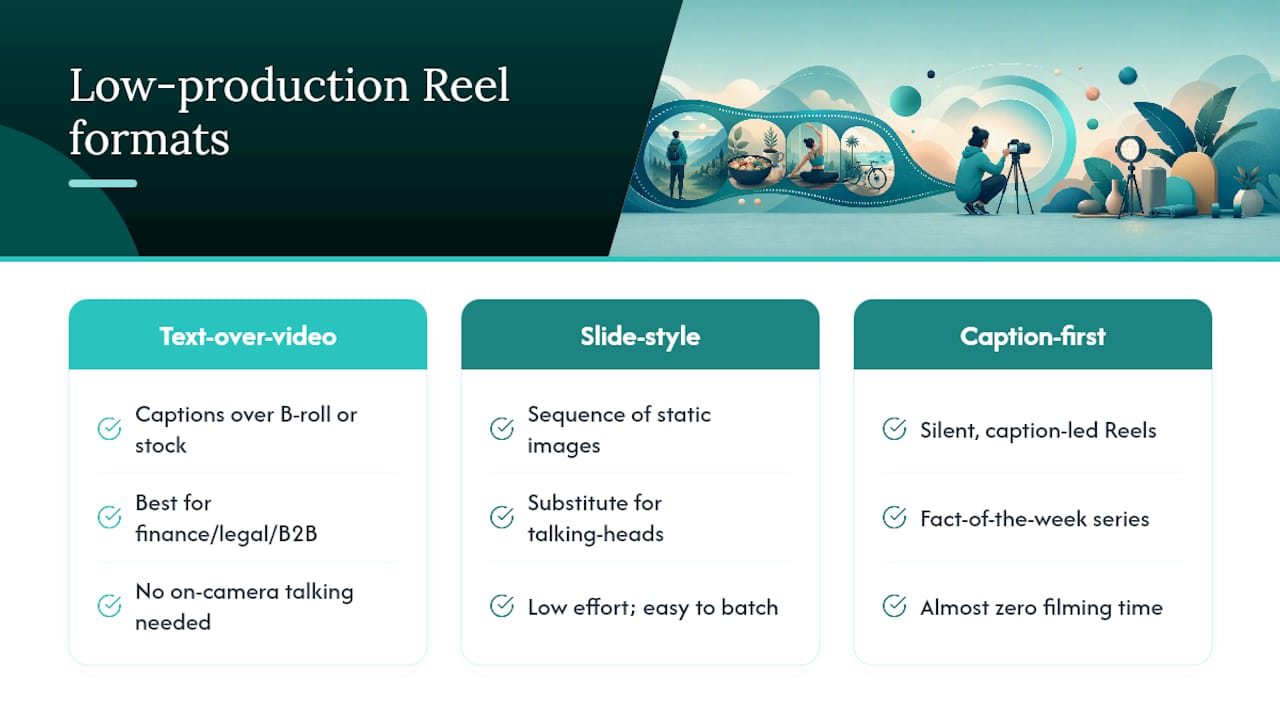
Not every creator wants to talk on camera, and you don’t need to. Text-over-video Reels, where captions carry the entire message over B-roll or stock footage, perform well for niches like finance, legal, or B2B advice. Slide-style Reels (a sequence of static images with a voiceover or captions) work as a lower-effort substitute for talking-head content and are easy to batch in one sitting. A silent, caption-first “Fact of the Week” series can run indefinitely with almost zero filming time.
How Do You Plan and Launch a Reels Series?
A series only reads as a series when it has three things: a fixed, recognizable name, a predictable release schedule, and either episode numbering or a narrative thread connecting each installment. That’s the working definition CreatorFlow uses, and it holds up because loose, unlabeled posts don’t train an audience to come back.
Start with the two-word naming rule: pick a name short enough to fit in a title card without shrinking the font, like “Shop Talk” or “Glow Up” from the list above. Pair that name with a consistent cover treatment, meaning the same colors, typeface, and title placement in every episode, so a viewer recognizes it before the first sentence lands.
Cadence matters almost as much as the name. Weekly works for most solo creators because it’s sustainable; daily arcs work only for short-term challenges (a 7 or 30 day series) where the finish line is visible. Predictable timing is what turns casual viewers into people who check for the next episode, according to Sup Growth’s breakdown of format-specific engagement.
Here’s the 4-episode launch blueprint, since planning at least four episodes before evaluating gives you enough data to judge the format fairly:
- Episode 1: the promise. State exactly what this series is and why someone should come back, in the first three seconds.
- Episode 2: prove consistency. Repeat the identical opening frame and structure from Episode 1 so the pattern registers.
- Episode 3: answer an objection. Address the doubt your niche always has (“this won’t work for beginners,” “this is too expensive”) head on.
- Episode 4: ask for participation. Include a direct comment-to-DM trigger to see if your audience will actually engage on command.
Before you publish Episode 1, confirm you have a cover template ready, captions written in your brand voice, a pinned post or highlight set up to house the series, and any DM automation configured to catch your comment trigger.
Pro Tip: Keep your first two episodes almost identical in structure. Recognition builds faster from repetition than from variety, and viewers reward familiarity before they reward creativity.
How Can You Produce a Series Without Burning Out?
Batching is what separates creators who ship a series for months from creators who quit after episode three. Set aside one afternoon to film four to six episodes back to back using the same cover template, the same two or three intro frames, and two CTA variants you can swap between episodes.
- Reuse a single cover image with only the episode number changed, rather than redesigning a thumbnail every week.
- Pull clips from a webinar, podcast, or long-form video you already recorded and slice them into numbered micro-episodes, a repurposing approach that Buffer points to as one of the fastest ways to lower production barriers.
- Write captions first, then film to match them, if you’re running a no-talking or text-over-video format.
- Keep a swipe file of three transition effects and reuse the same one across an entire series so editing time drops.
If you’re generating scripts and hooks from scratch, an AI tool like AmmarAI can speed up the brainstorming stage for episode topics and captions.
For creators who want the continuity benefit of batching without the manual editing, serialized AI production tools like Iguanify generate full episodes from a single script line while keeping the same characters consistent from one installment to the next. The trade-off is that you’re handing over creative control of the visual execution, so it fits best when your priority is consistent output over frame-by-frame customization.
Pro Tip: Film your cover frame and intro separately from your content, once, and reuse that same clip across every episode. It’s the single fastest way to fake consistency you haven’t fully built yet.
What Gets a Series More Saves and DMs?
A series lives or dies on whether people take an action after watching, not just whether they watch. Give every episode exactly one CTA, whether that’s “save this,” “share with someone who needs it,” or a comment keyword that triggers a DM. Mixing CTAs across episodes dilutes the data you need to know what’s working.
- Post each episode’s teaser to Stories with a reply sticker or a poll to pull in early engagement before the algorithm decides how far to push it.
- Pin Episode 1, or a hub post linking to all episodes, and reference earlier installments in later captions so new viewers can catch up.
- Route your comment trigger straight into DM automation. That single mechanic, Sup Growth notes, builds an owned list that doesn’t depend on the algorithm showing your next post to the same people.
- Save commerce CTAs for a designated conversion episode. Early episodes should carry soft product moments at most; hard-selling before the audience trusts the format tends to flatten saves.
How Do You Know If Your Series Is Working?
Track four numbers at the episode level: saves, completion rate, repeat views, and how many comments actually convert into DMs through your trigger phrase. Views tell you almost nothing about whether the format has legs.
Directional benchmark: Series built around a consistent name, cadence, and episode identity tend to see saves and completion climb from episode to episode as recognition builds, particularly once Meta’s Series hub feature surfaces earlier episodes to returning viewers.
Change only one variable between tests, cover, hook wording, or posting time, and hold everything else steady. Evaluate after four episodes. If saves and DM triggers are climbing, keep going. If they’re flat, pivot the format before you sink more time into it.
Why Series Beat One-Off Reels for the Long Game
Serialized Reels outperform one-off posts for a simple reason: familiarity does work that novelty can’t. A viewer who’s seen your cover frame twice already knows what they’re getting, and that expectation is what turns a scroll-past into a save. Keep a series alive as long as saves and DM triggers are trending up episode over episode. Retire it the moment engagement plateaus for three episodes straight instead of forcing a fourth. My honest recommendation: pick one format from this list, commit to shipping it weekly for six to eight weeks, and resist the urge to launch a second series before you know if the first one has legs.
— Leonard
Turn One Script Into a Full Reels Series Without the Edit Bay
If the idea bank above is the easy part and production is where your series usually stalls, that’s the actual bottleneck most creators hit around episode three. Iguanify is built specifically for that gap: it turns a script line into a finished, vertical-format episode while maintaining character and visual continuity across episodes, addressing common challenges creators face when scaling Instagram series.
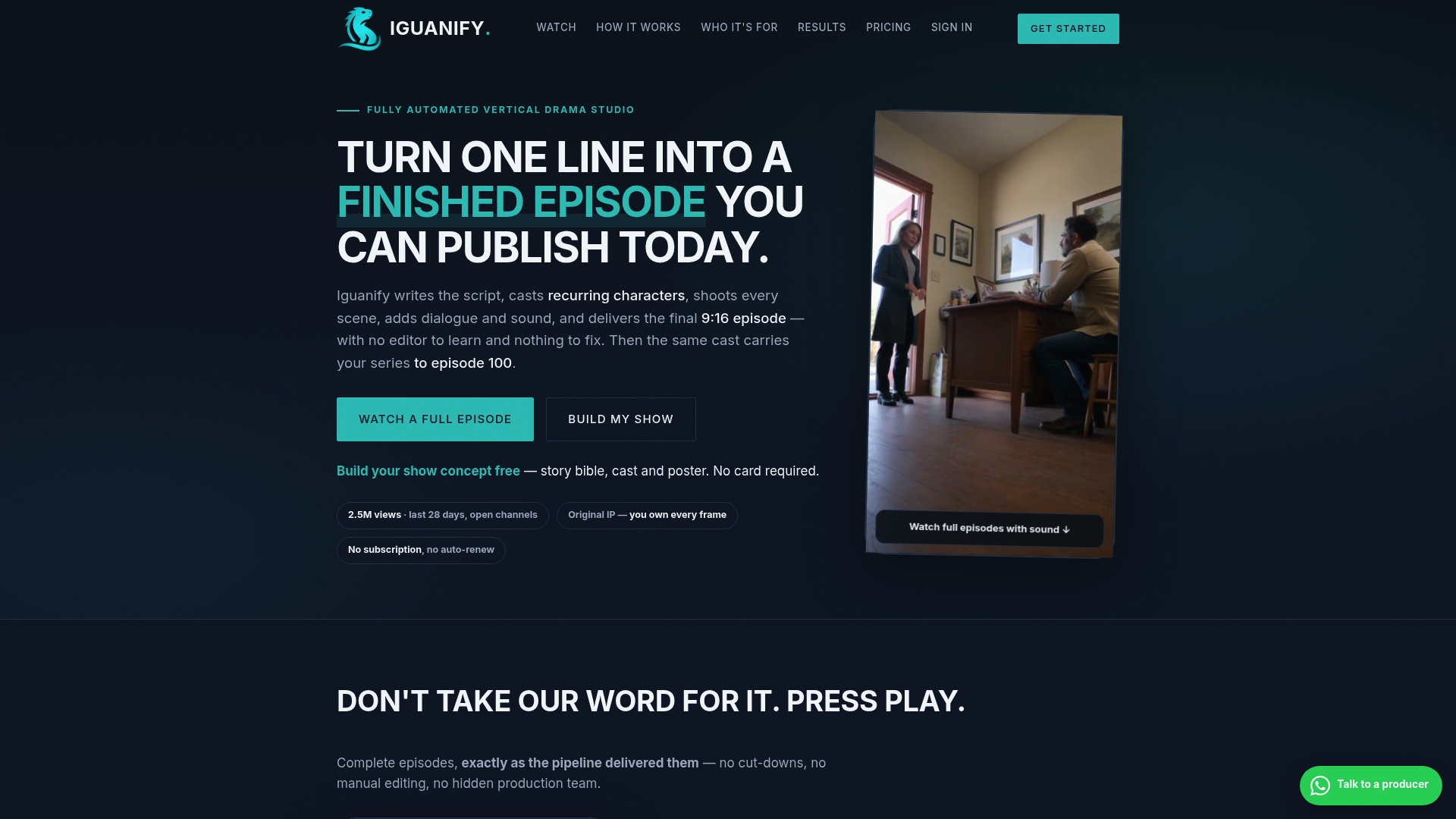
It’s built for creators and small teams who want a real cadence, weekly or faster, without hiring an editor or relearning a new tool every time they add a scene. Creators retain ownership of their produced content, and episodes are delivered ready to post on platforms like Instagram, TikTok, and YouTube without additional formatting needed. If you’ve got a premise for a series but not the hours to produce it manually, try the AI drama generator and see what your first episode looks like before you commit to anything.
Sources
- How to repurpose content (Buffer)
- How to create Instagram series that drive real growth - Sup Growth
- Instagram content series: build a show, not a feed (CreatorFlow)
- Meta’s new Series feature lets brands build a show inside Reels | SnapReelAI
FAQ
What Is the 5-3-1 Rule on Instagram?
The 5-3-1 rule is a weekly content mix guideline involving curated, original, and promotional posts. It’s a general posting cadence framework, not a series-specific rule, though this ratio works well for balancing series episodes against other content.
What Are Some Good Topics for Instagram Reels?
Good topics are narrow and repeatable: myth-busting in your niche, quick tutorials, before-and-after transformations, behind-the-scenes process clips, and recurring Q&A formats all work because they don’t run out of material after a few episodes.
How Do You Make a Reel Series on Instagram?
Give your concept a fixed two-word name, design a consistent cover and opening frame, and post on a predictable cadence with episode numbering or a narrative thread connecting each installment. Plan and publish at least four episodes before judging performance.
What Are Some Ideas for Instagram Reels?
Beyond a full series, standalone Instagram reels theme suggestions include quick tips, tool reviews, day-in-the-life clips, and customer transformation stories. Any of these can become the seed of a series once you repeat the format on a schedule and give it a name.