 IGUANIFY
How to Publish a TikTok Series That Actually Builds an Audience

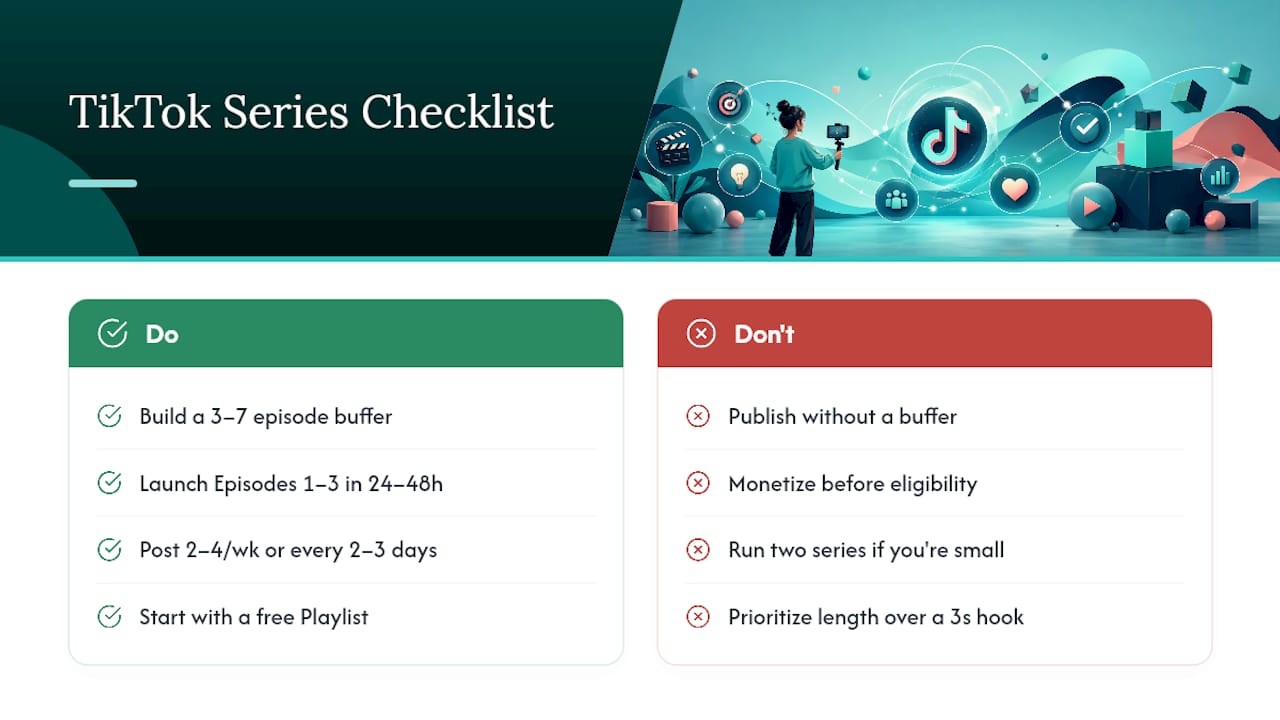
Plan a 5 to 10 episode arc, batch at least three episodes before you post anything, and launch Episodes 1 through 3 in a tight 24 to 48 hour window. That compressed opening is what trains both your viewers and TikTok’s algorithm to expect more, and it’s the single biggest difference between a series that gets abandoned at Episode 2 and one that builds real momentum.
Here’s the 72 hour version:
- Lock a 5 to 10 episode arc and script the first 3 to 7 episodes before you film anything.
- Post Episodes 1 to 3 within 48 hours, then hold a strict cadence after that.
- Use one visual hook, one series hashtag, and group episodes into a Playlist or Series so new viewers can binge immediately. Tools like Iguanify can compress the production side of this without costing you ownership of the finished episodes.
Key Takeaways
A TikTok drama series succeeds when a finite episode arc, a compressed 48 hour launch, and a strict cadence combine with a real production buffer.
| Point | Details |
|---|---|
| Plan before you film | Lock a 5 to 10 episode arc and write a series bible before Episode 1 is scripted. |
| Launch in a compressed window | Post Episodes 1 to 3 within 48 hours to train viewers and the algorithm together. |
| Build a real buffer | Keep 3 to 7 finished episodes ready so a busy week never breaks your cadence. |
| Choose the right container | Use a free Playlist for discoverability, a paid Series only once you meet eligibility thresholds. |
| Remove production bottlenecks | Iguanify generates full episodes from a script with consistent characters, instant delivery, and full creator ownership. |
Table of Contents
- What Does It Take to Publish a TikTok Series?
- How Do You Structure a Single Episode?
- How Do You Produce Episodes Without Burning Out?
- Should You Use TikTok Series or Just a Playlist?
- How Do You Grow and Monetize a Series Once It’s Live?
- What Actually Separates a Series That Lasts from One That Fizzles
- Where Iguanify Fits Into Your Production Pipeline
- Frequently Asked Questions
- Sources
What Does It Take to Publish a TikTok Series?
Publishing a TikTok series is different from posting standalone videos, and treating it the same way is the most common reason series die quietly after episode two. A standalone video needs to work once. A series needs a plan, a buffer, and a structure viewers can predict, because retention across episodes is what TikTok’s recommendation system actually rewards.
Pick a concept that survives 10 episodes
Before you write a single line of dialogue, run your idea through the 3x3 Matrix: three areas where you have real expertise or a distinct voice, crossed with three problems or curiosities your audience already has. The intersection is your series concept. Metricool’s TikTok strategy research frames this as the fastest way to find high-intent content pillars instead of guessing at what might trend.
Next, decide format:
- Finite arc (5 to 10 episodes). A contained drama with a beginning, middle, and resolution. Easiest to plan, easiest to promise viewers, and the safer starting point for a first series.
- Open-ended format. Ongoing story beats with no fixed end date. Higher ceiling, higher risk of losing the thread without a series bible.
- Series bible first, always. Character sheets, recurring beats, and an episode log so continuity holds even if you’re producing weeks apart.
Build a buffer of 3 to 7 finished episodes before you publish Episode 1. That buffer is what protects your cadence when life gets in the way.
Pro Tip: Write your series bible before you write Episode 1’s script. It takes an afternoon, and it’s the difference between a character’s coat color staying consistent for ten episodes and viewers noticing it change in episode 4.

How Do You Structure a Single Episode?
Every episode needs to do three things in order, and the order matters more than the runtime.
- 0 to 3 seconds: the hook. State the stakes or drop the viewer into conflict immediately. No slow open, no logo intro.
- The body: standalone payoff. A viewer who has never seen your series before should still feel like they got something. Series structure guidance from SocialCal is explicit on this: every episode needs its own contained value, not just setup for the next one.
- The final few seconds: an explicit open loop. Not a vague “stay tuned,” but a specific unresolved question. The open-loop hook formula works because a named, concrete question creates more return-viewing pressure than a generic tease.
Keep a consistent visual or audio signature, a title card style, a transition sound, a recurring on-screen font, so viewers recognize your series in the first second of autoplay. Caption formula: episode number, one line of context, your series hashtag, and one or two discovery keywords tied to the plot or genre.
Compressed launches directly move the needle on retention. Concentrating Episodes 1 through 3 into a 48 hour window is advised specifically because it trains viewers into the habit of returning before they’ve had time to forget your series exists.
How Do You Produce Episodes Without Burning Out?
Production is where most series quietly die, not because the idea was bad but because the workflow couldn’t sustain the cadence.
- Batch record in blocks. Film three to five episodes in one session using a fixed lighting setup, wardrobe plan, and audio preset so nothing visibly shifts between episodes shot weeks apart.
- Build a continuity checklist. Intro bumper, color grade, transition sound, and a shot list labeled by episode number, all stored in one folder. Keeping a single cloud folder with a series master shot list is what lets editors, or automated tools, reproduce consistent framing across episodes without you re-explaining the look every time.
- Refill the buffer constantly. The moment your buffer drops below three episodes, block time to shoot more. A depleted buffer is the single most common cause of missed posting days, and scheduling and batch publishing remove that emotional friction by taking the daily “do I have time to film today” decision out of the equation.
- Consider where automation genuinely helps. This is exactly the gap Iguanify was built for: it generates full episodes from a single line of script, keeps characters consistent across the entire run without a continuity supervisor, delivers in real time, and you retain full ownership and rights to what gets produced.
Pro Tip: If you’re using any automated production tool, export raw project files and confirm licensing terms before you spend credits on a season. Ownership clarity matters more once you’re ten episodes deep and want to repurpose footage elsewhere.
Should You Use TikTok Series or Just a Playlist?
TikTok gives you two structural tools, and picking the wrong one costs you either monetization or discoverability.
A TikTok Series is a paid collection, up to 80 videos, each running 30 seconds to 20 minutes, that viewers can purchase access to. Eligibility requires meeting follower and account thresholds before you can monetize, and submissions go through a review step. Build in a buffer of up to 72 hours for that review process so it doesn’t collide with your launch date.
A Playlist is free and built purely for discoverability. It auto-plays adjacent episodes and gives profile visitors an obvious entry point, especially when you pin Episode 1 to the top of your profile.
| Format | Best for | Cost to viewer | Eligibility |
|---|---|---|---|
| Free Playlist | Discoverability, new series, binge behavior | Free | None |
| Paid TikTok Series | Monetizing an established audience | Viewer pays for access | Follower and account thresholds apply |
Cadence should match your production capacity, not your ambition. Launch Episodes 1 to 3 within 48 hours, then either hold 2 to 4 posts a week if your buffer supports it, or settle into one episode every two to three days if you’re producing solo. Tools that help schedule TikTok posts remove the daily manual upload step and keep cadence consistent even during a busy week.
How Do You Grow and Monetize a Series Once It’s Live?
Publishing is only half the job. What you do around each episode determines whether the series compounds or plateaus.
- Pin Episode 1 to your profile so it’s the first thing new visitors see.
- Keep the same hashtag on every episode so TikTok’s system can group your series content correctly.
- Turn top comments into future episode prompts. This comment-to-video loop makes the series feel co-written by your audience, which drives both comments and return visits.
- Use Stitch and Duet strategically when another creator reacts to your series, and cross-promote episode drops on Instagram or YouTube Shorts.
- If you’re under 10,000 followers, run one series at a time. Interleaving two series confuses the algorithm before it has a chance to learn your first one; established creators with a proven audience base can handle two.
For monetization, weigh a paid TikTok Series against a free funnel that pushes viewers toward other monetized content, Series monetization prerequisites are worth reading closely before you decide.
Watch three numbers weekly: completion rate per episode, repeat-viewer share, and follower conversion from series viewers. A dropping completion rate on Episode 4 or 5 usually means your open loops got weaker, not that the audience got bored. When your finite arc reaches its planned ending, close it with a real resolution before deciding whether a Season 2 is earned or forced.
What Actually Separates a Series That Lasts from One That Fizzles
Most advice on this topic focuses on hooks and hashtags, and both matter, but the real failure point is almost always production capacity, not creative ideas. Creators plan an ambitious 10 episode arc, nail Episodes 1 through 3, and then the buffer runs dry around episode 5 because filming, editing, and continuity checks take longer solo than anyone budgets for.
The fix isn’t a better hook formula. It’s treating your buffer size as the actual constraint on your cadence, and being honest about how many hours a week you can sustain before you commit to a posting schedule publicly. A finite 5 episode arc you finish on time beats an ambitious 15 episode arc that stalls at episode 6.
Where Iguanify Fits Into Your Production Pipeline
If your buffer keeps running dry because filming and editing eat more hours than you have, that’s the exact bottleneck Iguanify is built to remove. You give it a single line of script, and it produces a fully realized episode: consistent characters across the entire run, no continuity supervisor required, dialogue and sound handled, delivered in real time.
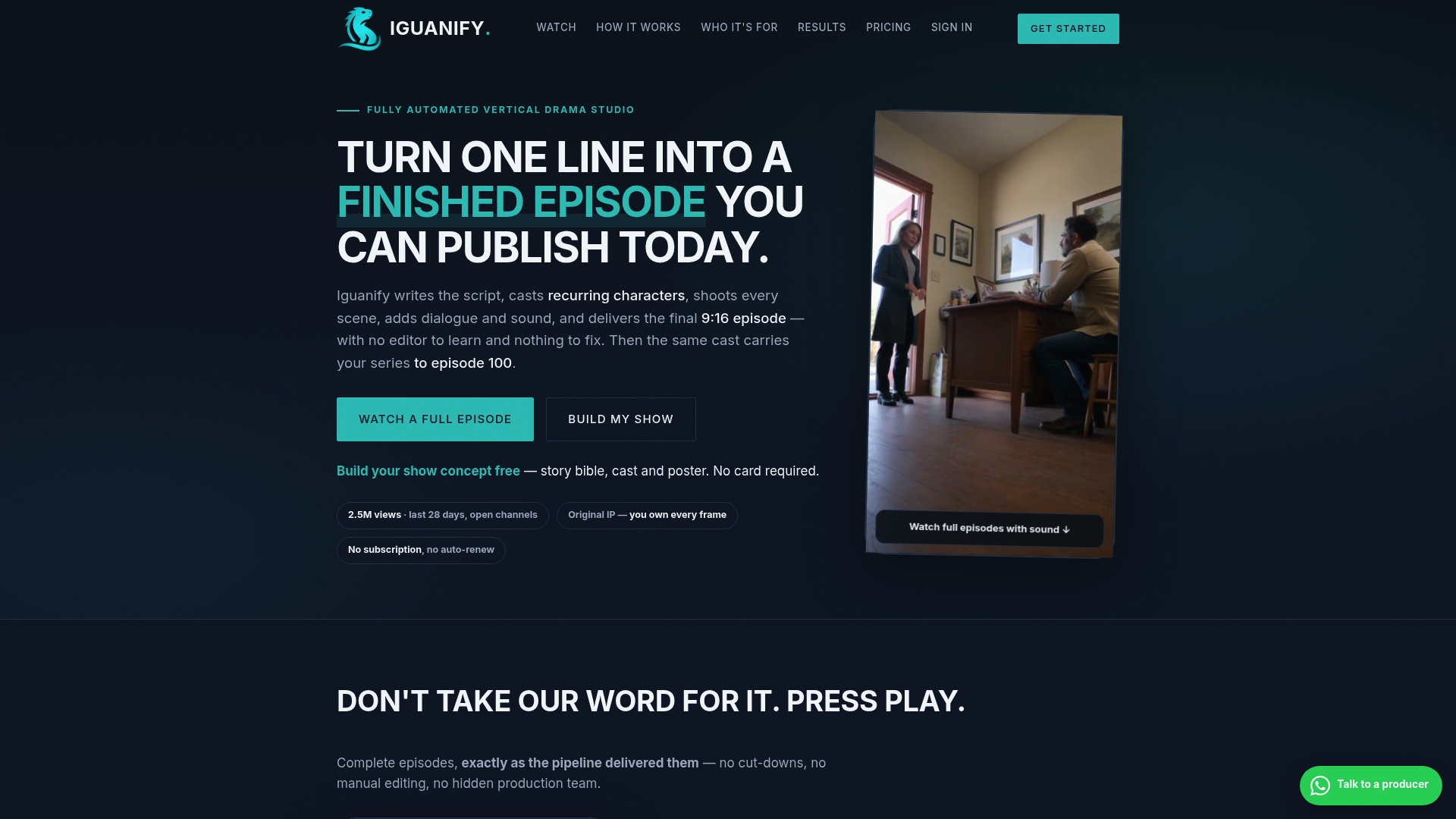
That matters most in three specific situations: you don’t have an editing team, you need characters to look and sound the same in episode 9 as they did in episode 1, or you’re trying to produce a full season faster than your current workflow allows. You keep full ownership and rights to every episode produced, and output is ready to post directly to TikTok, YouTube, or Instagram without extra formatting work.
If your concept is ready and production is the thing standing between you and a launch date, start with the Iguanify AI Drama Generator and see how quickly your first three episodes come together.
Frequently Asked Questions
How many episodes should I have ready before I publish a TikTok series? Aim for a buffer of 3 to 7 finished episodes before your first post. That cushion protects your posting cadence during weeks when filming or editing takes longer than planned.
What’s the ideal cadence for a new TikTok series? Launch Episodes 1 through 3 within a 24 to 48 hour window, then settle into either 2 to 4 posts a week if your buffer supports it, or one episode every two to three days for a solo, sustainable pace.
Should I use a free Playlist or a paid TikTok Series? Start with a free Playlist for discoverability and binge behavior. Move to a paid TikTok Series only once you meet the platform’s follower and account eligibility thresholds and want to monetize directly.
How long should each episode of a TikTok drama series be? Keep individual episodes within the platform’s runtime limits, but focus on keeping episodes tight and engaging. A 3 second hook and a clear open loop matter more than a longer runtime.
Can I run two TikTok series at the same time? Only if you are an established creator with a sufficiently large follower base. Smaller creators should run a single series at a time to avoid confusing the algorithm.
How does Iguanify help with publishing a TikTok series? Iguanify produces full episodes from a single line of script, keeps recurring characters visually consistent across every episode, delivers in real time, and gives creators full ownership of the finished content, removing the editing and continuity bottlenecks that usually break a season halfway through.
Sources
- How to Structure a TikTok Series: The Complete Guide
- How to Build a TikTok Series Strategy for Growth
- TikTok strategy (Metricool)
- How to Make a Series on TikTok
- How to Make a Series on TikTok