 IGUANIFY
Vertical Drama Production: A Creator’s Complete Guide

Vertical drama production is the process of creating serialized, 9:16-format episodes built for mobile viewing — short, repeatable, and fully automatable with AI. The fastest path to publishable episodes runs through an AI-first pipeline: generate a series bible, produce a pilot batch of 5–10 episodes, and publish with platform-optimized specs. Dr. Wenjia Tang’s research frames this as a structural shift in how audiences consume stories, not a passing trend. The duanju format — the Chinese-origin microdrama model that formalized vertical serial production around 2020 — runs 60–100 episodes at 1–2 minutes each, and that template now drives a $11 billion global market. Iguanify automates the entire pipeline from a single premise to platform-ready episodes, making this format accessible without a production team.
Your three immediate moves:
- Get a 9:16 series bible and premise locked before you produce anything
- Produce 5–10 pilot episodes through an automated pipeline to test audience response
- Publish with platform-optimized specs (aspect ratio, captions, metadata) from day one
Table of Contents
- What do you need before you start vertical drama production?
- How does the end-to-end vertical drama workflow run?
- How does AI automation solve the hardest problems in vertical serial production?
- What story and visual rules work best for serialized vertical drama?
- What are the platform specs and posting cadence for TikTok, YouTube Shorts, and Reels?
- What does ownership, licensing, and cost look like for a pilot season?
- What are the most common production pitfalls and how do you fix them?
- Key Takeaways
- Why automation changes the economics of vertical drama
- Iguanify produces your vertical drama series from a single premise
- Useful sources and further reading
What do you need before you start vertical drama production?
You need four inputs: a one-sentence premise, brief character bios for your two or three leads, a tone and genre decision (romance, thriller, or hybrid), and at least one sample line of dialogue that captures the show’s voice. Reference visuals help, but they are optional at this stage.
Your deliverables are equally specific: 9:16 script pages, a series bible, platform-compliant video files (H.264 or H.265, 1080×1920), SRT caption files, and vertical thumbnails cropped to each platform’s safe zone. For team size, most AI-led productions run solo or with a two-person pod (one writer, one QA reviewer). A voice actor is optional if you use synthetic voice.
Key file specs: 9:16 aspect ratio, 1080×1920 resolution, H.264 codec, SRT captions, and per-platform thumbnail dimensions (TikTok: 1080×1920; YouTube Shorts: 1280×720 cover image; Reels: 1080×1920).
How does the end-to-end vertical drama workflow run?
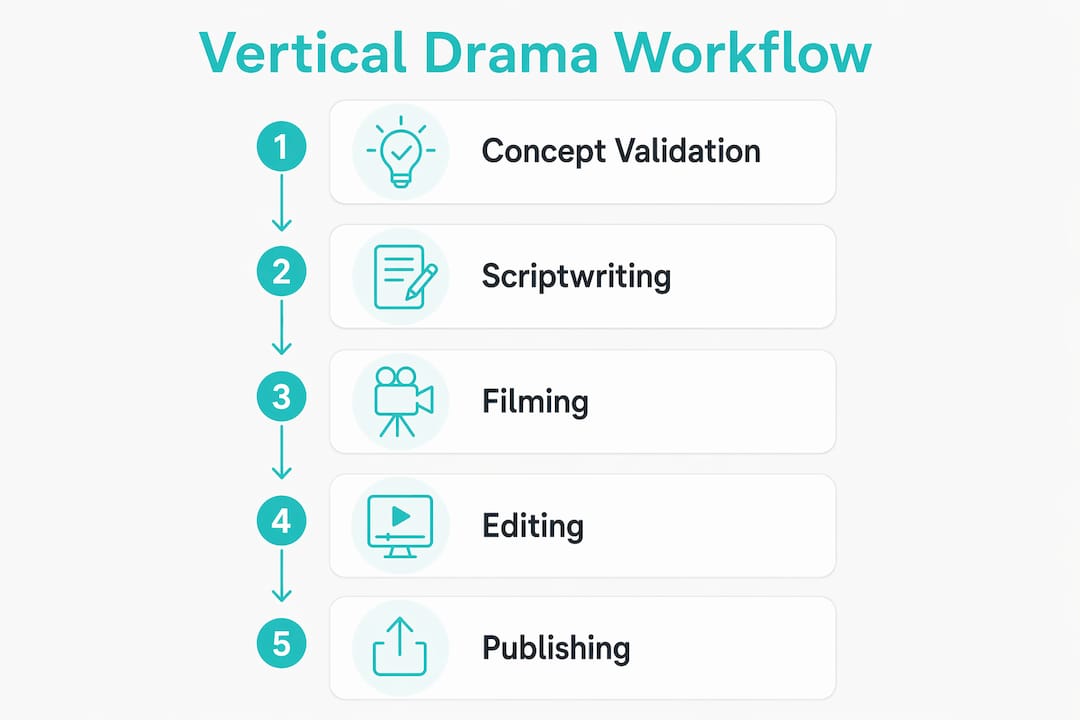
A 20–30 episode pilot season typically runs 8–12 weeks from greenlight to first publish for a small team. Here is the stage-by-stage breakdown:
- Concept validation (Days 1–2): Write a one-sentence premise, define your genre, and map three to five episode beats. Output: premise doc and episode arc outline.
- Series bible and character sheets (Days 3–5): Build recurring character profiles, tone guide, and location chassis. Output: series bible PDF and character reference sheets.
- Episode beat scripts (Days 6–14): Write each 60–90 second episode as a single high-tension beat ending on a cliffhanger. Output: script pages in vertical-first format.
- Batch production (Days 15–35): Run scripts through an automated pipeline for shot generation, synthetic casting, voice, and stitching. Output: raw episode files.
- Post-production QA (Days 36–42): Check audio sync, caption accuracy, character continuity, and metadata. Output: approved episode files with SRT captions and thumbnails.
- Platform delivery (Days 43–56): Upload with correct specs, schedule posting cadence, and set metadata. Output: live episodes on TikTok, YouTube Shorts, and Reels.
| Stage | Time Estimate | Key Output |
|---|---|---|
| Concept validation | 1–2 days | Premise doc, arc outline |
| Series bible | 2–3 days | Bible PDF, character sheets |
| Episode scripts | 1–2 weeks | Vertical-first script pages |
| Batch production | 2–3 weeks | Raw episode files |
| Post-production QA | 1 week | Approved files, captions, thumbnails |
| Platform delivery | 1–2 weeks | Live episodes, metadata |
LaCastle Studios reports production rates of 15–25+ pages per day using single-stage, zero company-move workflows, which confirms that the compressed timeline above is achievable when the location chassis is tight.
How does AI automation solve the hardest problems in vertical serial production?
The three problems that kill most vertical serial projects are character inconsistency across episodes, the time cost of batch production, and the technical gap between raw footage and platform-ready files. AI automation addresses all three directly.
- Character continuity: Automated pipelines lock character assets at the series bible stage and reuse them across every episode, eliminating the drift that plagues manual AI video tools.
- Batch episode generation: A single premise feeds the full season pipeline, producing multiple episodes in parallel rather than sequentially.
- Vertical-safe framing: Shot templates are built for 9:16 from the start, so no reframing is needed in post.
- Automated captions and thumbnails: Generated alongside each episode, not as a separate post-production task.
Iguanify handles all of this end-to-end. From a single-line premise, it generates a series bible, a recurring cast, episode scripts, dialogue, sound, and platform-ready video files. Creators retain full IP ownership of every episode produced. The AI micro-drama pipeline is built specifically for episodic continuity, which is the feature most general-purpose AI video tools skip.
Vertical drama audiences expect the same faces, the same voice, and the same visual register in every episode. Break that consistency once and you lose the binge pull that makes the format work. Automation is not just faster — it is the only reliable way to hold that consistency across 20, 50, or 100 episodes without a dedicated continuity supervisor.
What story and visual rules work best for serialized vertical drama?
Each episode needs to function as a standalone hook. Do not shrink a traditional script — write each 60–90 second episode as its own high-tension beat and end on an aggressive cliffhanger. The first 15 seconds must establish conflict or mystery; the middle carries one escalation; the final seconds leave a question unanswered.
Visually, 9:16 favors close-ups and artifacts over wide establishing shots. A text message on screen, a wedding invite, a ringing phone — these carry plot weight faster than any location reveal. Keep your location chassis tight: a penthouse, an office, and a hospital corridor can cover most genre scenarios without company moves.
- Do: reaction shots, sound design, artifacts as plot devices, lighting that flatters skin tones in close coverage
- Avoid: wide horizontal establishing shots, action sequences that require scale, slow-burn pacing in the first 30 seconds
Filmustage analysis shows romance drives the highest completion rates while thriller drives rewatch behavior and algorithmic longevity. Romance episodes run well at around 60 seconds; thriller episodes benefit from 90–120 seconds to build tension properly.
Pro Tip: Write your episode endings first. If the cliffhanger does not make you want to tap “next,” the episode is not ready.
What are the platform specs and posting cadence for TikTok, YouTube Shorts, and Reels?
| Platform | Aspect Ratio | Max Duration | Codec | Captions |
|---|---|---|---|---|
| TikTok | 9:16 | 10 minutes | H.264 | Auto-gen + SRT upload |
| YouTube Shorts | 9:16 | 60 seconds | H.264 | Auto-gen + SRT |
| Instagram Reels | 9:16 | 90 seconds | H.264 | Auto-gen + SRT |
For cadence, daily posting builds the fastest audience habit for romance serials. Thriller series can run every other day to let rewatch numbers accumulate before the next episode drops. Avoid binge-dropping a full season at launch — drip releasing keeps the algorithm feeding your content to new viewers over weeks, not hours.
- Title each episode with a number and a hook phrase: “Episode 3: She Already Knew”
- Use pinned comments to recap the previous episode and tease the next
- Thumbnail safe zone: keep faces and text within the center 80% of the frame to avoid UI overlap
What does ownership, licensing, and cost look like for a pilot season?
You own the episodes you produce. The key licensing checks are music (use platform-licensed libraries or royalty-free tracks only), synthetic voice (confirm your tool’s commercial license covers redistribution), and platform redistribution rights (standard for TikTok, YouTube, and Meta when you upload directly).
| Production Path | Per-Episode Cost Range | Time to Publish |
|---|---|---|
| AI-automated (solo) | Low to moderate | Hours per episode |
| Hybrid (AI + human QA) | Moderate | 1–2 days per episode |
| Traditional crew | High | 1–2 weeks per episode |
The vertical drama market hit $11 billion in 2025, with some forecasts projecting $14 billion by 2027. That scale means platform monetization, brand deals, and licensing are all realistic revenue paths for a series that builds an audience. Iguanify uses a one-time credit model — no subscription, no recurring fees — so your per-season cost is fixed at purchase.
What are the most common production pitfalls and how do you fix them?
- Character continuity mismatch: A character’s hair, voice, or wardrobe shifts between episodes. Fix: lock all character assets in the series bible before batch production and run a visual consistency check on episode one before producing the full batch.
- Voice drift: Synthetic voice tone or pacing changes across episodes. Fix: use the same voice profile settings for every episode and QA audio on a reference monitor, not laptop speakers.
- Inconsistent captions: Auto-generated captions miss proper nouns or timing. Fix: upload an SRT file rather than relying solely on platform auto-generation; review captions on a mobile screen at actual viewing size.
- Thumbnail/clip mismatch: The thumbnail shows a scene that does not appear in the episode. Fix: generate thumbnails from actual episode frames, not separately created images.
- Platform policy flags: Age-restricted content, unlicensed music, or misleading metadata triggers takedowns. Fix: run a pre-upload checklist covering music rights, age flags, and metadata accuracy before every publish.
Pro Tip: Build a one-page QA checklist covering audio sync, caption accuracy, character visual consistency, and metadata. Run it on every episode before upload — it takes five minutes and prevents most takedowns.
Key Takeaways
AI-first vertical drama production lets a solo creator go from a single premise to a platform-ready episodic series in weeks, with full IP ownership and no production team required.
| Point | Details |
|---|---|
| Format fundamentals | Each 60–90 second episode needs a hook, one high-tension beat, and an aggressive cliffhanger ending. |
| AI solves continuity | Automated pipelines lock character assets across all episodes, the core problem manual tools cannot reliably fix. |
| Platform specs matter | 9:16, H.264, SRT captions, and per-platform thumbnail safe zones are non-negotiable for algorithmic reach. |
| Genre drives strategy | Romance maximizes completion rates; thriller maximizes rewatch and algorithmic longevity — run a hybrid slate for both. |
| Iguanify end-to-end | Iguanify takes a single premise to a full season with consistent cast, series bible, and platform-ready files at a fixed credit cost. |
Why automation changes the economics of vertical drama
The conventional wisdom says you need a crew, a location budget, and weeks of post-production to produce anything worth watching. That was true for horizontal, long-form content. Vertical serial drama operates on completely different math.

The format’s compressed structure — 60–90 seconds, one beat, one cliffhanger — is not a limitation. It is a production advantage. Each episode is small enough to produce in hours rather than days, which means you can iterate on audience response in near real time. If episode three underperforms, you adjust the tone of episode four before it is even published. That feedback loop does not exist in traditional production.
What automation adds is the ability to hold character and visual consistency across that iteration cycle without a continuity supervisor or a dedicated editor. The economics shift from “can I afford to produce this?” to “how fast can I test and refine?” That is a fundamentally different creative position, and it is the reason the format is growing at the pace it is.
Start with five episodes. Measure completion rate and rewatch rate. Adjust one variable. Produce five more.
Iguanify produces your vertical drama series from a single premise
Full vertical drama production without a crew, a studio, or a post-production budget is exactly what Iguanify is built for. You write one line — your premise — and Iguanify generates the series bible, a recurring cast with consistent visual assets, episode scripts, dialogue, sound, and platform-ready video files. Your job is to review, approve, and post.
The credit model means you pay once per episode pack, with no monthly fees and no long-term commitment. Free concept and cast generation lets you validate your show before spending anything. When you are ready to produce, the AI drama generator delivers finished episodes, not raw clips that still need editing. You own the IP outright. If you want to build a faceless drama channel with a fully synthetic cast, that path is built in too. Generate your free show concept at iguanify.com and see your series take shape before you commit.
Useful sources and further reading
- Dr. Wenjia Tang — Vertical short drama and screen addiction: foundational research on vertical consumption behavior; start here for the academic framing.
- Duanju — Wikipedia: format history, episode-count norms, and the 2020 formalization of vertical serial production.
- The Guardian — vertical drama market reporting: market size figures and industry context.
- DramaLoft — how to produce a vertical drama series: scripting and cliffhanger structure guidance.
- Real-Reel — vertical drama script guide: visual storytelling techniques for 9:16, including artifact use and reaction framing.
- Filmustage — vertical drama genres: genre strategy and platform performance data.
- LaCastle Studios — vertical drama production: production design, chassis locations, and shoot-day math.
- Iguanify blog: practical production guides, AI workflow breakdowns, and episodic content ideas for creators at every stage.