 IGUANIFY
Publishable AI Show Concepts for Creators: Prompts & Approval Gate

The fastest way to produce publishable AI show concepts is to run targeted idea prompts that pair an idea, a hook, a visual direction, and a platform format, then push the strongest results through a short human-gated pipeline. That loop gets you from blank page to a workable concept in one sitting. Keep in mind that U.S. Copyright Office guidance treats pure AI output as unprotected, so your human input at every stage matters as much as the idea itself.
TL;DR:
- Carefully swap small words and visual keywords in prompt templates to generate diverse, workable show concepts suitable for different formats and platforms.
- Create visual assets like thumbnails and posters with specific prompts to ensure the show’s look matches your concept before full production.
- Match the concept format to the platform, using short clips for TikTok or YouTube and longer teaser pilots for series pitches, to maximize audience engagement.
- Implement a human approval gate after generating multiple ideas to prevent drift and ensure the concept aligns with your original taste and goals.
- Remember that AI content alone is not copyrightable; human input from prompting, selection, and editing is necessary and should be documented for ownership.
Table of Contents
- 1. Ready-to-run prompt templates for show concepts
- 2. Turning AI concept text into visual assets
- 3. Choosing the right format and platform for your concept
- 4. A compact, human-gated workflow for iterating concepts
- 5. Copyright and ownership rules for AI-assisted concepts
- 6. Iguanify example: moving a concept to episode with continuity intact
- Where AI earns its place and where you still have to show up
- How Iguanify turns your concept into a publishable episode
- Sources
- FAQ
1. Ready-to-run prompt templates for show concepts
Good prompts do three jobs at once: they generate the concept, suggest how to hook a viewer in the first few seconds, and describe what the thing should look like. Group your prompting by goal instead of firing random requests, and you will get usable variants faster.
Try these five templates, each built to output a one-sentence concept, a one-line hook, a visual direction, and a suggested format:
- Series pilot: “Generate a serialized drama premise about [theme], with a lead character who [conflict]. Give a one-line hook, a visual mood (lighting, era, palette), and recommend an episode length.”
- Micro-drama episode: “Write a 60-second episode concept where the twist lands in the final five seconds. Describe the opening shot and the first line of dialogue.”
- Character vignette: “Create a single-character concept built around a secret. Include a costume note, a signature location, and a hook line for a vertical feed.”
- High-concept visual spectacle: “Pitch a show concept driven by a striking visual world (describe it). Suggest a poster-worthy image and a genre pairing.”
- Wildcard: “Combine two unrelated genres into one show concept. Give the hook, the tone, and a first-frame image.”
Run each template three to five times, swapping mood keywords, adding a reference artist or director for tone, and constraining camera framing (close-up, wide, handheld) to sharpen the visual direction. Small word swaps produce noticeably different concepts, which is the point: you want a spread, not one perfect answer on the first try.
Pro Tip: Ask the model to output its response as “Concept / Hook / Visual Direction / Format” every time. That consistent structure makes it much faster to scan twenty variants and pick the two worth developing.
2. Turning AI concept text into visual assets
A concept sentence does not tell you if the show will look right. You need thumbnails, a poster, and a small continuity pack before you commit time to a full episode.
- Add camera angle, lighting style, era, and texture to your prompts (for example, “handheld, golden hour, early 2000s, film grain”) to push composition and color in a specific direction.
- Generate a batch of thumbnails first, then pick two visual directions that feel distinct rather than refining one option too early.
- Refine the two finalists with more specific language (wardrobe, set dressing, expression) before exporting a poster image and a simple three-beat storyboard.
- Build a continuity pack alongside the visuals: character sheets, a locked color palette, and costume notes so later episodes match the pilot.
- Keep the visual brief in one document so anyone (including you, three weeks later) can reproduce the look.
Pro Tip: Save every rejected thumbnail with a one-word reason (too dark, too generic, wrong era). That running list becomes a fast reference for what your audience or your own taste has already ruled out.
3. Choosing the right format and platform for your concept
Not every concept fits every feed. Short-form vertical platforms reward a different pace than a longer pilot teaser, and picking the wrong length wastes a strong idea.
- Use short cuts suitable for TikTok-style scrolling audiences to focus on a single hook or cliffhanger moment.
- Reserve mini-episodes that provide a beginning, middle, and twist, fitting platforms with slightly longer formats like YouTube.
- Save a full pilot teaser for concepts intended as series pitches where tone and world-building are emphasized alongside plot.
- Front-load the first frame: research on short-form drama shows YouTube and TikTok are the top discovery channels for mini-dramas, and both punish a slow open.
- Match genre to platform where you can. The same research points to romance, anime, and fantasy performing strongly in short-form, so a concept in one of those lanes has an easier path to an audience already primed for it.
4. A compact, human-gated workflow for iterating concepts
Generating ideas is easy. Generating ideas that do not repeat themselves and do not drift from your original taste is harder. A structured pipeline solves that, and you do not need custom software to run one.
- Batch generate ten to fifteen concepts from your prompt templates in one session.
- Score each one for short-form viability: does the hook land in the first line, does the visual direction feel distinct, does the format fit the platform.
- Set a human approval gate here. Nothing moves forward without a person picking it.
- Draft a script and storyboard for the approved concept, keeping it to a one-minute script for micro-drama formats.
- Refine the visuals using the poster and continuity pack from your visual brief.
- Compile a final package: logline, three hooks, three visual references, a one-paragraph series bible, the script, and a production prompt package ready for downstream tools.
A documented practitioner example, the NewGenAI TV Network pipeline, runs a similar twelve-step process with cross-session memory and viability scoring, and its approval gate sits at the script step for the same reason: catching drift early costs far less than fixing it after production.
Pro Tip: Keep a running taste memory: log rejected tags, character traits you keep gravitating toward, and tone words you never want to see again. It stops your prompts from drifting back toward generic output session after session.

5. Copyright and ownership rules for AI-assisted concepts
The U.S. Copyright Office is clear that AI-generated content alone is not eligible for copyright protection. Registration requires a human author who can point to original mental conception, and you must disclose AI involvement when it contributed more than a small part of the work.
- Treat prompting, selection, arrangement, and modification as your evidence of authorship, since these are the contributions the Copyright Office’s own analysis recognizes as potentially meaningful.
- Save prompt drafts, note why you picked one output over another, and keep a version history for anything you plan to register.
- Before filing, review our ownership checklist for how to disclose AI assistance and frame your human contributions clearly.
6. Iguanify example: moving a concept to episode with continuity intact
Iguanify’s platform builds on the same continuity-first logic: concept generation, a recurring cast that stays consistent across episodes, and poster generation feed directly into full episode packs. Its human approval points sit at the same places this workflow recommends, letting you lock a concept before it becomes a script. That structure addresses the common failure point in AI video: characters and tone drifting episode to episode, covered in more depth in our guide to building a recurring cast.
Where AI earns its place and where you still have to show up

AI is excellent at breadth. Ask it for twenty concept variants and it will not get tired or protective of a bad idea the way a person might after the fifth draft. That is genuinely useful for visual experiments and for testing hooks you would never have written yourself.
What it cannot do is make the narrative call that turns a pile of options into a show worth finishing, and it cannot stand in for the human authorship a copyright filing needs, as explored in Graphic Designers vs AI: Finding the Right Balance. Use AI to widen the pool, then put a person in charge of every decision that matters. That is the only way the finished concept is actually yours.
— Leonard
How Iguanify turns your concept into a publishable episode
Once you have a locked concept, the slower part starts: turning a script into a finished episode with characters that look the same in episode five as they did in episode one. Iguanify handles that step directly, producing full episodes from a single line of script while keeping cast and tone consistent throughout a season.
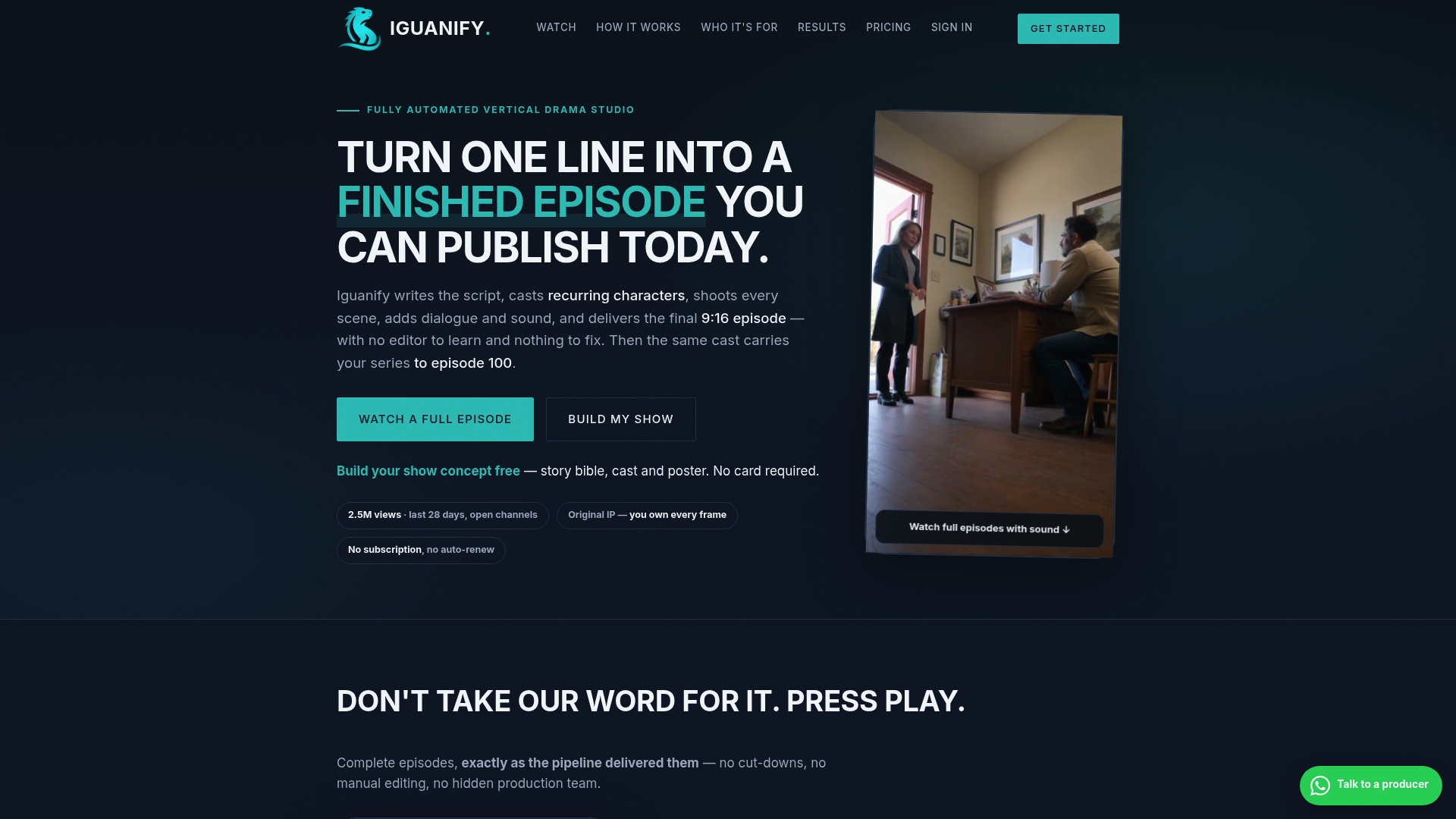
The lineup includes multiple episode and season packages, with pricing and details available on the company’s website. Every package comes with full ownership of the finished content, so the rights stay with you, not the tool.
- Recurring cast generation keeps characters visually and tonally consistent across an entire series.
- Episode packs handle scriptwriting, dialogue, sound, and production without a separate editing team.
- Output is ready to publish directly to TikTok, YouTube, and Instagram.
If your concept is ready to become an episode, start at the AI drama generator and see what a single script line can produce.
Sources
For deeper reading on the claims above: the Copyright Office’s AI guidance covers registration rules directly, Ampere Analysis has the underlying short-form drama audience data, and the NewGenAI TV Network project documents a working practitioner pipeline you can study step by step.
- U.S. Copyright Office news: Guidance on AI and copyright (2025)
- Ampere Analysis — Mini-dramas attract mega audiences (2025)
- NewGenAI-TV-Network — Agent Ops Dashboard (project files)
FAQ
What are some good AI topics to present as a show concept?
Strong topics pair a specific human conflict with a distinct visual world, such as a hidden identity story set against a striking location or a high-concept genre mashup. The five prompt templates above (pilot, micro-drama, vignette, visual spectacle, wildcard) each generate a workable starting topic in one prompt.
What are the 5 big ideas in AI most relevant to show creation?
For creators, the practical ideas are prompt engineering for concept generation, human-gated approval to prevent drift, cross-session taste memory, visual asset generation from text prompts, and copyright-safe documentation of human contribution. These map directly onto the workflow steps covered in this article.
What are some good ideas for AI projects in video production?
Beyond generating single concepts, try building a taste memory system that tracks rejected ideas and preferred character traits, or a viability scoring rubric to rank batches of concepts before you commit to production. Both reduce repetitive output and speed up the path from idea to finished episode.
Can I use AI for concept art?
Yes, and it is one of the fastest ways to visualize a show idea before committing to a full production. Generate a batch of thumbnails, narrow to two directions, then refine composition, lighting, and color with specific prompt language to get a usable poster and storyboard.
Do I own the copyright on an AI-generated show concept?
Not automatically. The U.S. Copyright Office requires a demonstrable human contribution, so your prompting, selection, and editing decisions are what make the work registrable, and you should document them as you go.