 IGUANIFY
AI Video Ownership: An 8-Step Legal Checklist for Creators
A purely AI-generated video typically cannot be copyrighted in the United States, but a video shaped by meaningful human authorship can protect the human-made parts. The U.S. Copyright Office and recent court signals make human contribution the deciding factor, not the tool. Your first move: document what you actually directed, wrote, or edited, then check your platform’s terms of service before you publish anything commercially.
TL;DR:
- Human authorship must involve specific creative actions like scripting, selecting takes, or editing, beyond just inputting prompts into AI models.
- Vendors’ terms of service often grant broad usage rights that may not align with actual copyright ownership, especially for commercial projects.
- Proper documentation of creative decisions, prompt revisions, and sourced inputs is essential for establishing ownership and defending against infringement claims.
- International copyright laws vary, with some countries granting protection without human authorship, making global content distribution legally complex.
- Effective proof of origin, such as provenance metadata and watermarking, combined with thorough documentation, strengthens legal claims in disputes over AI-generated videos.
Table of Contents
- What U.S. Law and the Copyright Office Say About AI Video Ownership
- What Counts as “Meaningful Human Authorship” in AI Video
- Vendor Terms of Service: Where Usage Rights and Copyright Diverge
- Training-Data Infringement Risk: When AI Output Resembles Someone Else’s Work
- Provenance and Watermarking: Proving Where Your Video Came From
- How to Make an AI Video Ownable, Defensible, and Safe to Publish
- Why Episodic, Human-Directed AI Video Holds Up Better
- Joint Authorship vs. Work-for-Hire in AI Video Projects
- AI Video Ownership Outside the United States
- What AI Video Ownership Means for Remixes and Derivative Work
- Why Enforcing AI Video Ownership Is Harder Than It Sounds
- Where AI Video Copyright Regulation Is Headed Next
- The Real Gap Isn’t the Law, It’s the Habit
- Produce Episodic AI Video You Actually Own
- Sources
What U.S. Law and the Copyright Office Say About AI Video Ownership
The Copyright Office has spent the last few years building out a formal position through its Copyright and Artificial Intelligence initiative, a three-part report covering digital replicas, the copyrightability of generative outputs, and training-data questions. The Office’s guidance is blunt on the core issue: copyright requires human authorship, and typing a prompt into a video model probably doesn’t clear that bar on its own.
That doesn’t mean AI video is a legal dead zone. The Office’s registration letter for the graphic novel Zarya of the Dawn shows how this plays out in practice: officials split the work into pieces, protecting the human-written text and arrangement while denying protection to the AI-generated images themselves. Expect the same logic applied to video, scene by scene, edit by edit.

Courts haven’t fully settled every edge case, but the trend lines up with the Office’s stance. Congressional researchers tracking the issue note that policy debates around training data, licensing, and authorship are still moving, which means today’s guidance is a floor, not a permanent ceiling.
What Counts as “Meaningful Human Authorship” in AI Video
Ownership isn’t a coin flip. Certain creative acts consistently strengthen a human-authorship claim, and others don’t move the needle at all.
- Writing the script, dialogue, or shot list before generation begins
- Selecting and arranging specific takes, shots, or generated clips into a sequence
- Iteratively directing the model through multiple rounds of feedback rather than accepting a first output
- Editing, color correction, sound design, or recutting after generation
- Making final creative decisions about pacing, structure, and story beats
A single prompt that produces a finished short clip, published as is, sits at the low end of this scale. Compare that to a workflow where a creator writes a full episode script, generates multiple takes per scene, rejects and regenerates dialogue for tone, then edits the sequence together with original music choices. The second workflow reads as human authorship because the human is directing craft decisions, not just requesting output. Reed Smith’s analysis puts it plainly: treat the AI as a tool, and the record of your creative choices becomes your legal evidence.
Vendor Terms of Service: Where Usage Rights and Copyright Diverge
Copyright law tells you what’s protectable. Your platform’s terms of service tell you what you’re actually allowed to do with it, and those are two separate questions that creators routinely confuse. A “license to use” grant from a vendor is not the same as owning copyright, and some platforms retain rights you wouldn’t expect.
Before you build a commercial pipeline around any AI video tool, audit these clauses:
- Usage grant scope: Does it cover commercial use, or personal/non-commercial only?
- Exclusivity: Can the vendor also license your output to other users, or use it in their own marketing?
- Training and data use: Does uploading your script, footage, or likeness give the platform rights to train future models on it?
- Indemnification: Who’s liable if your output infringes someone else’s copyright?
- Uploaded-input ownership: If you feed in your own footage, art, or voice, do you retain full rights to that input?
Platform contract terms often determine your real commercial rights more than copyright law does, especially on free or freemium tiers where broad license grants fund the business model.
Pro Tip: Save a dated copy of the terms of service you accepted at the time you generated each project. Vendors update terms quietly, and a claim you make in 2027 may need to reference language that’s since disappeared from the live page.
Training-Data Infringement Risk: When AI Output Resembles Someone Else’s Work
Ownership and infringement are separate legal questions, and creators who only think about the first one get blindsided by the second. The infringement concern breaks into two parts: did the model have access to a copyrighted work during training, and does your output bear substantial similarity to it? Both conditions typically need to be true for a real claim.
Litigation over training-data copying is still working through the courts, and fair use arguments remain genuinely unsettled at scale. That uncertainty is exactly why you can’t treat “the model generated it” as a legal shield.
Practical risk reduction looks like this: clear any reference footage, music, or likenesses you feed into a prompt, push your output through enough human editing that it counts as a transformation rather than a copy, and where possible choose tools trained on licensed or public-domain material. None of this eliminates risk entirely, but it moves your project away from the fact patterns that show up in infringement complaints.
Provenance and Watermarking: Proving Where Your Video Came From
Legal ownership and technical proof of origin are two different tools, and you want both. The Coalition for Content Provenance and Authenticity, known as C2PA, has become the industry’s default standard for embedding origin metadata directly into a file, letting anyone trace how content was created or edited. Adoption is spreading fast among major toolmakers, including provenance markers built into model output by default.
Watermarking goes a step further at the technical level. Research like VidStamp demonstrates frame-level watermarking that embeds a hidden message into individual video frames, holding up even after the video is recompressed or lightly edited. That kind of tamper detection matters if someone rips your episode, strips the credits, and reposts it as their own.
None of this substitutes for a copyright claim. Provenance metadata proves where a file came from; it doesn’t prove you own the copyright in it. Think of watermarking and C2PA as your paper trail’s backup copy, useful evidence to pair with your own documented edits and approvals when a dispute actually happens.
How to Make an AI Video Ownable, Defensible, and Safe to Publish
Treat this as your production checklist, not a one-time legal review.
- Capture your creative decisions in writing as you make them: script drafts, shot lists, and the reasoning behind edits.
- Log every prompt round and revision, especially multi-turn sessions where you rejected outputs and redirected the model.
- Save source files and version history for every episode, including intermediate cuts, not just the final export.
- Clear third-party inputs, licensing music, stock footage, or any likeness used in your prompts.
- Get written approvals from anyone whose voice, image, or IP appears in the finished piece.
- Record which terms of service you accepted and when, alongside any vendor indemnity language.
- Register the human-authored elements with the Copyright Office, describing clearly which parts are AI-generated and which are yours, following the Office’s registration guidance.
- Attach provenance metadata and watermarking to your final files as a standing part of your export process, not an afterthought.
Pro Tip: Build a one-page production log template once and reuse it for every episode. The Lemonlight checklist approach of separating ownership, infringement risk, and commercial clearance into three tracked columns catches gaps a single “did we clear this?” checkbox misses.
Why Episodic, Human-Directed AI Video Holds Up Better
Iguanify’s model is built around this exact tension: automated production paired with real human direction over character continuity, scripting, and story arcs across episodes. Recurring cast generation and consistent characters aren’t just a production convenience, they’re evidence of the kind of iterative, directed creative process that supports a stronger authorship record. Creators can retain ownership of the episodes they produce.
Joint Authorship vs. Work-for-Hire in AI Video Projects
These two doctrines get confused constantly, and the confusion gets expensive fast when a team scales up production. Joint authorship applies when two or more people intend to merge their contributions into a single, unified work, with each contributor holding an independent copyright interest afterward. Work-for-hire applies when an employee creates something within the scope of employment, or when specific categories of commissioned work are covered by a signed agreement, and ownership shifts entirely to the employer or commissioning party.
AI complicates both. An AI system isn’t a legal person, so it can’t be a joint author or an employee, no matter how much creative heavy lifting it appears to do. If a writer scripts an episode, a director shapes it through the AI tool, and an editor cuts the final sequence, you may have genuine joint authorship among the humans involved, with the AI treated as an instrument each of them used.
Work-for-hire gets messier in freelance and agency setups. If you hire a contractor to direct AI-generated episodes for your brand, that arrangement typically needs a signed work-for-hire agreement or a copyright assignment to transfer ownership to you, the same as it would for any freelance video work. Don’t assume “I paid for it” equals “I own it.” Without that paperwork, the contractor may retain rights to whatever human-authored elements they contributed, and you’re left owning only your own edits and direction, not the whole package.
AI Video Ownership Outside the United States
The human-authorship standard isn’t universal, and creators publishing internationally need to know that before they assume U.S. rules travel with them. The United Kingdom’s Copyright, Designs and Patents Act actually allows copyright in some computer-generated works with no human author, attributing ownership to “the person by whom the arrangements necessary for the creation of the work are undertaken,” a notably different standard from the U.S. approach.
The European Union generally holds closer to the U.S. position, requiring an author’s own intellectual creation as the touchstone for protection, though individual member states are still working out how that applies to generative tools case by case. China’s courts have gone further than the U.S. in some rulings, granting copyright protection to AI-assisted images where a human made enough specific creative choices during generation, even through prompting alone in certain cases.
This patchwork matters practically. A creator distributing episodic content globally through platforms like TikTok and YouTube may find their work protectable in one jurisdiction and unprotected in another, simultaneously. If your content strategy depends on licensing revenue or brand deals across multiple markets, that inconsistency is worth flagging to counsel before you sign anything, not after a dispute surfaces. Congressional researchers tracking U.S. policy shifts note that international divergence is itself becoming a pressure point pushing domestic reform conversations forward.
What AI Video Ownership Means for Remixes and Derivative Work
Derivative works have always been a legal gray zone, and AI video pushes that gray zone wider. If the underlying AI-generated footage in your episode isn’t copyrightable on its own, does that mean anyone can remix or reuse it freely? Not quite, and the answer depends entirely on which layer of the work someone is copying.
Your human-authored elements, the script, the specific edit, the arrangement of scenes, the original dialogue, stay protected even when the raw AI visuals underneath don’t. Someone lifting your edited sequence and reposting it is potentially infringing your protected contribution, even if they’d be free to generate similar raw AI footage themselves using the same prompts.
This creates an odd incentive structure for remix culture. Creators building on unprotected AI-generated base footage face fewer legal barriers than creators remixing traditionally filmed or heavily human-edited content, at least until courts and the Copyright Office draw clearer lines around mixed-authorship works. Fan communities repurposing AI-generated characters or scenes into new content should expect this area to stay contested for years, particularly as episodic AI series build the kind of recurring characters and story worlds that traditionally attract dedicated fan remix activity. The safest practical stance for now: assume your specific edit and arrangement are protected even when the raw generated elements aren’t, and extend that same courtesy when building on someone else’s AI-assisted work.
Why Enforcing AI Video Ownership Is Harder Than It Sounds
Even a rock-solid legal claim runs into a practical wall: proving what actually happened inside the AI model. Most commercial video generation tools operate as black boxes, and creators, courts, and even the platforms themselves often can’t fully reconstruct why a given output looks the way it does or which training data influenced a specific frame.
That opacity cuts both ways. If someone infringes your protected human-authored elements, tracing the theft back through a chain of AI-assisted reposts and re-edits gets genuinely difficult, especially across platforms with weak content moderation. And if you’re accused of infringing someone else’s copyrighted material through your AI output, defending yourself means explaining a generation process you may not fully understand yourself, since most consumer-facing tools don’t expose their training data or decision logic.
This is exactly where your documentation habits stop being a compliance exercise and start being your actual defense. A production log showing your prompts, revisions, and edits doesn’t just support an authorship claim, it gives you something concrete to point to when a platform’s internal workings can’t answer the question for you. Watermarking and provenance metadata help here too, giving outside parties a technical trail that doesn’t depend on anyone opening up a model’s black box. Expect enforcement to stay genuinely hard until either the technology gets more transparent or the legal standards adjust to account for that opacity, whichever comes first.
Where AI Video Copyright Regulation Is Headed Next
Nothing about this space is settled law in the way old-media copyright is, and creators building long-term production pipelines should plan for the ground to shift under them. Congressional researchers are actively tracking policy proposals around training-data licensing markets, potential compulsory licensing schemes, and whether Congress should legislate a clearer authorship standard rather than leaving it to case-by-case Copyright Office guidance.
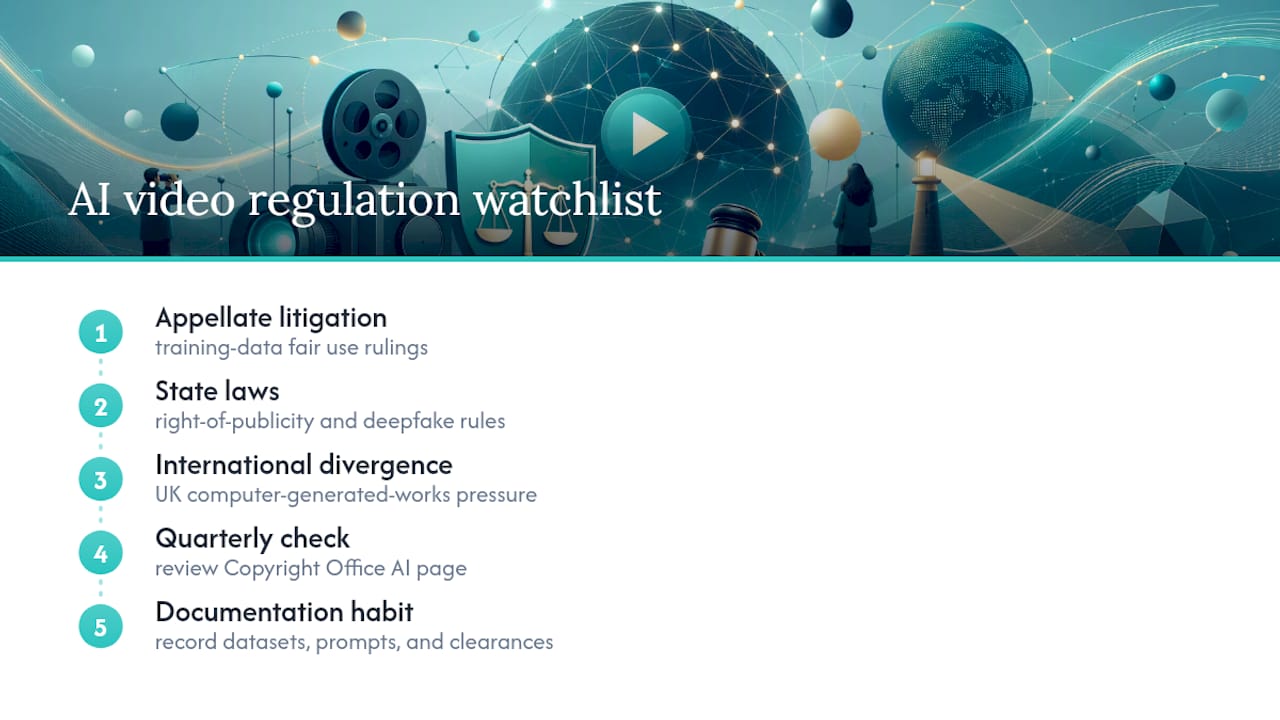
Watch three pressure points closely. First, ongoing litigation over training-data copying will eventually produce appellate rulings that either narrow or expand fair use protections for AI developers, and that outcome will ripple directly into how much liability creators inherit from the tools they use. Second, state-level right-of-publicity and deepfake laws are multiplying faster than federal copyright reform, meaning your likeness-clearance obligations may tighten before your authorship questions get resolved. Third, international divergence, particularly the UK’s computer-generated-works provision, creates real pressure for U.S. policymakers to either harmonize or explicitly reject that model.
The safest bet for now is treating current guidance as durable enough to build on, but not permanent enough to ignore updates. Set a recurring calendar reminder, quarterly is reasonable, to check the Copyright Office’s AI initiative page for new guidance, since the Office has shown it will keep issuing parts of its report as the legal landscape develops. Building a documentation habit now costs you almost nothing and pays off regardless of which direction the rules move.
The Real Gap Isn’t the Law, It’s the Habit
Most creators treat AI video ownership as a legal question to solve once, then forget. It’s actually an operational habit you either build into your workflow or don’t, and the ones who skip it are the ones who get burned when a dispute, a platform audit, or a licensing deal suddenly requires proof they never bothered to keep.
The conventional advice, “just add more human editing,” isn’t wrong, but it’s incomplete. What actually protects you is the record of that human work, not the work alone. A director who made a hundred creative decisions across an episode has a weaker legal position than one who made ten decisions and wrote every one of them down. Courts and the Copyright Office can only evaluate what you can show them.
If there’s one place conventional wisdom undersells the risk, it’s vendor terms of service. Creators obsess over copyright case law while signing away broad rights in a platform’s terms without reading past the first screen. Read the contract before you worry about the courtroom.
Prioritize documentation first, provenance tools second, and legal review third, in roughly that order and roughly that frequency. Skipping straight to “get a lawyer” without a paper trail to hand them wastes everyone’s time and your money.
— Leonard
Produce Episodic AI Video You Actually Own
Every checklist item above gets easier when your production tool builds the audit trail for you instead of leaving it to memory; understanding what a certificate of insurance means for your film production can help manage risks effectively. Some platforms generate finished episodes from a single-line premise while keeping characters consistent across a series, and episodes produced may be retained by creators without needing to negotiate licenses or parse ambiguous terms of service.
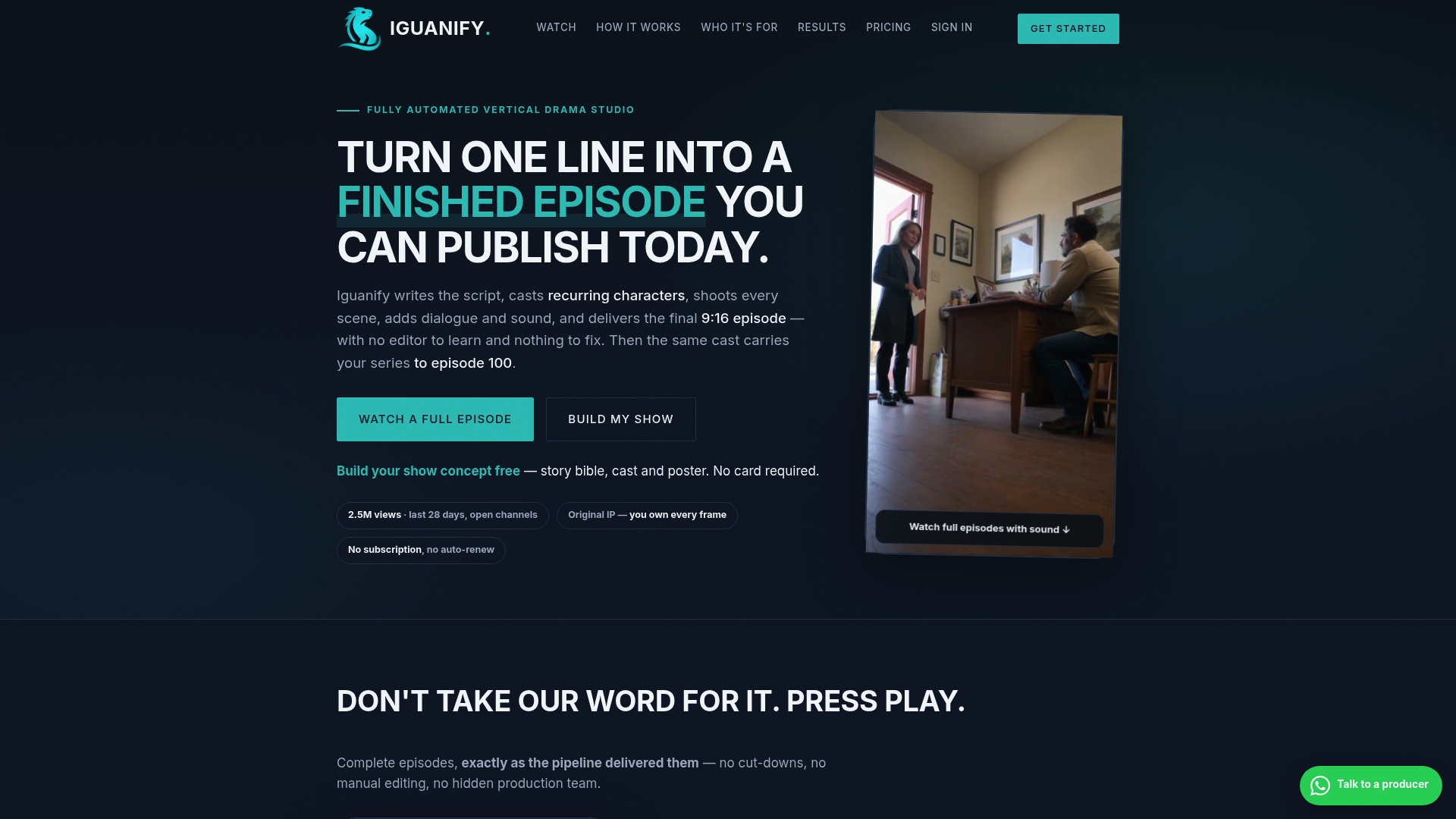
Consistency in characters and documented production processes can contribute to a directed, iterative creative record that strengthens a human-authorship claim. You’re not left assembling your own version-control system from scratch or guessing whether a platform’s fine print gives you real ownership. Some platforms offer real-time production workflows enabling creators to go from script to finished episode quickly, supporting timely publication to platforms like TikTok or YouTube.
If you’re building a series and want to see what a finished episode looks like before committing, start with the AI drama generator and generate your first show concept and cast at no cost.
Sources
- Copyright and Artificial Intelligence (U.S. Copyright Office)
- Ownership rights for AI-generated works and in machine learning - Reed Smith
- VidStamp: A Temporally-Aware Watermark for Ownership and Integrity in Video Diffusion Models