 IGUANIFY
What Platform AI Content Policy Rules Every Creator Must Follow

Platform AI content policy rules boil down to four requirements: disclose AI-generated content, run human review before publishing, avoid prohibited content categories, and embed provenance metadata where the platform supports it. Skip any one of these and you risk demotion, takedown, or account suspension.
Do this now, before your next upload:
- Add a disclosure label or caption note when content is substantially AI-generated.
- Run a human review pass on anything touching real people, political claims, or sensitive topics.
- Embed or attach provenance metadata (C2PA or IPTC) if your export tool supports it.
- Never publish content that falls into a prohibited category: CSAM, non-consensual deepfakes, impersonation, or deceptive political material.
Pro Tip: Research on AI image labeling found that disclosure labels measurably reduce how much audiences believe or share misleading AI content, particularly for images. Labeling isn’t just a compliance box. It changes how your content lands.
The section below breaks down how OpenAI, Google Play, Meta, Microsoft’s MSN, and Medium each enforce these rules, so you know exactly where to focus first.
Key Takeaways
Platform AI content policies converge on four requirements: disclosure, human review, prohibited-content compliance, and provenance metadata, and creators who document all four face the lowest enforcement risk.
| Point | Details |
|---|---|
| Disclosure reduces risk | Labeling AI content lowers audience belief in misleading claims and satisfies most platform mandates. |
| Human review needs proof | Keep edit logs or editorial notes; a review with no documentation won’t hold up in an appeal. |
| Provenance metadata travels with the file | Attach C2PA or IPTC tags at export, since retroactive tagging rarely satisfies detection systems. |
| Enforcement is graduated | Expect warning, demotion, or takedown before suspension, and respond fast to limit escalation. |
| Policies keep tightening | Platforms are expanding disclosure mandates to video and audio, not just images. |
Table of Contents
- What Do Major Platforms Require for AI Content?
- What Counts as Disclosure, Human Review, and Prohibited Content?
- How Do You Build a Platform-Compliant Publishing Workflow?
- What Happens When AI Content Violates a Platform Policy?
- How Does Iguanify’s Episodic Workflow Handle Compliance?
- What Rights Do Creators Have When Content Gets Flagged?
- How Transparent Are Platforms About AI Enforcement?
- How Are AI Content Policies Changing Over Time?
- Is There a Shared Standard Across Platforms?
- Which Publishing Tools Simplify This for Creators?
- The Compliance Gap Nobody Talks About
- Sources
What Do Major Platforms Require for AI Content?
Every major platform has published its own AI content policy, and the specifics vary more than most creators expect. Some platforms label content, others remove it outright, and a few make developers personally accountable for what their app produces.
- OpenAI: Maintains a single Usage Policies page listing explicit prohibitions, including CSAM and grooming content. No disclosure mandate for output, but violations trigger account-level enforcement.
- Google Play: Requires developers to prevent generative AI apps from producing offensive or deceptive outputs. Responsibility sits with the developer, not the platform.
- Meta (Instagram, Facebook, Threads): Uses visible labels plus invisible watermark and metadata detection aligned with C2PA and IPTC standards. Realistic synthetic video or audio requires mandatory disclosure in certain contexts.
- Microsoft/MSN: Ties partner obligations to the Microsoft Responsible AI Standard. Unreviewed AI-generated content is banned outright for partners; AI-assisted work must be tagged and disclosed.
- Medium: Distinguishes AI-assisted writing (allowed) from predominantly AI-generated stories, which lose distribution or get pulled from paywalled programs if undisclosed.
The common thread: developer and publisher accountability, prohibited content categories, and a growing reliance on provenance signals instead of manual spot checks.
What Counts as Disclosure, Human Review, and Prohibited Content?
Disclosure, human oversight, and prohibited categories are the three pillars every platform policy rests on, even when the wording differs.
Disclosure means telling your audience content involved AI, typically through a caption tag, watermark, or metadata flag. Platforms generally split this into three tiers: fully human content, AI-assisted content (a human wrote or edited most of it), and unreviewed AI-generated content (AIGC), which several platforms, including MSN, ban outright for publisher partners.
Human review requires a person to verify the output before it publishes; not a glance, but a documented check. Acceptable proof includes edit logs, a version history showing manual changes, or an editorial note describing what was reviewed and why. A screenshot of the raw AI output with no edits after it doesn’t count.
Prohibited categories show up across nearly every policy, though wording varies:
- Child sexual abuse material (CSAM) or grooming content
- Non-consensual sexual deepfakes of real people
- Impersonation of real individuals without consent
- Deceptive political content designed to mislead voters
- Malware, illicit instructions, or content that facilitates harm
Pro Tip: If your export tool supports C2PA or IPTC metadata, attach it before you upload, not after. Retroactively adding provenance data rarely satisfies platform detection systems, which often check metadata at the point of ingestion.
How Do You Build a Platform-Compliant Publishing Workflow?
A repeatable checklist beats a one-time policy read. Here’s the sequence that catches most violations before they become enforcement actions.
- Embed provenance metadata at export. If your tool writes C2PA or IPTC tags automatically, verify they survive the platform’s upload process.
- Add disclosure language in the caption, video description, or bio, depending on where the platform expects it.
- Confirm consent and likeness rights for any real person’s voice, face, or name used in the content.
- Run human review on anything touching politics, real people, sexual content, or medical/financial claims. Document the review with a note or log entry.
- Validate inputs on the developer side. Block disallowed prompts before generation, not after publishing.
- Log model inputs and outputs. Keep records for at least as long as the platform’s appeal window.
- Apply platform-specific tags where available (Meta’s AI label, MSN’s disclosure tag, Medium’s AI notice).
- Monitor distribution after publishing. Watch for demotion signals or takedown notices, and respond within the platform’s stated window.
Pro Tip: Check your account-level training opt-out settings. Some platforms default to allowing your uploaded media to train their own AI models unless you manually opt out. That’s a separate setting from your content’s disclosure status.
What Happens When AI Content Violates a Platform Policy?
Enforcement rarely jumps straight to a ban. Most platforms follow a graduated ladder: warning, demotion, takedown, then suspension for repeat offenses. Meta and similar platforms often lean label-first, adding a visible AI tag rather than removing content outright, unless it violates a hard prohibition like non-consensual deepfakes. MSN and Google Play tend toward removal-first when a violation touches developer accountability, since the responsibility sits upstream with the publisher or app maker.
Some platforms, including Hugging Face, favor a collaborative moderation model: creators get a chance to fix flagged content through relabeling or demotion instead of immediate deletion, provided they respond with corrective transparency.
If your content gets flagged, three moves reduce the damage:
- Edit and relabel immediately rather than waiting for an automated response to escalate.
- Retract and republish with proper disclosure attached, especially if the original omitted a required tag.
- Submit review logs and provenance tags as evidence in any appeal. Platforms weigh documented human oversight heavily when deciding whether to reverse a decision.
How Does Iguanify’s Episodic Workflow Handle Compliance?
Building a serialized drama episode from a single script line doesn’t mean skipping the checks platforms expect. Iguanify’s production pipeline treats compliance as part of the export process, not an afterthought bolted on after the episode is done.
- Provenance metadata gets attached during episode export, so the file carries its origin data before it ever reaches TikTok, YouTube, or Instagram.
- Disclosure language can be added directly into episode captions or series metadata, matching what each platform’s disclosure rules expect.
- A per-episode review checkpoint covers consent for any recognizable likeness, political or sensitive claims in dialogue, and sexual content boundaries, before the episode ships.
- Ownership records and review logs stay attached to each production, giving creators something concrete to submit if a platform ever questions an episode.
A production pipeline that generates the audit trail as a byproduct of making the episode, rather than as a separate compliance task, is the difference between a five-minute pre-publish check and a scramble after a takedown notice.
The AI drama generator workflow shows where these checkpoints live inside an actual production process, not just in a policy document nobody rereads.
What Rights Do Creators Have When Content Gets Flagged?
Every major platform gives creators some form of appeal, though the strength of that right varies widely. Google Play, Meta, and Medium all publish appeal mechanisms, typically a form or review request tied to the specific enforcement action taken against your content or account.
The appeal generally has to demonstrate one of two things: the content didn’t actually violate the policy cited, or the violation has been corrected. This is where documentation pays off. A creator who can show a human review log, a consent record, or a provenance tag attached before publication has a materially stronger case than one submitting a bare denial.
Response times vary by platform and by the severity of the action. A demotion or label dispute often resolves faster than a full account suspension appeal, which can take days to weeks depending on the platform’s review queue. Some platforms, particularly those handling high volumes of automated content, use a mix of automated pre-screening and human reviewers for appeals, meaning your first response might come from a system, with a human step only if you push back.
Creators also have a quieter right worth exercising: checking what data a platform has used or plans to use from your account. This matters as much for protecting your own likeness and voice as it does for resolving a specific takedown.
How Transparent Are Platforms About AI Enforcement?
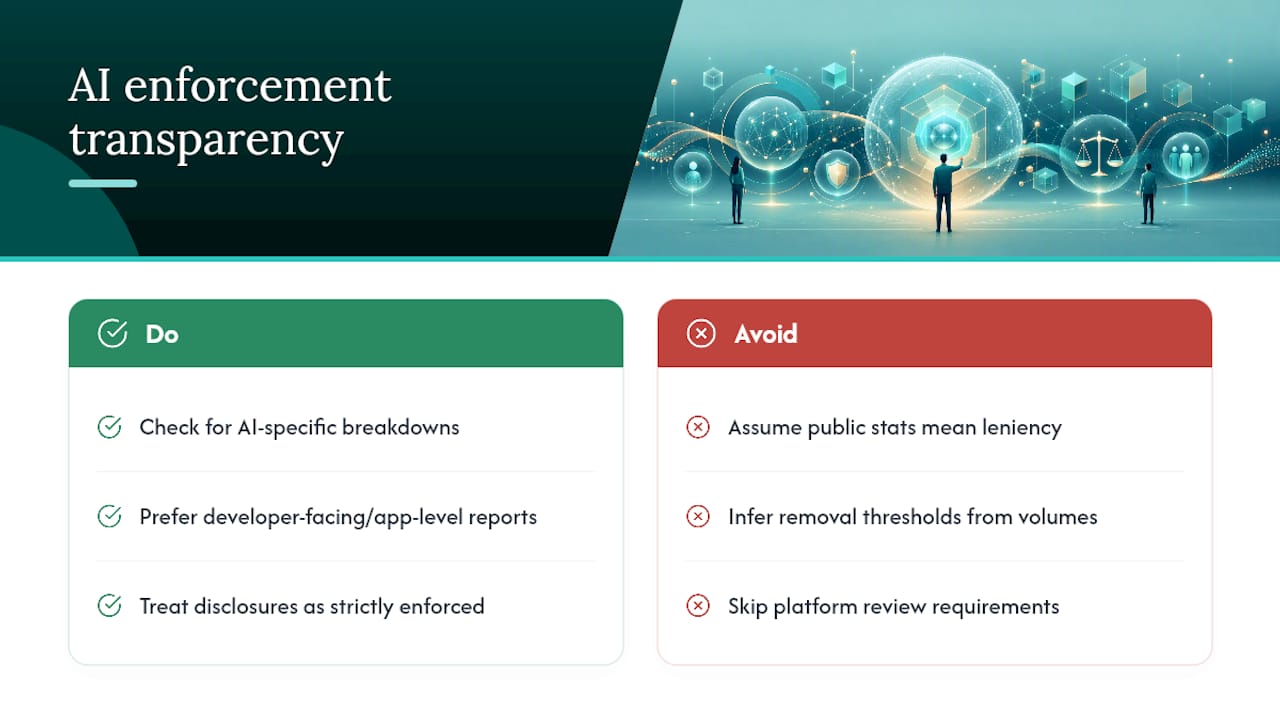
Transparency reporting on AI content enforcement is still uneven across the industry. Some platforms publish periodic transparency reports covering takedown volumes, appeal outcomes, and policy violation categories, but AI-specific breakdowns within those reports remain inconsistent. A platform might report total content removals without separating AI-generated violations from human-generated ones, which makes it hard for creators to gauge how aggressively AI content specifically gets enforced.
Developer-facing platforms tend to be more specific, since accountability for generative AI apps is baked into their developer terms. Google Play’s structure, for instance, ties enforcement data to app-level compliance reviews rather than broad public statistics.
The gap creators should watch: public disclosure of AI enforcement statistics helps set expectations, but it rarely explains how a specific decision was made. If a platform publishes that it removed a large volume of undisclosed AI content in a given period, that tells you enforcement is active. It doesn’t tell you the exact threshold that triggered removal versus demotion. Until platforms standardize AI-specific transparency metrics, the safest approach is to treat every disclosure and review requirement as strictly enforced, rather than assuming public statistics reflect leniency.
How Are AI Content Policies Changing Over Time?
Platform AI content policies are not static documents. OpenAI’s usage policies page includes a changelog, and recent revisions show a pattern of tightening rather than loosening safety rules as new misuse cases surface. Meta has moved from a narrower image-labeling rollout toward broader plans covering photorealistic images and mandatory disclosure for realistic video and audio, a direct response to how fast synthetic media quality improved.
This trajectory matters for anyone building a long-term content strategy. A workflow compliant with a platform’s rules today may need adjustment within a year, especially as photorealistic video and voice cloning improve and platforms respond with stricter provenance requirements. Expect three things to keep evolving: broader mandatory disclosure for audio and video (not just images), stricter metadata verification instead of self-reported tags, and tighter definitions of what counts as material human intervention.
Creators and developers who build compliance into their process, rather than treating it as a one-time policy read, adapt faster when platforms update their rules. Teams that rely on a static checklist from a year ago are the ones most likely to get caught off guard by a labeling requirement that didn’t exist when they last checked.
Is There a Shared Standard Across Platforms?
No single regulatory body governs AI content across platforms, but informal convergence is happening through shared technical standards. C2PA and IPTC metadata frameworks show up across Meta’s provenance approach and are increasingly referenced as the practical baseline other platforms build detection systems around. That’s less a coordinated mandate and more an industry defaulting to the same tools because building proprietary detection from scratch is expensive.
Where platforms diverge is enforcement philosophy, not the underlying technical signals. Meta prefers labeling first; MSN and Google Play push more responsibility onto developers and publishers upfront. That divergence means a single compliance workflow built around metadata and disclosure tends to satisfy multiple platforms simultaneously, even without perfect policy alignment.
For creators publishing across TikTok, YouTube, and Instagram at once, this cross-platform overlap is good news. Building your workflow around C2PA-compatible metadata, consistent disclosure language, and documented human review covers most of what any individual platform demands, even as each platform’s specific wording keeps shifting.
Which Publishing Tools Simplify This for Creators?
If you’re producing episodic video content, the right production pipeline can bake compliance into the export process rather than adding a separate review stage. Iguanify’s AI drama generator attaches provenance metadata and supports disclosure language at export, so episodes arrive ready for TikTok, YouTube, or Instagram without a manual metadata step. For creators formatting content specifically for short-form vertical feeds, the ReelShort-style export workflow applies the same principle to shorter formats. Both approaches mean the compliance checklist above happens inside the tool you’re already using to produce the episode, not as an extra task bolted on afterward.

The Compliance Gap Nobody Talks About
Most compliance advice treats platform AI content policy as a checklist you complete once before hitting publish. That’s backward. The platforms with the strictest enforcement, MSN and Google Play among them, put the burden upstream on developers and publishers to build filtering and review into the production process itself, not as a final gate.
The conventional wisdom oversells labeling as the whole solution, but knowing the key signs to tell you’re reading AI can help audiences better understand and evaluate AI-generated content. A disclosure tag helps, and the research on audience belief in labeled AI images backs that up, but a label without a documented human review behind it is a thin defense in an appeal. Platforms increasingly want evidence, not just a good-faith tag.
What creators should prioritize first: build the review checkpoint into your production tool, not your publishing routine. If your workflow generates provenance metadata and review logs as a byproduct of making the content, compliance stops being a separate task you dread and starts being something your pipeline already handles. That’s the gap between policies that sound reasonable on paper and workflows that actually hold up when a platform asks questions.
— Leonard
Sources
- Usage policies
- Understanding Google Play’s AI-Generated Content policy
- Labelling and the effect on belief/sharing of AI images