 IGUANIFY
Real Time AI Video for Creators: Instant Episodic Production

“Real time AI video,” as used here, means instant end-to-end automated production of serialized vertical-format episodes from a single premise, with recurring consistent characters and ready-to-publish output. It does not mean low-latency live streaming or interactive avatars. For creators who need fast, owned episodic content, the right solution class is an automated episodic production platform.
A production-ready solution must deliver all of the following:
- A serialized reference library that carries character identity across every episode
- A storyboard/orchestration layer that anchors visuals before video generation runs
- A character-consistency pipeline grounded in research (see Video Storyboarding and the Face Consistency Benchmark)
- Full creator ownership of every produced file, with no platform lock-in
- Platform-ready vertical outputs formatted for TikTok, YouTube Shorts, and Instagram Reels
Iguanify is built around exactly this stack.
Table of Contents
- How does an instant episodic AI production pipeline work?
- How does character consistency actually work across episodes?
- Which creators benefit most from instant episodic AI production?
- What can’t instant episodic AI production do yet?
- How do you produce your first real-time AI episode?
- Key Takeaways
- Why consistent characters change everything for solo creators
- Iguanify produces finished episodes, not raw clips
- Research and references
How does an instant episodic AI production pipeline work?
The pipeline has five stages, and understanding where each one saves time tells you where quality is controlled.
Series bible and script generation comes first. You supply a premise; the system drafts character profiles, episode arcs, and dialogue. Visual storyboarding follows: reference frames are locked for each character and scene before any video model runs. This is the stage that does the most work. Anchoring composition with image-model references means the video model only needs to solve motion, not figure out what your lead character looks like from scratch. According to the 2026 AI Video Production playbook, separating visual decisions from motion decisions is the single most effective way to improve first-try success and lower cost-per-finished-clip.
Batch generation runs shots in parallel using the locked storyboard. Orchestration carries references forward across shots and episodes, managing continuity automatically. Verification and export closes the loop: face-similarity checks flag any outlier frames for regeneration before the final file is packaged.
Maintaining a shared reference library across episodes lets you write running visual callbacks and recurring props without fearing continuity drift between episodes.
| Stage | Primary goal | Time-to-run impact |
|---|---|---|
| Series bible & script | Define characters, arcs, dialogue | Minutes (automated) |
| Visual storyboarding | Lock reference frames per shot | Low; prevents costly retries later |
| Batch generation | Produce shots in parallel | Scales with episode length |
| Orchestration | Carry references, track continuity | Minimal overhead; runs alongside generation |
| Verification & export | Flag outliers, package platform files | Fast; automated similarity checks |
For a deeper look at AI video workflow decisions at each stage, Iguanify’s production guide covers the full stack.
How does character consistency actually work across episodes?
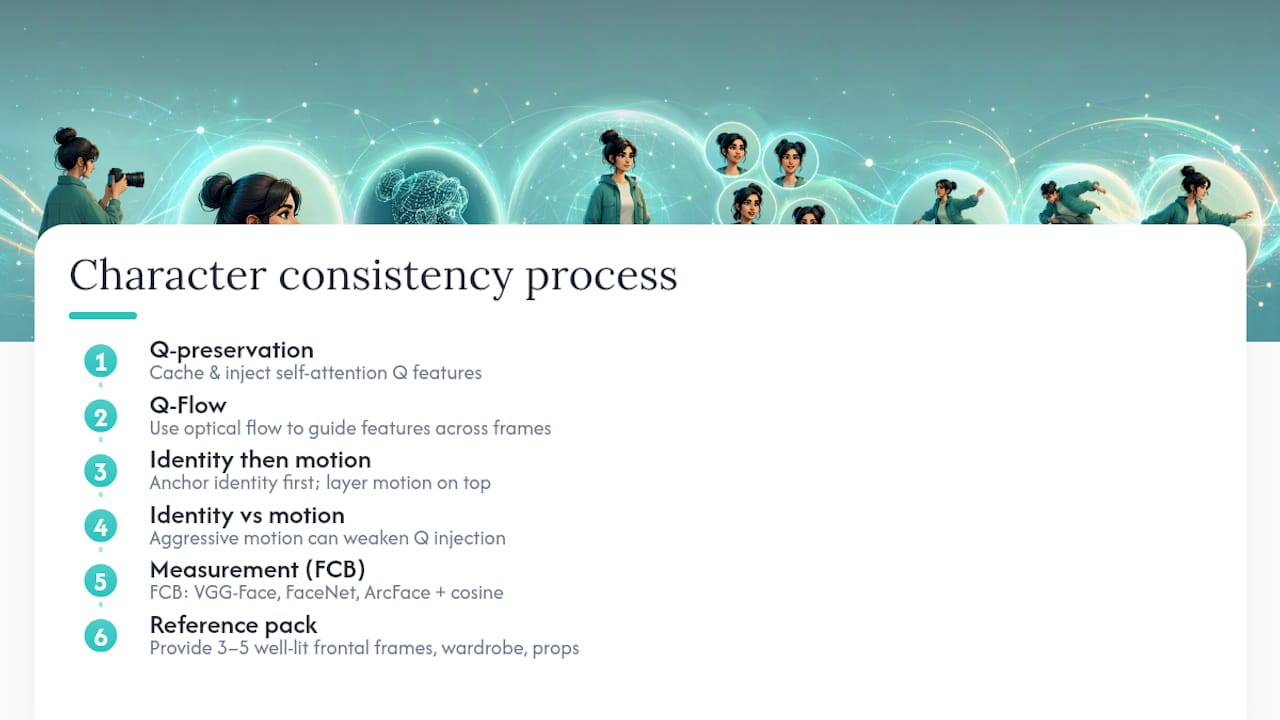
The core mechanism is called Video Storyboarding, a training-free method that injects character identity into a pre-trained text-to-video model without retraining it. The NVIDIA research behind this approach works in two phases.
In Q-preservation, the self-attention query (Q) features from a reference frame are cached and injected into new shots, anchoring the model’s internal representation of the character’s face and body. In Q-Flow, optical flow guides how those features are applied across frames, preserving natural motion while keeping identity stable. The result is a two-phase balance: identity first, then motion layered on top.
“Video Storyboarding enables pre-trained text-to-video models to generate multi-shot sequences with consistent characters by sharing self-attention query features between shots — without any additional training.” Multi-Shot Character Consistency for Text-to-Video Generation
The identity-vs-motion trade-off is real. Aggressive motion (fast action, extreme angles) can weaken Q-feature injection. Frame selection strategy matters: reference frames should show the character in a neutral, well-lit pose so the model has a clean anchor.
Consistency is measured using the Face Consistency Benchmark (FCB), which uses face-recognition embeddings (VGG-Face, FaceNet, ArcFace) and cosine-distance metrics to score frame-to-frame similarity. FCB scores are becoming a standard quality gate for B2B episodic workflows.
What you should provide: clear frontal reference frames, wardrobe images, and any recurring prop photos. The more specific your reference pack, the less drift you see across episodes.
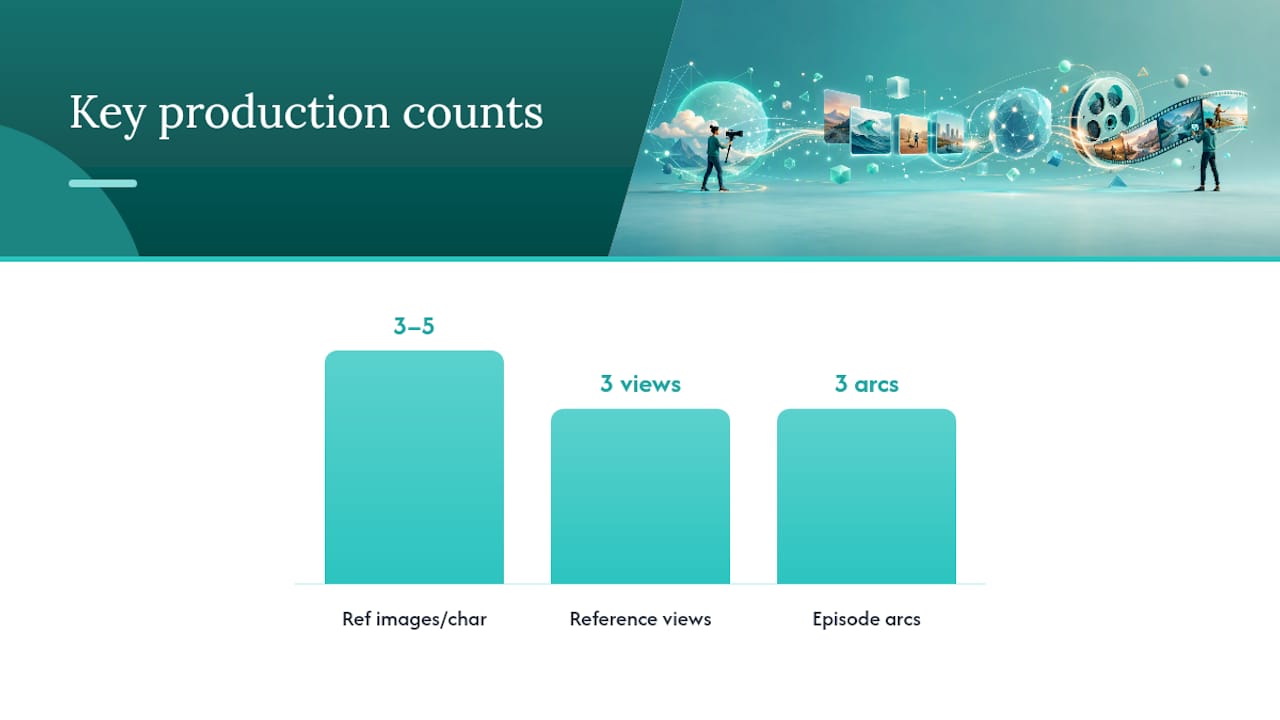
Pro Tip: Build your reference set from three to five frames shot under consistent lighting, with the character facing slightly different angles. Variety in the reference pack gives the model more to anchor on and reduces identity drift in action-heavy scenes.
Which creators benefit most from instant episodic AI production?
Five use cases consistently get the most out of this workflow:
- Serialized micro-drama: three-to-five minute vertical episodes with recurring characters and cliffhangers, published three times per week
- Faceless channels: faceless drama channels where no on-camera talent is needed and the AI cast carries the narrative
- Educational episodic shorts: explainer series with a consistent host character and episode-to-episode visual continuity
- Product-story verticals: brand storytelling in episodic format, where a recurring character demonstrates or experiences the product
- Regional publishers: local news or entertainment publishers producing short series for a specific community without a production team
For faceless channel operators specifically, AI-driven episodic production removes the biggest bottleneck: maintaining visual continuity across dozens of episodes without a dedicated editor.
Pilot roadmap:
- Produce one test episode with your full reference pack and evaluate character consistency against your own quality bar.
- Validate that the output meets platform specs (resolution, aspect ratio, caption format) before committing to a full season.
- Scale to a six-episode season once the reference library is locked and the pipeline is proven.
What can’t instant episodic AI production do yet?
Be clear-eyed about the boundaries before you commit a production schedule.
- Occasional frame outliers: no pipeline eliminates them entirely. Automated verification loops flag low-similarity frames and queue them for regeneration, but a small percentage may require manual review.
Explore AI video generator alternatives if your use case genuinely requires live-streaming or interactive avatar capabilities — that is a different product category with different infrastructure requirements.
How do you produce your first real-time AI episode?
Follow these steps in order. Skipping the reference-locking phase is the most common reason first episodes disappoint.
- Define your premise and series bible. Write a one-paragraph show concept, name your recurring characters, and outline three episode arcs.
- Build your character reference pack. Collect three to five reference images per character: frontal, three-quarter, and profile views under consistent lighting.
- Generate pilot storyboard frames. Submit your references and episode script to produce locked visual anchors for each scene.
- Choose delivery format and episode length. Vertical 9:16 at 1080p is standard for TikTok and Reels; confirm caption and audio format requirements for your target platform.
- Queue batch generation. Run shots in parallel where the platform allows; parallelize storyboards across scenes to cut total render time.
- Run verification. Review the face-similarity report; approve or regenerate flagged frames before export.
- Export and publish. Download platform-ready files and schedule posts. For AI voice-over integration, confirm the audio format matches your platform’s requirements before upload.
Asset checklist before you start:
- Reference images: 3–5 per character, 1080p or higher, consistent lighting
- Episode script: scene-by-scene with character cues
- Voice reference (optional): a short audio sample per character for voice cloning
- Wardrobe and prop images: any recurring visual elements that need to stay consistent
- Platform metadata: title, description, hashtags, and caption file ready for upload
With Iguanify, you can generate your show concept and cast before purchasing any credits. Start there, validate the characters match your vision, then buy a credit pack to produce your pilot.
Key Takeaways
Instant episodic AI production works because a storyboard-plus-orchestration pipeline resolves visual identity before the video model runs, keeping characters consistent and cost-per-finished-clip low across an entire series.
| Point | Details |
|---|---|
| Storyboard first | Locking reference frames before generation cuts retries and lowers cost-per-finished-clip. |
| Q-preservation drives consistency | Video Storyboarding injects self-attention query features from reference frames to keep characters stable across shots. |
| FCB is the quality standard | Face Consistency Benchmark scores measure frame-to-frame similarity; verification loops auto-regenerate outliers. |
| You own the IP | Confirm master file ownership, commercial use, and distribution rights before purchasing credits on any platform. |
| Iguanify for episodic creators | Free concept and cast generation before purchase; one-time credit packs; full ownership on delivery. |
Why consistent characters change everything for solo creators
The conventional wisdom in AI video is that the model does the hard work. It doesn’t. The model solves motion. The hard work is identity, and most creators discover this only after publishing three episodes of a series where the lead character looks like a different person in each one.
What the research on Video Storyboarding makes clear is that consistency is an engineering problem, not a prompting problem. You can’t write your way to a stable character across twelve episodes. You need a reference pipeline that carries identity state forward, a verification layer that catches drift before export, and a production system that treats your series as a continuous world rather than a collection of independent generations.
The creators who get the most out of instant episodic production are the ones who invest in their reference packs early. Three good reference frames, locked before episode one, will do more for your series than any amount of prompt refinement mid-season. Lock your cast, lock your references, and the pipeline does the rest.
Iguanify produces finished episodes, not raw clips
Most AI video tools hand you clips and leave the rest to you. Iguanify produces finished, platform-ready episodes from a single premise: automated series bible, recurring cast generation, storyboard orchestration, batch rendering, and full IP ownership on delivery. No editing team, no subscription, no lock-in.
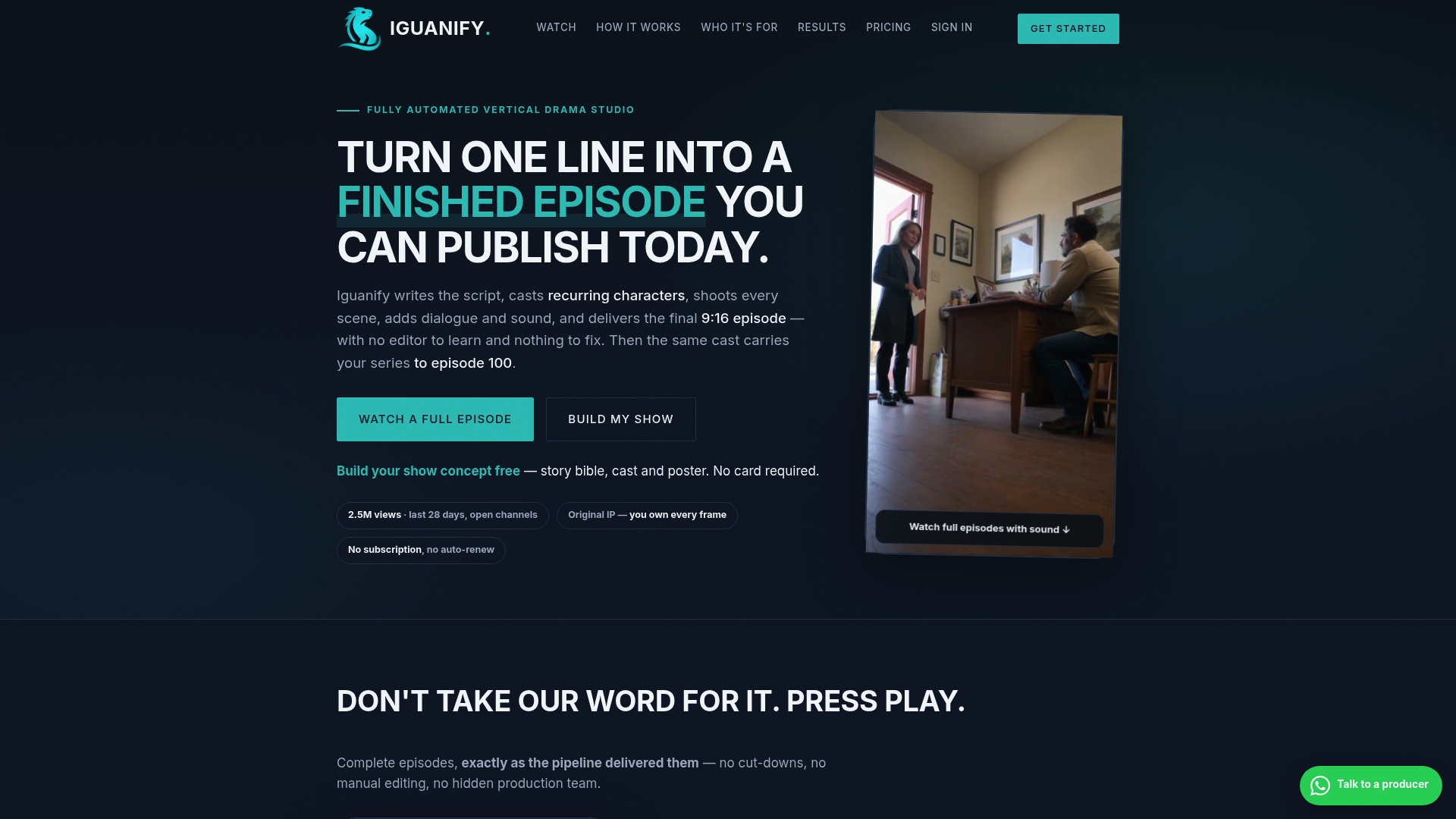
The purchase model is one-time credit packs. You generate your show concept and cast for free, see exactly what your series looks like before spending anything, then buy credits to produce your pilot. For creators building a vertical drama series or a faceless channel at scale, that means a finished episode in hours, not weeks, with characters your audience will recognize in episode twelve the same way they did in episode one.
Generate your free show concept at Iguanify and see your cast before you commit.
Research and references
The sources below ground the technical and production claims in this article in published research, benchmarks, and production playbooks.
- Multi-Shot Character Consistency for Text-to-Video Generation — Q-preservation and Q-Flow research
- Face Consistency Benchmark for GenAI Video — FCB metrics and verification standards
- Video Storyboarding project page — NVIDIA implementation details
- The 2026 AI Video Production playbook — pipeline economics and storyboard stack
- How AI Video Keeps Characters Consistent Across Frames — verification loops and persistent identity states
- How to create a video series with Fliki — series-level automation and scheduling patterns
- Why Episodic Creators Are Turning to Seedance 2.5 — reference library strategy for serial continuity
| Source | Focus |
|---|---|
| arXiv 2412.07750 | Research: Q-preservation, Q-Flow, multi-shot consistency |
| arXiv 2505.11425 | Benchmark: FCB metrics, face-similarity scoring |
| NVIDIA Video Storyboarding | Implementation: Q-injection, sub-batch attention |
| 2026 AI Video Playbook | Production economics: storyboard stack, cost-per-clip |
| Lychee.video | Practical: verification loops, identity state management |
| Fliki Masterclass | Tutorial: series automation, scheduling, bulk generation |
| The Salford Magazine | Use case: reference libraries, episodic continuity strategy |