 IGUANIFY
How to Produce a Vertical Drama Series with AI in 2026

You can produce a publishable vertical drama episode end-to-end with an AI-enabled workflow in under two weeks. That’s not aspirational — professional vertical dramas regularly complete full production cycles in that window. Your immediate next step: write a short beat sheet for one episode and run it through an AI episode generator. Iguanify’s credits page is the fastest route from that concept to a finished, platform-ready episode you own outright.
Table of Contents
- What is a vertical drama series, exactly?
- How to run a fast production workflow from concept to published episode
- Writing and directing techniques that work for vertical serials
- Which AI capabilities materially speed production
- Where vertical dramas publish and how they make money
- Which KPIs actually matter for a vertical drama series
- Production checklist and two-week sample timeline
- Ownership, clearances, and U.S. legal basics
- Key Takeaways
- The part most producers underestimate
- What Iguanify does that a standard production stack can’t
What is a vertical drama series, exactly?
A vertical drama series (also called a micro-drama or, in its Chinese-originated form, duanju) is serialized fiction shot natively in 9:16 portrait orientation and built for phone screens. The key word is natively. Reframing horizontal footage into vertical consistently loses critical visual information and signals low production quality to audiences who have been trained by premium mobile content.
Episodes run short by design. Common runtimes fall between one and three minutes, with most series releasing multiple episodes per season. Each episode opens with a hook and closes on a micro-cliffhanger — that cadence is the format’s structural engine, not a stylistic choice.
| Runtime | Typical episode count | Platform fit |
|---|---|---|
| 60 seconds | — | TikTok, Instagram Reels |
| 90 seconds | — | TikTok, YouTube Shorts, apps |
| 1–3 minutes | 15 per season | Dedicated mobile apps, YouTube |
The shot grammar changes too. Close-ups and over-the-shoulder framing carry emotional weight that wide shots lose on a small portrait screen. Plan your coverage for that reality from day one.
How to run a fast production workflow from concept to published episode
The pipeline has eight stages. What separates a two-week cycle from a two-month one is parallelization.
- Day 1–2: Write the series bible (genre, tone, recurring cast, season arc) and micro-beat sheets for episodes 1–3.
- Day 2–3: Cast or generate characters. Lock visual continuity assets (reference sheets or AI character seeds).
- Day 3–4: Build your 9:16 shot list. Writing and casting run in parallel here.
- Day 4–7: Shoot or AI-generate footage. Sound design and music bed selection start on Day 5, not after picture lock.
- Day 7–9: Editorial pass. Localization scripts drafted in parallel.
- Day 9–11: Sound mix, subtitle burn, thumbnail and poster generation.
- Day 11–13: QA review, platform metadata, schedule publish.
- Day 14: Episode 1 live. Bank a small buffer of two to three finished episodes before you go public.
Pro Tip: Lock your series bible before you touch a script. Continuity errors in micro-episodes compound fast — a character’s eye color or a recurring location detail that shifts between episodes will surface in comments within hours of publishing.
The one-episode proof-of-concept (POC) is your single most important deliverable before scaling. It stress-tests your pipeline, cast continuity, and hook design before you commit to a full season. For a practical fast video production sprint layout, the two-week template above maps directly to what working studios use.

Writing and directing techniques that work for vertical serials
The hook must land in the first 5–15 seconds. Not “introduce the premise” — land an emotional jolt, a question, or a visual surprise that makes stopping feel like a loss. Every episode ends on a micro-cliffhanger. Failure to engineer that cliffhanger causes steep audience drop-off between episodes, and the algorithm reads that drop as a quality signal.
Genre shapes everything downstream. Romance episodes tend to run shorter and convert audiences quickly — high completion rates and fast paid conversions. Thriller episodes run slightly longer and build higher rewatch value and subscriber loyalty. Top studios in 2026 run both deliberately: romance for acquisition, thriller for retention.
Sample 90-second beat sheet:
- 0–10s: Open hook. Protagonist faces an immediate, legible problem or revelation.
- 10–50s: Escalation. One obstacle, one emotional shift, no subplots.
- 50–75s: Small reveal or confrontation that raises the stakes.
- 75–90s: Micro-cliffhanger. Cut before resolution.
For casting, talent must deliver immediate emotional urgency across short takes with almost no runway for character development. Stage-trained actors who can land a beat on the first or second take are a practical advantage. If you’re using AI-generated characters, build a continuity brief that specifies emotional register, not just visual appearance.
Which AI capabilities materially speed production
AI doesn’t replace editorial judgment — it removes the mechanical labor that slows production. Here’s where it actually saves time:
- Script expansion: AI tools can take a micro-beat outline and generate full dialogue drafts. Expect to edit for voice and rhythm; the structure is usually sound.
- Character continuity: Maintaining consistent faces and costumes across 30+ episodes is where most solo creators break down. AI character synthesis tools that lock a seed or reference model solve this.
- Native 9:16 composition: AI-assisted shot composition built for portrait framing outperforms any post-production crop. Studios combining AI reframing with human editorial oversight produce premium vertical episodes at scale.
- Automated edit assembly: Rough cuts from timestamped beat sheets cut assembly time significantly.
- Sound design and music beds: AI music generation produces licensable beds in minutes. Pair with a music licensing guide to stay clear of rights issues.
- Localization: AI subtitle generation and dubbing drafts reduce localization time, though human review for contextual accuracy is a checkpoint you should not skip.
- Thumbnail and metadata generation: AI tools generate poster variants and SEO-ready metadata from episode stills and title strings.
The human-in-the-loop checkpoints that matter most: script beat approval before generation, continuity QA after each episode, and a final sound review before publish. Skipping any of these is where quality problems compound. For a deeper look at how AI integrates into production pipelines, the workflow guide covers tool selection and sprint structure in detail.
Where vertical dramas publish and how they make money
Short-form vertical drama hit $11 billion globally in 2025, and the platform landscape has matured to match. TikTok and Instagram Reels favor 60–90 second episodes with high hook density and strong first-frame visuals. YouTube Shorts handles slightly longer runtimes and rewards consistent posting cadence. Dedicated mobile apps — including premium services positioning vertical micro-series as cinematic mobile-first offerings — support paywalled episode models that TikTok and Reels don’t.
The three monetization models that work:
- Freemium: Episodes 1–3 free, paywall from episode 4. Best for romance where completion rates are high and conversion is fast.
- Pay-per-episode / in-app purchase: Viewers buy episode packs or unlock individually. Standard on dedicated apps.
- Season pass / subscription funnel: Works best for thriller and horror where rewatch value justifies recurring billing.
Ancillary revenue (music licensing, brand sponsorships, IP licensing to larger platforms) becomes relevant once your series has a proven audience. Release cadence matters: daily or every-other-day drops outperform weekly releases for retention on algorithmic feeds. For platform-specific packaging tips, the ReelShort-style video guide covers metadata and thumbnail strategy for TikTok, YouTube, and Instagram.
Which KPIs actually matter for a vertical drama series
Track these five metrics per episode, not per series:
- Completion rate: The percentage of viewers who watch to the final frame. Below 60% on a 90-second episode signals a hook or pacing problem.
- Retention by episode: Where in the season viewers drop off. A cliff at episode 3 usually means the cliffhanger on episode 2 didn’t land.
- Conversion to paid: The percentage of free viewers who purchase episode 4 or a season pass. This is your monetization health signal.
- Comment and engagement velocity: High comment volume in the first 24 hours feeds algorithmic distribution. Watch for sentiment, not just volume.
- First-week LTV: Revenue per viewer in the first seven days. Rewatch spikes on specific episodes tell you which beats are working.
Run a weekly optimization loop: measure → diagnose (script beat or thumbnail?) → experiment one variable → deploy. A 7–14 day cadence matches your episode release rhythm and keeps iteration tight.
Production checklist and two-week sample timeline
Pre-production checklist:
- Series bible with genre, tone, recurring cast, and season arc
- Micro-episode beat sheets for all episodes in the batch
- Rights and clearances confirmed (music, stock assets, talent)
- Casting continuity sheet or AI character seed files
- 9:16 shot list or AI generation brief
- Music and SFX briefs
- Localization plan (languages, subtitle format)
- Thumbnail and poster asset brief
| Day | One-episode POC | — |
|---|---|---|
| 1–2 | Bible + beat sheet | Bible + beat sheets for all 6 |
| 3–4 | Cast/character lock | Cast lock + continuity QA |
| 5–7 | Shoot or AI generate | Generate episodes 1–3 |
| 7–9 | Edit + sound | Edit episodes, generate others |
| 10–11 | Localization + thumbnails | Edit episodes, localization |
| 11–13 | QA + metadata | QA all, metadata |
| 14 | Publish | Schedule publish cadence |
Budget ranges vary widely. A DIY/AI-only production can run under $500 per episode when you own the tools. An indie-studio model with paid talent and licensed music typically runs $1,000–$5,000 per episode. Professional productions with name talent scale higher. AI automation compresses post-production and editorial labor most dramatically — that’s where the cost savings are clearest. Lock your final script beats, talent assets, and music rights before generation starts. Rework after that point costs time you don’t have in a two-week cycle.
Ownership, clearances, and U.S. legal basics
Copyright in the United States attaches to original creative work at the moment of creation, but who owns what gets complicated fast when AI tools and third-party assets are involved.
- AI-generated content: U.S. copyright law currently does not extend protection to purely AI-generated output without meaningful human authorship. Review your AI platform’s terms of service — Iguanify grants creators full ownership of the episodes they produce.
- Music licensing: Sync licenses and master licenses are both required for any music in your episodes. Using unlicensed tracks is the fastest way to get a series pulled from a platform.
- Talent releases: Every on-camera contributor needs a signed release covering multi-platform distribution and any AI-assisted reproduction of their likeness.
- Show title and logo: Run a trademark search before you commit to a series name. A conflict with an existing mark creates distribution problems later.
- Short-episode contracts: Include buyout clauses that cover all distribution windows you plan to use, including future platforms.
Pro Tip: Hire a music and media attorney before your first paid season launch. A one-time legal review of your contracts and licensing stack costs far less than a takedown dispute mid-season.
This article is general information, not legal advice. Confirm current copyright and licensing rules with a qualified attorney for your specific situation.
Key Takeaways
Producing a vertical drama series with AI is a production discipline, not a shortcut — the creators who succeed treat the two-week sprint, native 9:16 framing, and cliffhanger cadence as non-negotiable foundations.
| Point | Details |
|---|---|
| Native 9:16 from day one | Reframing horizontal footage loses critical visual information; shoot or generate portrait-first. |
| Two-week production cycle | Professional vertical dramas regularly complete full cycles in under two weeks using parallelized AI workflows. |
| Genre drives monetization | Romance converts audiences fast; thriller builds retention and rewatch value — run both when scaling. |
| Cliffhanger every episode | Engineering a micro-cliffhanger at the end of each episode is a format requirement, not a stylistic option. |
| Iguanify for end-to-end production | Iguanify automates script-to-episode generation with character continuity, sound, and localization — creators retain full ownership. |
The part most producers underestimate
The honest shift when you adopt an AI-enabled production workflow isn’t about speed — it’s about where your attention goes. You stop making decisions about rendering and assembly and start making decisions about story. That’s a better use of your time, and it’s also where the quality gap between good and forgettable vertical series actually lives.
Veteran film creators argue the core creative challenge — keeping an audience gripped across an episodic arc — is identical between classic feature filmmaking and vertical micro-series. The mobile screen changes shot selection and rhythm, not the fundamentals of tension and release. What AI removes is the mechanical friction between your story idea and a finished episode. That’s worth something.
In a two-week sprint, the day-to-day difference is concrete: you’re reviewing AI-generated episode drafts against your beat sheet, approving character continuity, and making editorial calls on sound and pacing — not sitting in an edit suite for eight hours. Iguanify supports that model directly: one-click episode production from a script, consistent characters across every episode, and you own the IP. After your first paid conversion event, the metric that tells you whether the system is working is simple: did viewers who paid for episode 4 come back for episode 5?
What Iguanify does that a standard production stack can’t
Producing a vertical drama series from scratch typically means stitching together five or six separate tools for scripting, character generation, editing, sound, and localization. Iguanify replaces that stack with a single platform that takes your premise and produces a finished, platform-ready episode — with the same characters, same visual continuity, and same production quality across every episode in your season.
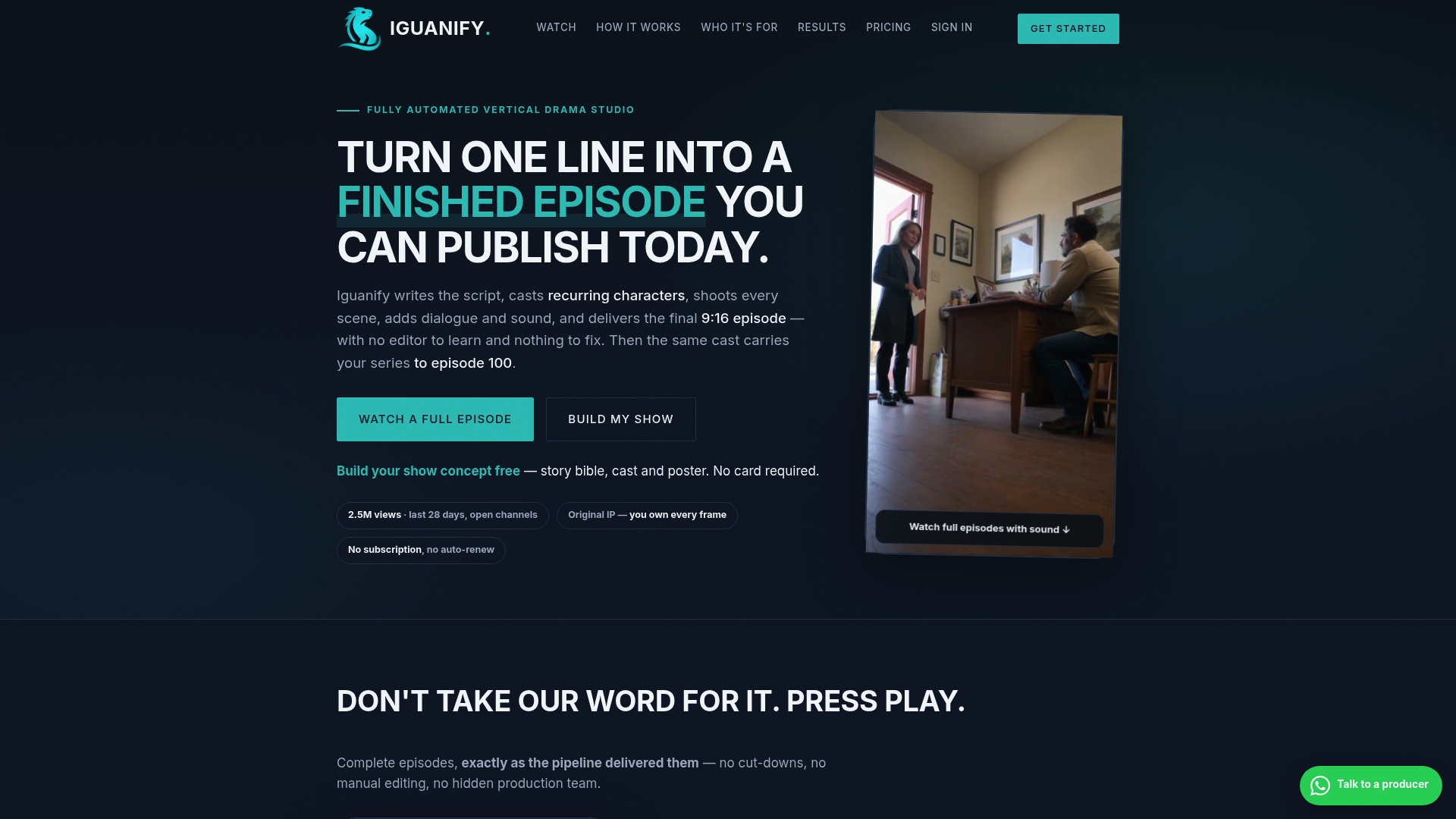
The pipeline Iguanify automates: script-to-episode generation, recurring cast continuity, native 9:16 framing, sound design, localization, and poster and thumbnail creation. You retain full rights to everything produced. There’s no subscription — you purchase episode or season credits and produce on your schedule. You can generate your show concept and cast for free before committing to a credit pack.
The recommended first action: produce one POC episode using an AI drama generator credit. That single episode will tell you more about your series concept, your hook design, and your monetization potential than any amount of planning. Start at iguanify.com and have a finished episode in your hands before the end of the week.