 IGUANIFY
Best AI Voice Over Tools for Creators in 2026

What are the best AI voice over tools for content creators in 2026?
ElevenLabs leads the pack for most creators, but the right choice depends on whether you need broad multilingual support, emotional depth, brand consistency, or real-time conversation. Here is how the top six platforms stack up.
| Tool | Best For | Voice Quality | Languages | Customization | Latency | Pricing Model |
|---|---|---|---|---|---|---|
| ElevenLabs | Multilingual creators | Highly expressive | 70+ languages | Voice cloning, design, emotion control | Sub-200ms (Flash model) | Free tier; paid plans |
| Inworld AI | Real-time character AI | Human-like dialogue | Multiple | Speech-to-speech, LLM routing | Real-time | Contact for pricing |
| OpenAI | LLM-integrated voice apps | Natural, conversational | Multiple | LLM routing, guardrails | Real-time | Usage-based |
| Hume AI | Emotional storytelling | Emotionally nuanced | Multiple | Prompt-based voice design | Standard | Contact for pricing |
| WellSaid | Brand and enterprise teams | Realistic, consistent | Wide variety of voice styles | Word-level control, AI Director | Standard | Subscription |
| Murf AI | Developers and content teams | Studio-quality | 35+ languages | Tone, pacing, emphasis controls | 130ms TTFA (Falcon) | — |
Ratings (where available): Inworld AI: 4.7★ (15 reviews) | OpenAI: 3.4★ (83 reviews)
ElevenLabs offers 10,000+ voices across 70+ languages, making it the most versatile library available. Murf AI’s Falcon model clocks a consistent 130ms TTFA measured across 33 global locations, making it the fastest verified latency available among the compared tools. WellSaid builds every voice from licensed recordings by real actors, giving enterprise teams legal clarity that scraped-data platforms cannot match.
How do these AI voice platforms compare in depth?
Voice quality is where the real differences show up, and it goes beyond sounding “not robotic.” The best tools apply linguistic modeling and emotional inflection to produce narration that holds up across long-form content without losing consistency.

ElevenLabs gives you the most control over delivery. Its Eleven v3 model is the most expressive text-to-speech option in the library, while Eleven Flash v2.5 drops latency below 200ms for live applications like conversational agents and streaming. Voice cloning is available on paid plans and requires consent verification. The free tier gives you 10,000 characters per month with no credit card required.
Murf AI is the developer’s first choice for production at scale. Its Falcon model is built for real-time conversations, and its Gen2 model handles fine-grained voiceover control including tone, pacing, and emphasis. Murf Studio cuts voiceover production time significantly, and the platform is trusted by 10 million+ users across 190+ countries.
WellSaid takes a different approach entirely. Rather than offering a massive voice library, it focuses on licensed, human-modeled voices built for brand consistency. Its AI Director feature lets you adjust pronunciation, pacing, and tone at the word level. Every voice file includes full commercial usage rights, and the platform is SOC2 and GDPR compliant.
Inworld AI is purpose-built for real-time conversational characters. Its speech-to-speech capability and LLM routing make it the strongest option for interactive applications, games, and character-driven content where the voice needs to respond dynamically.
Hume AI specializes in emotional voice design from prompts. If you are producing storytelling content or character work where emotional nuance matters more than speed, Hume’s approach to voice synthesis from descriptive prompts gives you a level of creative control that standard TTS tools do not offer.
OpenAI integrates voice generation directly with its large language models, making it the natural fit for developers building voice-powered apps that need deep language understanding baked into the speech layer.
How to choose the best AI voice over tool for your needs
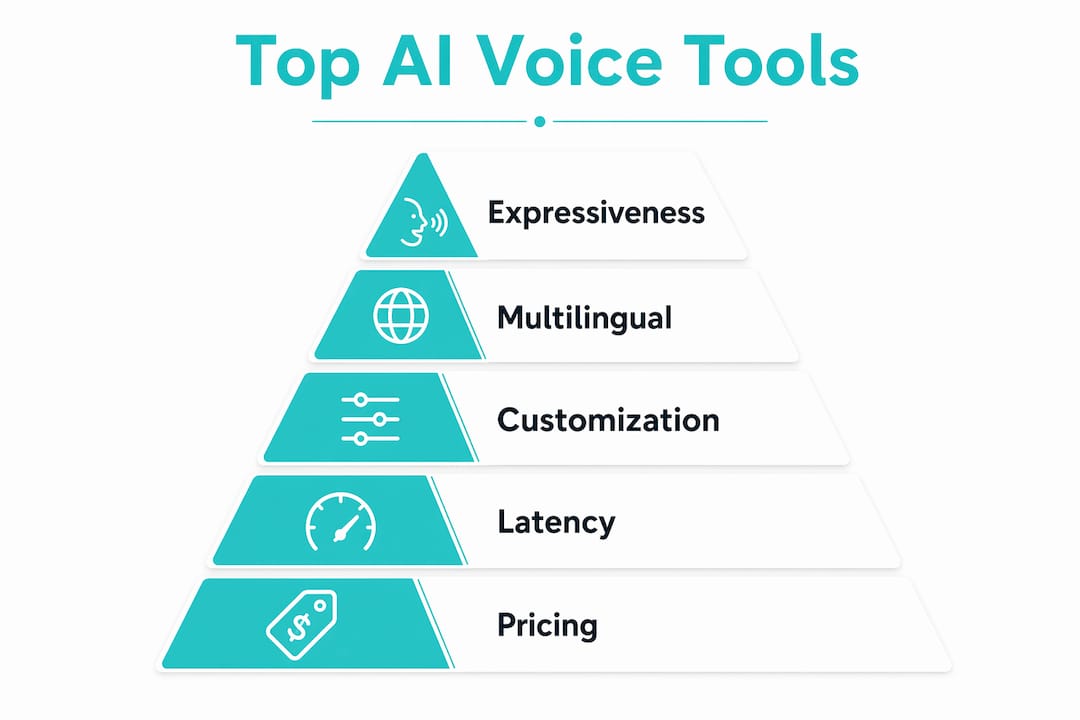
The decision comes down to five practical questions.
- What is your primary use case? Real-time conversation, long-form narration, brand marketing, and character work each favor different platforms. Inworld AI and OpenAI suit interactive apps; WellSaid and Murf AI suit content production.
- How many languages do you need? ElevenLabs covers 70+ languages; Murf AI covers 35+; WellSaid offers a wide range of voice styles covering many accents and regions.
- How much customization do you need? Word-level control matters for professional narration. WellSaid’s AI Director and Murf’s advanced controls including breath, emphasis, and cadence adjustments are the strongest options here.
- What is your latency requirement? For real-time applications, Murf Falcon and ElevenLabs Flash offer some of the lowest latency suitable for real-time applications. Standard generation on most platforms typically takes a few seconds.
- What are your rights and licensing needs? Prefer platforms that license voice data from human actors rather than scraped sources. WellSaid and Murf both use ethically sourced speech data.
Pro Tip: Always test a tool on your actual script before committing to a paid plan. Most platforms offer a free tier or demo. Run a 500-word sample through two or three finalists and listen for how the voice handles technical terms, pauses, and emotional shifts. That test will tell you more than any feature list.
For API-first production pipelines, ElevenLabs and Murf both offer Python and TypeScript SDKs with detailed documentation. Output formats typically include MP3 and WAV, with most platforms supporting direct integration into video editors, LMS platforms, and IVR systems.
What makes an AI voice over tool stand out in 2026?
The shift from basic text-to-speech to full voice design is the defining trend this year. Early TTS tools converted text to audio and stopped there. The best platforms now let you direct a voice the way a producer would direct a voice actor: adjusting breath, cadence, emotional register, and word-level emphasis.
Licensed voice models are increasingly the dividing line between professional and amateur tools. Platforms built on scraped voice data face legal exposure and tend to produce less consistent output. WellSaid’s model, built entirely on licensed recordings from real actors, is the clearest example of where the industry is heading.
Real-time capability is no longer a niche feature. Inworld AI and ElevenLabs both support sub-second voice generation for conversational applications, and Murf Falcon’s 130ms time-to-first-audio makes it viable for live customer-facing deployments. The benefits of AI video creation in 2026 extend well beyond simple narration, with voice now integrated into full production workflows.
Expert insights on voice design and AI voice trends
Professional voiceover workflows have always relied on voice directors. The best AI tools now replicate that role through granular controls, letting creators adjust tone and cadence word by word without re-recording entire takes.
Rights management is the issue most creators overlook until it becomes a problem. Voice cloning without consent is legally contested in multiple US states, and the regulatory environment is tightening. Choosing a platform with clear licensing from human voice actors protects your content and your channel.
For creators producing episodic or serialized content, character voice consistency across episodes is a separate challenge. A voice that sounds slightly different in episode three than in episode one breaks audience immersion fast. Platforms with stable, reproducible voice models address this directly.
How the featured tools were evaluated
Each tool was assessed across seven dimensions: voice naturalness and expressiveness, language and accent breadth, customization depth (including word-level and emotional controls), latency for both real-time and batch production, pricing transparency, platform compatibility and API quality, and rights and licensing clarity.
Voice quality was evaluated against the standard of professional narration: does the output hold up across a full script without sounding flat or inconsistent? Latency figures were taken from vendor-published benchmarks with third-party verification where available. Pricing was assessed for transparency and scalability, favoring models that do not hide costs behind opaque tier structures.
Iguanify takes a different approach to voice-driven content
If you are producing serialized drama or episodic content for TikTok or YouTube, the tools above solve the voice generation piece. But voice is only one layer of a full episode.
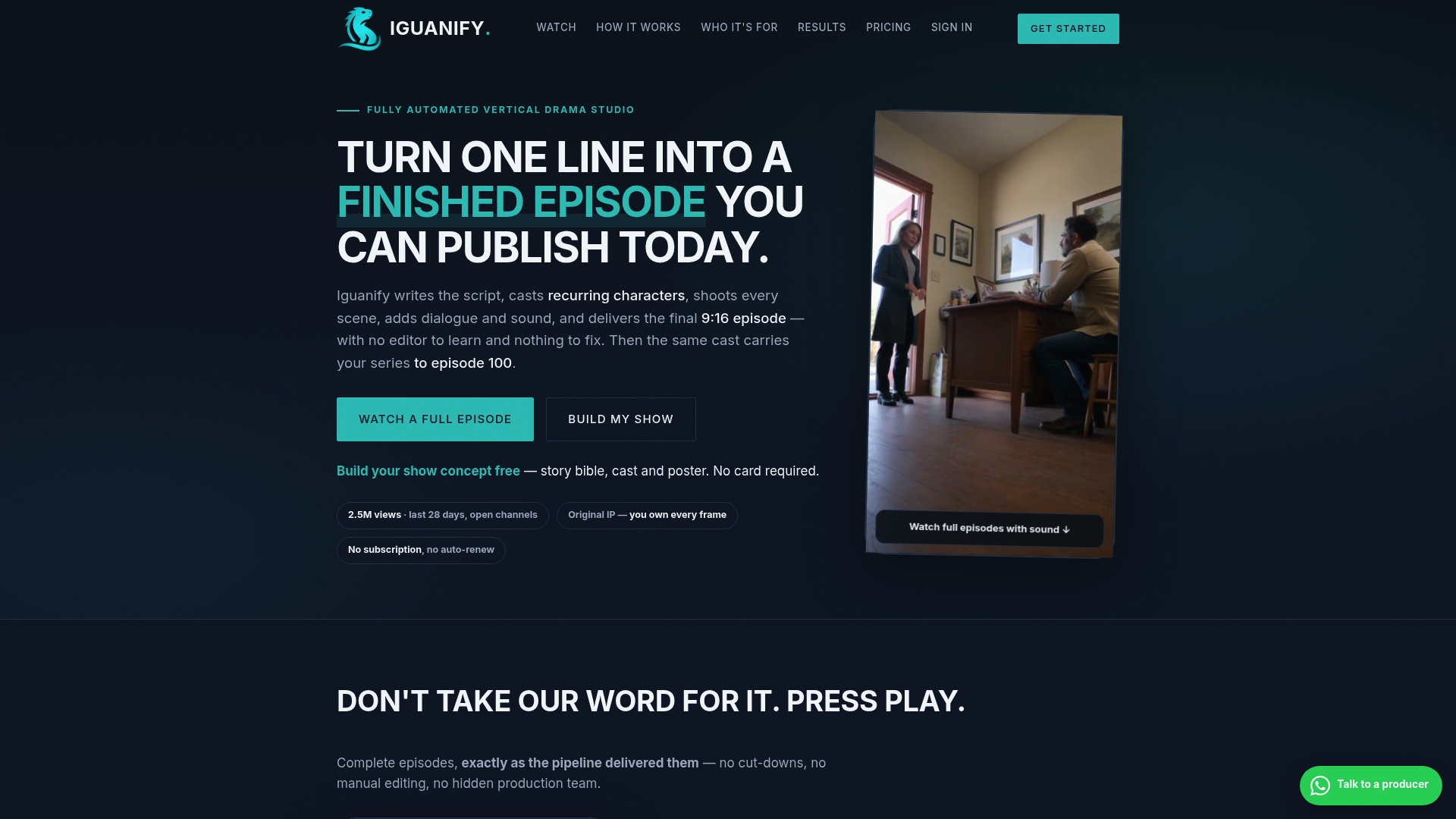
Iguanify automates the entire production stack: script, cast, dialogue, sound, and final episode output, all from a single premise. Characters stay consistent across every episode, which solves the continuity problem that trips up most AI video workflows. You own the IP outright, with no subscription or recurring fees. Instead, you buy credit packs for episode or season production and publish directly to your platform of choice.
If you want to produce a full drama series without assembling a separate voice tool, video editor, and publishing workflow, Iguanify handles all of it in one place. It is a different kind of solution than the voice generators compared above, and worth considering if your goal is finished episodes rather than raw audio files.
Key Takeaways
ElevenLabs, Murf AI, and WellSaid lead the 2026 AI voice over market for creators who need expressive, customizable, and legally sound voice generation at scale.
| Point | Details |
|---|---|
| ElevenLabs leads on scale | 10,000+ voices across 70+ languages with sub-200ms latency on the Flash model. |
| Murf Falcon sets the speed benchmark | Verified 130ms time-to-first-audio across 33 global locations, making it the fastest verified latency available among the compared tools. |
| Licensing protects your content | Platforms using licensed human voice data reduce legal risk and produce more consistent output. |
| Test before you buy | Run your actual script through a free tier or demo; feature lists do not reveal how a voice handles your content. |
| Iguanify for episodic creators | Automates full episode production with consistent character voices, no subscription, and full content ownership. |