 IGUANIFY
AI Showrunner for Creators: Produce Serialized Episodes Fast

An AI showrunner is a production platform that automates the full pipeline from concept to finished, export-ready episode — script, cast, voices, animation, and edit included. The practical recommendation: choose a shows-first platform that preserves your IP, maintains character continuity across episodes, and exports directly to your channels. Amazon’s backing of an AI showrunner startup signals that serialized AI-generated content is no longer a hobbyist experiment. Iguanify is the production-ready option built specifically for that use case.
Key Takeaways
AI showrunner platforms that prioritize serialized memory, full creator ownership, and export-ready formatting are the production-ready choice for creators building episodic content in 2026.
| Point | Details |
|---|---|
| Shows-first vs. clips-first | Choose a platform with persistent character memory and series bible support, not just single-scene generation. |
| Ownership comes first | Confirm full IP assignment and unrestricted export rights before generating any monetizable content. |
| Start with a three-episode bible | Lock character attributes and arc before producing; pilot a single scene to test prompts before scaling. |
| Viral reach ≠ serial retention | Early AI show experiments reached large view counts, but sustained audiences require story arcs and consistent characters. |
| Iguanify for end-to-end production | Iguanify delivers finished, export-ready episodes with recurring cast memory and a credit-pack ownership model. |
Table of Contents
- What does an AI showrunner platform actually do?
- How do prompts actually become finished episodes?
- What do AI-generated episodes actually look and feel like?
- Why are creators adopting AI showrunners?
- What are the real limits and ethical risks?
- How do AI showrunner platforms price their services?
- How do you launch your first AI-powered serialized show?
- How do leading AI showrunner platforms compare?
- What hardware and software do you actually need?
- What productions have been built entirely by AI showrunners?
- What does good human-AI collaboration look like in showrunning?
- Where is AI showrunner technology heading?
- The real gap between AI showrunner hype and what actually works
- Iguanify produces finished episodes, not just clips
- Sources
What does an AI showrunner platform actually do?
Most AI video tools generate a single clip and stop there. An AI showrunner platform does something structurally different: it manages an entire serialized show, keeping the same characters, tone, and story canon consistent from episode to episode.
The core capability stack looks like this:
- Concept to series bible: the platform generates a show premise, character profiles, and episode arc from a short prompt
- Script generation: scene-by-scene dialogue and stage directions produced from beat outlines
- Casting and voices: recurring characters assigned synthetic voices and visual identities that persist across episodes
- Animation and rendering: scenes assembled into watchable video with synchronized audio
- Edit and export: finished episodes packaged for TikTok, YouTube, or Instagram without manual post-production
The key distinction is shows-first vs. clips-first. One-off clip tools give you a 30-second scene with no memory of what came before. A shows-first platform tracks canon, so episode 4 knows what happened in episode 1. That continuity is what makes serialized drama possible and what keeps audiences coming back.
How do prompts actually become finished episodes?
The pipeline has five stages, and knowing where each one can break helps you decide where to spend your attention.
- Series bible and beat outlines: you define the world, the recurring cast, and a 3–5 episode arc. This document becomes the platform’s memory anchor.
- Prompt-engineered script generation: the AI expands beat outlines into full scenes. Multi-agent orchestration assigns dialogue to specific characters, manages pacing, and flags tone inconsistencies.
- Cast, voice, and timing layer: each character’s voice profile and visual identity are locked and applied consistently. AI voice tools at this stage determine whether your cast sounds distinct or interchangeable.
- Rendering and animation: scenes are assembled into video. This is where stylistic choices — animation style, color grade, camera framing — get baked in.
- Automated edit and export: cuts, transitions, and platform-specific formatting are applied automatically.
Hallucinations and continuity drift most often appear between stages 2 and 3, when the model loses track of a character’s established traits or contradicts an earlier plot point. Platforms that implement a canon and memory module — enforcing canonical saves and continuity checks at each stage — reduce this significantly.
Pro Tip: Lock your character’s name, physical description, speech pattern, and one defining motivation in the series bible before generating a single scene. Treat this locked profile as a system prompt that precedes every episode prompt. Platforms that let you inject a persistent character card into each generation call will preserve consistency far better than those that rely on context window alone.
What do AI-generated episodes actually look and feel like?
Expect stylized animation rather than photorealistic video, synthetic voices that are clear but occasionally flat, and editing that is competent but rarely surprising. The visual aesthetic tends toward graphic novel or motion-comic styles, which suits short-form drama well.
Public demos have shown what this output can do at scale. A prior AI-generated show experiment reportedly reached 80 million views, demonstrating that the format can generate viral reach. What those numbers don’t show is sustained serial retention, which is a different challenge entirely.
Key quality expectations to set before you launch:
- Visual consistency: recurring characters look the same episode to episode on shows-first platforms; one-off tools will drift
- Audio quality: synthetic voices have improved sharply, but emotional range in tense scenes still lags behind human performance
- Edit rhythm: automated cuts work for social-length episodes; longer formats expose pacing stiffness
- Story depth: The Verge’s reporting on early AI showrunner platforms noted that output can feel like scripted fan fiction — visually approximate but lacking the chemistry of a writers’ room
Episodic arcs and character depth still need human curation. The platform handles production volume; you handle the story logic that keeps viewers watching past episode 2.
Why are creators adopting AI showrunners?
Speed and cost are the obvious answers. A traditional animated episode can take weeks and a production team. An AI showrunner compresses that to hours or days for a single creator working alone.
The practical benefits break down into three areas:
- Speed: episode production measured in hours, not weeks, which lets you maintain a consistent posting cadence on TikTok or YouTube
- Consistency: generated recurring casts with locked visual and voice profiles solve the continuity problem that breaks most solo creator projects
- Ownership and distribution: platforms that export finished episodes to your own channels mean you retain the IP and the monetization path, rather than building an audience on someone else’s platform
For faceless channel operators and small publishers, the math is straightforward. You can produce a 5-episode series in the time it used to take to script one episode. That volume advantage compounds when you’re building a serialized show with a returning audience. Explore how faceless AI channels are already monetizing this model.
Pro Tip: Before you publish a single episode, download a test export and check three things: does the platform’s terms of service assign you full IP ownership, does the exported file include no watermark or platform lock-in, and can you monetize the content on YouTube and TikTok without a revenue share clause? These checks take ten minutes and can save you from building a series you don’t legally own.
What are the real limits and ethical risks?
The technology has genuine gaps, and some of them carry legal exposure.
- Shallow character chemistry: AI-generated dialogue can approximate a character’s voice but rarely captures the friction and subtext that makes relationships feel real. Scenes between two characters often read as parallel monologues.
- Continuity drift: without a dedicated memory module, the model will contradict established facts across episodes. A character’s backstory, a location’s name, a running plot thread — all are vulnerable to hallucination.
- Likeness and impersonation risks: generating content that resembles a real person’s appearance or voice without consent creates legal exposure under right-of-publicity laws. This applies even to stylized animation.
- Training-data copyright: the underlying models were trained on existing media. Depending on the platform’s licensing terms, derivative outputs may carry copyright risk, particularly for commercial distribution.
- Unclear ownership if vendor terms assign rights: some platforms retain a license to your generated content. Read the terms before you produce anything you plan to monetize.
Before committing to any platform, ask these questions directly:
- Do I own full IP rights to all generated content?
- Does the platform retain any license to distribute or sublicense my episodes?
- What is the training-data sourcing policy, and does it cover commercial use?
- What takedown and moderation procedures apply to my content?
- Is there a revenue-sharing trigger if my content earns above a threshold?
A workspace pattern that enforces canon and continuity checks addresses the technical risks. The legal ones require reading the terms of service, not trusting the marketing copy.
How do AI showrunner platforms price their services?
Pricing shapes your ownership rights and per-episode cost as much as any feature does. Three models dominate the market right now.
| Model | Structure | Ownership implications | Best for |
|---|---|---|---|
| Subscription | Monthly fee, unlimited or capped generations | Platform often retains broad license | High-volume creators testing formats |
| Pay-per-episode / credit pack | One-time purchase per episode or season pack | Cleaner IP assignment, no recurring obligation | Creators building owned series |
| Revenue share / licensing | Free or low-cost access; platform takes a cut of earnings | Platform has ongoing financial interest in your content | Branded IP or sponsored content deals |
Press reporting on early AI showrunner platforms has cited subscription pricing in the low-to-mid double digits per month as a likely model for consumer-facing tools. Credit-pack models tend to offer cleaner ownership terms because there’s no ongoing relationship between your revenue and the platform’s.
Questions to clarify before you pay:
- Does the per-clip or per-episode fee include all assets (voice, animation, music), or are those billed separately?
- At what revenue threshold does a licensing or revenue-share clause activate?
- Can you export and re-upload to any platform, or are distribution rights restricted?
How do you launch your first AI-powered serialized show?
Follow this sequence to go from idea to published episode without wasting production credits on content you’ll scrap.
- Write a three-episode series bible. Define the world, the core conflict, and three recurring characters with locked attributes (name, appearance, voice style, motivation). This is your canon anchor.
- Build a tone guide. Two or three sentences describing the visual style, pacing, and emotional register. “Gritty urban drama, fast cuts, morally ambiguous leads” is enough.
- Generate a pilot scene first, not a full episode. Test your prompts on a single 60-second scene. Check character consistency, voice quality, and visual style before committing to a full episode.
- Refine prompts and lock canonical traits. Adjust based on the pilot output. Once you’re satisfied, save the character cards and style parameters as your production template.
- Scale to full episodes and publish. Produce episodes 1–3 before publishing any of them. Banking a small buffer means you can post consistently even if one episode needs revision.
For prompt structure, start simple. A one-line prompt like “Episode 1, Scene 1: Maya confronts her landlord about the missing rent receipt — tense, urban apartment, night” gives the model enough context without over-constraining the output. For a full AI video workflow, expand to three lines: premise, character state, and scene goal.
Track these metrics after launch to know whether your series is building an audience or just generating views:
How do leading AI showrunner platforms compare?
The market currently splits into two categories: interactive/clip-generation tools and end-to-end production platforms. The distinction matters for serialized work.
Clip-generation tools, including early-stage platforms that launched with Discord-based workflows, are strong for experimenting with visual style and generating short scenes. They tend to lack persistent character memory, export-ready formatting, and clear IP assignment. The SF Chronicle’s coverage of one such platform noted it works better for episodic scenes than full-season arcs, which is an honest summary of where most clip tools sit today.
End-to-end production platforms handle the full pipeline: series bible, script, cast, animation, and export. Iguanify sits in this category, built specifically for serialized vertical drama with recurring characters and platform-ready output. Industry roundups of AI tools for showrunners in 2026 highlight that the gap between clip tools and production platforms is widening as memory and continuity features mature.
For creators building a series rather than a one-off experiment, the production platform category is the right starting point.
What hardware and software do you actually need?
The short answer: less than you think. Cloud-based AI showrunner platforms handle rendering server-side, so your local machine doesn’t need a GPU. A modern laptop with a stable internet connection is sufficient for most workflows.
What you do need:
- A browser or lightweight desktop client for the platform interface
- A script or outline document (Google Docs or Notion works fine) for your series bible
- A video review tool (VLC, QuickTime, or the platform’s built-in player) to QA exported episodes
- Platform accounts for distribution: TikTok Creator, YouTube Studio, and Meta Creator Studio for Instagram
For creators integrating multiple AI tools — separate voice generators, storyboard tools, or script assistants — a centralized AI dashboard can reduce subscription overhead and keep your workflow in one place. The main integration point to watch is export format: confirm the platform outputs MP4 at the resolution and aspect ratio your target platform requires (9:16 vertical for TikTok and Instagram Reels, 16:9 for YouTube).
What productions have been built entirely by AI showrunners?
The most documented public case is Exit Valley, a satirical series about Silicon Valley culture produced using an AI showrunner platform backed by Amazon. The show launched in 2025 and demonstrated that a fully AI-generated serialized format could attract press coverage and investor interest simultaneously.
Earlier experiments with AI-generated South Park-style content reportedly reached 80 million views, though those were test runs rather than sustained series. The view count showed the format’s viral ceiling; what it didn’t show was whether audiences would return for episode 2, which is the harder problem.
The honest read on case studies right now: the successful ones share three traits. They chose a genre with a forgiving visual style (satire, animation, stylized drama). They maintained strict character consistency across episodes. And they published on a cadence fast enough to build algorithmic momentum before audience interest faded.
What does good human-AI collaboration look like in showrunning?
The creators getting the best results treat the AI as a production department, not a co-writer. You own the story decisions; the platform executes them at scale.
Practical division of labor:
- Human: series bible, character motivations, episode arc, cliffhanger placement, tone adjustments after QA
- AI: script expansion from beat outlines, voice casting, scene rendering, edit assembly, export formatting
The biggest mistake is over-delegating story logic. Platforms that let you prompt a full episode from a single sentence will produce something watchable, but it will lack the cause-and-effect structure that makes viewers care about episode 3. Write your beat outlines with intention, then let the platform handle production volume.
A structured workspace with canon enforcement formalizes this division. You set the rules of the world; the system enforces them across every generation call. That’s the pattern that scales.
Where is AI showrunner technology heading?
Three developments are worth watching in 2026 and beyond.
Sandboxed world models are the next frontier. Developers are building persistent story environments where every generated scene is checked against an established canon before it renders. This eliminates most continuity drift without requiring human review of every frame.

Licensed IP experiences are coming. The same memory and world-model infrastructure that preserves a creator’s original characters can, in principle, host licensed versions of existing IP. That opens a path to branded content and franchise extensions that don’t require a full production studio.
Longer-form output is improving steadily. Current platforms handle short-form vertical episodes well. Full 22-minute episodes with coherent three-act structure are still technically demanding, but the gap is closing as context windows expand and multi-agent orchestration matures.
The practical implication for creators: the tools available today are already production-ready for short-form serialized drama. Building your workflow and audience now means you’re positioned to scale into longer formats as the technology catches up.
The real gap between AI showrunner hype and what actually works
The conversation around AI showrunners tends to split into two camps: breathless enthusiasm about replacing Hollywood, and dismissal of the whole category as glorified clip art. Both miss the point.
What the evidence actually supports is narrower and more useful. AI showrunner tools are genuinely production-ready for short-form serialized drama right now, specifically for creators who treat the platform as a production department and keep story decisions in human hands. The viral reach is real. The retention challenge is also real. Those two facts coexist.
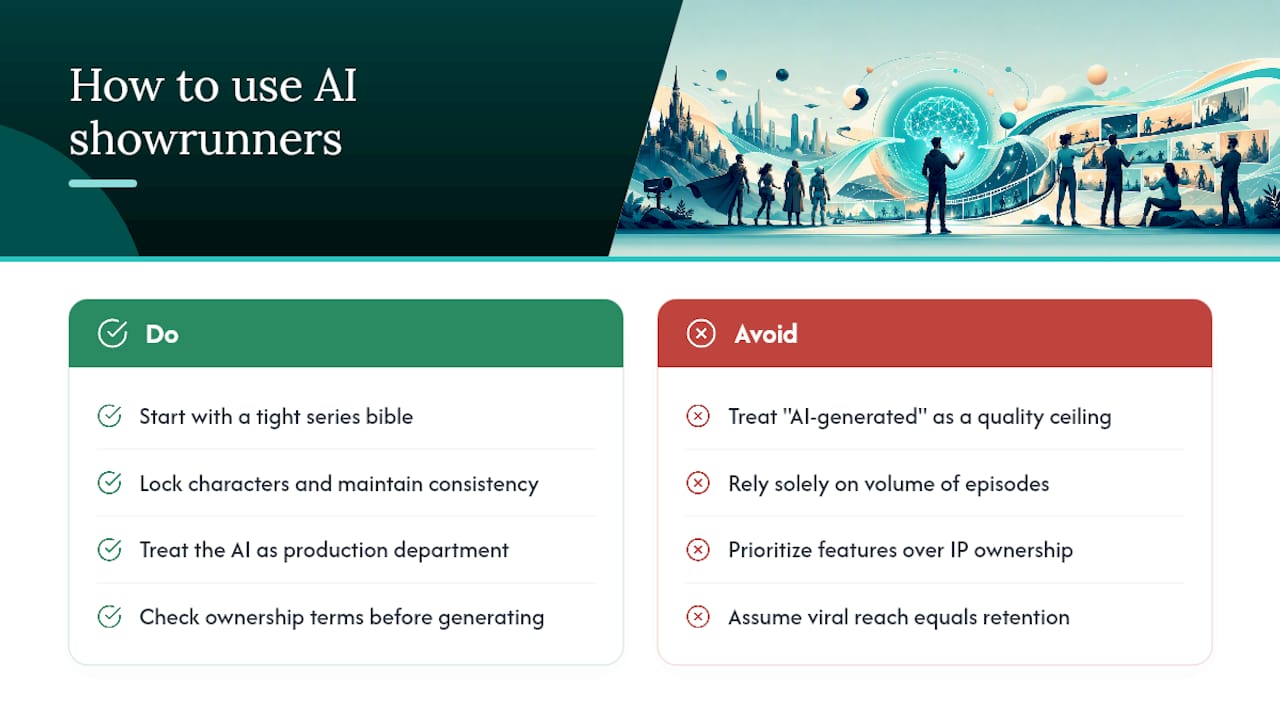
Where conventional advice falls short is in treating “AI-generated” as a quality ceiling rather than a starting point. The creators who will build durable audiences with this technology aren’t the ones generating the most episodes. They’re the ones who locked a tight series bible, maintained character consistency, and published on a cadence that gave the algorithm something to work with.
The other underrated point: ownership terms matter more than feature lists. A platform with slightly inferior animation but clean IP assignment and full export rights is worth more to a creator building a long-term channel than a technically superior tool that retains a license to your content.
Start with the series bible. Lock the characters. Check the terms of service before you generate episode one.
Iguanify produces finished episodes, not just clips
Most AI video tools hand you a clip and leave the rest to you. Iguanify handles the full pipeline: series bible, recurring cast generation, script, dialogue, sound, animation, and export-ready episode delivery, all from a single premise. Your characters look and sound the same in episode 8 as they did in episode 1, because the platform was built for serialized production, not one-off generation.
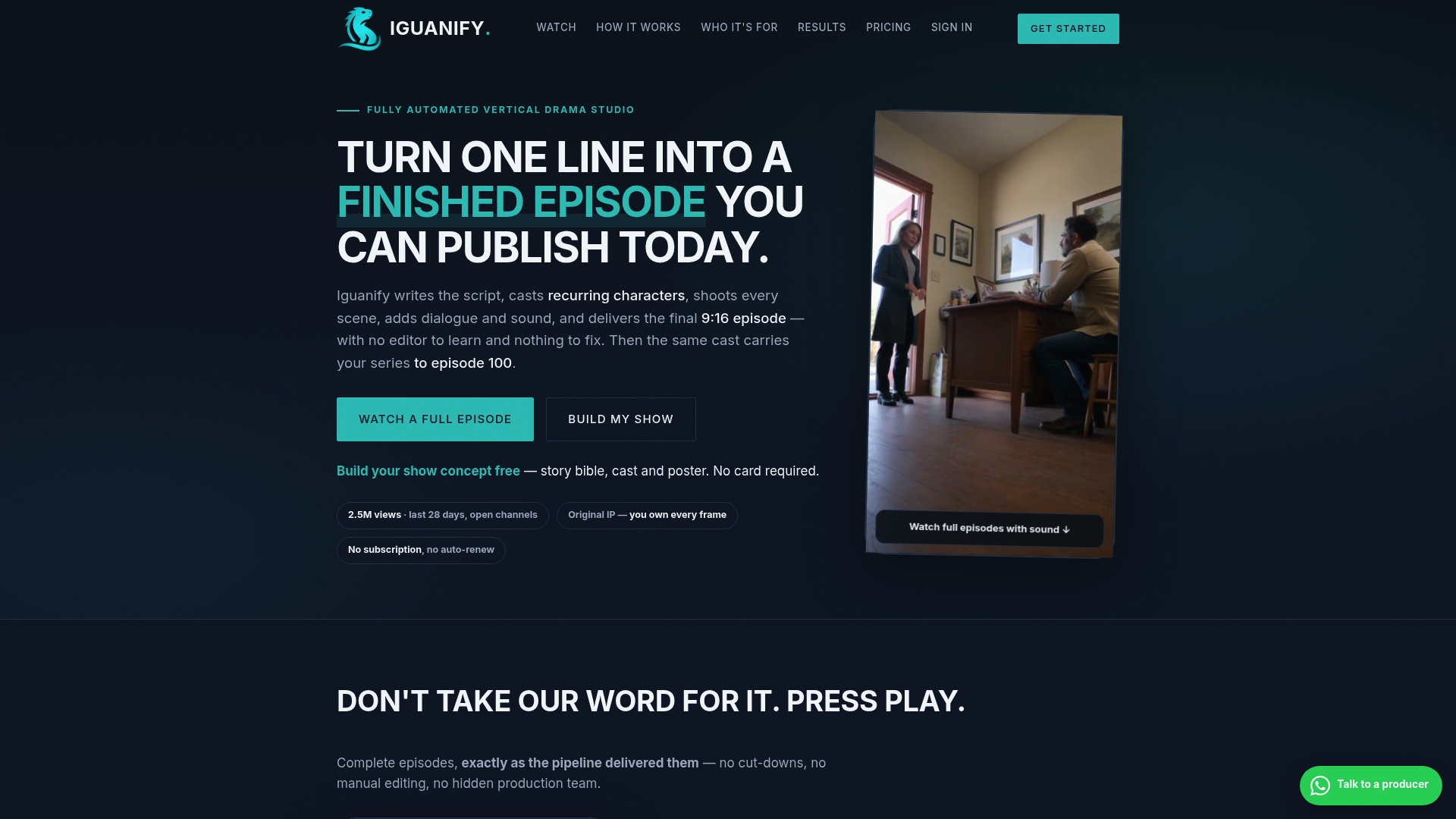
The pricing model is a credit pack, one-time purchase per episode or season, with no subscription and no recurring fees. You own the IP outright. Exports are formatted for TikTok, YouTube, and Instagram without additional editing. For creators who want to build a vertical drama series with a real audience, that combination of ownership, consistency, and distribution-ready output is what separates a production platform from a clip generator.
Generate your show concept and cast for free, then purchase an episode pack when you’re ready to produce. Start at Iguanify’s AI drama generator to see what your series looks like before you commit.
Sources
These sources offer primary reporting, workflow guidance, and product detail for creators who want to go deeper.
- Showrunner wants to turn you into a prompter for the ‘Netflix of AI’ | The Verge
- Showrunner launches AI-powered platform for interactive TV shows
- Gideon Workspace – Signal & Salt AI