 IGUANIFY
Produce Vertical Series at $1,000/Episode: Show Bible Format

A show bible format is the standard document creators use to pitch and produce episodic content, and it runs on a handful of non-negotiable parts: a logline, a series overview, character bios, a season arc with episode synopses, and production notes. A selling bible typically lands between 15 and 25 pages, though short-form and vertical projects can compress that considerably without losing pitchability.
TL;DR:
- A show bible should be concise, typically 15 to 25 pages, with each section providing clear, conflict-based character bios and a strong series engine.
- Episode synopses should be limited to five well-developed outlines that demonstrate the show’s core mechanism, avoiding extensive beat sheets.
- Production notes must include episode length, key locations, and platform specifics to enable accurate budgeting and feasibility assessment.
- Short-form projects require compressed character bios and expanded episode synopses, written as near-shootable scenes, to fit the fast-paced delivery format.
- Register the bible with the Writers Guild or Copyright Office before sharing externally and keep documentation of drafts to protect your intellectual property.
Table of Contents
- Core components and why producers care
- A page-by-page show bible template you can copy
- Adapting your bible for short-form vertical production
- Common mistakes and a pre-pitch checklist
- Tips for writing compelling character descriptions
- How to present a show bible to producers and networks
- Genre differences in show bible format
- Examples of effective show bibles
- Legal considerations and copyright for show bibles
- Why a tight bible is what actually powers production
- From bible to produced episodes with Iguanify
- FAQ
- Sources
Core components and why producers care
A show bible earns its length only when every section does real work. Academic research on the format found that bibles serve several roles at once: a writer’s framework, a selling document, a season-by-season reference, and an archive that outlives the original pitch, so the structure has to hold up long after the first meeting, according to research on TV series bibles.
Start with the logline and one-pager. This is the single paragraph that tells a producer what the show is, who it follows, and why now. Backstage’s pitch-bible guidance recommends placing the logline and one-pager at the very front, before any world-building, because that’s what decides whether the reader keeps going.
From there, the sections build on each other:
- Series overview: the world, tone, central theme, and visual style, written so a stranger understands the show’s identity in under a page.
- Character bios: each major character’s stakes, internal contradiction, and relationships to the others, since producers check for conflict potential, not biography.
- Season 1 arcs and episode synopses: a season-long throughline plus a handful of representative episodes, not a full beat sheet for every installment.
- Production notes: episode length, platform, primary locations, and deliverables, the details that let a producer rough out a budget in five minutes.
- Series engine: the repeatable mechanism that generates new episodes without exhausting the premise, whether that’s a case-of-the-week structure or a recurring relationship dynamic.
That last piece, the series engine, often decides whether a show gets picked up. Final Draft’s guidance on building a TV bible warns against outlining every beat of every episode and instead pushes writers to define the engine clearly and back it with three to five strong episode outlines. A show that can only justify its first ten episodes isn’t a series yet. It’s a miniseries with a long introduction.
A page-by-page show bible template you can copy
A practical template turns a blank document into a finished draft fast. Use this order, adjusting page counts to your genre and format:
- Title page and logline (half a page): show title, one-line logline, contact information.
- One-pager (1 page): expanded pitch covering premise, tone, and why the show works now.
- Series overview (2 to 3 pages): the world, central theme, writing style, and look and feel.
- Main character bios (2 to 4 pages): three to five leads, each with stakes, arc, and relationships.
- Supporting cast (1 to 2 pages): shorter entries, focused on function rather than full biography.
- Season 1 overview (1 page): the season’s arc in a paragraph, stated plainly.
- Episode synopses (3 to 5 pages): StudioBinder’s breakdown of show bible format recommends five strong, structural outlines over a longer list of thin ones.
- Future seasons sketch (1 page): where the engine takes the show in seasons 2 and 3, kept brief.
- Production notes (1 to 2 pages): format, episode length, locations, and anything that affects budget.
- Appendix (optional): moodboard images, reference shows, or a glossary of world-specific terms.
That lands most selling bibles in the 15 to 25 page range Amazon Studios outlines in its own format guidance, which also calls for sample episode synopses and production notes that let a reader estimate feasibility on the spot.
For short-form and vertical bibles, compress sections two through five into a tighter combined page, and lean harder on the episode synopses since that’s where a micro-drama proves its hook works episode after episode. Formatting matters as much as content here: use consistent headers, keep paragraphs short, and proofread for tense consistency. A bible full of typos reads like a first draft, not a show someone’s ready to greenlight.

Adapting your bible for short-form vertical production
Vertical episodic drama runs on a different clock than traditional TV, so the bible has to shift accordingly. Shorten the series overview and character bios. A 90-second episode doesn’t need four paragraphs of backstory per character, it needs one clear want and one clear obstacle. Expand the episode synopsis section instead, since short-form audiences judge a series by whether each individual episode lands a hook in the first three seconds and a cliffhanger in the last.
Write micro-episode synopses as single paragraphs: setup, turn, hook. Keep recurring cast notes tight too, just enough to confirm the same actor or AI-generated character appears consistently across episodes, since continuity is what turns casual viewers into followers.
Your deliverables checklist for serialized vertical production should include: episode scripts in short-drama format, a locked cast list with reference images, a metadata sheet for platform uploads, and a continuity log noting wardrobe, location, and relationship status per episode. We built our short drama script format around exactly this kind of lean, repeatable structure, since the script is what eventually turns a bible’s episode synopsis into a shot.

This is also where the bible stops being a pitch document and starts being a production plan. We map each episode synopsis directly to a script, then produce it with recurring cast continuity preserved automatically across the season, using real-time production that takes a single line of script to a finished episode without a crew. Our documentation describes remote episodic workflows built around a $1,000-per-episode cost target, which gives solo creators a concrete number to plan a season’s budget against before they write a single scene.
Pro Tip: Write your episode synopses as if they’re already scripts. The closer your bible’s episode descriptions are to shootable scenes, the faster your bible becomes a production schedule.
Common mistakes and a pre-pitch checklist
Most bibles fail for predictable reasons. Over-detailing every episode is the biggest one: a 40-page beat sheet reads like a writer who doesn’t trust the format, not one who’s thorough. A weak or absent series engine is close behind, since producers want proof the show can run past episode ten. Missing production notes is another common gap. Without episode length, platform, and location details, a producer can’t estimate cost, and an unanswerable budget question kills momentum fast.
- Mistake: Outlining every episode in full. Fix: Define the engine, then give five strong outlines.
- Mistake: Character bios that read like resumes. Fix: Lead with stakes and contradiction, not history.
- Mistake: No production notes. Fix: Add episode length, platform, and key locations on one page.
- Mistake: Inconsistent formatting. Fix: Lock headers, fonts, and page order before sending.
- Mistake: Burying the logline. Fix: Put it on page one, not page five.
- Mistake: No sense of future seasons. Fix: Sketch where the engine goes next, even briefly.
Tips for writing compelling character descriptions
A character bio earns its space when it tells a producer what the character wants and what’s stopping them, not when it recounts a full life story. Open with the character’s core want, then their central contradiction: the thing that makes them interesting to watch rather than just sympathetic to read about.
Skip physical description beyond what affects story function. A character’s job, class, or outsider status matters more to a producer than their hair color. Ground every bio in relationships, since a character bio that only describes a person in isolation tells a reader nothing about how the show actually generates conflict episode to episode.
Keep each major character’s bio to a tight paragraph or two, and use active verbs that show behavior rather than adjectives that describe personality. “Lies to protect her sister” tells a producer more in four words than “secretive and loyal” does in two. For supporting characters, cut further: one sentence on function, one on their relationship to the leads, nothing more.
How to present a show bible to producers and networks
Submission format matters almost as much as content. Send a clean PDF, never an editable document, and name the file with the show title and your name, nothing cryptic. Keep the whole package, bible plus any sample script, under a single attachment where possible, since fragmented submissions get deprioritized by busy readers.
Pitching tips from industry coverage of the format emphasize customizing the pitch to the buyer. Arctic7’s pitch bible advice notes that the core bible format stays the same across submissions, but the framing around it should speak to the specific network’s audience and programming slate. A streaming platform built around short attention spans wants a different opening pitch than a traditional broadcaster, even if the underlying bible barely changes.
Lead every pitch meeting or email with the logline, not the world-building. If a producer asks for more after that single sentence, that’s when the one-pager and full bible come out. Treat the bible as a leave-behind document too: something a producer’s team can read again after the meeting ends, which is exactly why clean formatting and a strong opening page matter more than density.
Genre differences in show bible format
Drama bibles lean hardest on tone, theme, and character psychology, since a drama pitch sells on emotional stakes more than jokes or visual gags. Expect longer character bios and a season arc that reads almost like a thesis statement about what the show is really about underneath its plot.
Comedy bibles shift weight toward voice. Producers reading a comedy bible want to hear the show’s sense of humor on the page itself, so the one-pager and episode synopses should be written in the show’s comedic voice, not a neutral pitch register. Character bios in comedy often foreground flaws and contradictions more bluntly, since those are what generate jokes.
Animation bibles add a visual layer the other genres don’t need as heavily: character design references, world style guides, and sometimes a short visual moodboard appendix. Because animation often targets a specific demographic and runtime (a kids’ show pitch looks different from an adult animated comedy), the series overview section usually states the target audience and tone comparison explicitly, something live-action drama and comedy bibles can leave more implicit.
Examples of effective show bibles
The strongest bibles share a pattern regardless of genre: a logline that could stand alone as a pitch, a series engine stated in one clear sentence, and episode synopses that read like scenes rather than summaries. Breaking down a handful of professional examples shows the same shape: tight opening pages, character bios built around conflict rather than biography, and production notes that answer budget questions before anyone asks them.
We put together a breakdown of series bible examples worth studying that walks through how professional bibles structure their premise, world, character bios, and episode synopses, which is useful as a reference while drafting your own.
Recurring detail across episodes is also what separates a bible that merely describes a show from one that proves the show has legs. Entertainment trackers that catalog continuity and recurring details across episodes show how much audience engagement depends on a show’s internal consistency being tracked and paid off, which is exactly the discipline a well-built bible enforces from the start.
Legal considerations and copyright for show bibles
A show bible is a copyrightable work the moment you fix it in writing, but copyright protects your specific expression, not the underlying idea. That means someone can’t legally copy your character bios or episode text, but a similar general concept (another workplace comedy, another superhero drama) isn’t automatically an infringement.
Register your bible with the Writers Guild or the US Copyright Office before sending it to anyone outside your trusted circle, and keep dated drafts as evidence of when each version was created. WGA East’s guidance on writing a TV bible treats the bible as the series’ foundational format document, recognizing several distinct versions (writer’s framework, selling document, season bible) that may need separate registration as a project evolves.
Never send a bible without at least a basic submission release or verbal agreement on confidentiality, especially to unsolicited contacts. If you’re using AI-assisted production tools to generate scripts or episodes from your bible, confirm in writing that you retain full ownership of the resulting content before you commit to a workflow, since not every platform grants creators clear rights to what gets produced.
Why a tight bible is what actually powers production
A bible that’s too long is usually a symptom of a writer who hasn’t figured out the engine yet, so they’re padding with plot instead of proving the show can sustain itself. I’ve found the opposite problem is rarer but just as damaging: a bible so thin it reads like a logline with extra pages, nothing a producer can actually budget or schedule against.
The best bibles I’ve seen treat the document as a living production archive, not a one-time pitch artifact. Every character note, location list, and continuity detail written into the bible on day one is exactly what a writers’ room or production team pulls from in episode forty. Treat the format as infrastructure, not marketing copy, and it keeps paying off long after the pitch meeting ends.
— Leonard
From bible to produced episodes with Iguanify
Once your bible is locked, the gap between a finished document and a finished pilot usually comes down to crew, cost, and continuity, three things a traditional production team solves slowly and expensively. We built Iguanify to close that gap directly: your episode synopsis becomes a script, your character bios become a recurring cast that stays consistent across every episode, and your production notes become the actual shoot, without a crew or an edit bay.
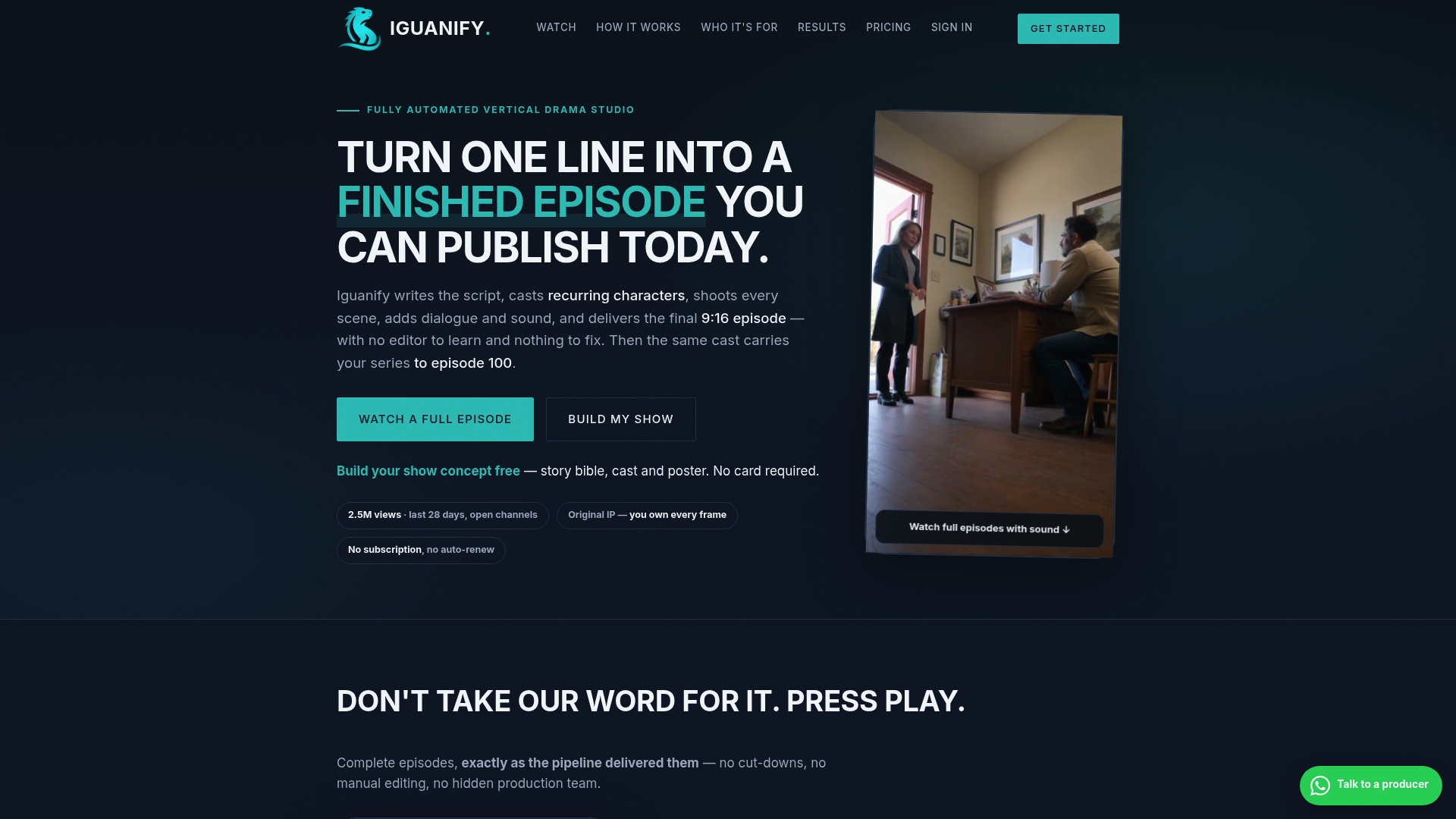
A simple path looks like this: drop your season’s first episode synopsis in as a script, let us generate the recurring cast once, then produce each following episode from your bible’s remaining synopses with that same cast locked in. A standard episode is available as a one-time purchase, so a five-episode season built straight from your bible’s synopsis section is a fixed, predictable cost you can plan before you write a single scene. You own every episode outright, ready to publish on TikTok, YouTube, or wherever your bible said the show belongs.
FAQ
What is a show bible used for?
A show bible is used to pitch a series to producers or networks and to guide the writers’ room and production team once a show is in development. It covers the premise, characters, tone, and episode structure in one reference document, according to Amazon Studios’ format guidance.
How long should a show bible be?
A selling show bible generally runs 15 to 25 pages, based on Amazon Studios’ guidance, though short-form and vertical formats can run shorter while keeping the same core sections. Length should scale with genre complexity, not with how much backstory a writer wants to include.
How many episode synopses should a show bible include?
Most guidance favors a handful of strong, structural episode outlines over a long list of thin summaries. StudioBinder recommends quality over quantity, typically five solid outlines that demonstrate the series engine in action.
Can I turn my show bible directly into produced episodes?
Yes, once your bible’s episode synopses and character bios are locked, they can map directly to scripts and production. We offer a standard episode production option as a one-time purchase, with recurring cast continuity carried automatically across your season.
Do I need to copyright my show bible before pitching it?
Your bible is protected the moment you write it, but registering it with the Writers Guild or the US Copyright Office before wide distribution gives you clearer legal footing. WGA East’s guidance treats the bible as a format document worth protecting at each distinct stage of its development.
Sources
- Amazon Studios series bible format guidance
- Tablets of Stone or DNA? TV series bibles (Macdonald)
- Final Draft: Building your TV series bible
- StudioBinder: What is a show bible (examples & template)
- Backstage: How to make a TV pitch bible