 IGUANIFY
Series Bible Examples Every TV Writer Should Study

Start here: open the Adventure Time series presentation on archive.org, then pull up the 101 Dalmatian Street pitch bible in a second tab. Those two files alone will show you more about how a real bible works than most how-to articles ever could. Before you read another word of guidance, spend ten minutes with those PDFs. Copy the one-page show overview from each into your own notes. That single action is worth more than any template you can download.
The six series bible examples below are the ones writers and development executives actually reference. Each entry tells you what the file is, where to find it, and the one thing it teaches that you cannot learn from a blank template.
Key Takeaways
The most useful series bible examples are the ones you can open, read in full, and copy a specific structural decision from — not the ones cited most often in theory.
| Point | Details |
|---|---|
| Open these files first | Adventure Time (archive.org) and 101 Dalmatian Street (archive.org) are the highest-value free downloads for studying pitch bible structure. |
| Design is a pitch argument | Match your bible’s visual style to your show’s tone before sharing it; plain text undersells the project’s voice. |
| Write the bible before the pilot | Locking tone, character dynamics, and audience before production makes both the pitch and the writers’ room more coherent. |
| Keep it short and assign one owner | A 15-page bible that stays current beats a 50-page document nobody updates after the pilot. |
| Iguanify bridges bible to production | Iguanify generates a series bible, consistent cast, and finished vertical episodes from a single show concept, with free concept generation before purchase. |
Table of Contents
- The best series bible examples you can read right now
- Where to find and download these bibles responsibly
- What a series bible actually is and how to use one
- A compact series bible template you can copy right now
- Why shorter bibles get used and longer ones get ignored
- Iguanify turns your series bible into produced episodes
- Sources
The best series bible examples you can read right now
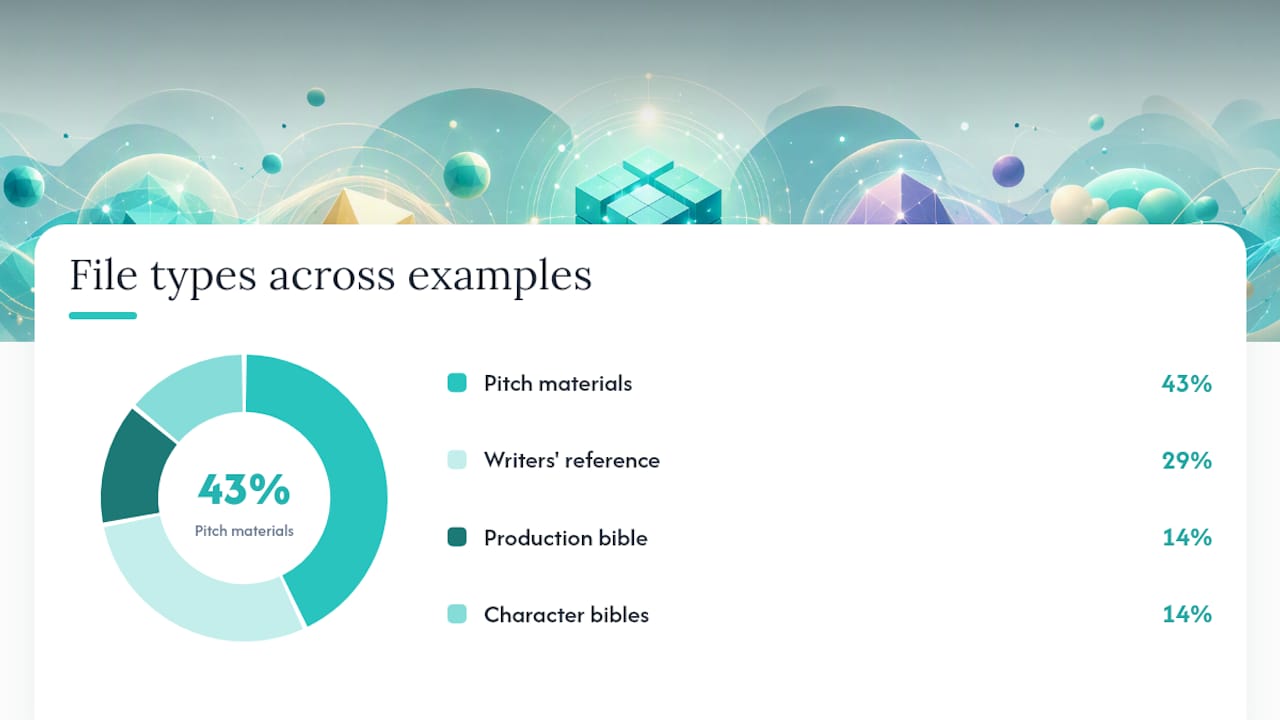
| Example | File type | Where to read/download | One lesson to copy |
|---|---|---|---|
| Adventure Time | Series presentation (pitch) | Archive | Design-forward tone: every page communicates the show’s voice visually |
| 101 Dalmatian Street | Pitch bible (Disney TVA) | Archive | Character roster with clear role differentiation across a large cast |
| Aeon Flux | Production/series bible | Archive | Pairing a visual design grid with story-world rules in one document |
| Breaking Bad | Character/arc bible materials | Referenced in Automateed’s series bible guide | Arc-first structure: character transformation drives every season beat |
| Star Trek: The Next Generation | Writers’ guide / staff bible | Widely cited; search “TNG writers guide PDF” for archived copies | Tone codification: explicit rules for what the show will and will not do |
| Freaks and Geeks | Pitch/series materials | Referenced in multiple writers’ resources | Grounded character specificity over genre mechanics |
| Scrubs | Writers’ room reference materials | Referenced in multiple writers’ resources | Tonal balance: comedy and emotional sincerity documented side by side |
Adventure Time: design as argument
The Adventure Time series presentation is the single most-cited example of a design-forward pitch bible. Pendleton Ward’s document does not just describe the show’s tone. It performs it. The typography, color palette, and page layout all read as Ooo before a word of story is processed. That is the lesson: your bible’s visual choices are a pitch argument, not decoration. If a development executive flips through your document and cannot feel the show’s register within three pages, the design is failing you.
101 Dalmatian Street: managing a large cast
The Disney TVA pitch bible for 101 Dalmatian Street is a practical study in character economy. The show carries a large recurring cast, and the bible handles that by giving each character a tight role label, a visual silhouette, and a one-line relationship note. Nothing is wasted. If your show has more than five recurring characters, this is the file to open first. It shows you how to make a roster scannable without flattening anyone into a type.

Aeon Flux: world rules and visual grammar together
The Aeon Flux series bible on archive.org pairs story-world rules with visual design in a way most bibles separate. The production bible lays out the show’s physical and political geography alongside its aesthetic logic, so a new writer understands both what the world allows and what it looks like. That pairing is worth borrowing directly.

Breaking Bad: arc-first character construction
Breaking Bad’s bible materials are frequently cited as the clearest example of arc-first character writing. Walter White’s transformation is not a surprise that emerges from plot. It is the premise, stated plainly at the document level. Every season beat exists to execute a character arc that was mapped before the pilot was shot. If your show is character-driven, this is the structural model to study: state the transformation first, then build the plot around it.
Star Trek: The Next Generation: codifying tone
The TNG writers’ guide is one of the most explicit tone documents in television history. It tells staff writers not just what the show is, but what it refuses to be: no interpersonal conflict among the main crew, no cynicism, no cheap jeopardy. That negative space is as useful as any positive description. When you write your own tone section, try listing what your show will never do alongside what it will.
Freaks and Geeks and Scrubs: specificity and tonal balance
Paul Feig’s Freaks and Geeks materials demonstrate that character specificity beats genre mechanics every time. The show’s bible grounds its characters in precise social detail rather than archetype. Scrubs takes a different angle: its reference materials document how the show holds comedy and emotional weight simultaneously, which is one of the harder tonal balances to maintain across a multi-season run. Both are worth reading if your show lives in mixed-register territory.
Where to find and download these bibles responsibly
The most reliable public repository for TV pitch bibles and series presentations is archive.org. It hosts Adventure Time, 101 Dalmatian Street, Aeon Flux, and dozens of other cartoon and live-action pitch packets. Most files are uploaded as PDFs or image scans.
A few practical notes before you download:
- Verify the uploader and date. Archive.org entries vary in provenance. Check the upload date, the item description, and any linked source notes before treating a file as authoritative.
- Cross-reference with writer credits. If a bible claims authorship, confirm that name against public production credits (IMDb is a reasonable starting point). Misattributed files circulate.
- Use for study, not republication. These documents are protected by copyright. Downloading for personal reference and craft study is standard practice in the industry. Reproducing, selling, or distributing them is not.
- Writers’ personal sites and university press archives occasionally host official or authorized bible excerpts. Carole Kirschner’s blog and StudioBinder both provide annotated examples and free series bible templates that are explicitly cleared for use.
- Check file metadata. PDF metadata sometimes carries the original creation date and software, which helps confirm authenticity for older documents.
If you want to sell your own bible template or pitch packet as a digital product, platforms like Payhip for screenplays let you distribute downloadable files directly to buyers without a middleman.
What a series bible actually is and how to use one
A series bible is a comprehensive reference document that covers a show’s characters, plots, settings, themes, and tone. It serves two distinct purposes: a pitch tool for development executives and a living blueprint for the writers’ room. Those two roles pull in slightly different directions, and understanding that tension is what separates a useful bible from a bloated one.
For a pitch, the bible needs to answer one question fast: why does this show have legs? Executives are not reading for completeness. They want to see long-range arcs, convincing character evolution, and evidence that the premise can sustain multiple seasons. Your one-paragraph show hook, your season arc sketch, and your character transformation maps are doing the most work in that context.
For the writers’ room, the bible is a continuity tool. It answers questions like: what does this character know at the end of episode four? What was established as canon in the pilot that we cannot contradict? Writing the bible before the pilot locks tone, character dynamics, and audience before you are under production pressure, which makes both the pitch and the eventual room work more coherent.
The practical split: keep a lean, designed pitch version (10–15 pages) and a more detailed working version that grows with the show. They share the same core sections but serve different readers.
A compact series bible template you can copy right now
Use this structure as your starting point. Adapt the depth to your show’s needs.
One-page master series overview
- Title and logline (one sentence)
- Premise (two to three sentences: world, central conflict, stakes)
- Tone (three to five adjectives, then one sentence explaining the register)
- Central conflict (what the show is really about beneath the plot)
- Planned season count and rough arc per season
- Target audience and platform
Character sheet (one per major character)
- Name, role, and function in the ensemble
- Arc summary (where they start, where they end)
- Key facts: age, background, defining trait
- Aliases or alternate identities if relevant
- Relationship map: two to three key relationships and the tension in each
- Per-character knowledge field: what this character knows that others do not
Season and episode grid
- Season arc in two sentences
- Six to ten episode bullets: each one a single sentence covering the episode’s plot function and the character beat it advances
- Retcon/log field: a running note of any established facts changed after a script pass, with the episode number and reason
Maintenance checklist
- Pick the sections from your example bibles that match your show’s complexity. A contained six-episode limited series needs far less than a 100-episode procedural.
- Purge “maybe-canon.” If a fact has not appeared on screen or in a locked script, mark it as provisional, not canon.
- Add provenance tags to every established fact: episode number, scene, and draft version.
- Assign a single update owner. One person is responsible for revising the bible after each script pass. Shared ownership means no ownership.
- Schedule a 15-minute review after every script lock to catch continuity drift before it compounds.
Building from zero works best with lightweight, interlinked templates: one file per character, one for locations, one for the event timeline. A Markdown or Notion workflow scales better than a single long document once the show grows past one season.
Pro Tip: Match your bible’s visual design to your show’s tone before you send it to anyone. A horror series bible in a clean sans-serif with generous white space sends the wrong signal. A comedy bible that looks like a legal brief does the same. Design is part of the pitch argument. Spend an hour on typography and color before you share the document.
For writers building a vertical drama series, the episode grid section is especially worth investing in early. Short-form episodic content lives or dies on arc clarity across brief runtimes.
Why shorter bibles get used and longer ones get ignored
The most common mistake writers make with a series bible is treating it as a place to store every idea they have ever had about the show. The result is a 60-page document that nobody reads after the first week of production.
A well-structured bible covers characters with relationship maps, locations, timeline, world rules, plot threads, per-character knowledge, and a retcon log. That is already a substantial document. The question is not what to add. It is what to leave out.
The bibles that actually get used in writers’ rooms share two qualities. First, they are short enough that a new writer can read the whole thing in under an hour. Second, they have a single owner who keeps them current. A 15-page bible that is accurate after episode eight is worth more than a 50-page bible that stopped being updated after the pilot. Assign the update role before production starts, not after the first continuity error surfaces.
The second practical takeaway: design for digestibility, not comprehensiveness. Use headers, short paragraphs, and visual hierarchy so a writer under deadline can find the answer to a continuity question in 30 seconds. The Adventure Time presentation and the TNG writers’ guide both do this well, in very different visual registers. Neither buries its most important information in dense prose.
Iguanify turns your series bible into produced episodes
You have the bible. The harder part, for most solo creators, is getting from that document to actual footage. That is the gap Iguanify closes.
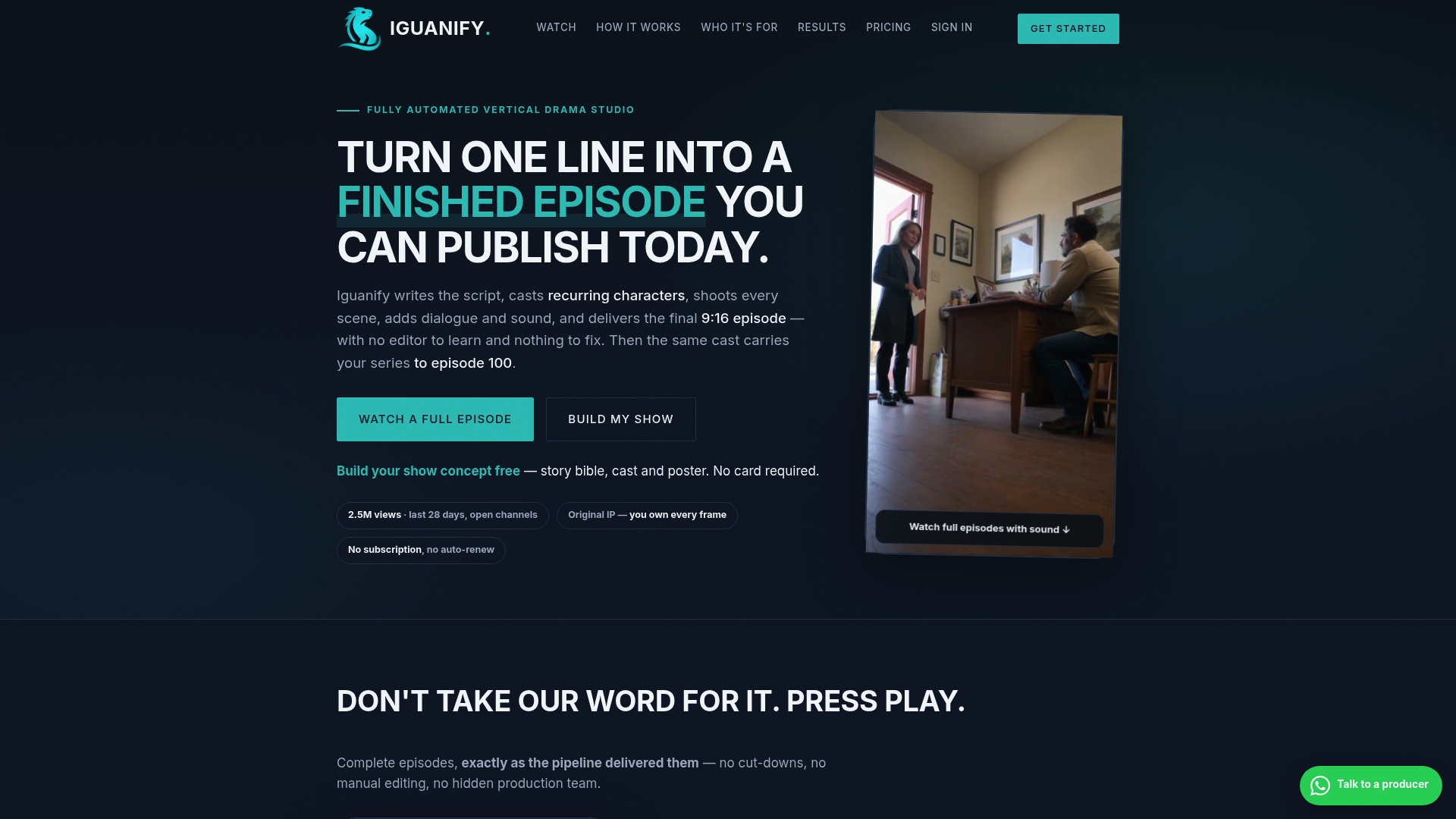
Iguanify automates the full production pipeline for serialized episodic content. Feed it your show concept and it generates a series bible, a recurring cast with consistent character visuals across every episode, dialogue, sound, and finished vertical episodes ready for TikTok, YouTube, or Instagram. No editing suite, no production team, no continuity headaches between episodes. You own the IP outright.
Three specific use cases where it fits the workflow described in this article: generating a pitch packet from your one-page show overview, exporting a writers’ room continuity reference from your character and arc data, and producing a short pilot episode directly from your bible to show alongside the pitch document. You can generate your show concept and cast for free before committing to a production credit.
Start with the AI Micro Drama Generator to see how your bible translates into produced episodes, or visit Iguanify to explore the full platform.
Sources
- What is a Show Bible — Examples and FREE Template
- What is a series bible? Overview, examples and why it’s important for all writers
- Series bible guide (blog)
- What Goes in a Series Bible (And What to Leave Out) — PlotLens Blog
- Building a Series Bible from Zero - Chloe Walton
- Archive
Always verify file metadata and author attribution when downloading from archive repositories. An upload date and a credited source are the two fastest authenticity checks.