 IGUANIFY
Solo Creators: Ship Social Media Drama Scripts in One Afternoon

Social media drama scripts are short, serialized episode scripts, typically 60 to 180 seconds long, built around a cliffhanger and formatted for vertical video. The fastest way to publish one is to pull a micro-drama template, plug in your premise, and run it through an automated production pipeline like Iguanify instead of hand-editing every frame yourself. Leonard, who covers this format for Iguanify, has watched that shortcut turn one-line ideas into finished episodes in a single afternoon.
TL;DR:
- Automated tools can produce a full, continuity-consistent episode from a single premise, but storyline strength remains crucial for engagement.
- Episodes should end on a cliffhanger mid-tension, with six to ten episodes in a season, to maximize viewer retention and algorithmic promotion.
- Publishing cadence of daily or every-other-day releases across platforms prevents audience fatigue and encourages habitual viewing.
- Keeping character design, voice, and look settings locked from the start ensures visual and narrative consistency across episodes, avoiding viewer trust issues.
- Creators should verify metadata, thumbnails, and hooks before publishing, and be aware of licensing restrictions around music, likenesses, and AI-generated content rights.
Table of Contents
- What Makes a Social Media Drama Script Different From a Regular Video Script?
- Script Templates You Can Use Today
- How Do You Structure a Season So Viewers Keep Coming Back?
- From One-Line Premise to Published Episode: The Production Workflow
- When and How Should You Publish Each Episode?
- Pre-Publish Checklist for Every Episode
- What Legal and Copyright Issues Come Up in Drama Scripts?
- Writing Characters and Dialogue That Work in 90 Seconds
- A Straight Answer on Where This Format Is Headed
- Turn a Premise Into a Finished Episode Without a Production Team
- Sources
- FAQ
What Makes a Social Media Drama Script Different From a Regular Video Script?
A micro-drama script is written for a phone screen and a short attention window, which means every beat has to earn the next three seconds. Episodes typically run 60 to 180 seconds, mobile-first by design, with a cliffhanger doing the heavy lifting instead of a wide plot.
That structure isn’t just a stylistic choice. Platforms increasingly reward serialized content because it boosts dwell time and turns casual viewers into repeat viewers, which is exactly what the recommendation algorithms are built to detect and amplify. Branded micro-dramas have already shown measurable engagement and retention gains on platforms where a single standalone video would have quietly disappeared.
Episodic scripts beat single-shot content when:
- You want a viewer to come back tomorrow, not just watch once and scroll on
- You’re building a recognizable cast or world that gets more valuable with each installment
- Your niche rewards binge behavior, like relationship drama, workplace conflict, or reveal-driven storylines
- You need the algorithm to keep surfacing you, since a strong series creates repeat impressions instead of one-off luck
Script Templates You Can Use Today
You don’t need a writers’ room to produce a tight episode. Three formats cover almost every situation a solo creator or small team will run into.
- The 60-second, four-beat script. Hook (0 to 5 seconds): a line or visual that states the conflict instantly. Complication (5 to 25 seconds): the stakes get worse or more personal. Reveal (25 to 45 seconds): new information flips the audience’s understanding. Cliffhanger (45 to 60 seconds): a question left open on purpose, timed to land right as the video would naturally end.
- The 90 to 120 second, six-beat script. Add a secondary character reaction and a mid-episode complication between the reveal and the cliffhanger. Dialogue density should stay light. Aim for short exchanges, not monologues, since text on a moving phone screen reads slower than spoken lines.
- The series-seed template. Map your core conflict across 7 to 10 episodes before you write episode one. Each episode should resolve a small question while opening a bigger one, so episode 3’s cliffhanger is answered in episode 4 but seeds a new mystery that doesn’t pay off until episode 7.
Format every script for a 9:16 frame and write dialogue short enough to auto-caption cleanly. Our short drama script format guide breaks down exact line lengths that hold up on a six-inch screen.
Pro Tip: Write your cliffhanger line first, then build backward. If you can’t state the unanswered question in one sentence, the episode’s ending is too muddy to hook a scroller.
How Do You Structure a Season So Viewers Keep Coming Back?
A satisfying micro-drama season runs on a three-phase arc: setup episodes that establish the world and cast, escalation episodes that raise stakes and introduce complications, and a resolution stretch that pays off the tension you’ve been building. Best-practice data points to 6 to 8 episodes as the sweet spot between building real anticipation and losing viewers to fatigue.
Cliffhangers work because most people discover these series through their feed, not by searching for them. Analysis of the format shows the majority of viewers stumble onto micro-dramas through algorithmic recommendations rather than deliberate search, so your episode has to hook someone who has zero context in the first three seconds.
A few things to keep consistent across the arc:
- End every episode mid-tension, never on a clean resolution, until the finale
- Reserve your biggest emotional beat for episode 6 or 7, not episode 2
- Adapt pacing slightly per platform: TikTok viewers expect a faster hook than YouTube Shorts audiences, while Instagram Reels tends to reward a slightly warmer opening frame before the conflict lands
- Keep the same aspect ratio and caption style across all three platforms so the series feels like one show, not three different products
From One-Line Premise to Published Episode: The Production Workflow
Writing the script is the easy part. Turning it into a consistent, watchable episode without a production team is where most solo creators get stuck, usually on continuity: a character’s hair color shifts, a voice changes tone, or a set detail disappears between episodes.
The workflow that avoids that problem looks like this:
- Start with a one-line premise and let your script template expand it into full episode beats.
- Lock your cast, wardrobe, and voice settings once, at the start of the season, not episode by episode.
- Feed the script into an automated rendering pipeline that keeps those character settings consistent across every episode.
- Export vertical masters sized for TikTok, Reels, and Shorts simultaneously.
- Generate captions and metadata (titles, descriptions, hashtags) as part of the same pass, not as an afterthought.
Automated pipelines matter here because AI tools are compressing production cycles and handling the repetitive parts, like subtitle generation and format transcoding, that used to require a full editing pass per episode. Iguanify builds its process around exactly this: a single line of script produces a full episode while keeping the same cast, voices, and look intact from episode one through episode ten, which is the continuity problem that trips up most generic AI video tools.
Keep an asset checklist so you don’t lose rights or repurposing options later: save your original script drafts, your character reference sheets, your exported masters at full resolution, and a record of which platform each cut was optimized for. Creators who skip this step end up re-generating assets from scratch when a brand deal or a repost opportunity shows up six months later.
Pro Tip: Lock your series bible, cast, and voice settings before you write episode two. Changing a character’s look mid-season is the single fastest way to break viewer trust in a serialized format.
When and How Should You Publish Each Episode?
Cadence is not a minor detail. It’s the difference between a series people wait for and a feed of disconnected clips. For a 7 to 10 episode arc, daily or every-other-day releases work best, matching the recommendation that serialization converts casual scrollers into habitual viewers when paired with a schedule people can rely on.
A workable cadence and engagement plan includes:
- Staggering cross-posts by a few hours across TikTok, Reels, and Shorts so you’re not cannibalizing your own first-view spike on one platform while the algorithm is still deciding whether to push the episode
- Pinning your most recent episode and linking the previous one in your bio or comments so new viewers can binge in order
- Using comment questions from episode 3 to shape a small twist in episode 5, which keeps your audience feeling like part of the writing process
- Dropping a short teaser or behind-the-scenes clip on off-days to hold attention between full episodes
Recurring characters and a steady release rhythm are what let creators build predictable appointment viewing instead of chasing one viral fluke after another. Our Twitch engagement guide from Happy Milo covers similar publishing-routine tactics if you’re also streaming behind the scenes of your series.
Pre-Publish Checklist for Every Episode
Run through this before any episode goes live:
- Confirm the export is a true vertical frame, not a cropped horizontal file, and that captions are burned in or auto-generated correctly.
- Check that your thumbnail or poster frame actually represents the cliffhanger, not a random still.
- Verify metadata: title, description, and hashtag set match your series naming convention.
- Rewatch the first three seconds cold. If the hook doesn’t land without context, rewrite it.
- Confirm the cliffhanger sits in the final few seconds, not buried mid-episode.
- Cross-check character continuity against your series bible: hair, wardrobe, voice.
- Schedule the post and confirm cross-posting settings are staggered, not simultaneous, across platforms.
What Legal and Copyright Issues Come Up in Drama Scripts?
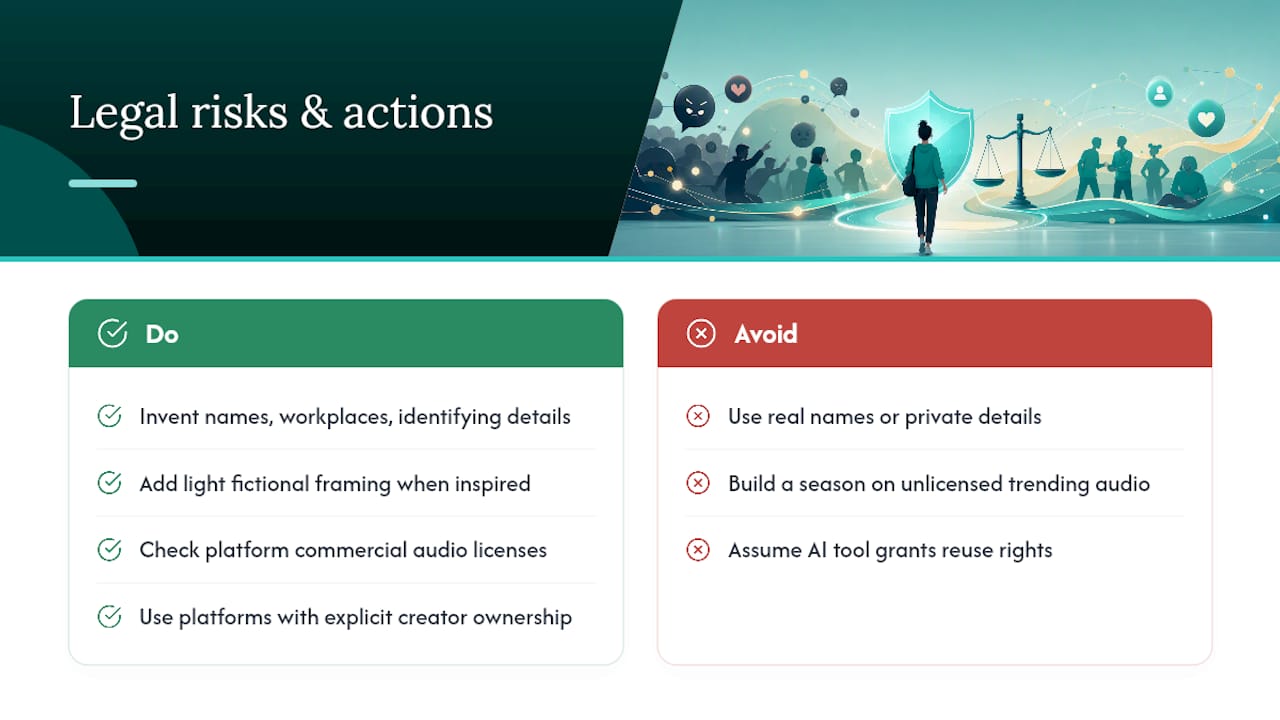
Original scripts you write and produce yourself are yours, but a few gray areas trip up creators regularly. Using real people’s names, likenesses, or private details in a “drama” storyline, even a fictionalized one, can expose you to defamation or right-of-publicity claims if viewers reasonably believe it depicts a real person. Keep character names, workplaces, and identifying details clearly invented, and add a light fictional framing if your premise is inspired by a real trend or news story.
Music and sound effects are the other common trap. A trending audio clip that’s fine for a 15-second meme post can carry different licensing terms when it’s the backbone of a serialized drama you’re monetizing. Check platform-specific commercial-use licenses before building a season around someone else’s audio.
Ownership of the finished episode matters just as much as the script itself. Many AI video tools bury usage restrictions in their terms, limiting how or where you can repost generated footage. This is one reason creators increasingly favor platforms where the production agreement is explicit about creator ownership: Iguanify’s model gives users full rights to the episodes they produce, so a season built today can be repurposed, licensed, or sold later without renegotiating anything.
Finally, if you’re building a faceless channel with recurring AI-generated characters, document your character designs and series bible as your own original work. That paper trail matters if a similar-looking series appears elsewhere and you need to establish that your cast came first.
Writing Characters and Dialogue That Work in 90 Seconds
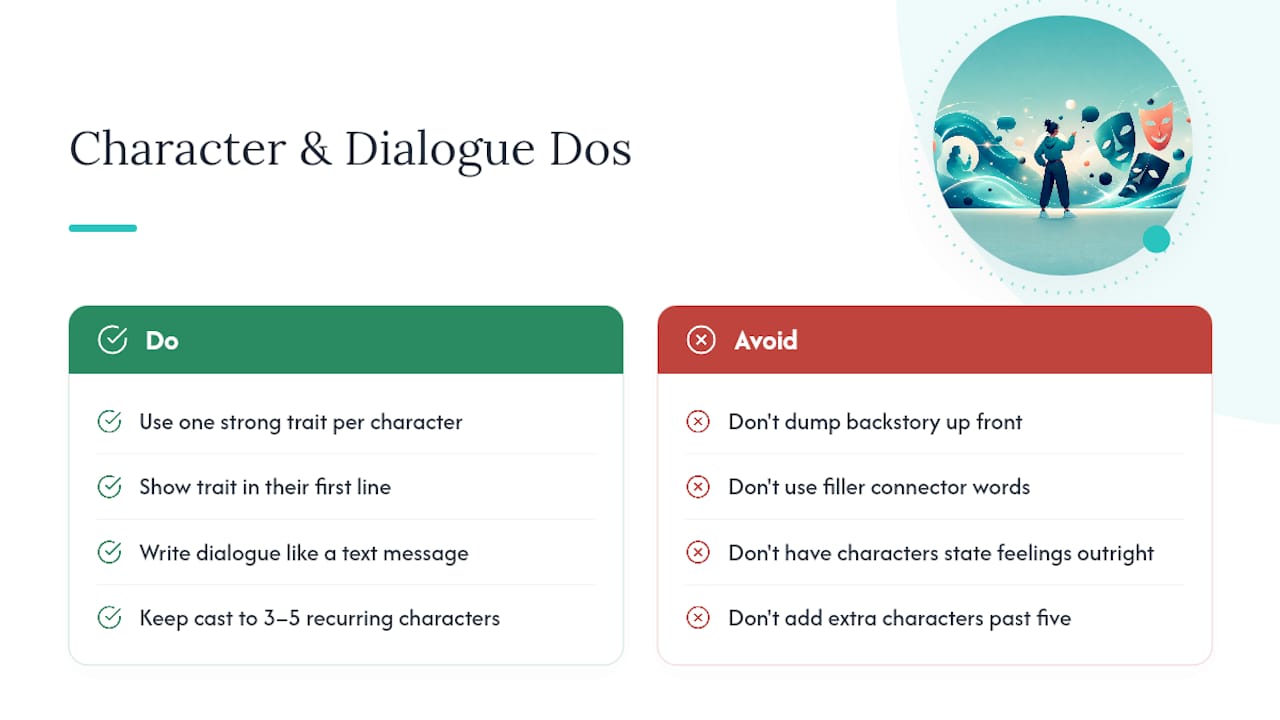
Short-format drama has no room for a slow character introduction, so lean on one strong trait per character instead of a backstory dump. A jealous coworker, a secretive sibling, a landlord with a grudge: the trait should be visible in the first line they speak, not explained in narration.
Dialogue should sound like something a person would actually text a friend, not a script line. Cut connector words, cut throat-clearing (“well, you know”), and let subtext carry the tension instead of having characters state their feelings outright. If a character says “I’m so angry right now,” you’ve told the audience what to feel instead of letting the delivery show it.
Keep your cast small, ideally three to five recurring characters across the season. Sprout Social’s guidance on building content series backs this up: a smaller, consistent cast is easier for viewers to track episode to episode and easier for you to keep visually consistent across renders. Every new character you add past that number dilutes screen time and makes continuity harder to manage.
Visual staging does a lot of the dialogue’s job for you in short-format video. A tight framing choice, a meaningful glance, or a prop placed in the background can replace a full line of exposition. If you want a deeper look at blocking and camera choices that reinforce a scene without extra dialogue, visual storytelling techniques from Video Productions Switzerland walks through framing decisions that translate well to vertical drama. Pull plot and character ideas from our list of short drama concepts built for 60 to 90 second episodes if you’re stuck on where to start.
A Straight Answer on Where This Format Is Headed
Automation didn’t remove the craft from writing drama scripts. It removed the production bottleneck that used to keep good scripts from ever becoming finished episodes. The creators doing this well aren’t the ones with the fanciest cameras. They’re the ones treating each episode as one piece of a season, not a standalone bet, and writing cliffhangers with real discipline instead of vague teasers.
The honest caveat: automation handles continuity and rendering, not your storytelling instincts. A weak premise still produces a weak series no matter how consistent the cast looks, and algorithm behavior shifts often enough that a cadence working today may need adjusting in a few months. Overextending past 8 to 10 episodes before you’ve confirmed an audience wants more is the most common mistake creators make with this format.
— Leonard
Turn a Premise Into a Finished Episode Without a Production Team
Some platforms serve as alternatives to hiring an editor or production crew for serialized short-form drama: you write a one-line premise, and the service produces a finished, continuity-consistent episode with cast, voices, and look intact, without you touching a timeline.
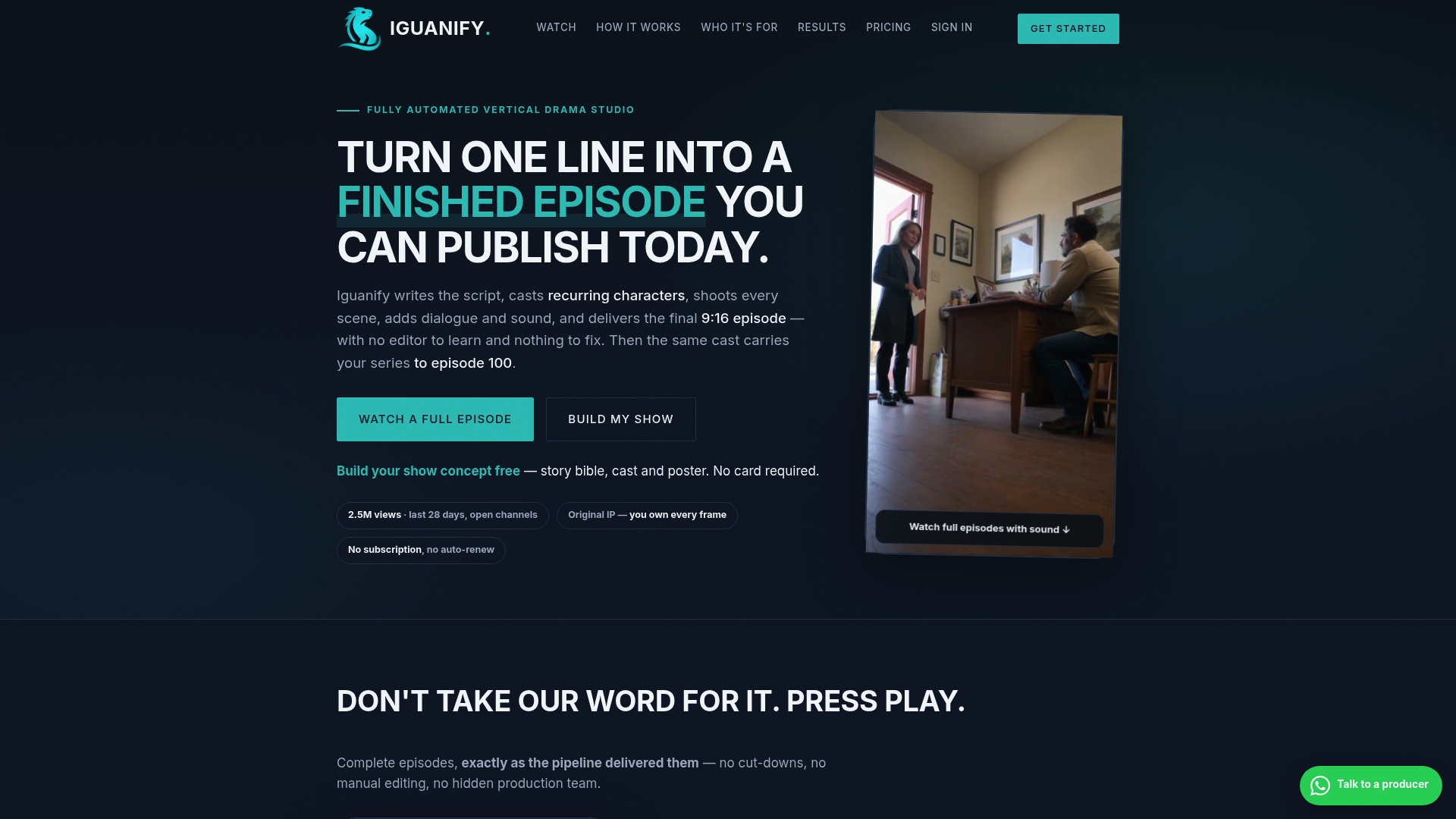
That continuity piece is the part most AI video tools quietly fail at, and it’s the reason creators lose viewers between episode 2 and episode 3 when a character suddenly looks or sounds different. Certain platforms maintain series bible consistency across the season and grant users ownership of produced episodes, ready for export to TikTok, YouTube, or Instagram without extra editing. If you want the full production system behind faceless episodic channels, our Faceless Drama Channel Playbook walks through the setup end to end. When you’re ready to see it work on your own premise, try the AI Drama Generator or explore self-serve production credits through the Iguana Engine and produce your first episode this week.
Sources
- Short-form video series | Deloitte Insights
- Boom Scroll — March 2026 social media updates | FINN Partners
- The rise of branded microdrama | CampaignLive
FAQ
What Is the Ideal Length for a Social Media Drama Script?
Most episodes run 60 to 180 seconds, with 60 seconds working best for a tight four-beat hook-to-cliffhanger structure and 90 to 120 seconds allowing a secondary character beat.
How Many Episodes Should a Micro-Drama Season Have?
A 6 to 8 episode arc released daily or every other day balances viewer anticipation against fatigue better than longer seasons.
Can I Use AI to Produce a Full Episode From a Script?
Yes. Platforms like Iguanify convert a single-line premise into a rendered episode while keeping cast, voice, and wardrobe consistent across the whole season, removing the manual editing step most creators get stuck on.
Do I Own the Rights to Episodes Produced With AI Tools?
It depends on the platform’s terms. Iguanify gives creators full ownership of every episode they produce, which matters if you plan to repurpose or license the series later.
Where Do Most Viewers Discover Serialized Drama Content?
Mostly through their feed. Research on the format found most viewers encounter micro-dramas through algorithmic recommendations rather than active search, which is why the first three seconds of each episode carry so much weight.