 IGUANIFY
4 Series Metadata Fixes for YouTube and TikTok Creators

Most series lose viewers to a search box, not a bad episode. If you fix four things, consistent series branding, a title template that survives truncation, a front-loaded description, and VideoObject structured data on your episode pages, you capture the bulk of the discoverability gain available to a serialized creator. YouTube and TikTok both reward series that behave predictably: same look, same title logic, same keyword signals in every layer. Follow the checklist below, then adjust per platform and measure what actually happens to watch time.
TL;DR:
- Consistently use a title formula with the key phrase first and episode number last, avoiding fillers that get truncated on mobile feeds.
- Front-load description lines with series name, synopsis, and keywords to improve indexing and viewer preview engagement.
- On YouTube, set up episodes as official Shows with structured VideoObject data and a unified series branding system to enhance discoverability.
- For TikTok, embed target keywords in spoken audio, on-screen text, and captions within the first few seconds, focusing on short captions and behavior signals.
- Automate metadata workflows with tools like Iguanify to ensure series branding and structure stay consistent across episodes, reducing manual effort.
Table of Contents
- Series Metadata for Discovery: The Core Checklist
- YouTube Vs. TikTok: Do This, Not That
- A Repeatable Workflow For Metadata You Don’t Have To Rebuild Every Week
- What To Measure, And How Fast To Expect Results
- Keeping Series Metadata Accurate As Your Show Grows
- Getting Found Off YouTube and TikTok Too
- An Editorial Take On What Actually Compounds
- Let Iguanify Handle The Metadata Continuity You Don’t Have Time For
- Official Docs Worth Bookmarking
- Sources
- FAQ
Series Metadata for Discovery: The Core Checklist
Literary series metadata (the fields that identify a title, season, and episode number) works the same way whether you’re cataloging a novel series or a 90-second vertical drama. The fields just move to different places. Here’s the order to fix them in, starting with what platforms weight most.
Episode title. Put the searchable phrase first and the episode number last. “Cheating Husband Returns Ep. 4” beats “Episode 4: Cheating Husband Returns” because most feeds truncate titles on mobile, and you want the meaningful words visible before the cut. Skip filler like “Watch Now” or “Part 4 of the Story,” which just eats space YouTube could use to understand what the video is about.
Episode description. The first one to two lines are the only part most viewers see before tapping “Show more,” so that’s where the series name, a one-line synopsis, and your primary keyword phrase belong. YouTube explicitly recommends front-loading the most important keywords in the opening lines since that’s what indexing and viewer preview both read first. Save cast notes, hashtags, and links for below the fold.
Series-level fields. Every series needs a clean name used identically everywhere, consistent season and episode numbering, a canonical poster in 16:9 for YouTube’s show format, and a lightweight series bible listing characters and genre tags. These aren’t bureaucratic overhead. They’re what tells the recommendation algorithm this cluster of videos belongs together.
Thumbnails. Keep a repeatable color and graphic system so a scrolling viewer recognizes your series in a fraction of a second. Text overlays need to survive a 5 inch phone screen, not just look good on your desktop preview.
Tags, captions, and on-screen text. Align what’s spoken, what’s typed on screen, and what’s in your captions. That triple alignment is how metadata for series identification actually gets indexed, not just filed under hashtags.
Pro Tip: Write your episode title template once, as an actual formula (Hook + Series Name + Ep. #), and paste it into every new upload. A template beats memory, and it’s the single fastest fix for inconsistent series metadata.

YouTube Vs. TikTok: Do This, Not That
The two platforms read metadata differently, and treating them identically is one of the most common ways creators sabotage their own series.
On YouTube, set up your series as an official Show, which lets you group episodes with season banners and consistent artwork instead of relying on a loose playlist. YouTube recommends 16:9 artwork up to 3840×2160 for show banners, and organizing this way makes you eligible for “recommended shows” and “continue watching” surfaces that a random upload never sees. Beyond the Show setup, add VideoObject structured data to the hosting page for each episode, on both mobile and desktop versions, since Google’s video SEO guidance treats that markup as how search engines understand what a given video actually is.
On TikTok, the calculus flips, and adopting practical tips on TikTok content and discoverability can help creators align creative hooks and metadata effectively. There’s no structured data layer to lean on, so the platform reads your spoken audio, on-screen text, and caption as three separate signals it cross-references. Put your target phrase in all three within the first few seconds, not buried at the end. Keep captions around 150 to 300 characters, treat hashtags as supporting labels rather than your primary keyword strategy, and lean on watch-through behavior, since TikTok’s own explanation of its recommendation system makes clear that completion rate outweighs almost everything else.

Do a mobile-first check before you publish anywhere. Structured data that only exists on your desktop page can get missed entirely, since Google’s mobile-first indexing guidance warns that markup absent from the mobile version doesn’t count. Preview every thumbnail and caption overlay on an actual phone, not just your editing timeline.
Pro Tip: If you’re producing for both platforms from the same source footage, build your on-screen text and captions for TikTok’s mobile-first rendering, then adapt down for YouTube. It’s easier to trim a caption than to stretch one that was never designed for a 6 inch screen.
Common mistakes worth naming directly: inconsistent branding between episodes, keywords buried three sentences into a description nobody expands, hashtag-only strategies with no aligned spoken or on-screen text, and structured data that exists on desktop but never made it to mobile.
A Repeatable Workflow For Metadata You Don’t Have To Rebuild Every Week
Improving series discoverability isn’t a one-time cleanup. It’s a workflow you run every time you publish. Here’s the sequence that keeps it from becoming a weekly chore:
- Build the series bible once. Title, genre, three to five character descriptors, and your canonical thumbnail system. This single document is what every future episode’s metadata gets pulled from.
- Create your episode template. Lock in a title formula, a two-line description opener, a thumbnail spec (fonts, colors, safe zones), a file-naming rule, and a caption/transcript standard.
- Batch the production work. Generate thumbnails, captions, and metadata fields in a single sitting rather than episode by episode, then schedule uploads and confirm VideoObject JSON-LD is live on each episode page.
- Run a QA pass before anything goes live. Preview on mobile, run structured data through a validator, check that captions match spoken audio, and glance at TikTok Creator Search Insights if you have access, since it surfaces which search terms are already gaining traction around your niche.
- Automate what’s repeatable. Manually rebuilding metadata for every episode is where consistency breaks down fastest. A production platform like Iguanify handles this by generating episodes, and their attached metadata scaffolding, from a single script line while keeping characters and visual identity consistent across the whole run.
What To Measure, And How Fast To Expect Results
Views tell you almost nothing on their own. Watch time, completion rate, saves, and shares tell you whether the metadata that got someone to click also got them to stay, and YouTube’s own guidance on discovery treats those behavioral signals as the real ranking input, not the headline view count.
Check your indexing separately from your engagement:
- Confirm VideoObject markup actually renders in your page source, on mobile specifically.
- Pull YouTube’s “How viewers find your video” report to see which search terms are already surfacing your content.
- Check TikTok Creator Search Insights, where available, for weekly search volume around your series topic.
- Give any metadata change 48 to 72 hours before judging it. Recommendation systems need a few cycles to recalibrate.
Run controlled tests, one variable at a time: change the title, leave the thumbnail alone, wait a few days, then flip the next variable. When you compare results, weight retention over raw view counts. A title that pulls in curious but unengaged viewers can tank your average watch time and quietly hurt discoverability, even while the view number looks like a win.
Keeping Series Metadata Accurate As Your Show Grows
A series that runs twenty episodes needs different upkeep than one that just launched. Character names get added, subplot threads open, and your original series bible stops matching what’s actually on screen. Revisit it every five to ten episodes and update genre tags, character descriptors, and your synopsis template so new viewers aren’t reading a description written for episode one.
Renumbering is where most shows quietly break their own indexing. If you insert a bonus episode or reorder a season, update every affected title and description in the same sitting rather than letting old numbering linger next to new. Platforms and viewers both use that number as a sequencing cue, and a gap or duplicate erodes trust fast.
Treat your title and description templates as living documents, not one-time setup. If a phrase in your template stops performing (check your search-term reports periodically) swap it rather than assuming the original setup is permanent. Series that maintain a consistent content calendar tend to catch these drift points earlier, simply because someone is looking at the whole series on a fixed schedule instead of episode by episode.
Archive old thumbnail files and description templates when you update your branding system. Nothing tanks a series’s perceived consistency faster than half the catalog using an old font and half using the new one, with no clear line between them.
Getting Found Off YouTube and TikTok Too
Series discoverability doesn’t stop at the two platforms most creators default to. Instagram Reels, Facebook, and any site where you host episode pages directly all read metadata in their own way, and skipping them leaves indexable signal on the table.
If you host an episode page on your own site or a landing page, VideoObject structured data belongs there too, not just on YouTube. Google’s guidance on video SEO applies to any page hosting video content, and a series with a home base outside the two major platforms gets an extra shot at search visibility that a platform-only presence never sees.
For Instagram and Facebook, the same triple-alignment principle from TikTok carries over: captions, on-screen text, and audio should echo the same keyword phrase rather than three different descriptions written for three different feeds. Consistency across platforms also reinforces brand recognition, since a viewer who follows your series on TikTok and then stumbles across it on Instagram should recognize the same title logic and thumbnail system instantly.
Cross-posting the same episode without adapting captions to each platform’s character limits and audience expectations is a common miss. A caption tuned for TikTok’s fast scroll doesn’t always translate cleanly to Instagram’s audience, and a description built for YouTube’s expandable box reads oddly pasted into a Facebook post. Adjust the wrapper. Keep the core keyword signal identical.
An Editorial Take On What Actually Compounds
Here’s the uncomfortable part: most creators treat metadata as a one-time setup task instead of the compounding asset it actually is. A consistent title template and thumbnail system don’t just help episode four. They help episode forty, because platforms build a profile of your series over time, and inconsistency resets that profile with every irregular upload.
The pitfalls that hurt series the most aren’t exotic. They’re transcripts nobody bothered to align with spoken dialogue, episode numbering that drifts after a reshuffled season, and thumbnails that looked fine on a laptop but turn illegible on a phone screen. None of these require more talent to fix. They require a template enforced before publish, not after a series has already stalled.
If you want three quick wins this week: lock a title template, publish a season playlist immediately instead of leaving episodes scattered, and add VideoObject JSON-LD to every episode page you control. None of that requires new production skills. It requires discipline applied consistently, which is exactly where most solo creators run out of time before they run out of ideas.
— Leonard
Let Iguanify Handle The Metadata Continuity You Don’t Have Time For
Building the checklist above by hand, every episode, every week, is the part that burns out solo creators long before the storytelling does. Iguanify produces full episodes from a single line of script while keeping characters, tone, and visual identity consistent across the whole run, which means the series branding and title logic that usually breaks down after episode ten stays intact by default.
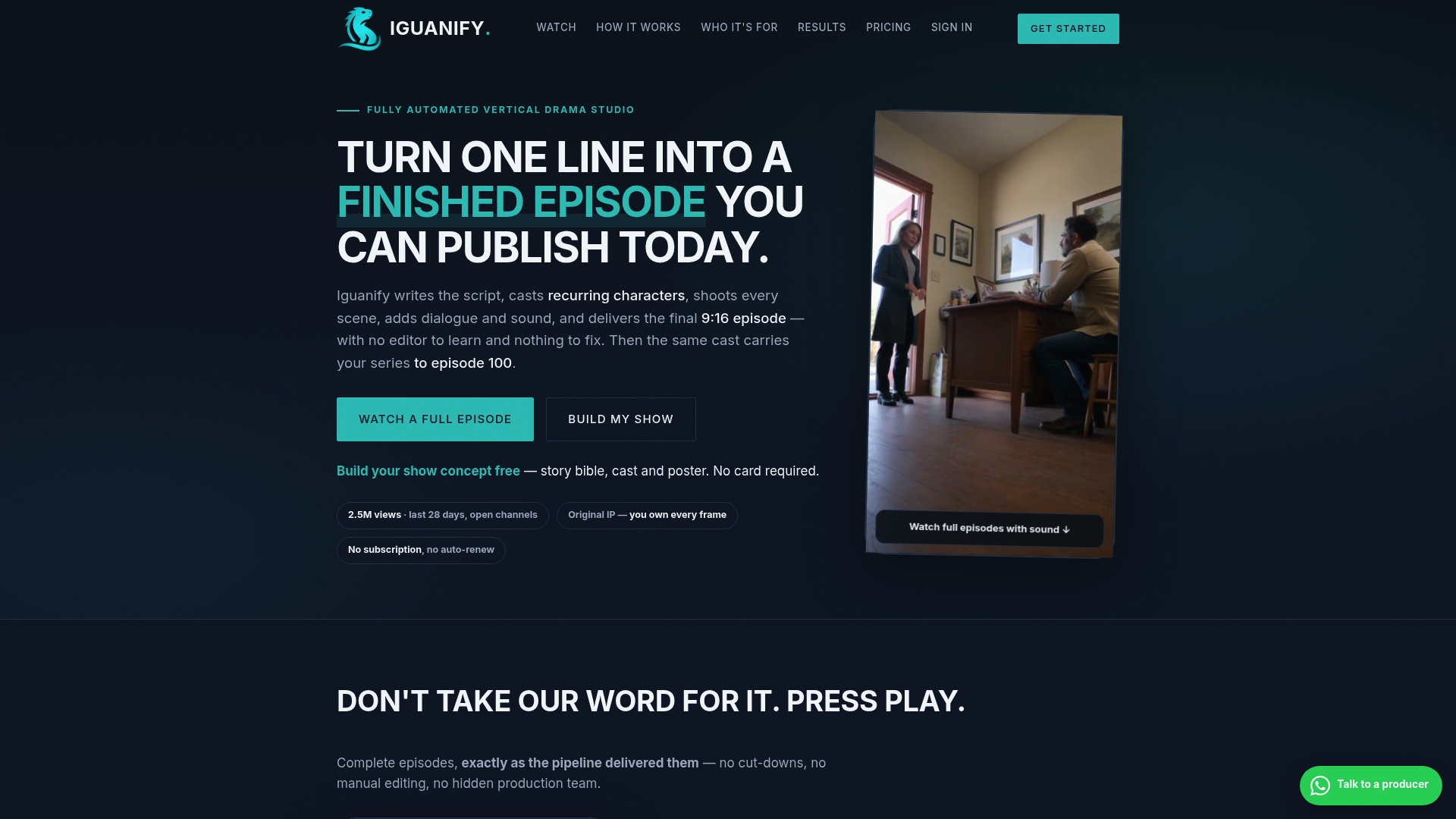
That consistency maps directly onto the metadata work covered above. Because Iguanify generates each episode with the same recurring cast and visual system, your thumbnail branding and title template stay uniform without you rebuilding a spec sheet every week, and captions come out aligned with the spoken dialogue instead of needing a separate pass to sync them. You also keep full ownership of every episode produced, so there’s no rights question hanging over content you’re trying to get indexed and recommended.
A standard episode or pilot runs $34.99 one-off, and larger Creator, Season, Studio, and Slate options are available for series that need more volume. If you’re ready to stop rebuilding metadata from scratch every episode, start with a pilot on the AI drama generator page and see how the continuity holds across your next few uploads.
Official Docs Worth Bookmarking
- YouTube’s guidance on organizing episodic content as Shows, including season/episode metadata and banner specs.
- Google Developers’ resources on VideoObject structured data for video SEO.
- Google’s mobile-first indexing guidance, critical for confirming your structured data actually gets crawled.
- YouTube’s help page on how viewers find your videos, covering description and keyword best practices.
- TikTok’s own explanation of its recommendation system, useful background for aligning captions, audio, and on-screen text.
Sources
- Use shows to organize episodic videos (YouTube Help)
- New resources for video SEO (Google Developers)
- Help viewers find your videos (YouTube Help)
- TikTok explains how its recommendation system works (TechCrunch)
FAQ
What Is Series Metadata For Discovery?
It’s the set of fields, titles, descriptions, thumbnails, tags, and structured data, that helps platforms and viewers identify episodes as part of the same series and recommend them together. Getting these fields consistent across episodes is what separates a discoverable series from a pile of disconnected uploads.
Do I Need VideoObject Schema If I Only Post On TikTok?
No. VideoObject structured data applies to pages you host yourself or on YouTube, since Google’s video SEO guidance is about search engine indexing rather than TikTok’s in-app feed. TikTok relies instead on captions, on-screen text, and spoken audio for its own indexing.
How Long Should An Episode Title Be?
Keep the searchable phrase at the front and the episode number at the end, since most feeds truncate titles on mobile before the full text renders. There’s no strict character cap, but anything that pushes your key phrase past the truncation point defeats the purpose.
Can Iguanify Help With Metadata, Not Just Production?
Yes. Because Iguanify keeps characters, tone, and visual branding consistent across episodes, the series-level metadata, thumbnails, titles, captions, tends to stay aligned without a separate manual pass. Pricing starts at $34.99 per episode for a standard episode or pilot.
How Soon Will A Metadata Change Show Results?
Give it 48 to 72 hours before drawing conclusions, since recommendation systems need a few cycles to recalibrate around a change. Judge the result by watch time and completion rate rather than raw view count, since YouTube’s discovery signals weight retention far more heavily than clicks alone.