 IGUANIFY
Audience Retention Shorts: Benchmarks and Fixes for 2026

A good YouTube Short holds at least 50% average view duration if it runs under 30 seconds, and swipe-away rate under 30%. Those two numbers, pulled from Retensis’s benchmark data and swipe-away thresholds tracked by Conbersa, are the fastest way to know if your Short is working before you obsess over anything else. If your numbers land below that, don’t rewrite your whole content strategy yet. Fix three things first.
Watch time matters more than raw percentage viewed once your Shorts start earning distribution, but percentage viewed is still the metric YouTube’s system reads fastest on a new upload.
Run these three tests on your next Short before you touch anything else:
- Rewrite your first line so the payoff (not the setup) is the first thing viewers see or hear.
- Cut your slowest 2 to 3 second stretch and see if your average view duration climbs.
- Add one loop element (a matched first and last frame, a callback line) and check for a spike at the very end of your retention graph.
Pro Tip: Pull your last 10 Shorts into a spreadsheet before you test anything. You need a baseline swipe-away rate and APV to know if a change actually worked or if you’re just seeing normal variance.
Key Takeaways
Good Shorts retention comes down to a fast hook, tight pacing with a mid-video re-hook, and a payoff that rewards a rewatch, tracked against length-specific benchmarks.
| Point | Details |
|---|---|
| Target 50%+ APV under 30 seconds | Aim for 55%+ average view duration on Shorts under 30 seconds, 45%+ for 30 to 60 seconds. |
| Watch swipe-away rate first | Keep swipe-away under 30% for strong distribution; above 50% signals a hook problem. |
| Fix the first 3 seconds | Cold-open on the payoff since most swipe-aways happen before the hook has time to land. |
| Test one variable per upload | Change one thing, hook, pacing, or ending, and compare against your last 10 to 15 Shorts. |
| Serialize for returning viewers | Iguanify’s consistent recurring characters help episodic Shorts build returning viewer rate over time. |
Table of Contents
- What Does Audience Retention Mean for YouTube Shorts?
- How to Find Your Shorts Retention Data in YouTube Studio
- What Counts as Good Retention for Shorts by Length and Niche?
- How Do You Write a Hook That Stops the Swipe?
- How Do You Design a Short People Rewatch?
- Which Editing Choices Actually Raise Retention?
- How Do You Build a High-Retention Short Step by Step?
- What Mistakes Are Quietly Killing Your Retention?
- How Should You Test and Iterate on Retention?
- How Do You Win Back Viewers After a Drop-Off Point?
- Do Retention Rates Vary by Content Niche?
- How Do Demographics Shape Retention Strategy?
- Why Serialized Shorts Change the Retention Equation
- How Iguanify Helps You Scale Retention-Focused Serialized Shorts
- Primary Sources and Further Reading
- Frequently Asked Questions
- Sources
What Does Audience Retention Mean for YouTube Shorts?
Audience retention on Shorts breaks down into four metrics that behave differently than they do on long-form video, and confusing them is the single most common reason creators misdiagnose a weak Short.
- Average Percentage Viewed (APV): the average share of the Short a viewer watched, expressed as a percentage. This is your headline number in YouTube Studio.
- Average View Duration (AVD): the average number of seconds watched, in absolute terms. Useful for comparing Shorts of different lengths on total attention captured.
- Swipe-away rate: the percentage of viewers who leave within the first few seconds, before the hook has a chance to land. Conbersa’s analytics research treats this as the fastest algorithmic signal YouTube reads on a Short.
- Engaged views: views that cross a minimum watch threshold, a rough proxy for whether someone actually consumed your content instead of scrolling past.
- Returning viewer rate: the share of views coming from people who’ve watched your channel before, which climbs sharply once you build a recognizable format.
For long-form video, AVD in minutes tells most of the story. For Shorts, percentage matters more because the format is short enough that a few seconds swing your APV wildly, and YouTube’s Shorts feed rewards videos that keep people from swiping to the next one.
If you’re diagnosing a weak Short, check swipe-away rate first. It tells you whether the problem is your hook (people are leaving in the first 1 to 3 seconds) or your pacing (people are watching partway through and then leaving). Those are two completely different fixes, and creators waste time rewriting hooks when the real issue is a slow middle section.
How to Find Your Shorts Retention Data in YouTube Studio
You don’t need a third-party analytics tool to get this data. YouTube Studio gives you the full retention curve natively, and most creators never open the tab.
- Open YouTube Studio and click Content in the left sidebar.
- Select the specific Short you want to analyze from your uploads list.
- Click Analytics, then go to the Engagement tab.
- Scroll to the Audience Retention graph. This shows a second-by-second line of how many viewers were still watching at each timestamp.
- Hover over any dip to see the exact second where viewers dropped, and check the swipe-away percentage displayed alongside it.
- Export the data as a CSV if you’re comparing multiple Shorts side by side (available under the top right export icon on most retention views).
The retention curve itself tells a story most creators skim past. A steep drop in the first 1 to 2 seconds means your hook or thumbnail-to-first-frame match is the problem. A slow bleed in the middle third usually points to pacing or a missing re-hook. A spike at the very end, above your baseline, means people are rewatching, which is one of the strongest positive signals you can get.
- Pull the last 10 to 15 Shorts into one view and look for repeatable drop points across multiple videos, not just one outlier.
- Compare swipe-away rate against APV for each Short. A high swipe-away rate with a decent APV usually means your hook is weak but your content holds once people stay.
- Segment by traffic source if you can. Shorts pushed to non-subscribers behave differently than ones shown to your existing audience.
Pro Tip: Screenshot your retention graph every time you hit a new format or hook style. A visual log across 10 to 20 Shorts shows you patterns that a single spreadsheet row never will.
What Counts as Good Retention for Shorts by Length and Niche?
Retention benchmarks shift meaningfully by video length, and treating every Short against the same bar is the fastest way to misjudge your own performance.
| Short length | Solid APV/AVD | Strong performance signal |
|---|---|---|
| Under 15 seconds | 60%+ average view duration | Consistent finishes, minimal swipe-away in first 2 seconds |
| 15 to 30 seconds | 55%+ average view duration | Peak engagement window across short-form platforms generally |
| 30 to 60 seconds | 45%+ average view duration | Solid distribution per Retensis benchmark data |
| 60 seconds | 30% viewed | Needs stronger mid-video re-hooks to hold this pace |
| Over 60 seconds | Variable, judge by AVD in seconds | Only worth it if content genuinely needs the runtime |
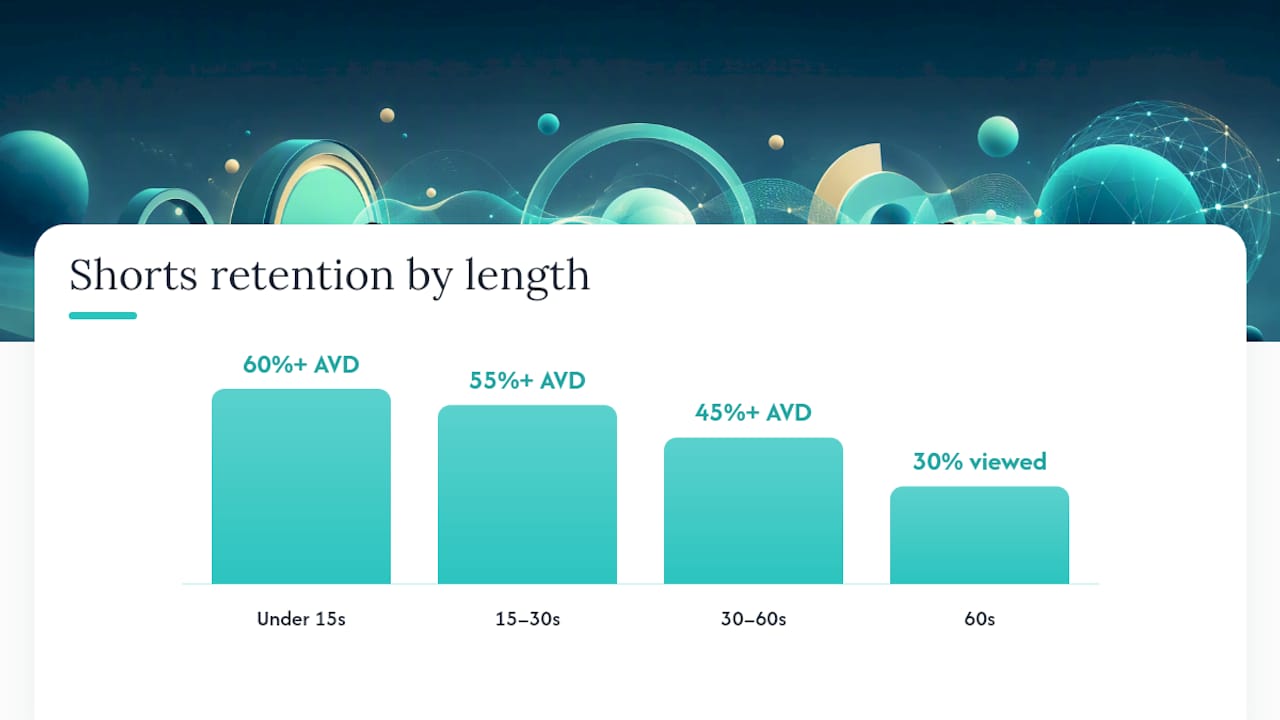
Anything above 80% viewed percentage is exceptional and usually signals real replay behavior, not just a well-paced first watch. On the other end, Shorts average watch time across the format sits around 14.3 seconds, which is why tighter Shorts under 30 seconds so consistently outperform longer ones on completion rate.
Content type shifts these numbers too. Educational Shorts tend to hold steadier mid-video retention because viewers are actively following a process, while surprise or entertainment formats live and die on the hook. Serialized drama Shorts, the format Iguanify builds for, behave differently again: their retention curves often show a distinctive end-spike because the cliffhanger structure rewards a second watch before the viewer moves to the next episode.
- Swipe-away above roughly 50% is a hook problem, full stop. Fix the first 3 seconds before anything else.
- Swipe-away between 30 and 50% is average. There’s room to improve, but it’s not an emergency.
- Swipe-away under 30% means your hook is doing its job and any remaining retention loss is likely a pacing or payoff issue further into the video.
Treat all of these as ranges, not laws. A brand-new channel with low subscriber trust will see noisier numbers than an established one, and a Short pushed heavily to non-subscribed traffic will read differently than one shown mostly to your existing audience.
How Do You Write a Hook That Stops the Swipe?
The first 1 to 3 seconds decide most of a Short’s fate. Platform research shows 65% of viewers who watch the first 3 seconds go on to watch at least 10 seconds, and 45% make it to 30 seconds or beyond. That early inertia is why the hook deserves more editing time than any other single element in your Short.
Three hook formats consistently outperform a generic setup:
- Cold open on the payoff. Show the result, the punchline, or the twist first, then rewind to explain how you got there.
- Problem, then immediate micro-proof. State the problem in one line, then show a flash of the fix working before you explain it.
- Teaser with instant payoff. Promise something specific (“here’s the exact line that stopped the argument”) and deliver a taste of it within the first second, not after a slow intro.
What kills a hook almost every time is a setup line that delays the point. “So today I want to talk about…” is a swipe-away generator. Cut straight to the interesting frame.
- Write two different opening lines for the same Short, script them out, and record both versions.
- Post them at different times or as separate Shorts if your format allows it, and compare swipe-away rate after 24 to 48 hours.
- Check whether your thumbnail (or the first frame the feed shows before autoplay) matches what actually plays first. A mismatch there causes a swipe before your hook even gets heard.
- Note which version held viewers past the 3 second mark using your retention graph, not just total views.
Pro Tip: Don’t judge a hook test on total views alone. A Short can get pushed to more people and still have a worse swipe-away rate. Always check the retention curve, not just the view count.
How Do You Design a Short People Rewatch?
A spike at the very end of your retention graph, above your starting baseline, means people looped back and watched again. That signal carries real weight because it tells YouTube’s system this content earns attention twice, not once.
Certain content types earn loops naturally. Quick tutorials people need to watch twice to catch a detail, satisfying transformations, and anything with a punchline that’s funnier on a second viewing all tend to show end spikes without much deliberate design. But you can engineer for it too.
- Seamless loop cuts. Match your final frame to your first frame so the video plays cleanly into itself without an obvious hard cut.
- Reverse edits. Structure content so the ending recontextualizes the opening, which makes viewers want to watch the beginning again with new information.
- A payoff that rewards a second pass. Drop a small detail early that only makes sense once the ending lands, so viewers loop back to catch it.
Serialized formats have a built-in advantage here. A cliffhanger ending doesn’t just create a loop within the video, it creates a pull toward the next episode, which is a different but related retention win.
Test this deliberately. Post two versions of a similar Short, one with a hard cut ending and one with a matched loop cut, and compare the tail end of your retention curves. If the loop version shows a visible bump in the last second or two compared to a flat decline, you’ve confirmed the technique works for your specific audience.
Pro Tip: Loop design only works if the middle of your Short earns the replay. Don’t bolt a clever loop onto a Short that lost most of its audience by the halfway point. Fix the mid-video dip first.
Which Editing Choices Actually Raise Retention?
Editing decisions you make in post-production account for most of the retention gains available to you, more than any single hook trick. A framework of nine editing tactics mapped to specific timeline zones treats retention as fundamentally an editing problem, and the data backs that framing up.
Captions and text overlays aren’t optional anymore. Most Shorts get watched with sound off in feed environments, so if your hook line isn’t captioned in the first frame, you’re losing viewers who would have stayed for audio-dependent content. Keep caption text short, place it in the upper or middle third of the frame away from platform UI elements, and match your text hierarchy so the most important word is the largest.
- Cut every shot that doesn’t add new information or a new visual angle. If a shot runs more than 2 to 3 seconds without a reason, trim it.
- Insert a pattern interrupt (a cut, a zoom, a sound sting, a text callout) every 10 to 20 seconds to reset viewer attention before it drifts.
- Use b-roll sparingly and only when it illustrates something the voiceover can’t show on its own.
- Match your music energy to your pacing. A slow, ambient track under fast cuts creates a mismatch viewers feel even if they can’t name it.
- Duck your music under dialogue so voiceover clarity never competes with the soundtrack.
Faster cuts generally favor entertainment and surprise formats where novelty drives retention. Holding a shot longer works better for tutorials or anything requiring comprehension, where a cut too early forces the viewer to rewind mentally, which reads as friction and often ends in a swipe.
How Do You Build a High-Retention Short Step by Step?
A repeatable checklist beats reinventing your process every time you sit down to script a Short. Here’s the sequence worth running before you hit publish.
Pre-production:
- Confirm your title (or opening caption) and your first frame promise the same thing. A mismatch here is one of the fastest ways to spike swipe-away rate.
- Pull the single best clip or moment from your footage and build the Short around that moment, not around chronological order.
- Write your hook line as one or two sentences before you touch the timeline. If you can’t say it in two lines, it’s too slow.
Editing: 4. Open cold on the most interesting frame, not a logo, an intro animation, or a slow establishing shot. 5. Deliver a small payoff within the first 5 to 8 seconds to reward the viewers your hook just captured. 6. Add a pattern interrupt every 10 to 20 seconds, timed against the specific timestamps where past Shorts have shown drops. 7. Insert a mid-video re-hook if your Short runs past 30 seconds, a new question or twist that resets attention. 8. End on a forward pull, a loop cut, or a cliffhanger, depending on whether this Short stands alone or belongs to a series.
Script template you can copy:
- Hook (1 to 2 lines): the payoff or the problem, stated immediately.
- Promise: one line telling the viewer what they’ll get if they stay.
- Evidence: the core content, cut tightly, with a pattern interrupt every 10 to 20 seconds.
- Re-hook (only for Shorts over 30 seconds): a new detail or twist to reset attention.
- Payoff: the resolution, timed to land with enough runway left for a loop or cliffhanger.
Add burned-in captions before export, and if you’re localizing for multiple regions, keep your hook line short enough that translated captions don’t run past two lines on screen. For creators building serialized episode formats, this template repeats cleanly across an entire season, which is exactly where consistent structure starts compounding.
What Mistakes Are Quietly Killing Your Retention?
Most weak Shorts fail for the same handful of reasons, and they’re almost all fixable once you know what to look for on your retention graph.
- Promise mismatch. Your title or thumbnail sets up one expectation, and your opening frame delivers something else. Viewers swipe within the first second because the content doesn’t match what pulled them in.
- Filler before the payoff. A slow intro, a throat-clearing setup line, or an unnecessary establishing shot before the interesting part starts.
- A weak middle with no stakes. This produces the classic mid-video dip on your retention curve, where viewers who survived the hook still leave because nothing new happens for 10 or 15 seconds straight.
- Pacing that’s too nervous. Cuts every half second with no room for comprehension exhaust viewers just as fast as pacing that’s too flat.
- Ignoring captions or audio clarity. Losing sound-off viewers, or burying a voiceover under music that’s too loud, both quietly inflate swipe-away rate without an obvious cause.
- Ending on nothing. A Short that just stops, with no loop, no forward pull, no payoff, leaves no reason for a rewatch or a follow.
How Should You Test and Iterate on Retention?
Treat retention improvement as an ongoing experiment cycle, not a one-time fix. The most reliable workflow identifies the single worst drop timestamp on your retention graph, applies the matching tactic, and compares the next upload against it, rather than changing five things at once and guessing which one worked.
- Pull your retention graph for your last 3 to 5 Shorts and identify the single worst drop point shared across most of them.
- Choose one variable to change (hook line, pacing, caption style, or ending) and apply it to your next upload only.
- Track swipe-away rate, APV, AVD, and shares per view for that upload against your baseline average from the prior 10 Shorts.
- Wait for a comparable sample, ideally 3 to 5 uploads using the same change, before declaring a win or a loss.
- Roll the winning variation into your standard template and repeat the process on the next weakest metric.
Four experiment types cover most of what’s worth testing: a hook-first test comparing two opening lines, a pacing-change test comparing cut frequency, a caption or visual-change test comparing overlay style, and a replay-focused test comparing loop cuts against hard endings. Run one at a time.
Pro Tip: Don’t judge a single Short’s performance in isolation. Compare it against your rolling average from the last 10 to 15 uploads, since one viral outlier or one unusually quiet week can make a fine Short look like a failure or a mediocre one look like a breakthrough.
How Do You Win Back Viewers After a Drop-Off Point?
Once your retention graph shows exactly where viewers leave, the fix depends on which type of drop you’re looking at. A cliff in the first 2 to 3 seconds means the hook failed. A gradual slope through the middle means engagement is fading, not collapsing. A sudden drop at a specific second, shared across multiple Shorts, usually points to a repeated structural habit, like a slow transition or a repeated phrase that signals “boring part coming.”

For gradual mid-video fade, the fix is a re-hook: a new visual, a new piece of information, or a direct question to the viewer, placed right before your data shows people start leaving. For a sudden drop at a repeated timestamp, go back and watch that exact second across your last several Shorts. You’re often looking for the same editing habit (a slow zoom, a pause for effect, a transition that runs half a second too long) repeated without you noticing.
Re-engagement also works retroactively. If an older Short is still getting impressions but losing viewers at a known point, a pinned comment addressing that exact moment, or a follow-up Short that references and resolves the drop-off point directly, can pull some of that lost attention back into your broader content.
Do Retention Rates Vary by Content Niche?
Retention benchmarks aren’t uniform across content categories, and comparing your numbers against the wrong niche is a common way to misjudge performance.
Educational and how-to Shorts tend to hold steadier mid-video retention because viewers are following an active process and have a clear reason to stay until the demonstration finishes. Their swipe-away rates are often lower too, since the audience arrives already looking for information rather than passively scrolling.
Entertainment and surprise-format Shorts live almost entirely on the hook. Their retention curves often show a sharper initial climb if the hook lands, but a steeper mid-video drop-off once the novelty resolves, since there’s less inherent reason to keep watching once the surprise has landed.
Serialized drama and episodic content behaves differently from both. These Shorts typically show stronger end-of-video retention and a distinctive spike right before the cutoff, driven by cliffhanger structure rather than loop editing alone. Returning viewer rate also tends to run higher for serialized formats once a season builds momentum, because the format itself creates a reason to come back that standalone content doesn’t.
None of this means one niche is objectively better for retention. It means the benchmark you compare yourself against should match your content type, not a generic average pulled from a mixed dataset.
How Do Demographics Shape Retention Strategy?
YouTube Studio’s audience tab shows age, gender, geography, and device data alongside your retention metrics, and cross-referencing the two data sets often reveals patterns a single retention graph can’t show on its own.
If your audience skews toward a specific age band or region, watch whether your swipe-away rate differs meaningfully between segments. A Short performing well overall might be underperforming badly with a subset of viewers, and that gap often points to pacing or cultural reference choices that land differently across groups. Device type matters too. Mobile viewing dominates Shorts consumption, but connection quality and screen size still affect how quickly someone abandons a slow-loading or visually cluttered opening frame.
Traffic source is just as important as demographics. A Short pushed heavily to non-subscribers will almost always show a higher swipe-away rate than the same content shown to an established audience, simply because non-subscribers have no prior trust built up. Segment your retention data by traffic source before drawing conclusions about a hook’s effectiveness. Otherwise you risk blaming a hook for a cold-audience problem it didn’t create.
Why Serialized Shorts Change the Retention Equation
Most retention advice treats every Short as a standalone bet: one hook, one payoff, one shot at holding attention. That framing misses what happens when a Short is part of something larger.
Recurring characters do something a fresh hook can’t. They build a form of trust that shows up directly in returning viewer rate. Once an audience recognizes a character or a format, the swipe-away decision changes shape. It’s no longer “is this interesting?” in isolation, it’s “do I want more of this story?” That’s a lower bar to clear, and it’s why serialized formats often post stronger end-of-video retention curves than one-off content built on novelty alone.
Cliffhanger structure is the clearest example. A well-placed unresolved beat at the end of an episode doesn’t just create a loop within that single Short, the way a matched first and last frame does. It creates a pull toward the next upload, which shows up over time as a lift in overall channel watch time rather than just one video’s numbers.
The tension worth naming honestly: serialization can hurt discoverability for brand-new viewers. Someone landing on episode 14 with no context might swipe away faster than they would on a well-built standalone hook, simply because they don’t have the backstory. The fix isn’t abandoning serialization, it’s building enough context into each episode’s first few seconds that a cold viewer gets oriented fast, while a returning viewer still gets the payoff they came back for. That’s a harder script to write than a pure standalone hook, but it’s the difference between a channel that lives upload to upload and one that builds compounding watch time.
How Iguanify Helps You Scale Retention-Focused Serialized Shorts
Building the checklist above once is manageable. Building it consistently across dozens of episodes, with the same character faces, the same hook rhythm, and the same caption style every time, is where most solo creators run out of hours in the day. That consistency is exactly what keeps returning viewer rate climbing instead of resetting with every upload.
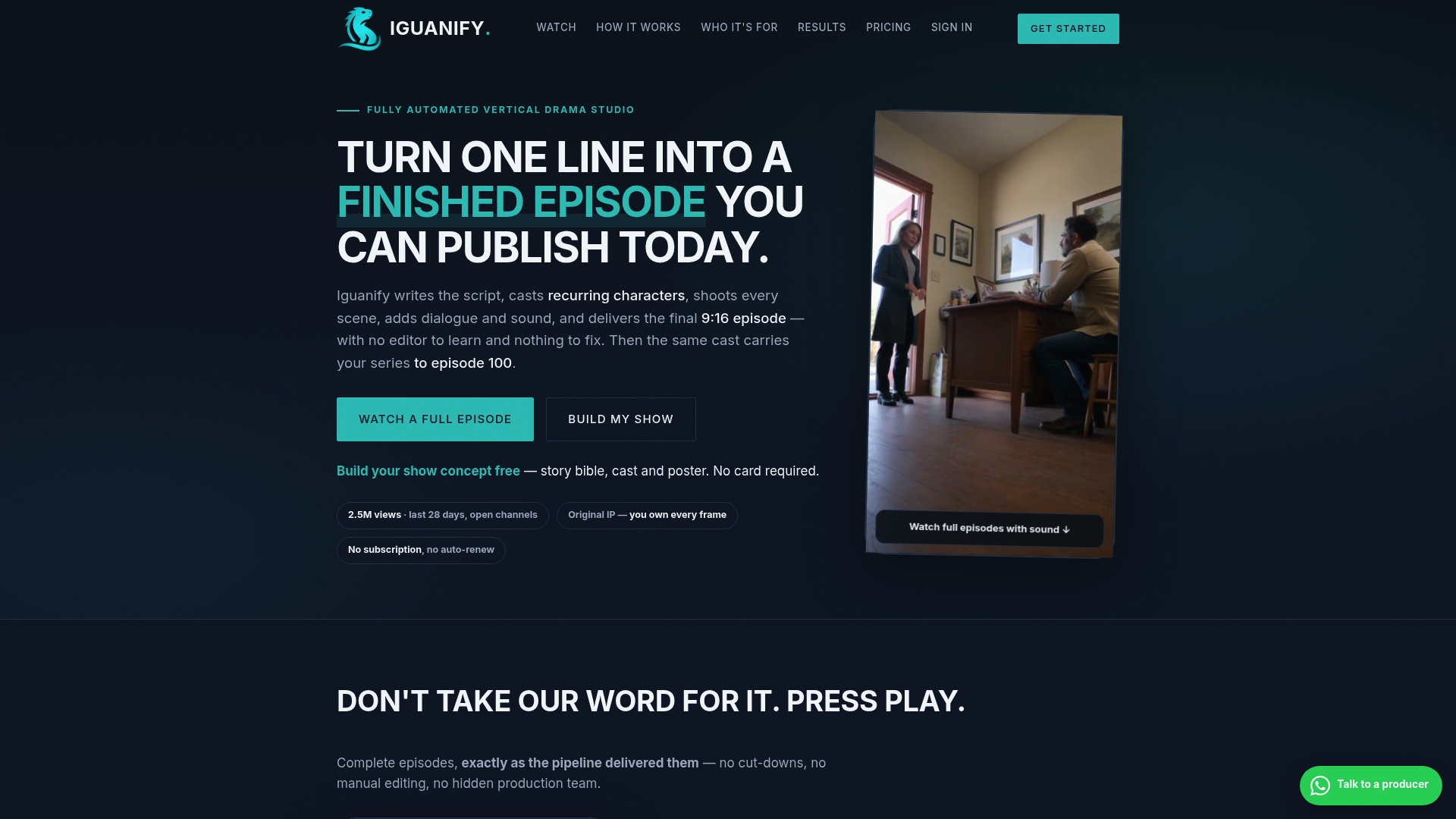
Iguanify produces full serialized drama episodes from a single line of script, and it keeps your cast consistent across every episode automatically, which solves the continuity problem that trips up most AI video tools. That matters directly for retention: a recognizable character delivering a cliffhanger in episode 12 only works if that character looks and sounds the same as they did in episode 1. You write the premise, and Iguanify handles the script, the recurring cast, the dialogue, the sound, and delivery ready for TikTok, YouTube, or Instagram, with no editing team required.
That speed also shortens your test-and-iterate loop. Instead of waiting days to produce a variant hook or a re-cut ending, you can generate a new episode fast enough to run the experiment cadence described earlier across a real week instead of a real month. You own full rights to everything produced. If you’re ready to test a serialized format at scale, start with the AI drama generator and build your first episode from a single premise.
Primary Sources and Further Reading
- Conbersa’s Shorts analytics guide explains swipe-away rate thresholds and why it’s the fastest diagnostic signal on a new upload.
- Kapwing’s short-form video statistics roundup covers average watch time data and the first-3-seconds research cited throughout this guide.
- LensPOV’s editing tactics framework maps nine specific editing moves to timeline zones, useful for anyone building a repeatable production checklist.
- Statista’s engagement-by-length data supports the case for favoring the 15 to 30 second range across short-form platforms generally.
Frequently Asked Questions
What is a good audience retention rate for a YouTube Short? For Shorts under 30 seconds, aim for 55%+ average view duration. For 30 to 60 second Shorts, 45%+ is solid.
How do I check my Shorts retention in YouTube Studio? Go to Studio, click Content, select your Short, open Analytics, and check the Engagement tab. The audience retention graph shows a second-by-second breakdown of where viewers dropped off, alongside your swipe-away rate.
What’s the difference between swipe-away rate and average view duration? Swipe-away rate measures how many viewers leave within the first few seconds, before your hook lands. Average view duration measures how long people watched overall, in seconds. A high swipe-away rate points to a hook problem, while a solid swipe-away rate paired with low AVD points to a mid-video pacing problem instead.
How long should a Short be for the best retention? Data across short-form platforms consistently shows peak engagement in the 15 to 30 second range, with Shorts under 60 seconds generally posting the highest completion rates. Longer runtimes can still work if the content genuinely earns the extra time.
Does audience retention actually affect the Shorts algorithm? Yes. Swipe-away rate and average view duration are read as fast distribution signals, and Shorts with low swipe-away and strong percentage viewed tend to get pushed to a wider audience beyond your existing subscribers.
Why do serialized Shorts often retain better than standalone ones? Recurring characters and consistent formatting build viewer trust faster than a one-off hook can, which raises returning viewer rate and often produces stronger end-of-video retention spikes tied to cliffhanger payoffs.
Sources
- Short‑Form Video Statistics: TikTok, Reels, and Shorts by the numbers in 2026
- Audience retention strategies (2026): 9 editing tactics – LensPOV
- YouTube Shorts Analytics: What metrics actually matter? | Conbersa
- Engagement rate of TikTok videos worldwide in 2026, by video length