 IGUANIFY
Series Hook Ideas That Convert in 3 Seconds for Short Form Creators

Use curiosity, action, character, question, specificity, contrarian, emotional, and data hooks as your working toolkit, then pick the one that fits your genre and write a 60 to 90 word pilot version today. Test it in a scene before you build the season around it. Iguanify and the copywriting research behind hook categories both point to the same conclusion: a hook only earns its place once it survives contact with an actual reader or viewer.
TL;DR:
- Most hooks need to align with the series’ actual conflict and stakes, otherwise they risk feeling disconnected or misleading.
- Combining a strong premise with a clear pilot opening that reflects the story’s tone, stakes, and promise is essential for engagement.
- Short-form video hooks should integrate an episode indicator and outcome promise within three seconds to maximize viewer retention.
- Reusing consistent character assets, visuals, and motifs across episodes helps create recognition-based micro-hooks that require less setup.
- Revising the initial hook after completing the full season ensures it remains relevant and tonally consistent with the story’s actual ending.
Table of Contents
- 30+ Series Hook Ideas Organized By Type
- Converting A Premise Into A Pilot, A Novel Opening, And A Micro-Hook
- Micro-Hooks For The First Three Seconds Of Serialized Video
- Seven Hook Mistakes That Sink A Series Before Episode Two
- A Three-Step Workshop To Generate And Test Ten Hooks Fast
- Production Choices That Make Micro-Hooks Reusable
- Why Your Best Hook Rarely Survives First Contact With Episode Ten
- Prototype A Hook Into A Finished Episode Without A Production Team
- Sources
30+ Series Hook Ideas Organized By Type
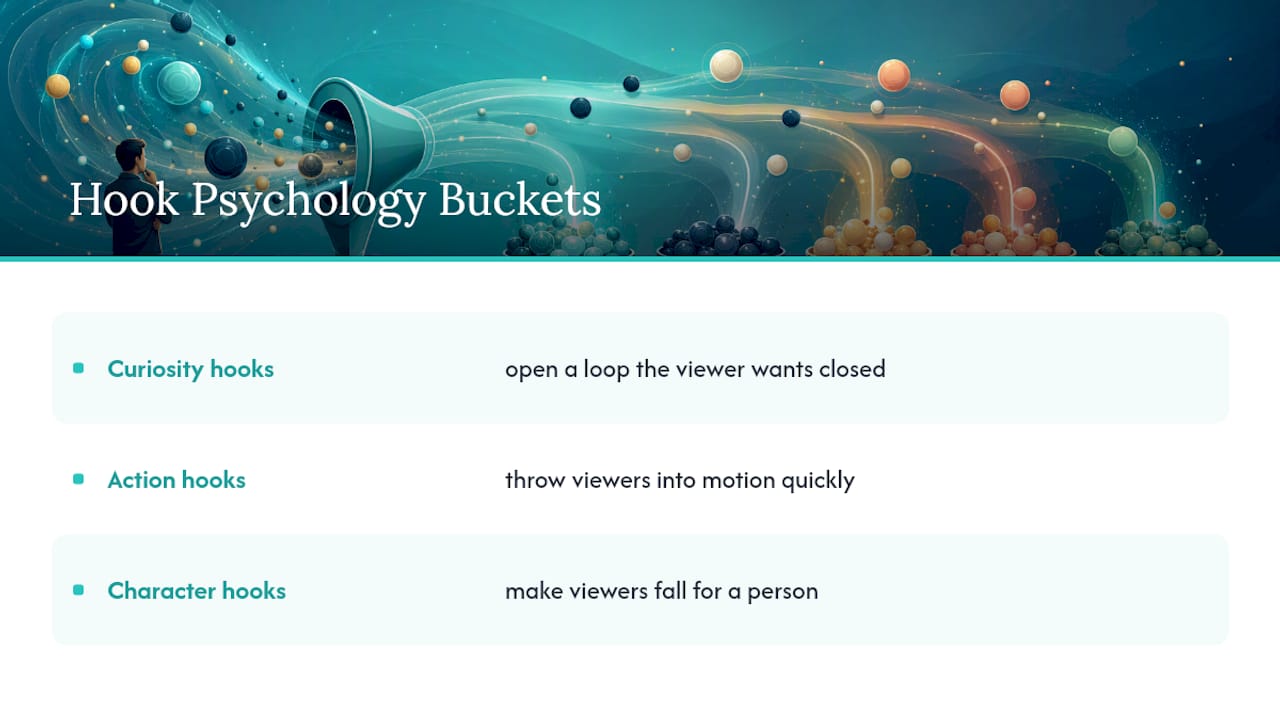
Every hook falls into one of eight psychological buckets, and knowing which bucket you’re pulling from tells you what kind of promise you’re making to the audience. Curiosity hooks open a loop your viewer needs closed. Action hooks throw them into motion before they’ve caught their breath. Character hooks make them fall for a person. The taxonomy behind these categories comes from copywriting research, but it maps almost perfectly onto what fiction editors call opening hooks.
Curiosity hooks
The open loop is the oldest trick in serialized storytelling, and it’s still the most reliable.
-
Premise: A detective solves the case, then realizes she’s the one who committed it.
-
TV variant: Cold open shows a body being found. Cut to the lead detective at her desk, coffee in hand, badge on the table. She already knows who did it.
-
Micro-hook: “She caught the killer in episode one. Episode two, she finds out she IS the killer.”
-
Premise: A small town has one rule nobody explains, and breaking it kills you within 24 hours.
-
TV variant: New arrival breaks the rule accidentally in the pilot’s final scene. Season one is the countdown.
-
Micro-hook: “This town has one rule. Nobody tells you why. Episode 1.”
Action hooks
Drop the audience mid-motion. No throat-clearing, no scene-setting, just consequence.
-
Premise: A getaway driver realizes the “cargo” in the trunk is still alive.
-
TV variant: Open on tires screeching, sirens closing in, then a knock from inside the trunk.
-
Micro-hook: “The job was simple. Drive the car. Nobody said what was in the trunk.”
-
Premise: A wedding is interrupted by the groom’s actual wife.
-
Micro-hook: “The vows got to ‘I do’ before the real Mrs. Chen walked in.”
Character hooks
These work because the audience falls for a person, not a plot.
-
Premise: A hitman only takes jobs against people who hurt kids.
-
TV variant: Establish the code in scene one through a job he refuses, not one he takes.
-
Micro-hook: “He’s killed 14 people. He’s only ever said no to one job.”
-
Premise: A retired con artist is forced back in for one last score, by her own daughter.
Question hooks
Pose the question the whole season is built to answer, right in the opening line.
- Premise: “What happens to the town that wins the lottery every single year?”
- TV variant: A journalist arrives to investigate the statistically impossible streak.
- Micro-hook: “This town has won the lottery 11 years running. Nobody’s asking why. I am.”
Specificity hooks
Vague openings vanish. A precise, odd detail sticks, and craft guidance on openings backs this up directly: concrete sensory detail beats generality every time.
-
Premise: A woman inherits her grandmother’s house on the condition she never opens the door to the cellar.
-
Micro-hook: “The will had 40 pages. One line mattered: never open the cellar door.”
-
Premise: A man wakes up every day with exactly $317 in his pocket. No more, no less, no matter what he spends.
Contrarian hooks
Take the assumption the genre trains audiences to expect, then flip it in line one.
- Premise: The monster isn’t hunting the town. It’s protecting it from something worse.
- TV variant: Structure episode one so the audience roots against the “hero” hunting the creature.
- Micro-hook: “Everyone in town thinks the thing in the woods is the monster. It’s not.”
Emotional hooks
Grief, guilt, and longing open doors that action never can.
- Premise: A father gets one phone call a year from his dead daughter, and this year she asks for help.
- Micro-hook: “She’s been dead six years. She called me yesterday.”
Data hooks
A specific number does work a vague claim can’t.
- Premise: A insurance actuary discovers a neighborhood where nobody has died of natural causes in 43 years.
- Micro-hook: “43 years. Zero natural deaths. One zip code.”
Mystery series lean hardest on question and curiosity hooks. TV pilots do best combining action with character. Novels can sit longer in specificity and emotional hooks because the reader has more patience to invest. Short-form serialized video needs contrarian or data hooks compressed into a single sentence, since there’s no room for a slow burn.
Converting A Premise Into A Pilot, A Novel Opening, And A Micro-Hook
A premise hook and a pilot hook are not the same thing, and confusing them is why so many series openings feel flat. The premise hook is the series-level promise, the one-sentence pitch that gets someone to click. The pilot hook is the actual first scene, built around what story-structure research calls the inciting incident, the specific event that starts the plot moving. A micro-hook compresses both into the first three seconds of a vertical video.
Here’s how one premise moves through all three formats.
Premise: A woman discovers her late husband had a second family in another city.
- TV pilot opening: Cold open at the funeral. She’s handed a condolence card signed by a name she doesn’t recognize, from a woman who signs it “his wife.”
- Mystery novel opening: First chapter starts with her going through his phone, three months after the funeral, and finding a contact saved as “Home 2.”
- Social micro-hook: “He had a wife. I was the other one. I just didn’t know it.”
A second example, built for a detective series:
- TV pilot opening: The detective closes a case in the first five minutes. In the final scene, evidence surfaces that her own partner planted the murder weapon.
- Mystery novel opening: Chapter one ends with her finding her partner’s fingerprint on evidence that should be untouched.
- Social micro-hook: “I solved the murder in episode one. In episode two, I find out my partner did it.”
When converting a hook across formats, keep these four elements intact no matter how much you compress or expand:
- Tone. A dark contrarian hook shouldn’t suddenly read as comic in the micro version.
- Stakes. If the pilot hook risks a life, the micro-hook can’t downgrade it to an inconvenience.
- Promise. Whatever question the premise hook raises has to still be the question by the time you reach the pilot’s final beat.
- Micro payoff. Short-form needs a resolution beat inside the hook itself, even a partial one, or the loop never closes.
Editors who study opening craft warn that a hook disconnected from the story’s actual conflict reads as a cheap gotcha rather than a real promise. The same warning applies going the other direction. If your micro-hook promises betrayal and your pilot delivers a slow character study, you’ve broken the deal before episode two even starts.
Micro-Hooks For The First Three Seconds Of Serialized Video
Short-form platforms give you almost no runway. A viewer decides whether to keep watching before your title card finishes fading, so the opening has to do two jobs at once: orient a returning viewer and hook a brand-new one, in the same three seconds.
The formula that works across most serialized drama accounts combines an episode indicator with an outcome promise. The indicator tells a returning viewer where they are in the story (“Episode 14”). The outcome promise tells a new viewer what’s at stake right now, without requiring them to know anything that came before.
Five templates to build from:
- “Episode [N]. She just found out [specific reveal].”
- “Last episode, he [action]. This episode, it backfires.”
- “[Character] has [time limit] to [goal], or [consequence].”
- “You don’t need to watch episodes 1 through 12. Just know: [current stakes].”
- “Episode [N] of [series name]. Today, everything changes.”
Statistic to know: Iguanify’s retention research on short-form serials ties the opening three seconds directly to whether returning viewers stay oriented and new viewers get pulled in, making that window the single highest-leverage edit you’ll make on any episode.
Visual and audio cues reinforce the same job the words are doing. A repeated on-screen graphic for the episode counter, a consistent title card color, or a two-second audio sting that plays before every episode all train the algorithm’s audience to recognize your series inside a scroll full of unrelated content. Production teams doing this well treat these motifs as a design system, not an afterthought bolted on after editing.
Pro Tip: Build your episode indicator and audio motif before you shoot a single scene, not after. Retrofitting continuity cues onto finished episodes is where most creators lose the thread by episode five.
Seven Hook Mistakes That Sink A Series Before Episode Two
- The disconnected gotcha. A shocking cold open that has nothing to do with the season’s actual conflict. Fix: tie the shock directly to the theme you’re building the whole series around.
- The cliffhanger with no payoff. Ending episode one on pure suspense with zero resolution. Fix: use a “satisfaction plus hook” structure, where a local problem gets resolved in the same episode that opens a bigger question, a pattern episodic writing guides recommend specifically to avoid audience frustration.
- The bait-and-switch premise. Promising a thriller and delivering a slow drama. Fix: rewrite the hook to match the actual pace of episode three, not the pace you wish you’d written.
- The overloaded opening. Cramming five characters and three subplots into fifteen seconds. Fix: cut to one character, one stake.
- The vague stakes. “Everything is about to change” with no specifics. Fix: replace with one concrete detail, a number, a name, a deadline.
- The recycled hook. Using the same structure every episode until it reads as a template rather than a story. Fix: rotate hook types across the season.
- The missing continuity cue. A returning viewer has no idea where they are in the story. Fix: add the episode indicator every single time, no exceptions.
Before: “You won’t believe what happens next.” (Promises everything, delivers nothing specific.) After: “She solved the case in episode one. Episode two, she finds out she’s the killer.” (Same shock value, actual stakes attached.)
A Three-Step Workshop To Generate And Test Ten Hooks Fast
Generate first, refine second, test third. Don’t edit while you’re generating, and don’t skip the test.
- Generate ten hooks in fifteen minutes using fill-in templates like: “[Character] discovers [secret] and has [time limit] to [action].” Or: “Everyone believes [common assumption]. [Character] knows it’s wrong.” Or: “The rule is simple: [rule]. Breaking it means [consequence].”
- Refine your top three by cutting every word that isn’t doing work. A hook under 20 words almost always beats one over 40.
- Micro-test each one by reading it aloud to someone unfamiliar with the project, giving them three minutes, then asking one question: “What do you think happens next?” If they guess correctly, the hook is too obvious. If they have zero interest, it’s too vague.
Pro Tip: Run the same three-minute test on five different people before you commit a hook to a full episode. One person’s reaction is an opinion. Five people’s reactions start to look like a pattern.
Production Choices That Make Micro-Hooks Reusable
Recurring character assets do more for hook design than most writers give them credit for. When your cast stays visually consistent episode to episode, you can build micro-hooks that lean on recognition instead of re-explanation, which means less setup and more stakes packed into three seconds.
- Keep the same character models, wardrobe, and setting motifs across episodes so a returning viewer clocks who’s who instantly.
- Reuse a signature prop or visual motif the way recurring motifs get tracked in film and TV analysis, turning a small detail into a season-long payoff.
- Lock your audio sting and episode-counter graphic early, since refining a hook works best after you’ve drafted the whole arc, once you know what continuity actually needs protecting.
Why Your Best Hook Rarely Survives First Contact With Episode Ten
Here’s the uncomfortable truth about hooks: the one you write before you’ve drafted the season is almost never the one that survives it. You write a hook believing you know where the story goes, then episode seven reveals a better version of the conflict, and now your opening promise is technically true but tonally off.
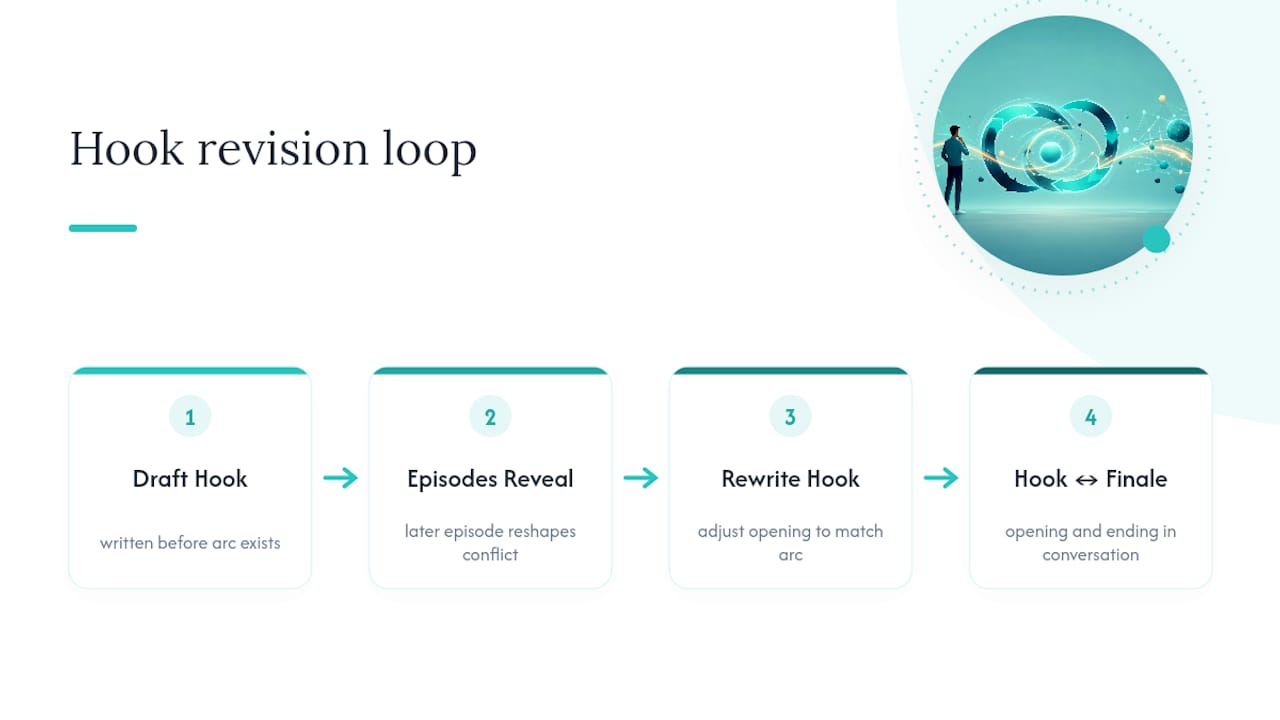
The fix isn’t writing a better hook up front. It’s treating the hook as a draft, the same way you’d treat a first chapter, and returning to rewrite it once the full arc exists. Most writers resist this because rewriting the opening feels like admitting the original idea was wrong. It wasn’t wrong. It was just written before you had all the information.
The series that hold up under a full-season rewatch tend to share one trait: their hook and their finale are in conversation with each other. That only happens when someone goes back and adjusts the opening after the ending exists, not before.
— Leonard
Prototype A Hook Into A Finished Episode Without A Production Team
Writing thirty hook variations is the easy part. Finding out which one actually survives a scene, and then building that scene into something you can post, is where most solo creators stall. Iguanify closes that gap by taking a single line of premise and turning it into a fully produced episode, recurring cast included, without you needing an editing suite or a crew.
That matters most in the testing phase this article just walked through. Instead of guessing which hook works from a script read-through, you can generate an actual episode from your strongest pilot hook, post it, and let real viewer behavior tell you whether the opening lands. Because character models stay consistent between episodes, you’re not rebuilding your cast from scratch every time you want to test a new hook variation. Start with your best 60 to 90 word pilot hook and turn it into a finished episode through the AI drama generator to see how it performs before you commit to a full season.
Sources
- Robpalmer
- How to write a hook for a story — The Writer
- Crafting an irresistible opening hook for any story — Literary Devices