 IGUANIFY
Anthology vs Serial: Which Format Should Creators Use?

An anthology tells a self-contained story in each episode or season, with a new cast or setting every time. A serial unfolds one continuous story across episodes, where every installment depends on the last. Pick anthology when you want variety, casual entry points, and flexible casting. Pick serial when you want deep character arcs and a binge-hungry audience.
Think of the soap opera as the serial’s original blueprint: decades of continuous plot, the same core cast, and a story that never resets. On the other side, a show built like The Twilight Zone hands you a fresh premise every week, tied together only by tone. Both models work. Iguanify exists because producing either one, well, used to require a full crew and a real budget.
Here’s the fast version:
- Anthology = new story, new (or partly new) cast, per episode or season. Low commitment for viewers, high creative flexibility for you.
- Serial = one plot, evolving continuously, built for sequential viewing and long-term investment.
- Verdict: if your idea is a strong concept that can support endless variations, go anthology. If your idea is a character or relationship you want to develop over dozens of episodes, go serial.
Key Takeaways
Anthology and serial formats differ mainly in continuity: anthology resets story and cast per unit, while serial builds one continuous plot that demands sequential viewing.
| Point | Details |
|---|---|
| Definitions differ by continuity | Anthology resets story/cast per episode or season; serial evolves one plot continuously across episodes. |
| Match format to platform | Casual-entry platforms favor anthology; binge-focused platforms reward serialized structure. |
| Budget shifts by casting model | Serials amortize sets and cast costs; anthologies pay a reset tax on casting and locations each unit. |
| Hybrids are increasingly common | Shows like The X-Files and Buffy mix episodic beats with serialized arcs for the best of both. |
| AI production tools narrow the cost gap | Platforms like Iguanify generate consistent-character episodes automatically, reducing anthology’s reset cost and serial’s casting overhead. |
Table of Contents
- Anthology vs Serial: A Side-by-Side Comparison
- What Are the Types and Subtypes of Each Format?
- How Does Format Change What You Can Write?
- What Does Each Format Cost to Produce?
- Which Format Fits Your Platform and Audience?
- How Do You Choose Between Anthology and Serial?
- What Real Shows Teach You About Format Choice
- How Is AI Changing Anthology and Serial Production?
- Produce Your Format Without the Production Bottleneck
- Frequently Asked Questions
- Sources
Anthology vs Serial: A Side-by-Side Comparison
The two formats split apart on almost every practical axis a producer cares about, not just the creative one. A serial) is defined by a continuously evolving plot and a consistent cast across episodes, while an anthology resets its story and often its characters each time, held together by theme or tone instead of continuity.
| Dimension | Anthology | Serial |
|---|---|---|
| Definition | New story per episode/season, unified by concept or tone | One continuous plot evolving across episodes |
| Scope | Episode or season is the complete unit | Season or full series is the complete unit |
| Character continuity | Optional, often none between installments | Central, cumulative across episodes |
| Plot/arc length | Short, resolves within the unit | Long, spans many episodes or seasons |
| Audience entry point | Jump in anywhere | Must watch in order |
| Bingeability | Good for sampling, less compulsive | Built for binge-watching |
| Production logistics | New sets, casting, and prep per unit | Sets and crew amortized across episodes |
| Casting model | Rotating guest cast, flexible scheduling | Reused core cast, long-term contracts |
| Marketing cadence | Season or concept trailer, episode-by-episode hooks | Season trailer plus cliffhanger-driven promotion |
| Ideal use case | Idea-driven concepts, variety, talent flexibility | Character-driven stories, franchise building |
A few things to act on right away:
- If your budget can’t support recurring big-name talent, an anthology’s rotating cast model spreads that cost differently than a serial’s long-term contracts.
- If you’re targeting a short-form platform where viewers scroll fast, anthology’s low-commitment entry points usually outperform serial’s slow-build structure.
- If your concept only works with sustained emotional investment, don’t force it into an anthology shell. It will feel thin.
What Are the Types and Subtypes of Each Format?
Most creators think in binary terms: anthology or serial. In practice, the format spectrum has at least five recognizable shapes, and mixing them up during pitching is a common rookie mistake.
- Episodic anthology: A new, complete story every episode, unified only by concept (The Twilight Zone, Black Mirror). Maximum creative freedom, maximum casting churn.
- Seasonal anthology: Each season is its own self-contained story, but the season itself is serialized internally (American Horror Story, Fargo). This gives you serial-style pacing within an anthology’s reset structure.
- Fully serialized series: One plot across the entire run, minimal reset points (The Sopranos, Breaking Bad). Character continuity is the whole engine.
- Limited or mini-series: A single contained story told over a fixed number of episodes with no intention of continuing. This is often confused with anthology, but the distinction matters. Mini-series and limited series tell one complete story once, while anthologies reset between seasons or episodes by design, ready to tell a new story next time.
- Hybrid format: Self-contained episodes that still advance an underlying mythology, like The X-Files’ “monster of the week” structure layered over its long-running conspiracy arc.
Hybrids deserve extra attention because they’re increasingly the default rather than the exception. Writers frequently mix episodic beats inside a serialized frame so each episode feels satisfying on its own while the larger arc keeps moving. If you’re pitching a show today, “purely” anthology or “purely” serial is rarer than a calculated blend of both.
The seasonal anthology in particular has become a favorite of the streaming era. It gives a show the reset flexibility of an anthology (new cast, new setting) while giving each season the emotional momentum of a serial. That’s not an accident. It’s a direct response to how modern platforms reward both discoverability and retention.
How Does Format Change What You Can Write?
Character work is where the two formats diverge hardest. A serial lets you build a character across dozens of hours, layering contradictions, callbacks, and slow reveals that only pay off because the audience has been there the whole time. An anthology episode gives you 22 to 90 minutes to make a stranger matter, then never touches them again.
That constraint changes pacing math completely. Episodic plots resolve quickly and stay accessible, while serialized plots trade that immediacy for complex arcs and sustained suspense across installments. A serial can afford a slow burn because the cliffhanger does the retention work between episodes. An anthology episode has no next-episode goodwill to lean on. It has to complete its emotional transaction before the credits roll.
Theme carries the weight in anthology work that plot carries in serial work. Black Mirror doesn’t need continuing characters because its unifying idea, technology curdling human relationships, is strong enough to hold a dozen unrelated stories together. Strip out the concept and you have nothing. A serial can survive a weaker premise if the character relationships are compelling enough to keep people watching.

Two quick illustrations. In a serial, you might plant a throwaway line in episode three that only pays off in episode nineteen, because you know the audience is following along. Try that in an anthology and most viewers will never connect the dots, because they might watch episode nineteen first.
Pro Tip: When writing a single anthology episode, front-load the emotional stakes in the first act. You don’t have three episodes to build sympathy. You have one scene.
- Serial pacing rewards patience and long-term payoff.
- Anthology pacing rewards immediate hooks and self-contained resolution.
- A hybrid needs both: a satisfying A-plot per episode and a B-plot that only serial viewers will notice building.
What Does Each Format Cost to Produce?
Casting is the first budget line that splits these formats apart. A serial locks in a core cast for a season or more, which means predictable payroll but real risk if a lead actor’s schedule falls through. An anthology can cast fresh talent per episode, which spreads scheduling risk but adds negotiation and onboarding overhead every single time.
Set and location reuse tells a similar story in reverse. A serial amortizes its main sets, the apartment, the office, the diner, across every episode, which is why serial budgets often drop after the pilot once builds are in place. An anthology frequently needs new locations and production design for every story, since visual variety is often part of the appeal.

Crew scheduling follows the same logic. Serial productions build continuity teams that live with the show for a season, learning its rhythms and shorthand. Anthology productions often reset crew relationships and prep cycles per episode or per season, which adds friction but also lets you bring in directors with different visual styles, something anthology producers frequently treat as a feature rather than a bug.
Run through this before locking a budget:
- Cast: reused core vs. rotating guest talent, and what each does to your payroll curve.
- Locations: how many new builds or scouts does each unit require.
- Wardrobe and props: continuity-dependent (serial) vs. disposable per story (anthology).
- VFX: recurring assets amortize in serial work; anthology VFX often can’t be reused.
- Turnaround time: how much prep buffer each new story or season needs.
A rough production timeline for either format follows the same three phases, just with different pressure points:
- Preproduction takes longer per unit for anthology (new casting, new locations, new design) but shorter overall for serial once the bible and sets exist.
- Shooting tends to be faster per episode in serial work because crews know the space and cast; anthology shoots often need more lighting and blocking time on new sets.
- Post-production costs rise fastest in anthology work when VFX or color needs to be rebuilt from scratch each story, compared to serial post pipelines that reuse templates and looks.
Which Format Fits Your Platform and Audience?
Platform behavior should shape your format decision before your creative preferences do. Anthology and episodic structures let viewers jump in at any point and favor variety, which fits casual-discovery platforms where a stranger might land on episode 40 before episode one. Serialized shows demand sequential viewing, which rewards platforms built around binge behavior and appointment viewing.
Short-form vertical platforms like TikTok and Instagram Reels tend to favor low-commitment entry points, which is why many creators building vertical drama series lean toward serialized micro-arcs that still let a scroller understand the gist within seconds. Traditional streaming and linear TV can support either format, but algorithmic recommendation engines often reward serial completion rates because they signal sustained engagement.
Marketing cadence has to match the format too. Anthology shows typically market around a concept trailer plus episode-by-episode hooks, since each story needs its own pitch. Serial shows lean on a single season trailer and let cliffhangers do the ongoing promotional work between releases.
Pro Tip: Before locking your format, map your intended platform’s typical viewing session length against your story’s natural unit size. If viewers scroll for 90 seconds, don’t build a story that needs 20 minutes to pay off.
How Do You Choose Between Anthology and Serial?
Run through these ten questions before committing a script to production. Answer honestly, not aspirationally.
- Does your audience have the patience for multi-episode commitment, or do they need instant payoff?
- What’s your realistic production budget, and does it favor amortized sets or one-off variety?
- Is your cast available long-term, or are you working with rotating guest talent?
- Do you want deep, cumulative character development, or concentrated, self-contained arcs?
- What platform are you targeting, and does it reward binge behavior or casual entry?
- How much marketing capacity do you have to sustain episode-by-episode hooks versus one season push?
- Can your concept sustain mystery and cliffhangers across multiple installments?
- Is your core idea strong enough to hold together stories with no continuing characters?
- Do you want the creative variety of new settings and casts each time?
- What’s your production timeline, and can you afford anthology’s higher per-unit prep cost?
Weight the production constraints (questions 2, 3, 6, 10) more heavily if you’re a solo creator or small team with limited resources. Weight the creative priorities (questions 1, 4, 7, 8, 9) more heavily if you already have funding or a dedicated crew.
If most of your answers point toward flexibility, variety, and casual audience entry, an anthology is your format. If most point toward sustained investment, character depth, and binge-friendly structure, build a serial. If you land somewhere in the middle, a seasonal anthology or hybrid structure is often the honest answer, not a compromise.
What Real Shows Teach You About Format Choice
- The Twilight Zone — Episodic anthology. New story, new cast, every week, unified purely by concept and tone.
- Black Mirror — Episodic anthology. Technology-driven premises with no continuing characters, proof that a strong idea alone can carry a series.
- American Horror Story — Seasonal anthology. Each season resets story and setting but reuses a repertory cast across different roles.
- Fargo — Seasonal anthology. New crime story and cast per season, unified by tone and Coen-adjacent sensibility rather than plot.
- True Detective — Seasonal anthology. Each season is a self-contained case with a new lead cast, built for prestige limited-run storytelling.
- The X-Files — Hybrid. Standalone “monster of the week” episodes layered over a long-running serialized conspiracy arc.
- The Sopranos — Fully serialized. Continuous character development across seasons, minimal reset points.
- Breaking Bad — Fully serialized. One evolving plot and character transformation across the entire run.
- Buffy the Vampire Slayer — Hybrid. Episodic monster-of-the-week structure combined with season-long serialized “big bad” arcs.
- Soap opera — The serial archetype. Continuous plot and cast that never resets, built for decades of appointment viewing.
How Is AI Changing Anthology and Serial Production?
Modern production tools are compressing the cost gap between these two formats faster than most creators realize. Automated editing, repeatable cast generation, and templated asset pipelines cut the per-episode marginal cost that used to make anthology’s constant reinvention so expensive.
- Faster editing pipelines mean anthology’s per-story setup no longer demands a full new post-production cycle each time.
- Repeatable character generation lets serial creators maintain a consistent cast without recurring casting overhead.
- Automated asset creation reduces the VFX rebuild cost that historically made anthology post-production the pricier of the two formats.
Human oversight still matters most where taste and continuity intersect: tone consistency across an anthology’s varied stories, casting direction that keeps a serial’s ensemble believable, and high-stakes visual effects that automated pipelines can’t yet fully judge on their own. What’s genuinely shifted is the economics. A platform that maintains consistent characters across episodes removes one of serial storytelling’s biggest production bottlenecks, while automated per-episode generation removes anthology’s traditional reset tax. That changes which format makes financial sense for a solo creator, not just which one makes creative sense.
A quick way to test your format before you commit
I’d start smaller than most guides suggest. Write one episode, not a season bible. Build a minimal pilot, even a rough one, and put it in front of the actual audience you’re targeting, not friends who’ll be polite about it.
Give yourself one week: script on day one, produce by day three, publish and collect feedback by day seven. Watch completion rate and re-watch behavior, not just view count. If viewers finish and come back for more, you likely have a serial. If they enjoy it once and move on without complaint, you may have found your anthology concept.
Produce Your Format Without the Production Bottleneck
Whichever format you choose, the production math is what usually kills the project before the story does. Anthology work demands new casting and design every episode; serial work demands a consistent cast you can’t afford to lose mid-season. Iguanify removes both bottlenecks by generating fully-produced episodes from a single line of script, with characters that stay consistent across installments without hiring a continuity team or rebooking talent.
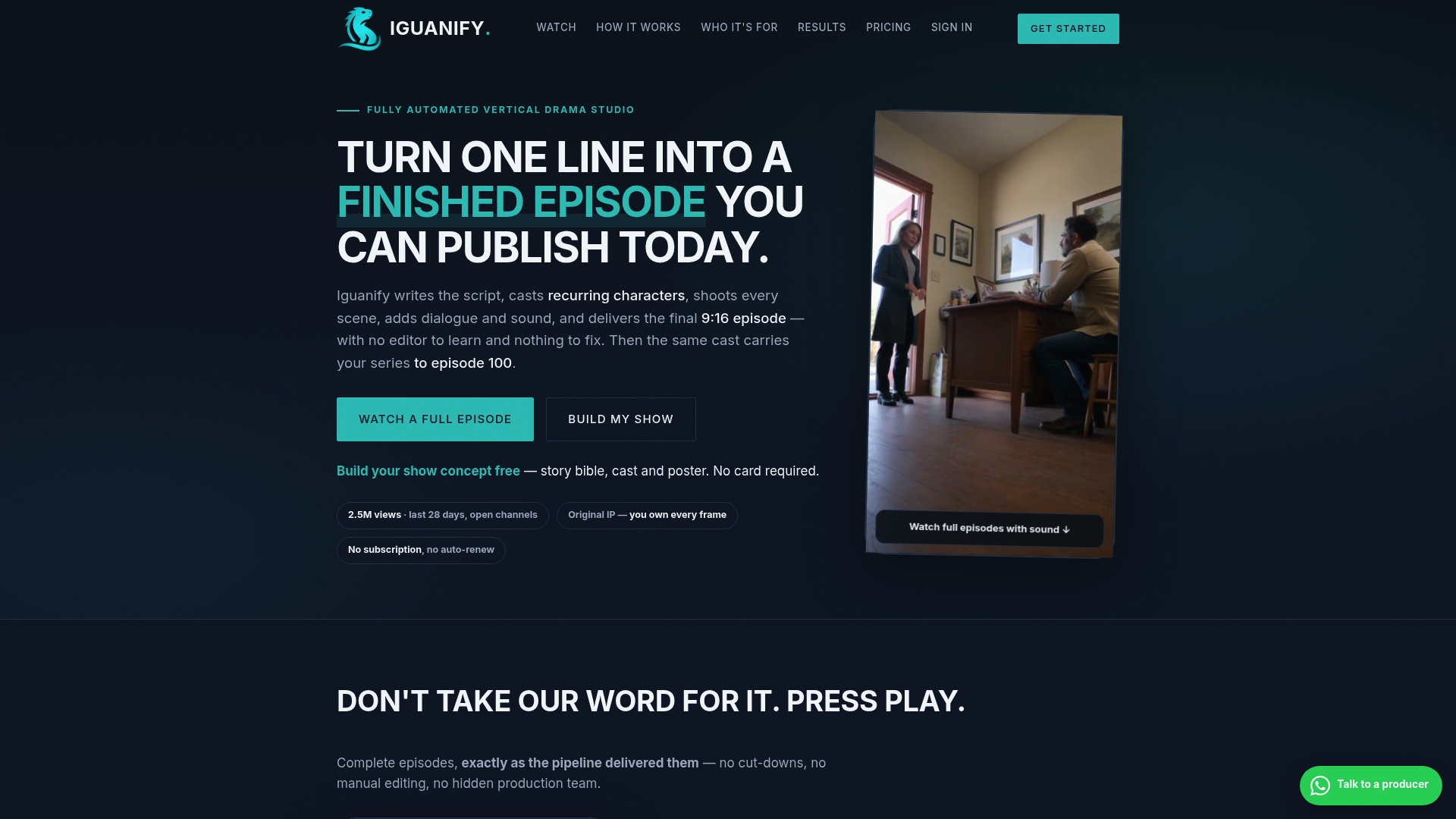
That consistency matters whether you’re building a seasonal anthology that needs a repertory cast across different roles, or a fully serialized drama that needs the same lead recognizable in episode 40 as in episode one. You keep full rights to everything produced, and output comes ready for TikTok, YouTube, and Instagram without a separate editing pass. If you’re testing a format before committing real budget to it, start with the AI drama generator and produce your pilot episode this week instead of waiting on a crew.
Frequently Asked Questions
What is the main difference between anthology and serial formats? An anthology tells a new, self-contained story per episode or season, while a serial builds one continuous plot that evolves across every episode.
What is a serial in television terms? A serial is a production with a continuously evolving plot and consistent cast that unfolds across multiple episodes rather than resolving each one independently.
Are limited series and anthologies the same thing? No. A limited or mini-series tells one complete story once and ends, while an anthology resets with a new story each season or episode by design.
What are the best anthologies to study for format structure? The Twilight Zone and Black Mirror represent pure episodic anthology, while American Horror Story, Fargo, and True Detective show how seasonal anthologies blend reset structure with serialized pacing within each season.
Can a show be both anthology and serial? Yes. Hybrid formats like The X-Files and Buffy the Vampire Slayer combine standalone episodes with an overarching serialized arc that rewards long-term viewers.
How do I decide which format fits my project? Weigh your budget, cast availability, and platform against how much character depth versus creative variety your concept actually needs, then run the ten-question checklist above to confirm the choice.