 IGUANIFY
Plan Six Episodes, Lock Your Cadence, and Build an Episodic Audience

Launch a named, repeatable series with six episodes planned before you post the first one, and lock a cadence you can actually keep. Track episode-over-episode retention, not raw views, to know if it’s working. Use Later’s 6-episode planning rule as your minimum bar, and if solo production is your bottleneck, a tool like Iguanify can carry the batching load. Start today: write six episode hooks and pick your publish day.
TL;DR:
- Consistently tracking episode-over-episode retention above 40% is key, with stable weekly publishing for at least 12 episodes increasing follower growth by about 40%.
- Creating a detailed one-page series brief ensures format, tone, and continuity remain consistent, reducing production errors and maintaining audience expectation.
- Batch producing six episodes before launch validates the concept and allows analysis of retention and engagement metrics to inform future adjustments.
- Automating episode production with tools like Iguanify can cut down editing time, keep visuals and characters consistent, and speed up the buffer period needed for publishing.
- Locking a fixed schedule and maintaining continuity anchors like recurring lines or characters help prevent momentum loss caused by cadence drift or scope creep.
Table of Contents
- What Makes Content Episodic (And Why It Builds Loyalty)
- What Results Should You Expect From an Episodic Series?
- What Belongs in Your Series Brief
- The Week-by-Week Plan: Plan, Batch, Publish, Measure
- Adjusting Cadence and Format by Platform
- Why Series Momentum Dies (And How to Protect It)
- Where Automated Production Fits Into the Workflow
- Commit to a Test Arc, Then Scale
- A Faster Path to Your First Six Episodes
- Sources
- FAQ
What Makes Content Episodic (And Why It Builds Loyalty)
Episodic content is a standalone, repeatable format, the same shape and payoff every time, like a weekly “myth busted” segment or a recurring “day in the life” check-in. Serialized content is different: it’s a single story told in sequence, where episode 4 makes no sense without episode 3. Both can build an audience, but they build it through different mechanics.
The engine underneath both is a habit loop: a cadence (cue), a viewing session (routine), and a payoff (reward). Miss the cue consistently and the loop breaks.
Formats that succeed on social platforms tend to share a few traits:
- A fixed question or premise repeated weekly (“What went wrong this week in [industry]?”)
- A recurring character or host viewers recognize instantly
- A consistent runtime and pacing, so the format itself becomes the hook
What Results Should You Expect From an Episodic Series?
The payoff for building a series instead of one-off posts shows up in three places: retention, discovery, and production cost.
Episode-over-episode retention is the number that matters most. A healthy series holds onto roughly 40% or more of its viewers from one episode to the next, though the exact benchmark shifts by format and platform. Drop well below that and it’s a sign to rework the format or the cadence, not just the topic.
Two secondary metrics round out the picture:
- Subscriber or follower lift per episode. YouTube’s Audience tab explicitly tracks returning viewers as a signal of habit formation, and that same logic applies wherever you publish.
- Time-to-next-view. How fast someone comes back after episode one tells you whether the hook or the cliffhanger actually landed.
Statistic Callout: Series published on a consistent weekly cadence for 12 or more episodes generate roughly 40% more followers per episode than series posted irregularly. Platforms learn to distribute a predictable series, and audiences learn to expect it.
There’s a production dividend too. Once a series compounds, you spend less on paid amplification because the format itself does the promotional work, and older episodes keep feeding new viewers into the funnel.
What Belongs in Your Series Brief
Before you shoot anything, write a one-page series brief. Think of it as the contract that keeps every episode behaving like part of the same product instead of a random upload.
- Series name and single pillar. One clear premise, not three. “Weekly small-business horror stories” beats “a show about business stuff sometimes.”
- Repeatable format and length. Same structure, same runtime range, every episode.
- Continuity anchors. A recurring line, visual cue, or character beat that returning viewers recognize within the first three seconds.
- A forward hook. Every episode should end pointing at what’s coming next, even if it’s a loose tease.
- Tagging, titles, and thumbnail rules. Decide your naming convention now (Episode 1, Ep. 1, “Part 1”) and never switch mid-run.
- Locked cadence and a production buffer. Pick the publishing day before you launch, and build in slack.
Pro Tip: Add a two-day production buffer per episode before you lock your cadence, as detailed in the Video Production Process Guide for Creators and Marketers. A single sick day or a corrupted file shouldn’t be the reason your series misses its slot in week three.
The Week-by-Week Plan: Plan, Batch, Publish, Measure
Here’s the sequence that gets a series from idea to a sustainable, trackable habit.
- Pick your pillar and name the series. One sentence should describe it. If it takes a paragraph, narrow it.
- Write a one-page story bible. Format, tone, recurring character notes, and the continuity anchor you’ll reuse every episode.
- Plan six episode hooks before you produce anything. Six titles, six one-line outcomes. This is the minimum batch size that lets you validate the concept and confirm your cadence is realistic before you commit publicly.
- Choose your cadence. Weekly is the default for most solo creators and small teams; it balances production time against audience expectation. Add the two-day buffer per episode into your production math from the start.
- Batch the production. Shoot or generate multiple episodes in one session. Batching reduces day-to-day friction and is the difference between a series that survives month two and one that quietly dies.
- Publish a teaser or concept clip first. A 60 to 90 second trailer validates your hook, your title format, and your metadata before episode one goes live.
- Track episode-over-episode retention from day one. Don’t wait until episode ten to start measuring.
- Run a checkpoint at episode three. Look at retention and time-to-next-view. If both are trending up, keep going. If they’re flat or dropping, fix the format before you shoot episode four, not after episode eight.
An episodic content calendar built around this cadence keeps the whole plan visible in one place instead of scattered across notes and reminders.
Adjusting Cadence and Format by Platform
A one-size cadence doesn’t survive contact with three different platforms. Each one rewards a slightly different shape.
- Short-form (TikTok, Reels). Lead with a sharper hook in the first two seconds, keep each episode to a single idea, and post daily to weekly depending on how much you can realistically batch.
- YouTube. Longer runtimes work, and playlists plus consistent episode tagging matter more here than on short-form. Serialized arcs can run biweekly; standalone episodic formats hold up fine at weekly.
- Cross-posting. Keep your continuity anchor (the recurring line, visual, or character beat) identical across every platform, even when you trim runtime or reformat for vertical video.
A platform-specific TikTok series playbook walks through hook timing and posting windows in more detail if that’s your primary channel.
Why Series Momentum Dies (And How to Protect It)
Three things kill an episodic series faster than a bad topic ever will.
- Cadence drift. One missed week trains your audience to stop expecting you. Lock the schedule before launch and build the buffer in, not after you’re already behind.
- Scope creep. Changing the format mid-arc, longer episodes, a new host, a different tone, breaks the habit loop viewers built around the old version. If a pivot is necessary, say so on camera.
- Broken continuity. New viewers who land on episode 9 need a way in. A one-second flashback or a caption reminder rewards returning viewers while still welcoming newcomers.
Pro Tip: Keep a running “callback log,” a simple list of running jokes, character names, and previous plot points, so you never accidentally contradict episode 2 in episode 14.
Where Automated Production Fits Into the Workflow
Batching six episodes by hand, shooting, editing, maintaining consistent characters across every installment, is where most solo creators stall out before they ever hit the retention data that tells them the series is working. This is the exact gap Iguanify was built to close.

Iguanify automates the production loop for serialized, vertically formatted episodes from a single line of script, and it maintains consistent recurring characters across every episode automatically, which is the continuity problem that trips up most AI video tools. That matters for cadence specifically: real-time production and instant delivery mean the two-day buffer you’d normally need for editing shrinks dramatically.
A few ways creators use it inside the playbook above:
- Generate the first six episodes in a single pilot batch to validate the concept before committing to a public cadence.
- Keep the same cast and story bible running across a season without re-briefing a production team each time.
- Publish straight to TikTok or YouTube with full ownership of the finished episodes.
An automated production playbook for solo creators and a continuity-focused workflow guide both go deeper on setting this up.
Commit to a Test Arc, Then Scale
Treat your first series as a contract with a small audience, not a career bet. Three to six episodes is enough to see whether your format earns real episode-over-episode retention or just polite views. If the number holds, extend the run and formalize the cadence. If it doesn’t, that’s information, not failure, and it’s cheaper to learn at episode four than episode forty. Try the six-episode plan before you touch anything more ambitious.
— Leonard
A Faster Path to Your First Six Episodes
Building the series brief, planning six hooks, and batching production by hand is the right foundation, but it’s also where most solo creators lose weeks they don’t have. Iguanify removes the production bottleneck specifically: it turns a single line of script into a fully produced episode with consistent recurring characters, so your six-episode pilot batch doesn’t require an editing team or a continuity spreadsheet to hold together.
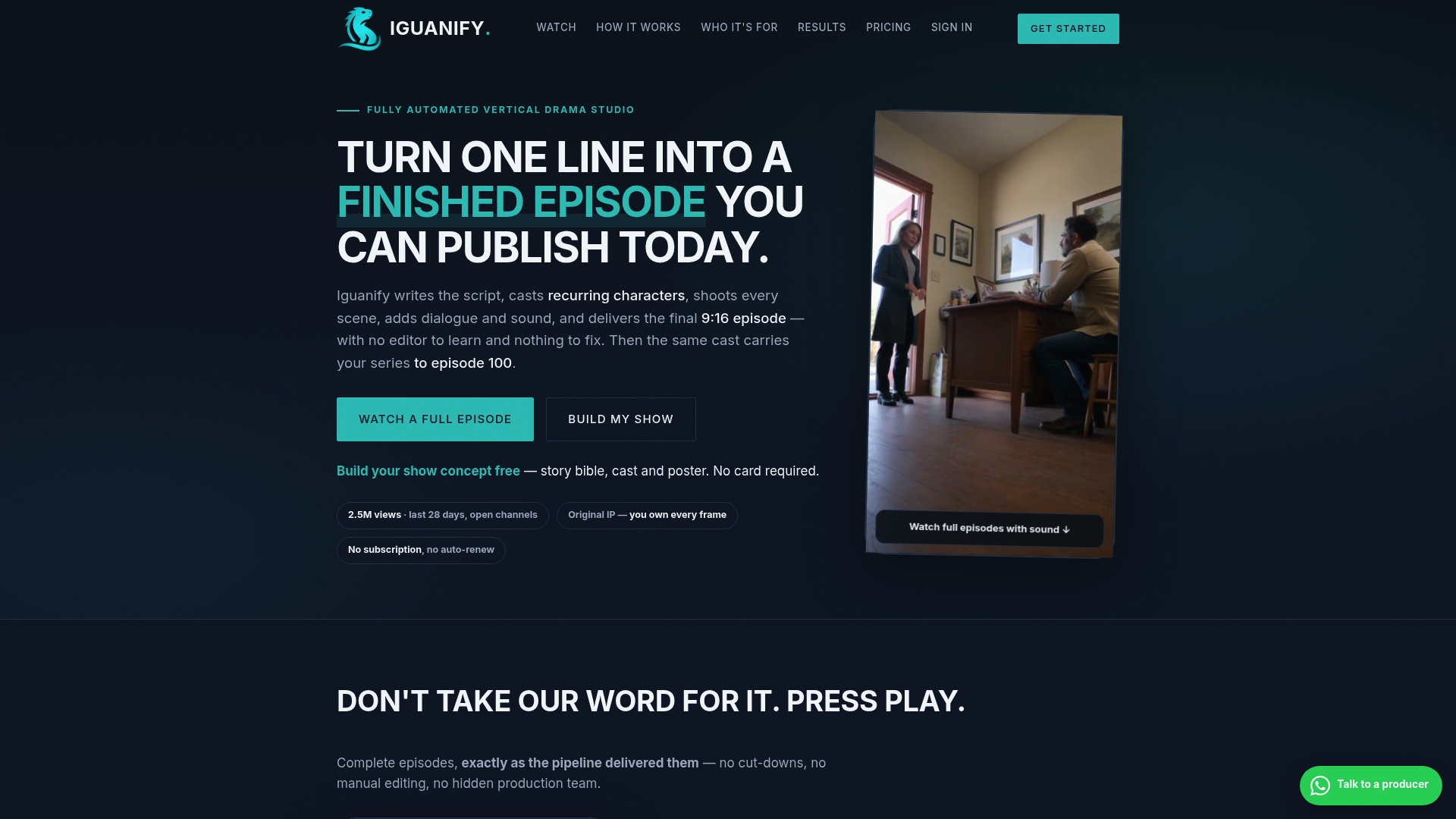
If you’re validating a new series concept, the Standard episode and Pilot options are built for exactly that: producing individual episodes at $34.99 each so you can test a hook before committing to a full season. For creators who already know they want a full recurring cast across a longer run, the AI Micro Drama Generator handles a full series on one consistent cast. Start by generating your first episode concept and see what a produced pilot actually looks like before you lock your cadence.
Sources
- How to Build a Signature Content Series (Later)
- YouTube Help — Audience tab and viewer types
- How to Batch Social Media Content Series That Build Audience (River)
FAQ
What Does Episodic Content Mean?
Episodic content is a recurring, standalone format where each installment follows the same structure and premise but doesn’t require watching previous episodes to understand it. That’s different from serialized content, which tells one continuous story across episodes in a required sequence. Both formats rely on cadence to build a returning audience.
What Is Episodic Storytelling?
Episodic storytelling uses a repeatable format, tone, and length to create a habit loop: viewers learn to expect a specific kind of payoff at a specific time. Continuity anchors, like a recurring line or character beat, reward viewers who watch every episode while still keeping each installment accessible to someone watching for the first time.
How Do You Build an Audience With a Series?
Plan at least six episodes before launching, lock a cadence you can sustain (weekly is the most common default), and publish a short teaser first to test your hook and metadata. Then track episode-over-episode retention, the most reliable signal that your format is building a habit rather than just collecting one-off views.
What Are the Main Types of Audiences a Series Attracts?
Definitions vary across marketing frameworks, but most creators dealing with episodic content think in simpler terms: new viewers discovering an episode for the first time, casual viewers who watch occasionally, and regular viewers who return consistently. YouTube’s Audience tab tracks this last group specifically because it’s the strongest indicator that a series has built real habit formation.
How Much Does Iguanify Cost to Produce an Episode?
A single Standard episode or Pilot through Iguanify costs $34.99 as a one-time purchase, with no subscription required. Pricing for larger packages like Season, Studio, or Slate production is available directly on the site.