 IGUANIFY
AI Character Consistency: 3 Layers From Tags to Episodes

The most reliable path to AI character consistency combines three layers: a curated reference set, a saved reusable character asset, and structured prompts, with lightweight personalization added only when a project demands higher fidelity. Reference based reuse is fast but can drift; methods like LoRA and DiffLoRA trade a bit of speed for tighter identity control, and a continuity-first platform like Iguanify builds this logic in from the start.
TL;DR:
- Curate 8 to 20 references across angles, lighting, expressions, and outfits; remove off model images, because variety matters more than adding near duplicates.
- Use tags or saved assets for a single short, but add LoRA once the character must survive more than a handful of scenes.
- Choose DreamBooth for stronger fidelity when setup time and broader references are acceptable; LoRA uses fewer parameters, while DiffLoRA speeds setup with a small fidelity tradeoff.
- Use training free attention sharing when backgrounds or secondary characters flicker; it stabilizes sequences, but it does not solve a face that changes between shots.
- Vary seeds during early testing, then lock them after choosing a result; record each approved image’s prompt, seed, and model version for reproducibility.
Table of Contents
- Methods for keeping a character’s identity stable
- Building a reusable character asset step by step
- Tool-level techniques that reduce character drift
- Fixing the most common continuity problems
- How a continuity-first production platform handles this at scale
- Keeping a character’s voice and dialogue tone consistent
- Tracking character traits with metadata and tagging
- Keeping visual consistency aligned with your story arc
- Automated tools for catching continuity errors
- A quick test worth running yourself
- Produce consistent episodes without building the pipeline yourself
- FAQ
- Sources
Methods for keeping a character’s identity stable
Every method for preserving character identity falls into one of three buckets, and picking the right one depends on how much drift you can tolerate and how much time you have before publishing.
- Reference-image reuse (Elements/tags): you save a character as a reusable asset or token and reference it in every new prompt; it’s the fastest route and works well for simple reuse across a single project or a handful of episodes.
- Personalization methods (LoRA, DreamBooth, DiffLoRA): you train or generate a small set of weights tied to your character, which locks identity more firmly but asks for more setup time and reference images.
- Training-free adapter methods: techniques like point-tracking attention and adaptive token merging share information between frames without any training step, which helps most with background and foreground continuity in sequences.
Reference-based reuse suits a creator testing a concept or producing a single short, since there’s no training step and you can start generating within minutes. It’s less reliable once you need the same face across a dozen episodes shot from different angles or in different lighting.
Personalization earns its keep when a character needs to survive close-ups, costume changes, and varied poses without losing their face. DreamBooth-style fine-tuning gives strong fidelity but can take anywhere from several minutes to a few hours depending on your setup, and it typically wants a broader reference set to avoid overfitting on a single pose. LoRA adapters cut that cost by training a smaller set of parameters, and newer parameter-generation approaches like DiffLoRA skip training entirely by predicting the weights directly from your reference images, trading a little fidelity for a much faster turnaround.
Training-free adapter methods solve a different problem: they don’t fix a wandering face so much as they stop the background, clothing, or secondary characters from flickering between shots. CharaConsist demonstrates this by sharing attention information across frames, which is especially useful once you move from single images into video keyframes.
As a rough heuristic: reach for tags and Elements first, add LoRA when a single character needs to appear in more than a handful of scenes, and layer in training-free adapters when backgrounds or secondary characters start to flicker.
Building a reusable character asset step by step
A character asset is only as strong as the reference set behind it, so the workflow starts well before you open your prompt box.
- Collect 8 to 20 varied reference images covering different angles, lighting conditions, expressions, and outfits; the ORACLE research found this range enough for most personalization pipelines, and variety matters more than volume because a model trained on one pose will reproduce that pose everywhere.
- Curate the set by removing outliers. Drop any image where the face looks off-model or lighting washes out key features. The ORACLE team showed that filtering by mutual information, rather than simple visual similarity, catches inconsistent candidates that naive filtering misses.
- Save and name the character asset. Whether that’s a token, an Element, or a trained adapter file, give it a clear name and a version number so you can track changes as you refine the character.
- Write a structured prompt template with consistent slots: identity anchors (hair color, face shape, a scar or tattoo), role, emotion or action, visual style, camera angle, and scene context. Keeping these slots in the same order across prompts reduces accidental drift.
- Generate in small batches with fixed seeds, then compare results using CLIP similarity or face-sim scores before picking a final image; this catches drift early instead of after a full episode is rendered.
- For video, map keyframes to consistent seeds and lock your aspect ratio before generating, then check lip-sync and pose continuity between frames rather than after the full sequence renders.
Pro Tip: Keep one reference sheet per character, with the original 8 to 20 images, the prompt template, and the seed numbers that worked, stored together so a future episode starts from the same foundation instead of from scratch.
Tool-level techniques that reduce character drift
A handful of settings and small tool choices do most of the work once your character asset is in place.
- Fixed seeds keep composition and lighting stable across generations, but locking a seed too early can also lock in an unwanted pose, so vary it during early testing and fix it once you find a result worth repeating.
- Negative prompts and attribute anchors explicitly state what should not change, such as hair color or eye shape, which helps catch the model before it swaps a feature mid-scene.
- LoRA injection and adapter composition let you apply a trained identity on top of a flexible base prompt, and CharCom’s research shows that composing separate per-character adapters at inference supports multi-character scenes without retraining anything.
- Tuning-free parameter generation, the approach behind DiffLoRA, predicts those same adapter weights directly from reference images, cutting personalization time without a full training run.
- Training-free attention sharing between frames, as used in CharaConsist, helps keep backgrounds and secondary elements from flickering in a sequence.
DiffLoRA’s evaluations rely on CLIP-based similarity and face-sim metrics alongside human judgment to measure identity preservation, and these same metrics give creators a practical way to spot-check their own output before publishing a scene.
Run a quick visual check on top of any metric: pull five generations side by side and look for the same face shape, same signature feature, and same general proportions. A metric can miss a subtle jawline shift that your eye catches immediately.
Fixing the most common continuity problems
Most character consistency problems trace back to one of five symptoms, and each has a fast, specific fix.
- Identity drift (face slowly changes): add or strengthen a LoRA adapter trained on your curated reference set rather than relying on tags alone.
- Pose copying (every image looks identical): vary your seed and loosen pose-related anchors in the prompt.
- Frozen pose (character won’t move naturally): relax camera and action anchors, and generate more batches before selecting.
- Background flicker across a sequence: add training-free attention sharing or masking rather than retraining the character itself.
- Prompt misalignment (output ignores part of the prompt): shorten the prompt and move identity anchors earlier in the structure.
Move from tags to full personalization once a character needs to hold up across more than a handful of scenes or multiple episodes, since that’s the point where small inconsistencies start to compound.
Version every character asset and log the prompt, seed, and model version behind each approved image, so a future episode can reproduce the same look instead of guessing.
Pro Tip: Keep a small “golden set” of five to ten validation prompts and reference keyframes for each character, and re-run them whenever you update a prompt template or swap models, so you catch continuity breaks before they reach a published episode.
How a continuity-first production platform handles this at scale
Manually managing reference sets, adapters, and prompt templates works for a handful of images, but it gets heavy fast once you’re producing episode after episode. That’s the problem Iguanify is built around: automated episodic production that keeps a recurring cast consistent from a single line of script, with real-time production and instant delivery built into the pipeline rather than bolted on afterward.
A continuity-first platform earns its place in your workflow when it handles the parts that don’t scale by hand:
Before trusting any continuity platform with a series, check how it handles rights, asset versioning, cast management across episodes, and delivery speed. Those four areas tend to separate a tool that saves real production time from one that just adds another manual step.
Keeping a character’s voice and dialogue tone consistent
Visual consistency solves only half the continuity problem. A character whose face stays locked but whose dialogue tone shifts from episode to episode still reads as a different person to your audience.
Tie voice choices to the same identity anchors you use visually: a character’s vocabulary, pacing, and emotional register should map to the same traits that define their look, whether that’s a clipped, no-nonsense speech pattern for a stern character or a looser, joke-heavy cadence for a comic one. Writing a short voice profile alongside your visual reference sheet, covering typical sentence length, favorite phrases, and emotional range, gives you something concrete to check dialogue against before it ships.
For episodic work, dialogue tone drift tends to creep in gradually rather than appear all at once, which makes it easy to miss until several episodes have shipped. Spot-checking a line of dialogue against your character’s voice profile before finalizing each episode catches this early, the same way a golden set of validation prompts catches visual drift.
If your production involves actual voice recording or remote collaboration with a sound team, keeping session quality and workflow standards consistent matters too. Industry standards for remote studio sessions offer a useful reference point for creators coordinating voice work across a distributed team, since inconsistent recording conditions can undercut even a well-written voice profile.

Tracking character traits with metadata and tagging
A character sheet that lives only in your head doesn’t scale past two or three episodes. Metadata and tagging systems solve this by turning each trait, physical and behavioral, into something you can search, compare, and reuse.
A practical tagging system for episodic work typically covers:
- Physical tags: hair color, eye color, signature marks, and typical outfit, matched to the identity anchors in your prompt template.
- Behavioral tags: personality traits, typical reactions, and relationship notes to other characters in the cast.
- Scene tags: which episode, scene, and emotional beat each generated image or clip belongs to.
Keeping these tags attached to your saved character asset, rather than scattered across separate notes, means you can pull up exactly how a character looked and acted three episodes back before generating episode four. This matters most once a series runs long enough that memory alone can’t hold every detail, and it’s part of why structured cast management inside a dedicated episodic workflow tends to outperform a folder of loose reference images once a series grows past a few episodes.
Keeping visual consistency aligned with your story arc
A character’s look shouldn’t stay frozen if the story calls for change, an injury, a costume shift, a time jump, but that change needs to track the plot deliberately rather than happen by accident.
The practical fix is to treat any planned visual change as a new, versioned variant of your character asset rather than a fresh character. If your protagonist gets a scar in episode five, save a new reference sheet and token labeled for “post-injury” continuity, keep the original identity anchors that don’t change, and update only the ones the story requires. That way, episodes six onward pull from the correct version automatically instead of you trying to remember which episode introduced the change.
Mapping these variants to your story outline ahead of time avoids a common failure: a character’s appearance reverting to an earlier version because a later prompt accidentally referenced an outdated asset. Keeping a short list of “which version applies to which episode range” alongside your series bible solves this with almost no extra effort once it’s in place.
Automated tools for catching continuity errors
Manual spot-checks catch a lot, but they don’t scale cleanly once you’re producing episodes on a regular cadence. This is where automated continuity checking earns its place in a production pipeline.
The research behind tools like CharaConsist points at the kind of checks that catch errors before a human has to: comparing face-sim and CLIP similarity scores across a batch of generated frames flags a character whose face has quietly drifted, while attention-sharing and masking techniques catch background elements that flicker between shots without you needing to review every frame by eye.
For creators working at episode-after-episode pace, an end-to-end production workflow that builds continuity checking into the pipeline removes a layer of manual review that would otherwise fall on you after every render. The goal isn’t to replace human judgment entirely, since a quick visual spot-check still catches subtle issues a metric might miss, but to flag the obvious breaks automatically so your review time goes toward judgment calls rather than frame-by-frame comparison.
A quick test worth running yourself
If you take one thing from this: save a reusable character asset and build your prompts around a structured template before you worry about anything fancier. Try a three-shot reference set, register it as a token, generate five scene variations, then compare faces side by side. Adjust and repeat.
— Leonard
Produce consistent episodes without building the pipeline yourself
Everything above describes the manual version of what Iguanify handles automatically. Our Standard episode and Pilot packs turn a single premise into produced episodes with a recurring cast already locked for continuity, and Creator, Season, Studio, and Commissioned production options scale that same approach as your series grows.
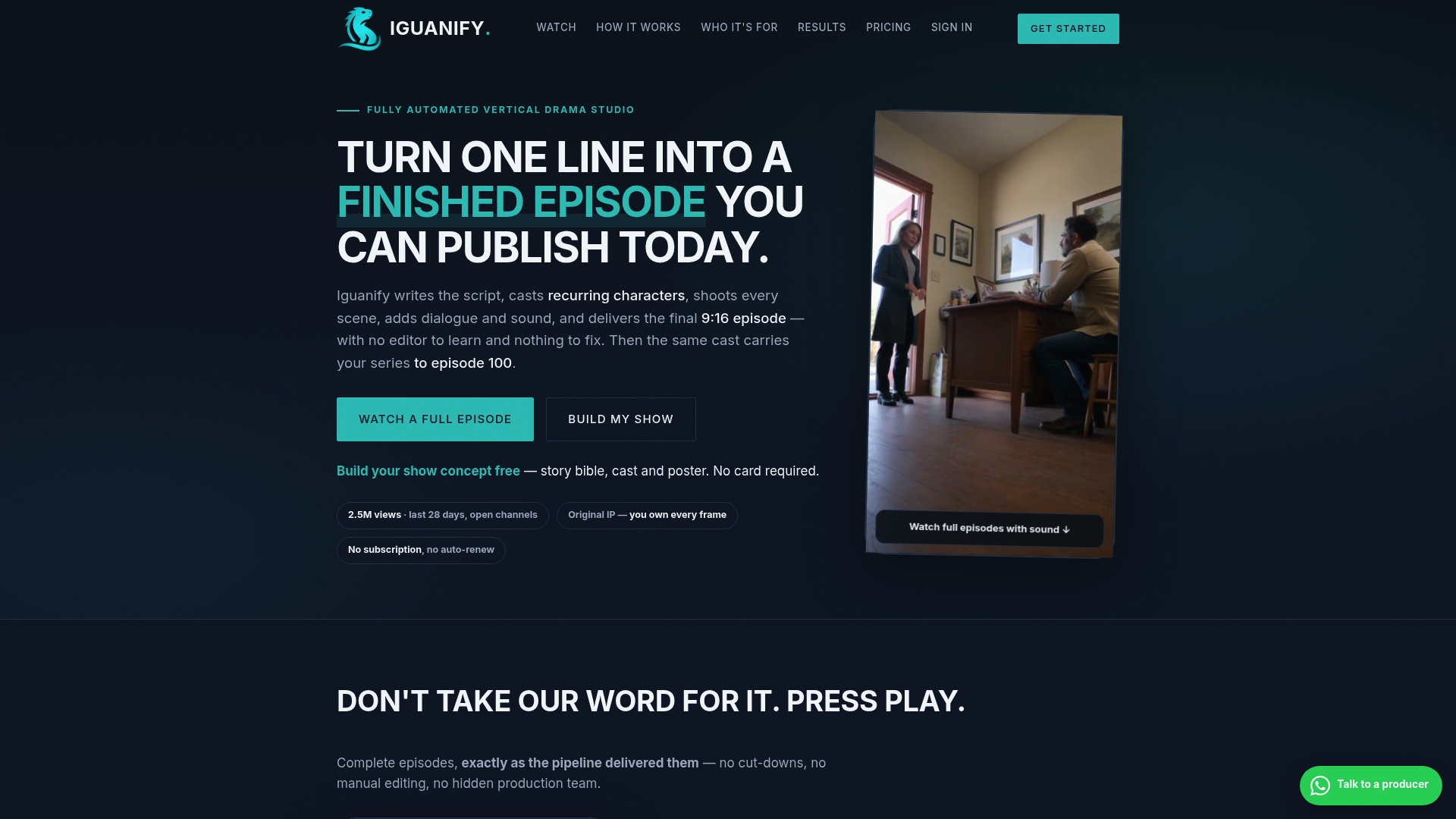
You bring the premise, we handle cast generation, continuity, and delivery, no reference-set curation or adapter training required on your end. Visit the AI Drama Generator page to start an episode, or try the Iguana Engine if you want a self-serve pass at show concept and cast generation first.
FAQ
What is the fastest way to keep an AI character consistent?
Saving a reusable character asset, such as an Element or token, backed by 8 to 20 varied reference images is the fastest method, since it needs no training step. It works well for a single project but tends to drift once a character appears across many episodes, which is when lightweight personalization like LoRA becomes worth the extra setup.
How many reference images does a character need?
Most personalization pipelines work well with 8 to 20 varied images covering different angles, lighting, and expressions, according to ORACLE’s research. Variety across the set matters more than raw volume, since a narrow set tends to lock in one pose rather than the character’s identity.
What causes AI character drift between scenes?
Character drift usually comes from a reference set that’s too narrow, a prompt template that shifts between generations, or the absence of a saved identity anchor like a LoRA adapter. Adding structured prompts and a trained adapter, as shown in CharCom’s composable approach, reduces drift across multi-scene sequences.
Is LoRA or DreamBooth better for character consistency?
DreamBooth-style fine-tuning tends to give slightly stronger fidelity but costs more time and reference images, while LoRA reaches comparable consistency with less compute and a smaller dataset. Newer tuning-free approaches like DiffLoRA predict similar adapter weights directly from reference images, trading a small amount of fidelity for a much faster turnaround.
How does Iguanify keep characters consistent across episodes?
Iguanify builds recurring-character continuity directly into episode production, so a cast generated for episode one carries through later episodes automatically. Pricing starts at $34.99 per episode for the Standard episode and Pilot packs, with Creator, Season, Studio, and Commissioned production available for larger series.
Sources
- ORACLE: Leveraging Mutual Information for Consistent Character Generation with LoRAs in Diffusion Models
- CharaConsist: Fine-Grained Consistent Character Generation (ICCV 2025)