 IGUANIFY
How Creators Keep AI Actor Likeness Rights With an 8 Step Workflow

Ownership of a recurring AI character comes down to two things: how much original human creativity went into building it, and what your production platform’s contract says you keep. The U.S. Copyright Office will only register the human-authored parts of your work, never the purely machine-generated output, so your claim stands or falls on documented creative choices plus favorable licensing terms.
TL;DR:
- Human involvement in selecting, designing, and directing a character’s development is necessary to claim copyright protection for AI-generated characters.
- Platform licensing clauses, especially those granting perpetual rights, training rights, or broad sublicensing, can significantly undermine your ownership unless negotiated carefully.
- Documenting creative decisions, revisions, prompts, and scene details strengthens your legal claim and is essential for registering enforceable rights.
- Disclosures in marketing content must be clear and visible when using AI avatars to avoid FTC violations for deceptive endorsements.
- International differences in copyright and publicity laws mean creators must review local regulations before distributing AI-based characters abroad.
Table of Contents
- When is a recurring AI character protectable?
- Platform terms and licensing pitfalls: what to read and what to negotiate
- How to document and register your human-authored elements
- Marketing and FTC compliance when using AI avatars
- Legislative and enforcement developments to watch
- Practical creator checklist for recurring AI characters
- Recent case law shaping AI-created character rights
- How likeness rights for AI characters differ internationally
- Treat recurring AI characters as hybrid IP projects
- How Iguanify helps you keep ownership while producing recurring characters
- FAQ
- Sources
When is a recurring AI character protectable?
The Copyright Office draws a clear line: machine-only output has no human author behind it, so it gets no copyright. What changes the picture is your involvement. Selecting a character’s design from dozens of generated options, arranging scenes in a specific sequence, revising dialogue, and directing how a personality develops across episodes are all acts of authorship, and the Copyright Office’s registration guidance treats them as protectable when they reflect genuine creative judgment.
For an episodic series, this plays out in concrete ways:
- Writing and revising scripts that shape a character’s voice and arc counts as human authorship.
- Choosing and refining a visual design from AI-generated options counts, even when the base image came from a model like those explained at Palmedor AI.
- Directing continuity decisions, like how a character reacts across a season, builds a documentable creative record.
- Raw, unedited AI output with no selection or arrangement does not qualify on its own.
When you register, disclose the AI-generated material and describe your own contribution plainly. The Office wants to know what you made versus what the model made, and vague applications invite rejection or future challenges.
Platform terms and licensing pitfalls: what to read and what to negotiate
Authorship only gets you halfway. The platform you use to generate your characters controls the other half through its terms of service, and many creators never read the clauses that matter most.
Watch for these three patterns before you sign up or renew:
- Perpetual, irrevocable assignment language that hands your character designs to the platform permanently, even after you stop using the service.
- Training-rights grants that let the platform use your scripts, character art, or footage to train its own models, sometimes producing lookalikes for other users.
- Broad sublicensing rights that allow the platform to relicense your content to third parties without your approval.
When you find any of these, push back with specific asks: a time-limited license instead of a perpetual one, an explicit carve-out that excludes your content from training data, and a written confirmation that you retain exclusive ownership of the character’s identity, name, and design.
Pro Tip: Search any terms page for “irrevocable,” “perpetual,” and “train” before you read anything else. Those three words flag most of the risk.
How to document and register your human-authored elements
Evidence wins disputes. If you can’t show what you created versus what the model generated, you have a weak claim no matter how original the character feels.
- Keep versioned scripts with timestamps so you can show how a character’s dialogue and personality evolved through your edits.
- Log your prompts and the variations you rejected, since the choices you made among generated options are themselves a form of authorship.
- Export staged direction notes, scene timelines, and source files as you produce each episode.
- When you file with the Copyright Office, describe your specific contributions in the “Author Created” field and list the AI-generated portions in “Material Excluded.”
Registration isn’t just paperwork. A completed registration establishes a public record of your claim and is generally required before you can pursue certain remedies, including statutory damages, in a U.S. infringement case. The Copyright Office’s guidance on AI-assisted works confirms that disclosure of AI content alongside a clear description of human contribution is what makes a registration enforceable rather than cosmetic.
Marketing and FTC compliance when using AI avatars
Using an AI-generated character to promote your work is not inherently a problem. The FTC’s guidance on consumer reviews and testimonials makes clear that AI avatars are not banned from marketing, but deceptive endorsements built around them are.
A few practices help ensure compliance:
- Do not present an AI character’s reaction or review as coming from a real customer or user.
- Clearly disclose when a testimonial, review, or endorsement features a synthetic performer instead of a real person.
- Make disclosures visible and not hidden in captions or linked pages.
- Avoid suggesting your AI character has tested or used a product in ways only a real human could.
Compliant marketing simply labels what it is. Risky marketing lets viewers assume a synthetic actor is a genuine customer.
Legislative and enforcement developments to watch
Federal lawmakers are actively working on rules that would change how synthetic likenesses get treated. The NO FAKES Act, introduced in the 119th Congress, would create a licensable digital-replication right covering voices and visual likenesses, and it would bar disclaimers as a defense in civil actions over unauthorized replicas.
If something like this passes, expect stronger private rights to sue over unauthorized digital replicas and less room to rely on a simple “AI-generated” disclaimer as legal cover. For creators building recurring characters now, the practical response is the same regardless of how the legislation lands: keep clean contract language with your platform, document every creative decision, and avoid basing a character too closely on any identifiable real person without a release.
Practical creator checklist for recurring AI characters
We built an 8-step legal checklist specifically for creators producing serialized AI content, and it maps directly onto the risks covered above.
- Document your creative contributions to each character as you make them, not after a dispute starts.
- Limit your platform’s licensing rights to what you actually need, in writing.
- Register the human-authored elements of your series with the Copyright Office.
- Secure a release if any character design draws on a real person’s identifiable likeness.
- Label AI-generated marketing content honestly and consistently.
- Retain your own master files and exports outside the platform.
- Negotiate training-rights exclusions before you sign any contract.
- Keep secure, dated prompt and revision logs for every episode.
Each step closes a specific gap: the registration step gives you something to enforce, the training exclusion keeps your character off a public model, and the retained masters mean you aren’t dependent on one vendor’s servers. Our guide on building a recurring cast walks through the documentation habits that make step one and step eight actually hold up.
Pro Tip: Treat your character bible, with design notes, voice guidelines, and episode history, as a legal document, not just a creative reference.
Recent case law shaping AI-created character rights
Courts are still working through how existing copyright doctrine applies to AI-assisted creative work, and most rulings so far track the Copyright Office’s own position rather than breaking new ground. The consistent theme across registration refusals and early court decisions is that purely AI-generated material, with no human selection or arrangement, does not qualify for protection, while works blending human creative judgment with AI tools can succeed in claiming the human-authored portions.
This matters directly for recurring characters because a series built over many episodes accumulates a thicker record of human decisions: script revisions, character arc choices, directed line readings, and edited designs. The more that record exists, the stronger a copyright claim looks if it’s ever challenged. Conversely, a character generated once and never substantially revised by a human hand is the weakest kind of claim, since it most closely resembles the unprotectable, machine-only output the Copyright Office has repeatedly declined to register.

Because this area is developing quickly, creators should treat any precedent as provisional rather than settled law. The safest practical stance is not to wait for a court to clarify your specific situation. Build your documentation trail now, register what you can, and keep your platform contracts favorable, so that whichever way future rulings land, you already have the evidence a court or examiner would look for.
How likeness rights for AI characters differ internationally
Copyright systems outside the United States handle human authorship differently, and creators distributing internationally should know the baseline differs even when the underlying AI tools are the same. Some jurisdictions apply a stricter originality standard that may make it harder to protect AI-assisted work with minimal human revision, while others have begun drafting AI-specific guidance that has not yet reached the clarity the U.S. Copyright Office has published.
Right-of-publicity style protections, which govern whether a real person’s identity can be used without consent, also vary significantly by country, and these rules are separate from the copyright questions covering your original, fictional AI characters. If your recurring character is entirely synthetic and not based on a real, identifiable person, your main international exposure is usually about where you can enforce a copyright claim, not about publicity rights.
Because this article focuses on U.S. law, treat any international distribution as a separate compliance question. If you plan to license or sell a series abroad, a local review of that market’s copyright and advertising rules is worth the cost before you commit to a distribution deal, rather than assuming U.S. protection travels with the content.

Treat recurring AI characters as hybrid IP projects
The mistake we see most often is creators assuming a character is either “theirs” or “not theirs,” when the real answer is almost always partial. A recurring AI character is a hybrid: part machine output, part human craft, and the law only protects the human part. Treating your series like a hybrid IP project from the first script, rather than an afterthought once it gets popular, changes everything about how defensible it becomes.
Start documenting before you publish, not after someone copies your character. Read your platform’s contract before you build a season around it. The creators who protect their work are the ones who treated the paperwork as part of production, not a chore for later.
— Leonard
How Iguanify helps you keep ownership while producing recurring characters
We built our platform to solve the continuity problem that makes most AI video tools unusable for series work, and ownership follows the same philosophy: you keep full rights to what you produce.
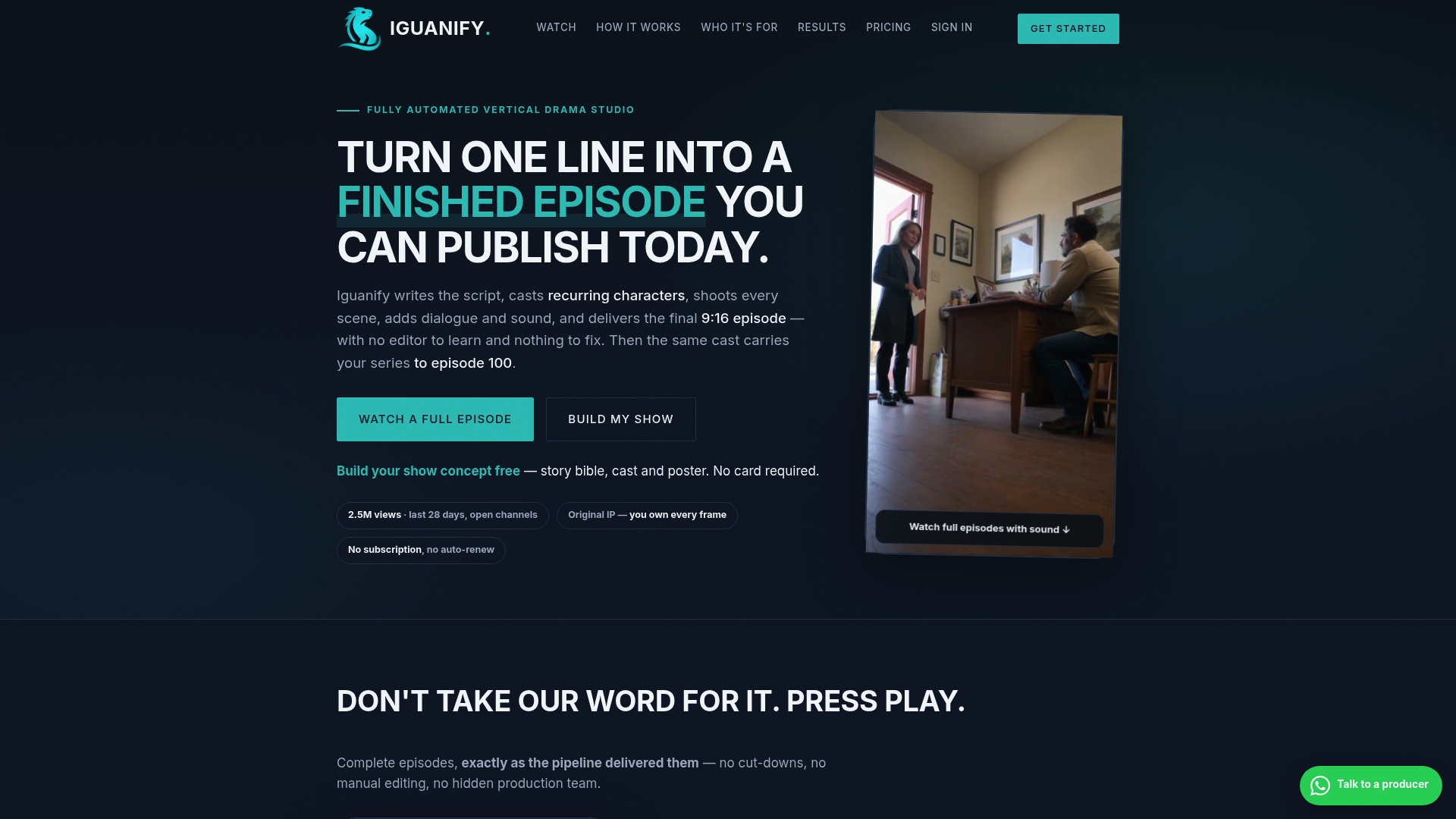
- Our automated production process maintains consistent recurring characters across episodes, so you’re not rebuilding a cast from scratch every time.
- You retain full ownership of the episodes you produce through our episodic drama generator, without a training-rights grab buried in the fine print.
- Our 8-step legal checklist gives you a documented process for claiming your human-authored contributions from day one.
If you want continuity and documented ownership without assembling a production team, explore the Iguana Engine for a self-serve route to building your own recurring cast.
This article is general information, not a substitute for advice from a qualified lawyer. Consult a qualified legal professional about your own circumstances before acting on anything here.
FAQ
Can I copyright an AI-generated character I didn’t heavily edit?
Probably not on its own. The Copyright Office requires human authorship, so a character generated with minimal selection or revision likely won’t qualify for protection until you add documented creative choices like design edits, scripted personality traits, or directed scenes.
Does a platform’s terms of service affect who controls my character?
Yes, often more than copyright law does. Even when you hold human-authored rights, a platform’s license terms can grant it broad reuse, training, or sublicensing rights over your content unless you negotiate narrower terms.
What should I disclose when registering a work with AI content?
You need to describe your human contribution and disclose or exclude the AI-generated portions in the application, using the “Author Created” and “Material Excluded” fields as outlined in the Copyright Office’s registration guidance.
Is it legal to use an AI avatar in advertising?
Yes, the FTC permits AI avatars in marketing, but presenting an AI character’s reaction as a genuine customer endorsement or testimonial is deceptive and prohibited.
How much does it cost to produce a recurring AI character series?
A standard episode through our AI drama generator costs $34.99 one time per episode, with no subscription required; other packages like Creator, Season, and Studio are priced on request.
Sources
- U.S. Copyright Office news release (2025)
- The Consumer Reviews and Testimonials Rule: Questions and Answers | Federal Trade Commission
- Rep. Salazar press release on the NO FAKES Act