 IGUANIFY
60–120 Second TikTok Script Format for Automated Episodic Creators

The right TikTok script format for serialized vertical drama is a 60 to 120-second episode built on the Beat Engine: Hook, Friction, Spike, Button. Draft it with timestamps, upload the whole season as one multi-episodic project, and lock a character bible before you write a single line of dialogue. Get those three things right and an automated pipeline like Iguanify can turn your script into a rights-owned, publish-ready episode without a shoot day.
TL;DR:
- Upload the entire season as a single project to maintain character, prop, and wardrobe consistency across episodes and prevent drifting.
- Draft timestamps and beat intent words for the four key beats before writing dialogue to ensure tight pacing and clear plot progression.
- Lock the character bible, including canonical names, face and voice IDs, wardrobe presets, and signature props, prior to production begins.
- Use metadata-heavy scene headers with location tags and grouped micro-scenes to facilitate efficient shooting and automation in post-production.
- Incorporate visual and sound cues directly into the script to aid pacing, scene continuity, and the integration of TikTok platform features and trends.
Table of Contents
- Episode-level script structure: the Beat Engine and timestamp skeleton
- Series bible and arc fields automated producers need
- Continuity practice: locking a character bible and multi-episodic asset linking
- Production-ready formatting and packaging rules
- Quick sample timestamp skeleton and pre-upload checklist
- Tips for writing effective dialogue for TikTok’s short-form video format
- Best practices for integrating visual and audio elements in the script
- Techniques for incorporating TikTok trends and platform features into scripts
- Common mistakes to avoid in TikTok scriptwriting
- Specific formatting guidelines and conventions unique to TikTok scripts
- What format discipline actually buys you in production
- Turn a locked script into a finished episode with Iguanify
- Sources
- FAQ
Episode-level script structure: the Beat Engine and timestamp skeleton
Vertical drama runs on a different clock than a traditional script. The Beat Engine breaks a micro-episode into four timed beats, and drafting those timestamps before you write dialogue changes how you build the whole scene.
- Hook (0 to 15 seconds): Open mid-conflict or mid-reveal. No setup, no scene-setting small talk.
- Friction (15 to 60 seconds): Escalate the obstacle between what the character wants and what stands in the way.
- Spike (60 to 90 seconds): Land the emotional peak, the twist, or the confrontation the first minute promised.
- Button (final 5 to 10 seconds): Cut on a cliffhanger that forces the next tap.
That last point matters more than it looks. Practitioner guidance frames the viewer’s action as a “tap,” and every line in your script needs to earn it: advance the plot, or reveal character under pressure. A line that does neither is dead weight in a format this tight.
Dialogue in vertical drama also has to work as action. You’re shooting close-up, vertical, and fast, so a character’s line often has to carry what a wide shot would normally show: intent, status, threat. Write it that way from the first draft rather than patching it in later.
Episode length should sit between 60 and 120 seconds, and across a season that adds up fast. A full run of episodes translates into a dense stack of micro-scenes, which is exactly why the timestamp skeleton comes first: it gives your automated pipeline a clean structure to read before a word of dialogue exists.
Pro Tip: Write your four timestamps and one beat-intent word for each (reveal, escalate, twist, cliffhanger) before you write a single line of dialogue. It keeps every episode the same shape even when the story changes.

Series bible and arc fields automated producers need
A script format only works at scale if the series bible behind it can prove the premise has legs. Reporting on the vertical drama market shows business models vary between gaming-style conversion funnels and studio-style approaches, but both depend on a bible that documents the strategy clearly enough for an automated system, or a human producer, to schedule against.
Your bible should cover:
- Premise and genre, stated in one line a stranger could pitch back to you.
- Structural conflict, the recurring friction (enemies-to-lovers, forbidden proximity, power imbalance) that can generate new episodes without running dry.
- Character configuration, including who carries the emotional debt and who pays it off.
- Episode-by-episode outline for the first stretch of the run, enough to show the premise can sustain a long season rather than five good episodes and a stall.
- Revenue and paywall strategy, since pay-or-wait monetization is standard in the category and needs to be planned into the story, not bolted on after.
Emotional-debt architecture is the part writers skip and regret. Document exactly which episodes carry conversion weight, which reveal a secret, and which resolve a promise made three episodes earlier. Each episode entry in your bible should also carry metadata: episode ID, paywall flag, a short synopsis, key props and wardrobe, and key locations. That metadata is what turns a bible from a writing document into a production one.
Continuity practice: locking a character bible and multi-episodic asset linking
Character drift is the single most visible failure mode in AI-driven episodic production, and it’s preventable at the script stage. The fix, according to breakdown guidance for vertical drama, is uploading the entire season as one multi-episodic project rather than episode by episode, so the system can co-reference characters, props, and wardrobe across the whole run instead of treating each episode as a stranger.
Lock these fields before production starts:
- Canonical name and aliases, so a nickname in episode 12 still resolves to the same character record.
- Face and voice asset IDs, tied once and reused, not regenerated per episode.
- Wardrobe presets, so a signature jacket or uniform stays consistent scene to scene.
- Signature props, anything a character carries or uses that a viewer would notice if it changed.
Automated tagging can build a master breakdown sheet from this data, pulling every scene’s cast, props, wardrobe, and location into one canonical table. That sheet becomes the production source of truth. It still needs a human pass, though, particularly on paywall-adjacent episodes where a wardrobe or prop inconsistency does more damage to viewer trust than it would in a free episode.
Pro Tip: Treat your character bible as a locked document once production starts. Mid-season edits to a canonical asset ID are the fastest way to reintroduce the drift you built the bible to prevent.
Production-ready formatting and packaging rules
Formatting for vertical drama isn’t spec-script formatting with the margins tightened. Long-form conventions like act headings and traditional scene transitions do little for an automated pipeline, so formatting guidance from the Writers Guild Foundation on scene mechanics is worth knowing mainly as a contrast: micro-episodes need lighter, metadata-heavy headers instead.
- Write scene headers with location tags, marking whether it’s a standing set or a practical location, so scenes can be grouped for shooting rather than left in narrative order.
- Group micro-scenes by location, not by story sequence. A breakdown of vertical drama production notes that a full season can span 70 to 140 script pages split into 200 to 400 or more micro-scenes, and grouping by location is what keeps that volume shoo table in a reasonable number of days.
- Attach metadata to every scene: episode ID, scene ID, character IDs, wardrobe and prop tags, paywall flag, and estimated shot type.
- Export in a format your pipeline accepts. Final Draft, Fountain, or CSV all work, but keep episode-number prefixing consistent across the season so a multi-episodic upload doesn’t scramble order.
This is also where format pays for itself operationally. A properly tagged master sheet can generate an export straight into scheduling tools, cutting a compilation task that once took hours down to minutes. Skip the metadata and you’re back to doing that by hand.
Quick sample timestamp skeleton and pre-upload checklist
Here’s a 90-second skeleton you can copy and adjust:
0 to 12s (Hook): Character discovers the note they weren’t supposed to see. 12 to 55s (Friction): They confront the person who left it, get deflected, escalate. 55 to 80s (Spike): The truth comes out, mid-argument, in the worst possible place. 80 to 90s (Button): A third character walks in and says the one thing that changes everything.
Before you upload, run the script against this checklist:
- The full season exists as a single multi-episodic project file, not separate uploads.
- The character bible is locked, with canonical IDs assigned to every recurring face, voice, and wardrobe piece.
- Wardrobe and prop IDs are tagged at the scene level.
- Paywall episode flags are set, especially near the conversion point in your outline.
- Location tags are consistent across every scene set in the same place.
- Your export format has been validated against the pipeline you’re using.
Reserve your human-review time for paywall-adjacent episodes and any scene using a recurring prop or wardrobe piece. That’s where a small tagging error does the most visible damage.
Tips for writing effective dialogue for TikTok’s short-form video format
Dialogue in a 60 to 120 second episode has no room for warm-up. Every line should do one of two jobs: move the plot or expose character under pressure, and the strongest lines do both at once.
Cut greetings, small talk, and scene-setting exposition. If a viewer needs backstory, deliver it through a loaded accusation or a defensive reaction, not a recap. Keep sentences short enough to read as speech, not as prose, since the actor or the AI voice model needs a rhythm that sounds spoken rather than written.
Write toward the Button. If the last line of the episode is the cliffhanger, every earlier line should be setting that line up, even indirectly. A useful test: read the episode backward from the final line and check whether each prior beat makes that ending land harder.
Avoid dialogue that explains emotion instead of showing it under pressure. “I’m furious with you” is weaker than a line that makes the fury obvious through what’s said and what’s withheld. Vertical drama audiences are used to fast, blunt confrontations, and dialogue that hedges or softens reads as slow in a format built for speed.
Finally, write for close-up. Since most vertical drama frames tightly on the face, a character’s dialogue often has to carry information a wider shot would normally show through blocking or background action. Say the thing the camera can’t.
Best practices for integrating visual and audio elements in the script
Visual and audio cues belong in the script itself, not left to guesswork on set or in post. Note the shot type at each beat, at minimum whether it’s a close-up, a two-shot, or an insert on a prop, since that decision affects pacing as much as dialogue does.
Sound cues matter more in vertical drama than their length suggests. A short sting on the Hook, a beat of silence before the Spike, or a music swell under the Button all shape how the cliffhanger lands. Mark these directly in the script rather than as a separate note, so they travel with the scene through tagging and production.
Visual continuity cues, like a recurring object entering frame or a specific camera move tied to a character’s introduction, should be documented once in the character bible and referenced by ID in the script rather than re-described every episode. That keeps the script readable and keeps the automated pipeline consistent about how a character is framed across the season.
Keep captions and on-screen text minimal and purposeful. A caption that repeats what the dialogue already says wastes the one visual element viewers actually read in the first two seconds. Use it instead for information dialogue can’t carry cleanly, like a time jump or a location change.
Techniques for incorporating TikTok trends and platform features into scripts
Trends move fast, and a script format that can’t absorb a current sound, a text overlay style, or a transition trend without breaking continuity is a problem. Build trend flexibility into the Hook specifically, since that’s the beat most tied to what’s currently getting taps, and the Friction, Spike, and Button beats can stay structurally stable underneath it.
Treat trending audio and effects as optional Hook-level dressing, not something that reshapes your character bible or episode outline. A trend that requires rewriting your premise isn’t worth chasing for a serialized format built to run for dozens of episodes.
Platform features like stitch-style openings or duet-style framing can work as a Hook device for episode one of a season, where you’re trying to earn a first tap from a cold audience. After that, consistency matters more than novelty, since returning viewers are taping in for the story, not for a fresh gimmick every episode.
Watch for format signals rather than individual viral clips. If a particular caption style, pacing, or text-overlay convention is showing up across a category consistently, that’s a format shift worth testing. A single viral video is not a pattern.
Common mistakes to avoid in TikTok scriptwriting
The most common mistake is writing sequence-first instead of beat-first: drafting a scene as continuous action and only later trying to force it into Hook, Friction, Spike, and Button. That produces episodes with a mushy middle and a weak ending, because the cliffhanger was never designed in, just discovered.
A second mistake is skipping the timestamp skeleton entirely and writing straight to dialogue. Without timed beats, episodes run long, pacing drifts, and the Button often arrives too late to function as a real cliffhanger.
A third mistake, and the one that causes the most damage over a full season, is uploading episodes one at a time instead of as a single multi-episodic project. Doing this makes it harder for an automated system to keep a character’s face, voice, and wardrobe consistent, and drift compounds fast once a season passes a dozen episodes.
Writers also under-plan the middle of the run. A premise that’s strong for ten episodes but has no structural conflict to sustain forty or eighty falls apart right where paywall-adjacent episodes need to carry the most weight. Plan your arc length before you write episode one.
Last, treat wardrobe and prop tagging as optional. It never is. A recurring object that changes color or disappears between episodes is a small error that reads as a big one to a viewer who’s been tapping in for weeks.

Specific formatting guidelines and conventions unique to TikTok scripts
Scene headings in vertical drama script format skip the full slugline conventions of feature scripts. A location tag, a standing set or practical designation, and an episode and scene ID are more useful than a formal INT/EXT header, because those are the fields an automated pipeline actually reads.
Timing cues belong inline with the beat, not as a separate shot list. Write the timestamp range directly above or beside the dialogue it governs, so anyone, human or automated, can see at a glance which line belongs to which beat.
Keep scene descriptions short, close to a single line, since vertical drama rarely uses the kind of extended action description a feature script relies on. Most of the visual information should live in the shot-type and cue notes rather than in prose.
Episode numbering should be consistent and prefixed the same way across the whole season file, since multi-episodic upload depends on that consistency to sequence episodes correctly. A script format that mixes numbering conventions partway through a season is one of the more common self-inflicted production delays.
What format discipline actually buys you in production
Format discipline is the difference between an episode that ships clean and one that comes back from production with fixes. Loose scripts create loose footage, and loose footage is where viewer churn actually starts. Automated production platforms need structured input to return consistent episodes, so the real work is drafting your timestamp skeleton and locking your character bible before you write a single line of dialogue.
— Leonard
Turn a locked script into a finished episode with Iguanify
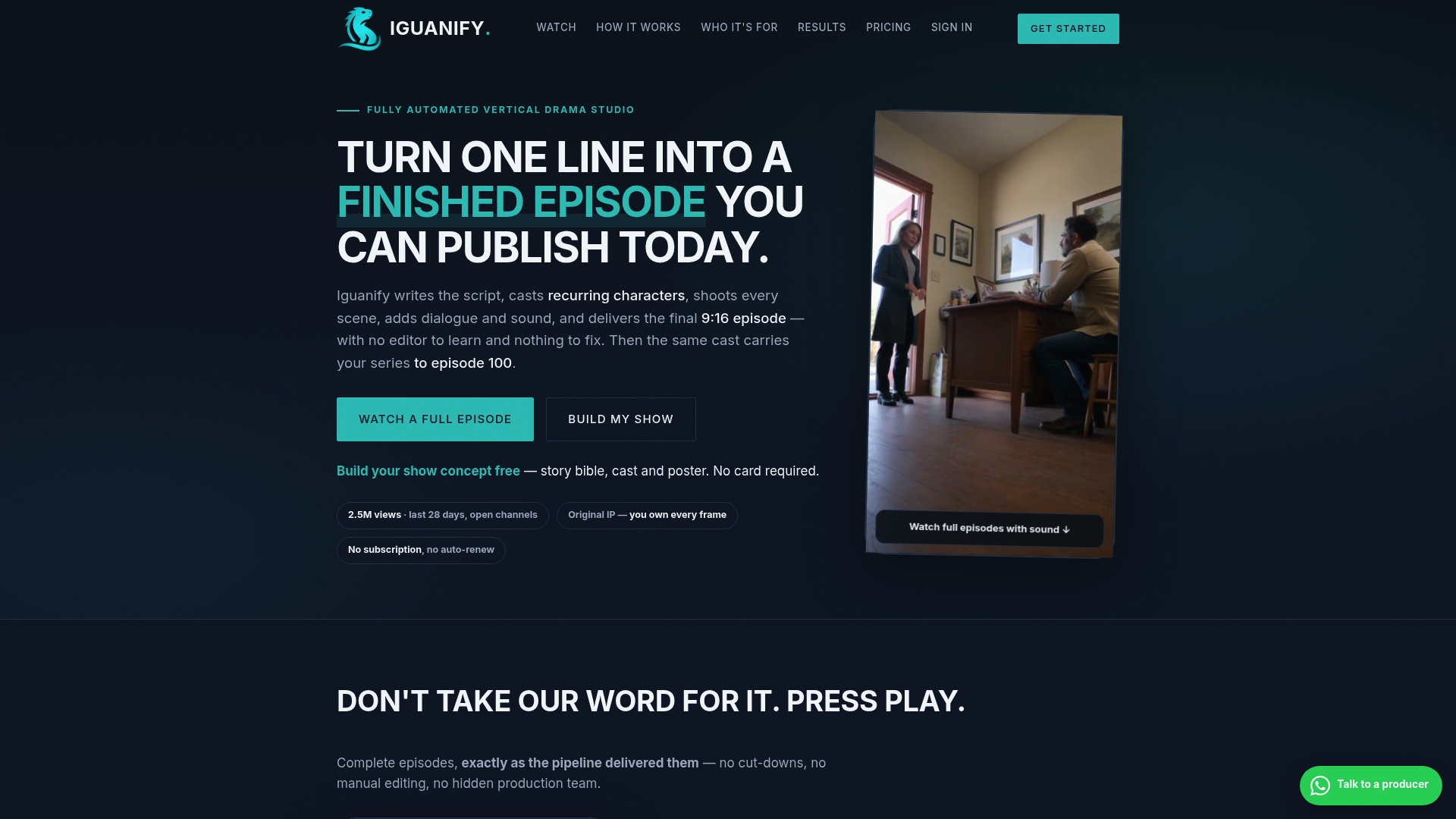
Once your script and character bible are locked, the slow part of vertical drama production is everything after the page: casting, shooting, editing, exporting. Iguanify removes that stretch entirely, converting a script and a locked cast into a fully produced episode with consistent characters carried across the whole season, no editing team required.
That matters most for creators managing volume or continuity they can’t track by hand. If you’re producing one or two episodes and have the time to shoot yourself, self-production still works. If you’re running a season with recurring characters and a paywall strategy that depends on wardrobe and prop consistency, an automated pipeline is built for exactly that pressure point.
- Episodes are delivered with minimal waiting once the script and cast are set, with no long edit queue.
- You keep full ownership of every episode produced, ready to publish across TikTok, YouTube, or Instagram.
- A Standard episode or Pilot runs $34.99 one off per episode, with Creator, Season, Studio, and Slate options for larger runs, priced on the AI drama generator page.
Run your script through the pre-upload checklist above, then bring it to the AI drama generator and see what a locked bible turns into.
Sources
- How to Write a Vertical Drama Script in 2026 | Filmustage
- Vertical Dramas: the short-form stories of today - Hollywood Branded
- Vertical Drama Is Splitting in Two - Maureen Kerr
FAQ
What is the Beat Engine in a TikTok script format?
The Beat Engine is a four-part structure for vertical drama episodes: Hook, Friction, Spike, and Button, each mapped to a specific time range within a 60 to 120 second episode. Writers draft the timestamps first, then write dialogue to fill each beat.
How long should a TikTok drama episode script be?
Vertical drama episodes typically run 60 to 120 seconds, which usually converts to a tight page count once formatted for micro-scenes. The exact length depends on how many beats the story needs to hit the cliffhanger cleanly.
Why upload a whole season as one project instead of episode by episode?
Uploading the season as a single multi-episodic project lets an automated system co-reference characters, props, and wardrobe across all episodes, which is what prevents drift. Uploading episode by episode makes it harder for the system to recognize that a character introduced earlier is the same one appearing later.
Where should the first paywall episode fall in a series bible?
Industry practice commonly places the first paywall near episode 10, which means the series bible should flag that episode and the ones around it for extra continuity attention. Those episodes carry the conversion weight, so wardrobe, prop, and dialogue consistency matter more there than in a typical free episode.
What does Iguanify need from a creator to produce an episode?
Iguanify converts a locked script and character bible into a fully produced, rights-owned episode ready to publish, with pricing starting at $34.99 one off per episode for a Standard episode or Pilot. Larger runs are available through the Creator, Season, Studio, and Slate options listed on the same page.