 IGUANIFY
4 TikTok Drama Templates You Can Copy and Shoot

TikTok micro-dramas are serialized, vertical episodes you can produce in 60 to 180 seconds, and the strongest ones follow patterns you can reverse-engineer. This article walks through real examples, breaks each one into a one-line template, and covers the format rules, production shortcuts, and legal basics you need before you shoot. If you’d rather skip the manual work, Iguanify can produce episodes from a single line of script.
TL;DR:
- Using a fixed setting or cast significantly reduces production costs and helps viewers quickly familiarize themselves with the story world.
- Keep episodes between 60 and 120 seconds, with a clear three-part structure: hook, escalation, and payoff, to maintain engagement.
- Focus on storytelling discipline by limiting each episode to one main problem and no more than two short scenes to preserve clarity and flow.
- Reuse wardrobe, props, and characters consistently across episodes, and employ automation tools like Iguanify for scaled, coherent series production.
- Avoid real people, brands, or events in storylines unless properly licensed and protected against legal claims, and ensure cast releases are obtained if necessary.
Table of Contents
- 1. Real TikTok drama series worth studying
- 2. How to structure a micro-drama episode that actually works
- 3. Writing, casting and shooting on a tight budget
- 4. What creators need to know legally before posting drama content
- 5. Why serialized drama is a real opportunity for creators right now
- Iguanify: a direct way to produce serialized micro-dramas at scale
- FAQ
- Sources
1. Real TikTok drama series worth studying
A handful of series have done the hard work of proving what works, and each one reduces to a template you can adapt with your own characters.
Bistro Huddy is a scripted restaurant series with a rotating cast of servers, cooks, and managers navigating one dramatic shift after another. The setting never changes, which means the creators can reuse the same kitchen set and build new conflicts around the staff instead of new locations. A typical episode beat: a server clocks in late, the manager threatens a write-up, a regular customer overhears and takes sides. The template: pick one location and one rotating ensemble, then mine workplace friction for a new conflict every episode.
Screen Time, created by Issa Rae’s Hoorae studio, took the opposite route: high production value and a single, immediately legible premise. The series drew tens of millions of views within weeks of release, showing that cinematic short-form drama can scale fast when the hook is clear from episode one. The template: a one-sentence premise anyone can repeat to a friend, paired with escalating personal stakes each episode.
The Nursery Nurse runs on ensemble workplace drama, with viewers steering the story through comments that creators fold into later episodes. It works because the cast is large enough to rotate storylines without losing the thread, and because a stable setting with rotating character conflicts keeps viewers returning episode after episode. The template: workplace soap plus recurring character beats, with the comment section treated as a writers’ room.
Paloma Diamond takes a character-led approach built around a single recurring persona rather than an ensemble. Each episode functions as a monologue arc, with the character inventing a new scheme or crisis that escalates from the last one. The template: one character, one voice, one new complication per episode, building toward a recognizable catchphrase or signature moment.
What ties all four together:
- A fixed setting or a fixed cast cuts production cost and lets viewers settle into the world fast.
- Every episode introduces one new problem instead of multiple plot threads.
- The premise is explainable in a single sentence, which makes it shareable.
- Comment sections function as informal audience research for what to write next.
2. How to structure a micro-drama episode that actually works
Vertical video rules are non-negotiable here. Shoot in 9:16 framing with episodes between 60 and 120 seconds, though you can stretch to 180 seconds if the scene genuinely needs it. Anything longer and you’re fighting the format, not using it.
Inside that window, practitioners behind hits like Screen Time lean on a repeatable beat pattern:
- Hook: open on the conflict already in motion, never with setup.
- Escalation: raise the stakes with one new piece of information.
- Reveal: deliver a small, honest payoff, not a tease.
- Mini-beat resolution: close the immediate question so the episode feels complete.
- Cliff or question: leave one open thread that pulls into the next episode.
This structure matters because each episode needs its own turn and a satisfying mini-arc while still feeding the season’s larger story. A cliffhanger without a payoff reads as a cheap trick, and viewers notice.
Write so a new viewer can drop in on episode 14 and still follow along. That means each episode is self-contained enough to make sense alone, while the recurring engine (the restaurant, the nursery, the persona) does the work of continuity.
For a 60-second episode, place your turn around the 35 to 40 second mark, leaving the final 20 seconds for the reveal and the cliff. Going longer pushes the turn later and risks losing viewers before the payoff lands.

Pro Tip: Write your cliffhanger line first, then build the 50 seconds before it to earn that line.
3. Writing, casting and shooting on a tight budget
Script discipline is what separates a sustainable series from a one-off skit. Give each episode exactly one clear turn and no more than two short scenes. Trying to cram three plot beats into 90 seconds dilutes all of them.
Continuity is the next biggest risk for solo creators and small teams. Keep a simple running document of costumes, props, and character details so a character’s job title or relationship status doesn’t flip between episodes shot weeks apart. Low-budget creators who fix a single location and reuse wardrobe and props consistently outperform those who rebuild their world every shoot.
A few shooting and editing habits that pay off fast:
- Shoot two-shot setups first, then grab close-ups for reaction cutaways in the same session.
- Use a phone stabilizer or even a stack of books for static shots; shaky vertical footage reads as amateur fast.
- Rig one soft light source (a window or a cheap ring light) and keep it consistent across episodes shot in the same location.
- Batch-edit using the same caption template and subtitle style so your series looks consistent even when episodes are cut weeks apart.
- Clean up audio with a basic noise-reduction pass before adding music, since phone mics pick up more room noise than you’d expect.
Platforms are investing in this format at the infrastructure level. TikTok rolled out PineDrama as a dedicated micro-drama pathway, which means creators who nail the format basics now have an actual distribution channel waiting for them, not just the open algorithm.
Release episodes in small batches rather than one at a time. This lets you watch comments for which character or subplot gets traction, then steer the next batch without breaking what’s already aired. If you want a deeper technical workflow for this, see our guide to producing TikTok drama series.
4. What creators need to know legally before posting drama content
Fictional drama series still carry real legal exposure if you’re not careful. If your episodes use real people, real brand names, or real events as the basis for a storyline, you risk defamation or right-of-publicity claims, even inside clearly labeled fiction. Keep characters and businesses invented, and avoid naming real competitors, restaurants, or public figures as thinly veiled inspiration.
Music and sound effects need proper licensing or TikTok’s commercial sound library; a catchy needle-drop that isn’t cleared can get an episode muted or a series account flagged. If a cast member isn’t you, get a simple release confirming they’re comfortable with the footage being published and monetized, especially once a series starts generating revenue.
Ethically, audience-steered plots (letting comments shape storylines) work well, but creators should be transparent that a series is scripted fiction, not a real documented conflict. Blurring that line to chase engagement has burned creators before, since viewers who feel deceived tend to turn on a series fast and publicly. Treat your cast and crew fairly on compensation if a series starts earning, and keep a simple written agreement for anyone appearing regularly, since a hit series becomes harder to untangle rights-wise the longer it runs without one.

5. Why serialized drama is a real opportunity for creators right now
Serialized drama rewards creators who think in seasons, not single viral clips. A fixed world and a recurring cast compound: every new episode gets easier to write because the audience already understands the stakes, and every viewer who finishes episode one is a stronger bet to watch episode ten. That’s a different asset than a one-off video, and it’s one you actually own.
The creators who win here aren’t necessarily the ones with the biggest budgets. They’re the ones who treat the format like a writers’ room: test a beat, read the comments, adjust the next batch. That discipline matters more than production polish.
— Leonard
Iguanify: a direct way to produce serialized micro-dramas at scale
Writing, casting, shooting, and editing a series by hand takes real time, and continuity breaks the moment you’re juggling wardrobe notes across twelve episodes. Iguanify automates that entire chain from a single line of script, generating consistent recurring characters so your restaurant staff or nursery crew look and sound the same in episode one and episode forty. You keep full rights to what gets produced, and episodes come back ready to publish on TikTok, YouTube, or Instagram without a separate edit pass.
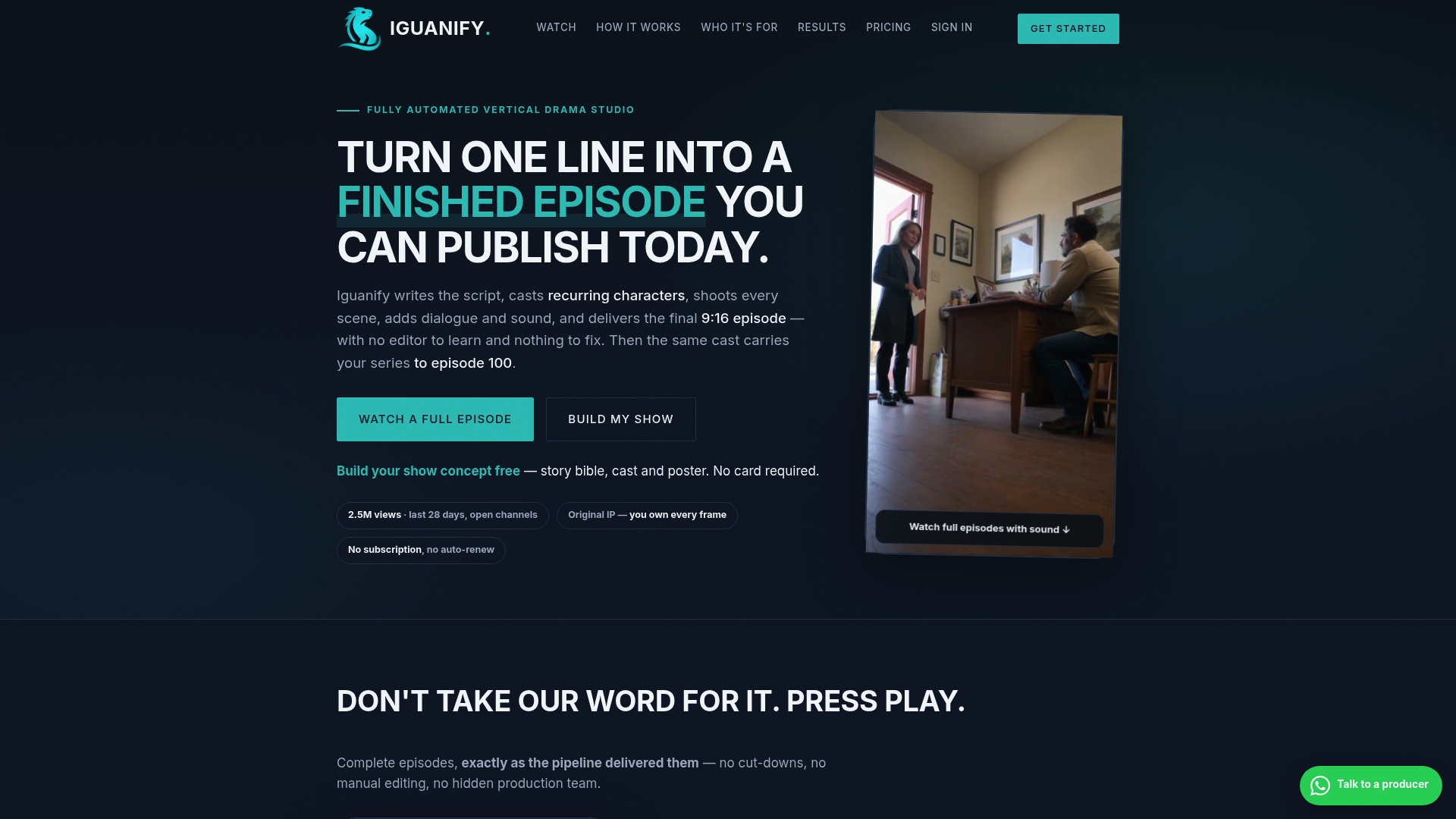
A single episode runs $34.99 through the Standard episode or Pilot options, and larger Creator, Season, Studio, and Slate packs are available for series-length production. If you want full-series automation from one cast, the AI micro-drama generator builds out an entire season on one consistent cast from a single premise. Start with a free show concept and cast generation before you commit to a pack.
FAQ
What is a TikTok micro-drama example?
A TikTok micro-drama example is a short, scripted episode, usually 60 to 180 seconds, that’s part of a serialized story with recurring characters, shot in vertical 9:16 format. Bistro Huddy and Screen Time are two widely cited examples that each built a season around a fixed setting or cast.
How long should a TikTok drama episode be?
Most practitioners aim for 60 to 120 seconds per episode, with 180 seconds as the outer workable limit. Shorter episodes tend to hold attention better and fit more naturally into a vertical scroll feed.
How do I keep a TikTok drama series consistent across episodes?
Fix one location or one recurring cast so you’re not rebuilding the world every shoot, and keep a running document of costumes, props, and character details. Tools like Iguanify handle this automatically by generating the same characters across every episode from a single script line.
What makes a TikTok drama hook work?
The strongest hooks open mid-conflict rather than with setup, and the premise should be explainable in one sentence, the same approach Screen Time used to reach a massive audience quickly. If a friend can’t repeat your show’s premise back to you in one sentence, simplify it.
Do I need legal clearance to post a scripted TikTok drama series?
You need licensed music or TikTok’s commercial sound library, and any real person appearing on camera should sign a simple release. Keep storylines and characters fictional rather than modeled on identifiable real people or businesses to avoid defamation risk.
Sources
- What is Bistro Huddy? TikTokers’ fictional restaurant goes viral — Dexerto
- How Issa Rae built TikTok’s first micro-drama hit — Los Angeles Times
- Hoorae’s Screen Time shows how micro‑drama episodes should structure turns and mini‑arcs — Tubefilter
- Writing for vertical video scripts — InkTip