 IGUANIFY
60 Second Shorts Story Arcs: Micro Beat Templates for Creators

A shorts story arc is a compressed version of the classic five-beat structure, designed to deliver a complete emotional journey in a brief runtime or word count. The single rule that makes them work: put the inciting incident within the early portion of the piece, and design the climax before you write anything else. Once you know your ending, write a one-line version of it now, before you draft a single scene.
TL;DR:
- Placing the inciting incident within the first 10% of the story or video is crucial to maintain audience engagement in short-form content.
- Designing the climax before drafting allows for a focused structure where all scenes directly build toward the final turning point.
- Short stories and videos typically compress the traditional five-beat narrative into two or three key moments, merging or omitting beats to save time.
- Using linear structure is generally best for clarity in very short formats, while non-linear methods require careful signposting to avoid confusing viewers.
- Consistent character portrayal across episodes is vital for serialized shorts, and tools like AI generators help automate this while preserving continuity.
Table of Contents
- Core Elements of a Short Story Arc, Condensed
- How Fast Should the Inciting Incident Hit in a Short?
- Design the Climax First, Then Work Backward
- Linear or Non-Linear: Which Structure Fits Your Short?
- Compressing Character Arcs Without Losing the Payoff
- Templates and Micro-Beats You Can Reuse
- Applying These Arcs to Vertical Video and Episodic Shorts
- A Fast Checklist and Three Timed Exercises
- Common Short Story Arc Variations by Genre
- Techniques for Creating Emotional Impact Within Short Arcs
- Balancing Theme and Plot in Short Story Arcs
- Why Tight Arcs Matter More on Serial Platforms Than Anywhere Else
- Ship Consistent Episodes Without Rebuilding Your Cast Every Time
- Sources
- FAQ
Core Elements of a Short Story Arc, Condensed
A classic narrative arc runs on five beats: exposition, rising action, climax, falling action, and resolution, as Reedsy’s structure breakdown lays out. In a short story or a shorts video, you don’t get five separate scenes for those five beats. You get maybe two or three, and some beats have to fuse together or disappear entirely.
Here’s how each one compresses:
- Exposition shrinks to a visual detail or a line of dialogue that implies the whole world, not a paragraph of setup.
- Inciting incident happens almost immediately, often inside the exposition itself.
- Rising action becomes one or two escalating complications, not a chain of five.
- Climax is the single moment your entire piece has been built to reach.
- Falling action and resolution frequently merge into a final image or one closing line.
If a beat takes more than a sentence or a single shot to convey, it’s probably underdeveloped, redundant, or fighting for space it hasn’t earned.
How Fast Should the Inciting Incident Hit in a Short?
Industry guidance from MasterClass recommends placing the inciting incident within the first 10% of runtime or word count, and in short-form work that window is unforgiving. In a 500-word story, that’s within the first part of the text. In a 60-second short, that’s within the opening moments. Miss it, and half your audience has already scrolled past.
Three pacing tools keep momentum once you’ve hit that mark:
- Micro-conflict, a small friction point that signals bigger trouble is coming.
- Immediate consequence, where the inciting event visibly changes something within seconds, not scenes later.
- Tightening time pressure, a countdown, a deadline, or a closing door that keeps raising the cost of delay.
A short story might open on a character reading a text that changes everything; a shorts video might open mid-argument, skipping the walk-up entirely. Both work because they skip the runway and land straight on the tarmac.
Pro Tip: Write your inciting incident line first, then write backward to the opening image. Most drafts waste their strongest hook on line five when it belongs on line one.
Design the Climax First, Then Work Backward
Designing the climax before anything else is a recommended technique precisely because it lets you reverse-engineer every scene so nothing exists without a job to do. Once you know the turning point, everything upstream either builds toward it or gets cut.
- Write the climax scene first, even roughly. What decision or reveal happens, and what changes because of it?
- Name the stakes that make that moment matter. What does the protagonist stand to lose or gain?
- List the minimum turning points needed to earn that climax, usually just one or two.
- Cut any scene that doesn’t shift the stakes or change the protagonist in a visible way.
Shorts often work best when the writer picks one clear dramatic question, the “will this character get what they want?” that the climax answers directly, rather than juggling several. That single-question focus is what makes the climax-first method so effective for tight formats.
Linear or Non-Linear: Which Structure Fits Your Short?
Linear structure wins when clarity is the priority and your runtime is under a minute. Writers generally split narrative order into linear (chronological) and non-linear (flashbacks, flash-forwards) approaches, and each carries a different cognitive cost for the viewer. Non-linear reveals earn their place when the twist depends on withheld information, but they demand tighter signposting in short form, since non-linear structure raises perceived complexity fast, and a confused viewer on a vertical platform simply leaves.
Three devices to consider, and their trade-offs:
- In medias res (starting mid-action) buys you an instant hook but requires quick orientation right after.
- Flashback deepens a character in seconds but risks stalling forward momentum if overused.
- Circular ending (closing on an echo of the opening image) delivers a satisfying click but only works if the opening was memorable enough to echo.
Platform viewing behavior punishes anything that asks for patience, so reserve non-linear tricks for moments where the payoff clearly outweighs the extra decoding work.
Compressing Character Arcs Without Losing the Payoff
Plot in short form runs on the protagonist’s want to collide with real stakes, and the character arc is just that engine viewed from the inside. You don’t have time to show gradual change through a dozen small moments, so the change has to land in one visible action.
- Build toward a single decisive micro-decision that reverses or confirms what the character believed at the start.
- Use a prop or repeated image as shorthand for interior change, so the audience reads growth without a monologue explaining it.
- Keep internal change tied to an external payoff, a choice the character actually makes on screen or on the page, not a feeling they merely report.
Pro Tip: If you can’t point to one specific frame or sentence where the character’s belief flips, the change hasn’t actually happened yet. Feelings described are weaker than choices shown.
Templates and Micro-Beats You Can Reuse
Short narratives generally run on a compressed four-stage version of Freytag’s structure: situation, complication, resolution, and denouement, according to Wikipedia’s narrative structure overview. That collapsed shape is the backbone behind most usable shorts templates.
- The condensed three-act: setup (10%), confrontation (70%), resolution (20%). Works for anything from 300 words to three minutes.
- The six-beat episode: hook, incident, complication, reversal, climax, button. Built for episodic shorts that need a clean loop.
- The Freytag micro-beat: situation, complication, climax, denouement, useful when you have almost no runway, like a 30-second short.
For a 30-second short, compress to hook and climax only, cutting everything else to implication. For 60 seconds, add one complication beat. For three minutes, the full six-beat episode fits comfortably. Choose freeform structure only when you already have a strong image or voice driving the piece; templates exist for everyone else.
Applying These Arcs to Vertical Video and Episodic Shorts
Vertical platforms reward writers who map beats to micro-scenes running five to fifteen seconds each, with the hook landing in the opening seconds rather than eased into, a structure detailed in Iguanify’s breakdown of the short drama script format. Episodic shorts add a second layer: each episode needs to work as its own self-contained arc while still feeding a larger season-long question, a structure Reedsy’s narrative resources describe as the backbone of episodic storytelling.
- Place your hook in the opening micro-scene, not after a table-setting shot.
- Treat each episode’s climax as a mini-payoff, then leave one thread open for the next installment.
- Individual episodes commonly run a few minutes, with the season arc functioning as the rising action across the whole run rather than inside any single episode.
- Recurring props, phrases, or settings do double duty as continuity anchors across episodes, since durable character hooks are what keep viewers coming back episode after episode.
Automated production tools that generate full episodes from a single script line still depend on this structure working; consistent characterization across episodes helps keep a serialized short cohesive rather than feeling like disconnected clips.
A Fast Checklist and Three Timed Exercises
Before you call a draft done, run it against six checkpoints: hook, inciting incident, stakes, reversal, climax, payoff. Miss any one and the arc will feel hollow even if the writing is polished.
- Ten-line climax-first sketch (5 minutes): write only the turning point and the line before it.
- Sixty-second scene proving change (10 minutes): show the character make one different choice than they would have at the start.
- Two-hundred-word reverse-engineer (15 minutes): work backward from your climax to the minimum setup it needs.
Pro Tip: On your second pass, cut before you add. Every beat that survives a cut and still makes sense was never necessary.
Common Short Story Arc Variations by Genre
Genre shapes which beats get emphasis, even inside the same five-part skeleton. A thriller short front-loads the inciting incident almost to the first line, then spends nearly its entire runtime on rising action and time pressure, with a climax that resolves in seconds and barely any falling action at all. The tension is the point; anything slower kills it.
A comedic short inverts that ratio. Setup gets a beat longer because the joke needs context, the complication is often a misunderstanding rather than real danger, and the climax is a punchline moment where two mismatched expectations collide. Falling action in comedy is usually just the reaction shot.
Horror shorts lean hard on withheld information, often using non-linear or delayed-reveal structure so the audience senses wrongness before understanding it. The climax frequently arrives with an image rather than a decision, since horror trades on dread more than choice.
Romance shorts compress the arc around a single vulnerable admission instead of a physical event. The inciting incident might just be a glance or a text left unanswered, and the climax is almost always an emotional risk taken out loud.
Drama and slice-of-life shorts often skip a traditional climax altogether in favor of a quiet realization, which is why they lean most heavily on symbolic props and small gestures to signal change, since there’s no big external event to carry the weight.
Knowing your genre before you outline saves you from forcing a thriller’s tight time pressure onto a story that actually needs romance’s slower emotional build, or vice versa.
Techniques for Creating Emotional Impact Within Short Arcs
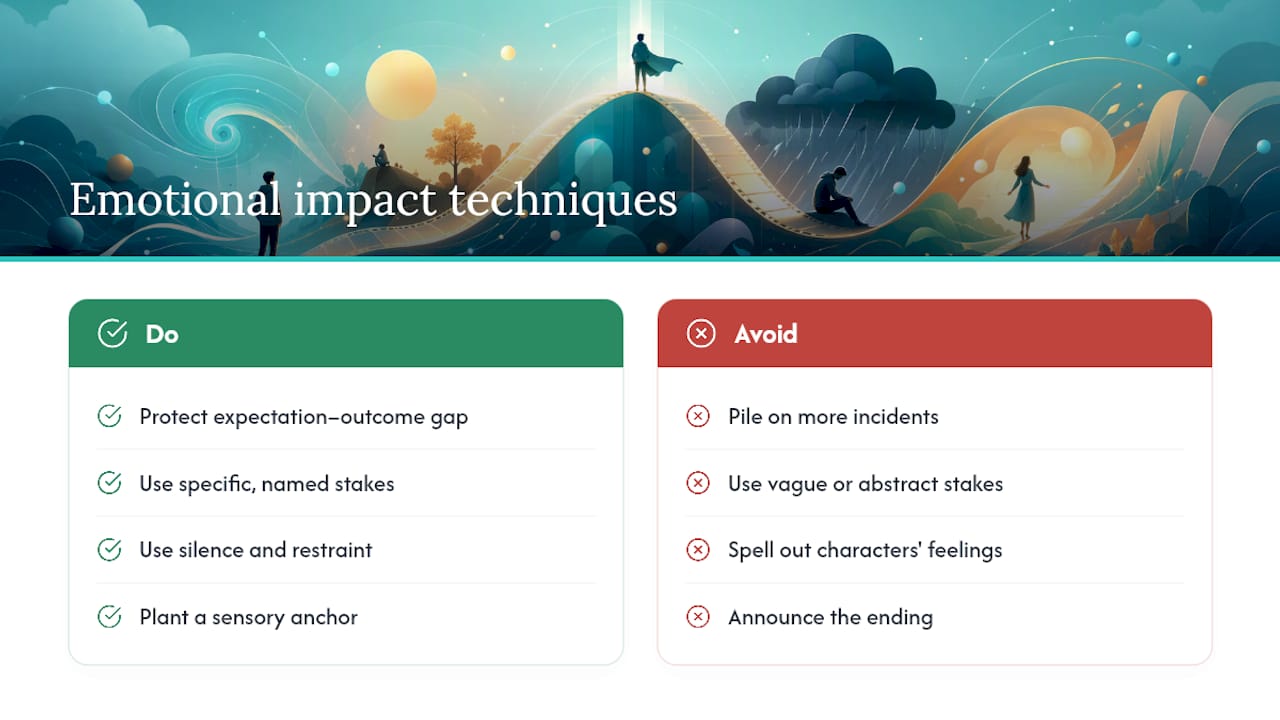
Emotional impact in a short arc comes less from what happens and more from how tightly the audience’s expectation and the outcome collide. The gap between what a viewer expects and what actually happens is where the emotional charge lives, so protecting that gap matters more than adding more incident.
Specificity beats generality. A character losing “everything” lands weaker than a character losing one named, concrete thing, a photograph, a phone call they didn’t return, a chair at a table. Vague stakes produce vague emotion; specific stakes produce a specific ache.
Silence and restraint often outperform explanation. Cutting away a half-second before a reaction, or letting a character say nothing when the audience expects a speech, creates more feeling than spelling out what they’re going through. Short form especially rewards a beat of stillness right after the climax, since it gives the emotional weight a second to land before you cut to black.
Sensory anchors do heavier lifting than adjectives. A specific sound, a smell, a texture mentioned once and echoed at the climax creates a physical throughline the audience feels without being told to.
Earn the ending, don’t announce it. A climax that states its own meaning out loud (“and that’s when she realized she’d been wrong all along”) flattens the very feeling it’s trying to produce. Show the choice; let the audience supply the realization.
Callback structure pays off fast. Because shorts don’t have room for a slow buildup of motifs, a single image or line planted early and echoed at the climax does the emotional work that would take a novel three chapters to build.
Balancing Theme and Plot in Short Story Arcs
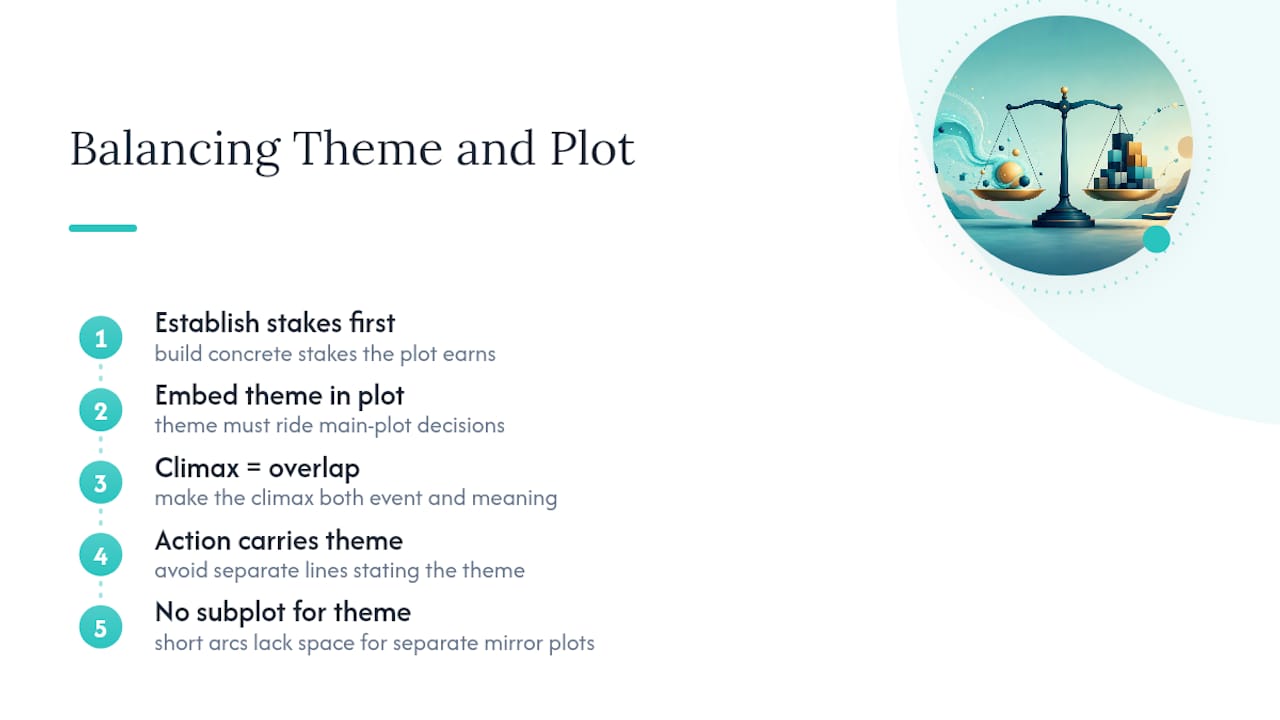
Plot and theme aren’t competing for space in a short arc; they’re the same structure viewed from two angles. Plot answers what happens. Theme answers what it means. When they pull in different directions, the piece feels busy but hollow, all event and no resonance.
The cleanest way to check the balance: your climax should be the moment plot and theme physically overlap. If your theme is about the cost of pride, the climax should be a plot event where pride literally costs the character something concrete, not a scene followed by a line of dialogue explaining the theme. When the plot event and the thematic point are the same beat, you don’t need to state the theme separately; the action already carries it.
Short form has no room for a subplot dedicated purely to theme, the way a novel might use a secondary character to mirror the protagonist’s arc. In a short arc, theme has to ride inside the main plot’s decisions, or it doesn’t fit at all. That’s a constraint, not a loss: it forces every scene to do double duty, advancing the story and encoding the meaning simultaneously.
Watch for a common failure mode: writers who know their theme in advance sometimes build a climax that proves the theme rather than one that grows naturally from the stakes already established. If the ending only works because a character suddenly says something thematic, the plot didn’t actually earn it. Build the stakes first, let the climax resolve them, and the theme will surface from the resolution rather than needing to be bolted onto it.
Why Tight Arcs Matter More on Serial Platforms Than Anywhere Else
Consistent arcs are what keep a viewer coming back episode three, five, ten. On a platform where the next creator is one swipe away, a shorts story arc that pays off its own promise, and hints at the next one, is doing real retention work, not just craft work. The writers who treat structure as optional are the ones whose second episode gets half the views of their first.
— Leonard
Ship Consistent Episodes Without Rebuilding Your Cast Every Time
Some platforms solve the problem that breaks most solo creators trying to run a serialized short: keeping characters, tone, and continuity intact throughout the series without a production team, automating episodes from brief script input while maintaining consistent cast and voice.
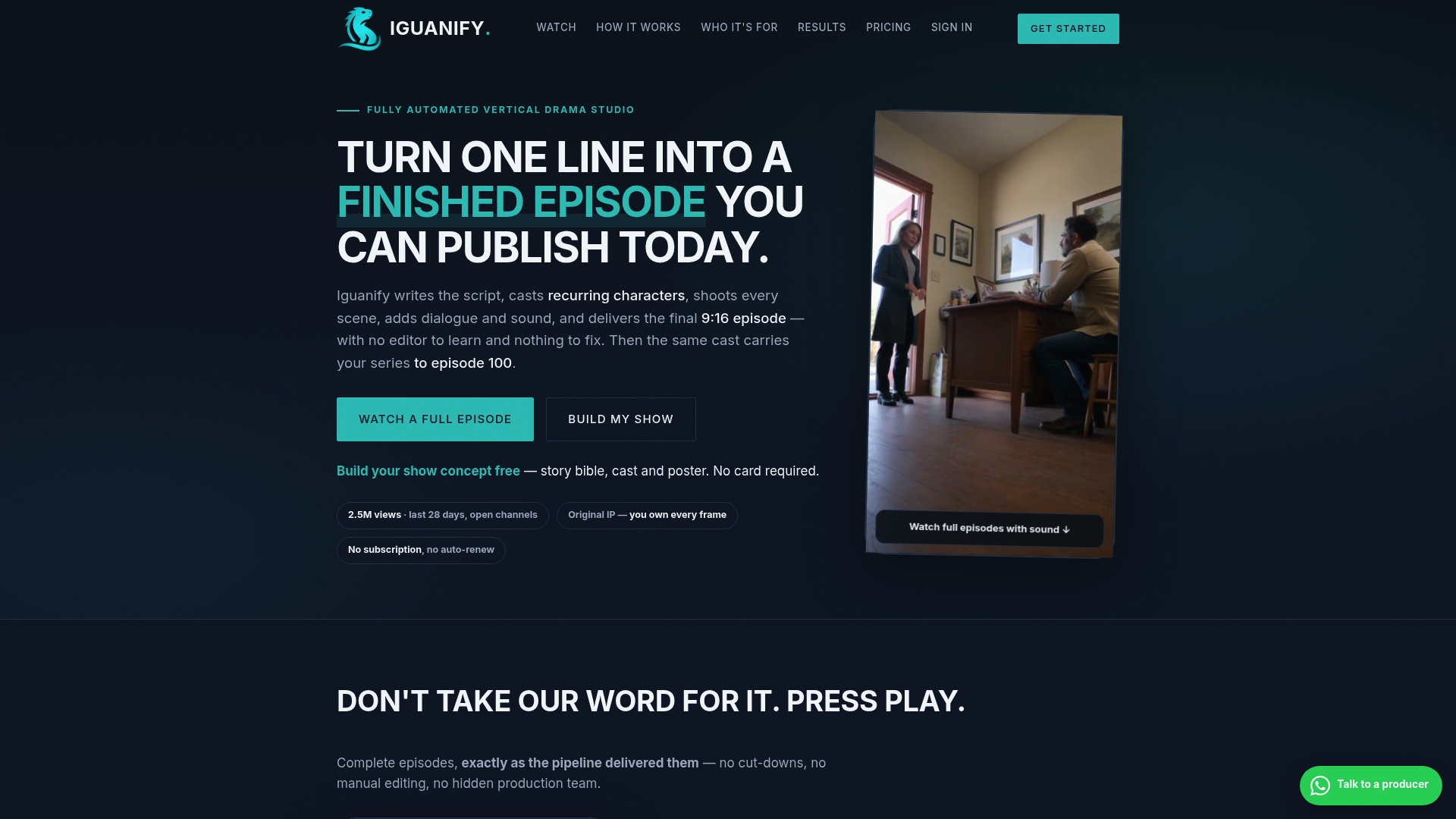
That matters because the arc techniques covered above only pay off if viewers can trust that episode four’s character is the same person they met in episode one. Iguanify’s AI drama generator is built around that continuity problem specifically, producing output ready for TikTok, YouTube, or Instagram without a manual edit pass. If your goal is something closer to the fast-paced serialized style popular on short-form platforms, the ReelShort-style production guide walks through the same pipeline for that format. Users typically retain rights to content they produce on these platforms. Users can often generate free show concepts and casts to preview how a short arc might look before spending credits.
Sources
- How to Structure a Narrative Arc — Reedsy
- What are the elements of a narrative arc? — MasterClass
- Narrative structure — Wikipedia
FAQ
What Is a Shorts Story Arc?
It’s a condensed version of the standard five-beat narrative arc, exposition, rising action, climax, falling action, and resolution, built to deliver a complete emotional journey inside a short story or a short-form video.
Why Design the Climax Before Anything Else?
Designing the climax first lets you reverse-engineer every earlier scene so each one serves the ending, which cuts detours and tightens pacing considerably.
Should a Short Story Use a Linear or Non-Linear Structure?
Use linear structure when clarity matters most and runtime is very short; reserve non-linear devices like flashback or in medias res for cases where the reveal genuinely earns the extra cognitive load.
How Does Iguanify Help With Episodic Short Arcs?
Iguanify turns a single line of script into a finished episode while keeping the same cast and continuity across an entire series, addressing the character-consistency problem that undermines most serialized shorts.