 IGUANIFY
16 Series Logline Examples, With Rewrites and a Path to Production

A series logline is a one to two sentence pitch that names your protagonist, the event that disrupts their world, and the stakes that will keep generating episodes. A model example: “A disgraced ER surgeon takes a job at a rural clinic to rebuild her reputation, but every patient forces her to confront the mistake that ended her career.” That single line tells a reader who to follow, what started the story, and why it won’t run out of fuel. Get this sentence right and everything else in your pitch gets easier.
TL;DR:
- Serialized shows should foreground the disruption and hint at lasting change, while episodic shows should lead with an appealing status quo and recurring tension.
- Place the logline at the top of the Overview, add a format subtitle, and reduce spoken pitches to the protagonist, disruption, and stakes.
- Test the logline on someone unfamiliar with the project; ask them to repeat the premise, and revise if they miss the protagonist or stakes.
- After drafting the logline, expand it into a series overview, then write a pilot synopsis, break the pilot into scenes, and prepare production.
- Replace vague themes with a concrete action and personal risk, and cut plot twists that turn the pitch into a synopsis.
Table of Contents
- Logline format checklist: protagonist, inciting incident, stakes, and tone
- Series logline examples by genre you can adapt
- Breaking down six examples and tightening them further
- Using your logline in a pitch packet and series bible
- From logline to produced episode: the practical path
- Examples of weak series loglines and why they fall short
- Why your logline decides whether producers keep reading
- Tips for writing a logline that actually gets read
- How to refine and test your logline before you pitch it
- What makes an editor stop scrolling and actually read your pitch
- Iguanify: turn a finished logline into a produced episode
- FAQ
- Sources
Logline format checklist: protagonist, inciting incident, stakes, and tone
A workable logline rests on four elements. Miss one and even a strong concept reads flat on the page.
- Protagonist: name the role and a defining trait, not a full backstory (“a burned-out paramedic,” not “a woman who grew up in foster care and always wanted to help people”).
- Inciting incident: the event that knocks your protagonist off their normal path, stated as an action, not a theme.
- Goal or stakes: what they want and what happens if they fail. This is your engine, the thing that justifies episode after episode.
- Tonal cue: a word or phrase that signals genre and register, so a reader knows if this is a dark thriller or a warm comedy before they open page one.
Write loglines in present tense with active verbs. “A detective hunts a killer” beats “A detective is searching for a killer who has been terrorizing the city.” Keep it to one or two sentences and resist the urge to preview your season finale. A logline sells the premise, not the plot.
Title formatting matters more than writers expect. Italicize or bold your series title at the top of the pitch document, and use a subtitle line (“half-hour workplace comedy” or “10-episode limited series”) to signal format immediately. That line also tells a reader whether you’re pitching something episodic or serialized: serialized loglines lean on an inciting incident and a hint at long-term change, while episodic or hangout shows lead with an appealing status quo plus one recurring ironic tension.
Pro Tip: Read your logline out loud to someone unfamiliar with the project. If they ask “wait, what happens?” you’ve buried the stakes.
Series logline examples by genre you can adapt
Below are original, genre-tagged loglines built to the checklist above. Use them as scaffolding, not scripts to copy outright. Each is labeled by format so you can see how serialized and episodic structures differ in practice.
- Comedy, episodic: A newly licensed therapist inherits her mentor’s eccentric client roster and must keep every session from spiraling into chaos, one impossible patient at a time.
- Comedy, episodic: Four roommates running a failing food truck navigate city permits, rival vendors, and their own egos while chasing a single viral moment that might save the business.
- Drama, serialized: A small-town mayor discovers the factory she fought to keep open is poisoning the water supply, and must choose between her community’s jobs and its health.
- Drama, serialized: After her father’s sudden death, a woman returns home to run the family vineyard and uncovers debts and secrets that threaten to take it from her.
- Procedural, episodic: A forensic accountant partners with a skeptical detective to crack financial crimes hidden inside ordinary businesses, one fraud case at a time.
- Procedural, episodic: A veterinary pathologist consults on crimes involving animals, using evidence other investigators overlook to solve cases the police can’t close.
- Thriller, serialized: A cybersecurity analyst discovers her own company planted the malware she’s been hired to hunt, and has one week to expose it before she becomes the next target.
- Thriller, serialized: A former intelligence officer living under a new identity is pulled back in when the asset she once protected resurfaces, and so does the agency that wants her silenced.
- Sci-fi, serialized: Survivors of a failed colony ship wake from stasis a century off course, and the captain who gave the order to launch early must earn back their trust before the ship runs out of air.
- Sci-fi, episodic: A repair technician on a derelict space station fixes one malfunctioning system per episode, each one hiding a clue about the disaster that killed the original crew.
- Ensemble, hybrid: Six paramedics working the same overnight shift carry the city’s worst nights and their own unraveling lives, one call and one relationship at a time.
- Ensemble, serialized: A multigenerational family runs a struggling auto shop, splitting into factions over whether to sell to a developer who wants the land for something bigger.
- Family, episodic: A single dad and his three kids navigate a cross-country move into their late grandmother’s house, each episode unearthing a new family secret alongside the renovation.
- Family, serialized: After their parents’ divorce, two siblings are shipped between households and slowly realize both parents are hiding the real reason the marriage ended.
- Anthology, hybrid: Each episode follows a different tenant in the same apartment building on the night before it’s demolished, tied together by the building superintendent who knows everyone’s story.
- Anthology, episodic: A traveling insurance adjuster investigates a different impossible claim in a different small town each week, and nothing he’s assigned to is ever what it looks like on paper.
Notice how the serialized examples carry a hint of escalation (debts, secrets, a target to expose) while the episodic ones promise a satisfying, self-contained return trip. The ensemble and anthology entries borrow from both: a through-line character or setting holds the season together even when each hour tells a mostly complete story.
Breaking down six examples and tightening them further
Even a decent logline usually has fat to trim. Here’s how six of the examples above map to the checklist, with a sharper rewrite for each.
- Therapist comedy: protagonist (new therapist), inciting incident (inherits a client roster), stakes (keep sessions from derailing), tone (chaos, comic). Tightened: “A newly licensed therapist inherits her mentor’s most unmanageable patients and has thirty days to prove she’s not in over her head.”
- Vineyard drama: protagonist (daughter returning home), inciting incident (father’s death), stakes (losing the vineyard), tone (family drama). Tightened: “A woman returns home to save her late father’s vineyard and finds the debts he hid are the least of what he kept from her.”
- Cybersecurity thriller: protagonist (analyst), inciting incident (discovers internal sabotage), stakes (one week, becomes the target), tone (paranoid, urgent). The original already lands; the fix is trimming “hired to hunt” to “paid to find” for rhythm.
- Colony ship sci-fi: protagonist (the captain), inciting incident (waking a century off course), stakes (survival, trust), tone (isolation, slow-burn tension). Tightened: “A captain who launched her colony ship a year early must win back a hundred survivors who woke up a century off course and out of air.”
- Overnight paramedics ensemble: protagonist (six paramedics as a unit), inciting incident (the shift itself, ongoing), stakes (personal and professional collapse), tone (gritty, intimate). Tightened: “Six paramedics on the same overnight shift hold the city together one call at a time, even as their own lives come apart.”
- Demolition anthology: protagonist (rotating tenants, anchored by the superintendent), inciting incident (the building’s final night), stakes (closure, connection), tone (bittersweet). Tightened: “The night before their building is demolished, a superintendent who knows every tenant’s secret watches a different one unravel each episode.”
The pattern across every rewrite: cut throat-clearing words, move the strongest image to the end of the sentence, and make sure the stakes are a consequence, not a mood.
Using your logline in a pitch packet and series bible
Your logline isn’t a one-time asset. It shows up at the top of your series bible under the Overview section, according to Final Draft’s series bible template, and it needs to flex into a few different formats depending on where you’re pitching.
- Place it first. In a one-page pitch or a full series bible, the logline sits at the top of the Overview, before “Why This, Why Now,” the world, or character breakdowns. It’s the first thing a reader or executive sees, and often decides whether they read further.
- Shorten it for the room. A written logline can run two sentences; a verbal pitch needs to land in about ten seconds. Strip it to the protagonist, the disruption, and the stakes, and drop any subordinate clauses.
- Practice the verbal version out loud. Example adaptation: written as “A disgraced ER surgeon takes a job at a rural clinic to rebuild her reputation, but every patient forces her to confront the mistake that ended her career,” spoken as “It’s about a disgraced surgeon trying to rebuild her career in a small clinic, where every patient reminds her of the mistake that ended it.”
- Check it against a pitch-ready list before you walk into a room: does it name a clear protagonist, avoid jargon, fit in two breaths, and hint at why episode two exists?
From logline to produced episode: the practical path
A strong logline is the start of a pipeline, not the finish line. The usual sequence runs from logline to series overview, then a pilot synopsis, an episode outline, a scene-by-scene breakdown, and finally production. Commissioners and platforms look for specific artifacts at each stage: a clear Overview, a “Why This, Why Now” rationale, character breakdowns, and a pilot synopsis are the backbone of a well-built series bible.
- Draft the logline, then expand it into a one-paragraph series overview that names the engine driving future episodes.
- Write a pilot synopsis covering the opening image, key turns, and the hook into episode two.
- Break the pilot into scenes, then a shot list or production outline.
- Move into production, whether that’s a traditional crew or a scene-by-scene outline built for faster turnaround.
That last stage is where an automated production option like ours fits: once the outline exists, we turn it into finished episodes without a separate editing pass.
Examples of weak series loglines and why they fall short
Some loglines fail quietly, and it’s worth seeing why. “A woman navigates life after a big change” names no inciting incident, no stakes, and no tone: it could describe almost any drama ever written. The fix is specificity: what changed, and what does she stand to lose?
“In a world where magic is outlawed, a young mage must fight for freedom” leans on a generic premise without a protagonist trait or a concrete goal. “Fight for freedom” is a theme, not an action. A stronger version names what the mage actually does in episode one and what she personally risks.
A third common failure mode: cramming in too much plot. A logline that lists four characters, two betrayals, and a twist ending isn’t a pitch, it’s a synopsis squeezed into one overlong sentence. If your logline needs three semicolons, it’s hiding the real hook rather than revealing it. The test is simple: can a stranger repeat your premise back to you after hearing it once? If not, the sentence is doing too much or too little.
Why your logline decides whether producers keep reading
A logline is often the only part of your pitch a busy executive reads in full before deciding whether to continue. Industry pitch-bible guidance treats the Overview, built around that single-sentence hook, as the first signal of whether a project is ready to be taken seriously.
Producers and platforms aren’t just judging the premise itself. They’re judging whether you understand your own show: a logline that clearly identifies the recurring conflict tells a buyer this creator knows what will fuel season two, not just episode one. A vague or overstuffed logline suggests the opposite, even if the underlying idea has potential.
This matters just as much for investors and platforms evaluating a slate of projects at once. A logline that reads cleanly next to ten others on a development slate gets a second look; one that requires explanation gets set aside. Clarity isn’t a nicety at the pitch stage, it’s the filter that determines whether anyone reads your series bible at all.
Tips for writing a logline that actually gets read
Clarity beats cleverness every time. A reader should understand your premise on the first pass, not the second. If a line requires you to explain it afterward, rewrite it rather than defend it.
Originality usually lives in the specifics, not the concept. “A cop investigates murders” is generic; “a forensic accountant who can’t read social cues becomes the only investigator who notices the pattern no one else sees” gives you a protagonist worth following. Swap a generic role for a specific trait or contradiction, and the premise sharpens on its own.
The emotional hook is what separates a competent logline from a memorable one. Ask what your protagonist stands to lose on a human level, not just a plot level, and build the sentence around that. “A surgeon loses her license” is a fact; “a surgeon who destroyed her own career must now save the people who remind her why” is a reason to care.
Finally, match your tone word choice to your genre. A single adjective (“darkly comic,” “slow-burn,” “high-stakes”) does a lot of work in signaling what a reader should expect before they’ve seen a page of script.

How to refine and test your logline before you pitch it
Treat your first draft as a working draft, not a finished sentence. Read it aloud, and if you stumble or run out of breath, it’s too long. Cut any clause that explains rather than shows.
Test it on someone outside the project entirely. Ask them to repeat your premise back in their own words. If they get the protagonist and the stakes right, the logline is doing its job. If they miss the central conflict or describe a different show entirely, you’ve found the gap.
Run the comparison test: place your logline next to three others in the same genre, ideally ones you admire. Does yours hold its own in specificity and stakes, or does it read vaguer by comparison? Trim adjectives that aren’t doing real work, and replace passive constructions with a protagonist taking a clear action.
Finally, give it a cooling-off period. A logline that feels airtight the day you write it often reveals its weak spots a week later, once the excitement of drafting has faded and you can read it the way a stranger would.

What makes an editor stop scrolling and actually read your pitch
Editors and executives read dozens of loglines a week, and most get judged in the time it takes to read one sentence. What stands out isn’t cleverness, it’s a protagonist whose want is instantly clear and a conflict that sounds like it could sustain more than one episode.
A useful experiment: write five versions of your logline, each emphasizing a different element first, protagonist, incident, stakes, tone, and see which one a reader remembers an hour later without rereading. That’s usually your real logline.
Don’t finalize it alone. Test it on two or three peers who haven’t heard your pitch yet, and revise based on what confuses them, not what they politely praise.
— Leonard
Iguanify: turn a finished logline into a produced episode
Once your logline and outline are locked, the slower part of the process is usually production: casting, shooting, editing, and keeping characters consistent from one episode to the next. We built our platform to skip that bottleneck. Starting from a single line of script, we produce a fully realized episode with recurring characters that stay consistent across your whole series, so continuity doesn’t break the way it often does with other AI video tools.
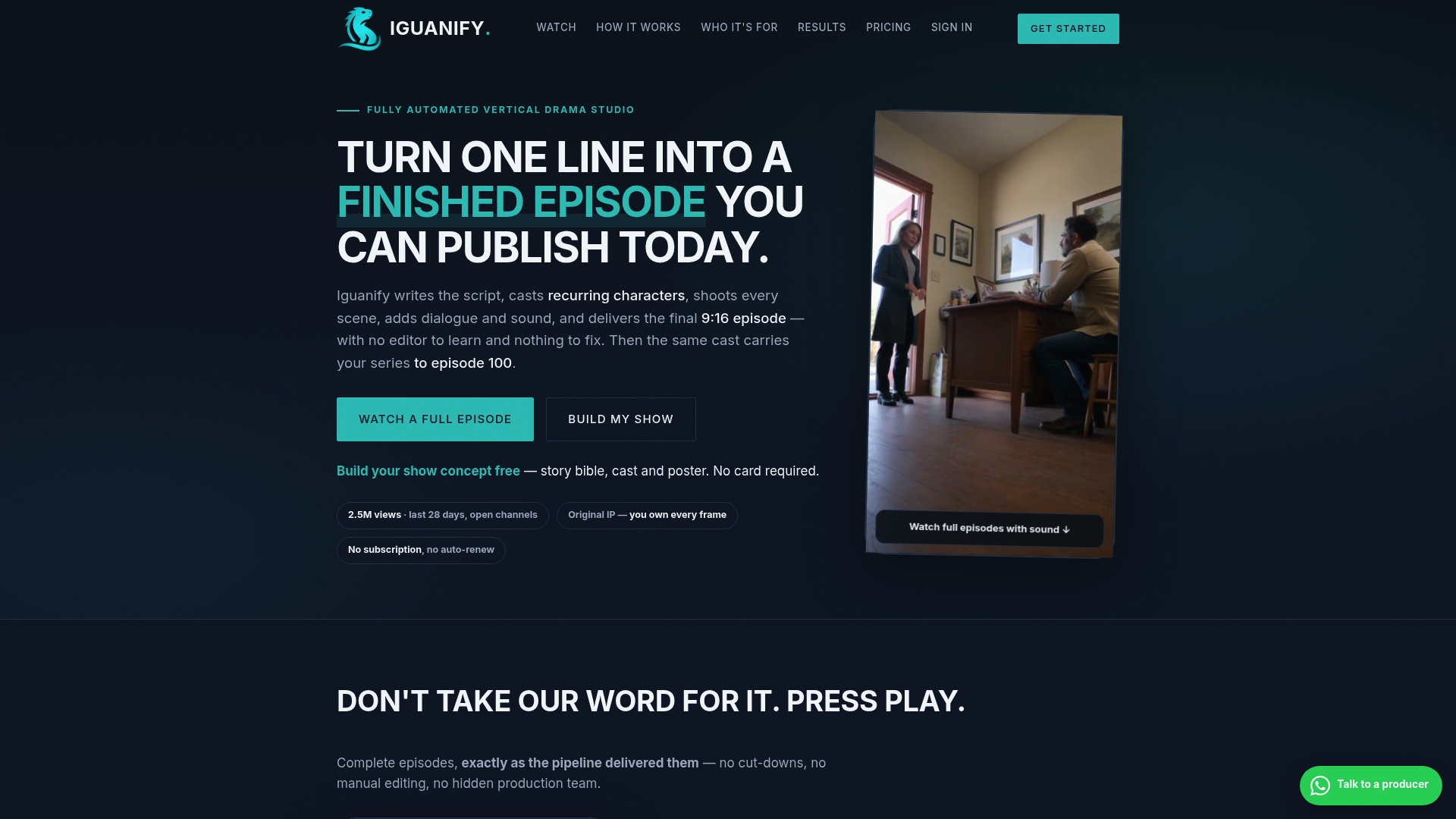
Our episodes are produced in real time with instant delivery, a pace that matters when you’re testing multiple loglines before committing to a full season, according to our own product details. You keep rights to your content, and publishing across social platforms stays manageable.
If you’ve already got a pilot outline, our scene-by-scene templates help structure it before production, and our self-serve engine lets you generate episodes directly from your premise. Start with a standard episode at $34.99 and see your logline become a finished episode without hiring a crew.
FAQ
What is the difference between a synopsis and a logline?
A logline is one to two sentences that condense your premise into protagonist, inciting incident, and stakes. A pilot synopsis runs much longer, typically one to two pages, and walks through the pilot’s actual story beats, act turns, and ending hook.
What is the meaning of “logline”?
A logline is the one-sentence pitch for a story, originally named for the line editors or executives would scan on a script’s cover page. In television, it’s the sentence that tells a reader who the show follows and what keeps it running.
What is the format of a logline?
A logline is one to two sentences in present tense, naming a protagonist, the event that disrupts their situation, and the goal or stakes that follow. Serialized shows hint at an arc, while episodic or hangout shows lead with an appealing status quo and a recurring tension.
How do I format the title of a TV series?
Series titles are typically italicized or bolded at the top of a pitch document, followed by a subtitle line noting the format, such as “half-hour comedy” or “8-episode limited series.” This signals genre and structure before a reader reaches your logline.
How much does it cost to turn a logline into a produced episode?
Pricing depends on the production path you choose. A standard episode or pilot through our platform runs $34.99 one-off per episode, with larger packages and commissioned production available on request.
Sources
For deeper study, see Final Draft’s series bible template, Backstage’s pitch bible guide, and our own series bible examples.
For writers adapting loglines into short-form pitches, this story arc guidance for short-form commercials offers useful structural parallels.
- How to Make a TV Pitch Bible (With Examples) | Backstage
- Building your TV Series Bible in Final Draft — Final Draft