 IGUANIFY
Produce a Pilot Fast: One Line and Scene by Scene Outline Templates

The fastest way to get a finished pilot is to start with a one-line beat sheet that proves your series engine, then expand it into a scene-by-scene outline. We’ll give you both templates below, copy-ready. The point of either one is the same: your pilot has to deliver a satisfying episode and prove the show can run for seasons, not just one great hour.
TL;DR:
- Starting with a one-line beat sheet helps quickly test the story engine and ensures the series concept, protagonist, and ongoing questions are solid before scene planning.
- Each scene should introduce a clear change in understanding or decision, with roughly one paragraph of summary, to maintain focus on how the story progresses toward major act turns.
- Outlines must accurately place inciting incidents, midpoint reversals, and climaxes within acts, ensuring each act serves to set up, complicate, confront, or resolve the central conflict.
- For pitches, shorten the outline to emphasize the logline, series engine, and future episode seeds, removing scene-level details to convey scope and tone efficiently.
- Production-ready outlines often convert directly into episodes with AI tools, provided they clearly specify character actions, scene changes, and the vital “what changes” detail for continuity and character arcs.
Table of Contents
- A quick one-line beat sheet to test your story spine
- Scene-by-scene outline template with sluglines and summaries
- Placing your inciting incident, midpoint, and climax
- Formatting and length your outline should hit
- Turning the templates into a draft: workflow and checklist
- Common mistakes and tips for tighter beats
- Turning a scene outline into a produced pilot
- Building character arcs inside the pilot outline
- Keeping the outline consistent with its genre
- What strong pilot outlines actually look like
- Tailoring your outline for a network or studio pitch
- A short note on beat-first outlining
- Turn your outline into a produced pilot
- FAQ
- Sources
A quick one-line beat sheet to test your story spine
Before you write a single scene, you need to know if your idea survives contact with structure. A one-line beat sheet is the fastest, cheapest way to find out. Script Magazine’s guidance on writing a pilot stresses starting with the series concept, not an isolated episode: your logline, world, protagonist, and the relationships that will carry multiple seasons.
Here’s a copyable structure:
- Logline: one sentence, protagonist, goal, obstacle, stakes.
- Six to ten one-sentence beats, each naming what changes.
- Series engine line: one sentence explaining how next week’s episode works.
A genre-neutral example: a beat might read “Dana discovers her new boss is running the same scam she escaped from,” followed by a beat that forces her to decide whether to expose him or use the leverage. Each beat should seed a question the next episode can answer. If your beats only describe locations or moods, the engine isn’t there yet.
Scene-by-scene outline template with sluglines and summaries
Once your beat sheet proves the engine, expand each beat into scenes. Writers’ room practice recommends blending beats chronologically first, then adding sluglines and paragraph summaries so problems surface before you draft, not after.
Use these fields for every scene:
- Scene number, in sequence, no gaps.
- Slugline: INT or EXT, location, time of day, formatted the same way it will appear in the script.
- A one to three sentence summary in present tense, naming the character’s action.
- Dramatic purpose: what changes by the end of the scene.
John August’s published pilot outline shows how flexible this gets in practice. Numbered scenes and act headings are common, but one of his samples runs through an entire first act without a teaser, because the story didn’t need one. Aim for roughly one paragraph per scene. A half-hour outline usually lands around 20 to 35 scenes; an hour runs longer. Keep summaries tight: if a scene needs five sentences to explain, it’s probably two scenes.
Placing your inciting incident, midpoint, and climax
Act breaks exist to force a decision, not to mark time. Your inciting incident disrupts the protagonist’s normal world, the midpoint flips their understanding of the problem, the low point strips away their resources or illusions, and the climax forces the choice that proves who they are. Map these onto your act structure, whichever shape you’re using:
- Three acts work for tighter half-hour stories with a single clear turn.
- Four or five acts give hour-long pilots room for a midpoint reversal and a distinct low point before the climax.
- Each act should do one job: set up, complicate, confront, or resolve.
Marilyn Horowitz’s beat-by-beat method, outlined in Script Magazine’s sitcom structure piece, applies to drama too: a beat can be a full scene or a shift inside one, but it has to be a turn, not a location change.
Pro Tip: Run each act break through the Four Magic Questions: does this act set something up, complicate it, force a confrontation, or resolve it? If you can’t answer, the break isn’t earning its place.
Formatting and length your outline should hit
Editors and showrunners expect an outline that reads fast and signals craft before they read a word of dialogue. GL Coverage’s pilot outline guidance puts typical lengths at roughly 5 to 10 pages for a half-hour outline and around 15 to 20 pages for an hour, written in paragraph style.
Keep the formatting itself boring and consistent:
- Readable font (Courier or a standard screenwriting typeface), clear act headers, numbered scenes.
- Present tense scene summaries, matching slugline format to your actual script style.
- A pitch packet includes the logline, series engine, full pilot outline, three to five future episode seeds, and one-line character descriptions.
None of this is decoration. A reader who has to hunt for structure stops reading.
Turning the templates into a draft: workflow and checklist
The templates only work in sequence. Start with the series outline, the document that states your premise and the ongoing engine, before you touch the pilot. Then build your one-line beat sheet. Then expand to scene-by-scene. Only then do you draft.
- Write the series outline: premise, world, and the repeatable question each episode answers.
- Build the one-line beat sheet and timebox it. If it takes more than a day, the engine probably isn’t working yet.
- Expand to scene-by-scene, checking each scene against a short list: does it serve the series engine, does the act break do its job, is the character’s motivation clear, are stakes rising.
- Only then write the first draft.
Expand a beat into multiple scenes when the emotional turn needs room to land. Rewrite the series engine, not just the pilot, when a beat sheet keeps producing one-off stories instead of ongoing questions. That’s a sign the premise, not the outline, needs work.
Common mistakes and tips for tighter beats
The most common failure is confusing a pilot outline with a series bible: one tells a complete episode, the other maps a universe, and they need different documents. Script Magazine’s pilot-writing guide is direct about this: a pilot outline has to do two jobs at once, deliver a satisfying episode and prove the engine, and conflating them weakens both.
- Listing locations instead of dramatic turns is the second most common error. A scene that just moves characters from the kitchen to the car isn’t a beat.
- Outlining acts before you know your ending backs you into endings that don’t pay off the setup.
- Treat every beat as a change in understanding, decision, or power, never a location marker.
Pro Tip: Write your series engine line before your pilot beats, not after. A weak beat reads “she goes to the office.” A tight one reads “she walks into the office she just quit, because the only evidence is on that desk.”
Turning a scene outline into a produced pilot
A scene-by-scene outline already contains most of what a production workflow needs: locations, character actions, and the “what changes” field for each scene map directly onto cast notes, continuity requirements, and episode specs; this approach is explained in detail in Storyboard vs Shot List for Outdoor Shoots. Automated episodic production tools can take that structure and generate recurring characters, dialogue, and finished video from it, without a separate production team.
This path suits solo creators and small teams who have a tight outline but no production budget or crew. If you already have access to actors, locations, and an editor, a traditional shoot might still serve you better. The outline work stays the same either way.
Building character arcs inside the pilot outline
Your pilot outline needs to do more than move plot; it has to show who your characters are by the end that they weren’t at the start, even in episode one. Give each major character a single internal question your pilot answers partially: what do they believe about themselves that the pilot’s events start to challenge.
Write that question into your beat sheet directly. If your protagonist believes she works alone because trusting people gets her hurt, your inciting incident should force a moment where she has no choice but to rely on someone, and your climax should show the cost or benefit of that shift without resolving it completely. Series television runs on incomplete arcs: a pilot that fully resolves a character’s core flaw leaves nothing for episode two.

Secondary characters need less room but still need a turn. A one-line note in your beat sheet, something like “Marcus realizes his loyalty has a price,” gives your scene-by-scene outline a thread to track even if that character only appears in three scenes. When you expand to paragraph summaries, check that every major character’s scenes build toward a specific change, not just more screen time. A character arc that’s just “we learn more about them” isn’t an arc. It’s exposition wearing an arc’s clothes.
Keeping the outline consistent with its genre
Readers evaluate a pilot outline partly on craft and partly on whether it delivers the specific pleasures its genre promises. A thriller outline that spends three scenes on a character’s morning routine breaks genre contract even if the writing is good. A comedy outline where nobody makes a joke in the first ten pages reads as misfiled.
Check your beat sheet against genre expectations before you expand it into scenes. A procedural needs its central case or mystery active by the end of the first act. A workplace comedy needs its ensemble dynamic visible in the pilot’s first ten pages, not explained later. A serialized drama needs its central tension restated or complicated by the midpoint, not just implied.
Tone consistency matters as much as plot mechanics. If your beat sheet mixes broad comic beats with a grounded dramatic climax, decide early which register wins, because an outline that can’t commit reads as unfinished rather than ambitious. Horowitz’s point about act breaks landing on real plot turns, covered in Script Magazine’s structure piece, applies here too: a genre’s rhythm often lives in where its turns happen, not just what happens in them. A sitcom’s act break hits differently than a drama’s, even with a similar event.
What strong pilot outlines actually look like
Published outlines are useful precisely because they’re inconsistent with each other, which proves there’s no single right format. John August’s sample pilot outline uses numbered scenes and act headings, but skips the teaser entirely in one version, because the story didn’t need a cold open to work.
A second working outline from the same source shows a different approach: numbered scenes, short slugline location tags, brief action hooks for each character, and a one-line “what changes” note attached to every scene. That last field is worth stealing directly. It turns an outline into a diagnostic tool instead of just a summary, because any scene without an answer in that field is a scene you can probably cut.

What both examples share matters more than their differences. Every scene earns its place by changing something: a relationship, a piece of information, a character’s resolve. Neither outline pads length with description for its own sake. And both stay flexible on formatting specifics, teaser or no teaser, strict act headers or looser scene lists, as long as the underlying structure proves out. Study a published outline the way you’d study a floor plan: not for decoration, but for how weight gets distributed.
Tailoring your outline for a network or studio pitch
An outline you write for yourself and an outline you send to a buyer are different documents, even when the underlying beats don’t change. A pitch outline needs to work harder in less space, because the person reading it is evaluating dozens of ideas and deciding fast whether yours is one of them.
Lead with the logline and series engine before the pilot summary, not after. A buyer wants to know in the first paragraph whether this show can run for five seasons before they invest time in how episode one unfolds. Attach three to five future episode seeds directly after your pilot outline: one-line descriptions of episodes two, three, and beyond that prove the engine generates stories without repeating itself.
Trim scene-level detail for a pitch document compared to your working outline. A buyer doesn’t need every scene’s slugline; they need paragraph-level movement through the pilot’s acts, tight enough to read in ten minutes. Character one-liners belong near the front too, not buried in act three when a character first appears. Keep tone consistent with how the finished show will feel: a pitch outline for a dark comedy shouldn’t read like a procedural’s case file. The structure can flex, but the voice on the page should already sound like the show.
A short note on beat-first outlining
Beat-first outlining works because it fails cheaply. A bad beat sheet costs you an afternoon; a bad draft costs you weeks. We’ve watched that math change how fast ideas move from premise to page when the structure gets tested before the writing does.
— Leonard
Turn your outline into a produced pilot
Once your scene-by-scene outline holds up, the next bottleneck is usually production, not writing. Our platform can take a tight outline and produce a fully realized episode from it, aiming to keep characters consistent across episodes to avoid common continuity problems found in typical AI video tools.
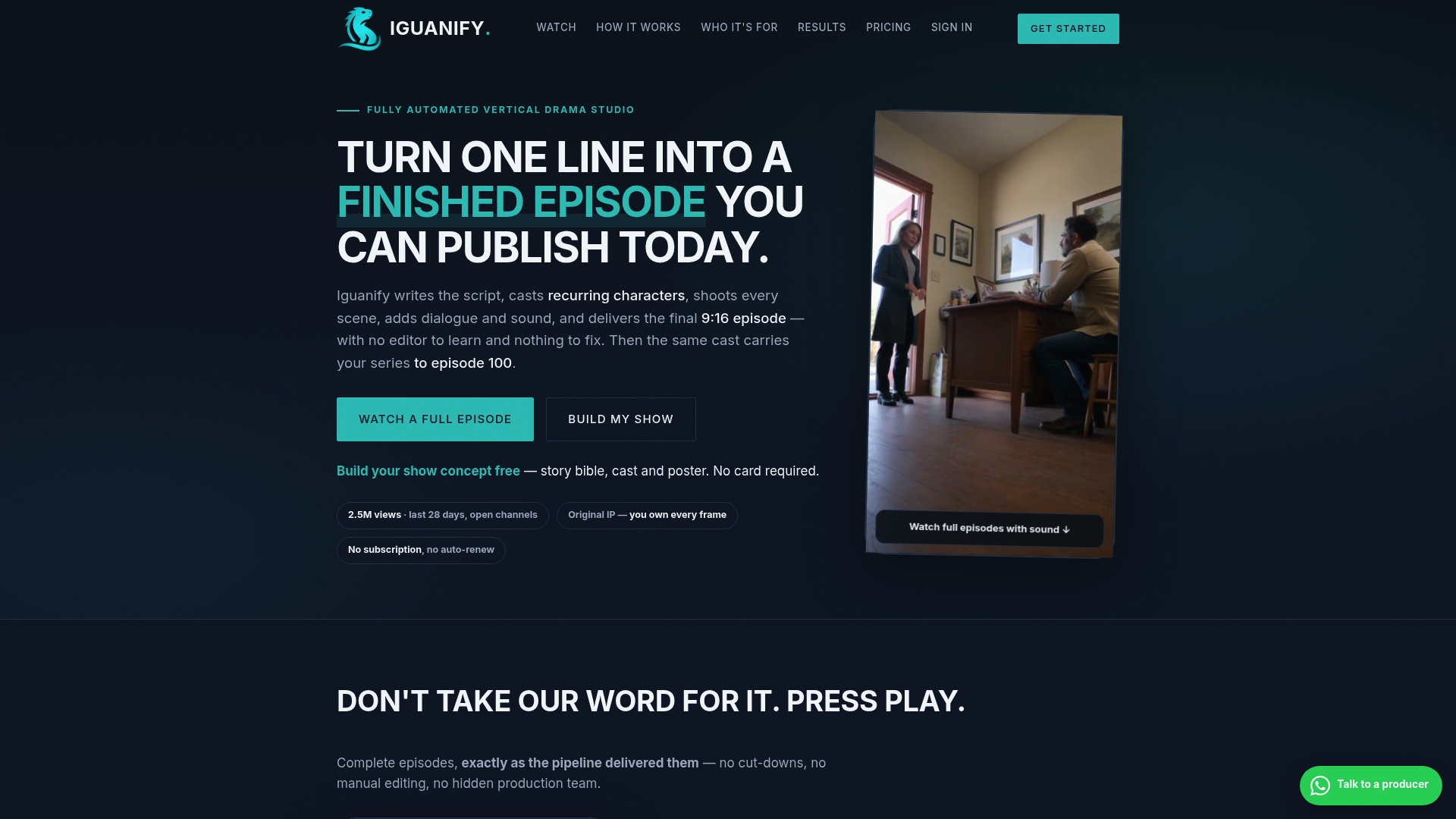
This fits solo creators and small teams aiming at TikTok, YouTube, or Instagram who have the story but not a crew. Users keep ownership rights to what gets produced, and output arrives ready to publish without a separate edit pass. If your outline is ready, our Pilot package turns it into a finished episode for $34.99 one-off, or you can look at commissioned production if you want a studio-built season instead.
FAQ
What’s the best template to start a pilot outline with?
Start with a one-line beat sheet: a logline, six to ten one-sentence beats, and a series engine line. It’s the fastest way to test whether your idea holds together before you invest in a full scene-by-scene outline.
How long should a pilot outline be?
A half-hour outline usually runs 5 to 10 pages, while an hour-long pilot outline typically runs 15 to 20 pages in paragraph style. Length varies by genre and how much scene-level detail a pitch requires.
Does a pilot have to fully resolve its story?
A pilot needs to deliver a satisfying, complete episode, but it shouldn’t resolve every character question or plot thread. Leaving some tension active is what proves the series has room to keep running.
What’s the difference between a pilot outline and a series bible?
A pilot outline maps one episode’s scenes and acts, while a series bible documents the whole show’s world, characters, and ongoing arcs across seasons. Confusing the two is a common mistake that weakens both documents.
Can I use an outline template for any genre?
Yes, the core fields (logline, beats, scene summaries, series engine) work across genres, but you should check your beats against genre-specific expectations, like when a procedural’s case needs to be active or when a comedy’s ensemble dynamic needs to show up.
Sources
- How to Write a TV Pilot — Script Magazine
- Sample pilot outline — John August
- Writing a TV pilot outline — GL Coverage