 IGUANIFY
Creators: Budget 2–4x for Episode Pack Pricing

Most creators buying AI-produced episodes will run into three pricing structures: one-time credit packs, per-episode purchases, or a season bundle. A single short episode typically lands in the $30–$100 range, while a full season pack runs into the hundreds depending on length and complexity. The rule that matters more than any price sheet: budget two to four times your platform’s raw credit estimate, because iteration always costs more than the first draft suggests.
TL;DR:
- Budget at least two to four times your platform’s raw credit estimate to account for iterative rewrites, which often cost more than initial drafts.
- Episode complexity, scene count, and character continuity significantly increase costs, especially with added features like licensed music or custom voiceovers.
- Per-second or per-scene billing allows for precise, upfront budgeting, but failed generations can sometimes be refunded, reducing waste.
- Season packs and bundles offer cost savings through character reuse and setup transfer between episodes, making them more economical for longer series.
- Confirm credit expiration policies and ownership rights before purchasing to avoid losing unused credits or licensing restrictions on generated content.
Table of Contents
- What Are the Main Episode Pack Pricing Models?
- What Drives the Cost of an Episode Pack?
- How Do Credits and Per-Second Billing Actually Work?
- What Pack Types Are Available and What Do They Include?
- What Do Real Episode Pack Budgets Look Like?
- How Do You Choose the Right Episode Pack?
- Leonard on Iguanify’s Approach to Episode Pricing
- Why Most Pricing Advice Undersells Iteration Costs
- Get an Episode Pack Quote From Iguanify
- Sources
- FAQ
What Are the Main Episode Pack Pricing Models?
Three structures dominate this market, and each fits a different stage of your channel.
One-time credit packs are the most common setup for episodic AI production. You buy a batch of credits upfront, spend them on generating scenes, dialogue, and edits, and the credits don’t renew until you buy more. There’s no monthly bill hanging over your head, which matters if you’re testing a concept before committing to a release schedule.
Per-episode pricing charges a flat rate for a finished episode, which simplifies budgeting for creators who know exactly how many episodes they need. Iguanify prices its Standard episode and Pilot options at $34.99 one-off per episode, which makes cost forecasting straightforward for anyone planning a weekly drop.
Subscriptions and retainers work differently. You pay recurring fees for ongoing access or production capacity, which suits creators publishing constantly and needing predictable monthly output rather than sporadic bursts.
Here’s how the three stack up for a working creator:
- One-time packs: best for testing a pilot or launching a limited series without ongoing commitment
- Per-episode pricing: best when you know your episode count and want simple, predictable math
- Subscriptions/retainers: best for high-frequency publishers who need steady monthly capacity
Many creators end up running a hybrid: a one-time pack to launch a series, then a subscription once the show finds an audience. Switcher Studio’s breakdown of one-time versus recurring payments makes the same case for creator businesses generally: one-time products fund the launch, and recurring revenue stabilizes what comes after.
What Drives the Cost of an Episode Pack?
Price scales with production complexity, not just runtime. A 30-second episode with one character costs a fraction of a 90-second episode with a recurring cast and multiple locations.
Runtime and scene count matter first. More scenes mean more individual generations, and each generation draws down credits. Shot complexity compounds this: a static dialogue scene costs less than a scene with movement, multiple camera angles, or crowd shots.
Character continuity adds its own multiplier. Maintaining the same recurring cast across episodes, which is the entire premise behind serialized drama, takes more computational work than generating a one-off character who never needs to look consistent again.
Add-ons stack on top of the base price:
- Licensed music tracks instead of generated scores
- Professional voiceover versus synthesized dialogue
- Custom sound effects and foley work
- Color grading passes for a cinematic look
Iteration is the quiet cost driver most creators underestimate. Every re-run of a scene you don’t like consumes credits, and few first attempts are publish-ready.
Pro Tip: Generate your pilot’s most complex scene first. If a crowded location or a tricky character interaction burns through credits faster than expected, you’ll know your real cost-per-episode before you commit to a full season pack.
How Do Credits and Per-Second Billing Actually Work?
Most AI episodic platforms bill by the second or by the scene, and they show you the exact cost before you hit generate. This upfront pricing is one of the more useful things about the credit model. CreateVision’s pricing breakdown notes that platforms itemizing cost per second commonly refund failed runs, so a botched generation doesn’t always disappear into a black hole.
A simple formula gets you close to a real budget:
- Estimate your finished runtime in seconds
- Multiply by your platform’s shots-per-minute average to estimate total shots needed
- Multiply total shots by the credit rate per shot
- Multiply that raw estimate by an iteration multiplier of 2 to 4x
- Convert the final credit total to dollars using your platform’s credit price
Documented episodic productions have burned anywhere from 3,000 to 30,000 credits per project, depending on episode count and revision volume. That range exists because creators rarely nail a scene on the first attempt, and every retry adds to the total.
Before buying, check the platform’s policy on credit expiration and bundled discounts. A pack that expires in 30 days is a different purchase than one that rolls over, even at the same sticker price.
What Pack Types Are Available and What Do They Include?
Pack names vary by platform, but most fall into a handful of categories creators recognize once they start shopping around.
- Pilot: a single test episode meant to validate a concept before committing to a full run. Iguanify prices its Pilot at $34.99, matching its standard per-episode rate.
- Standard episode: one finished episode with script, recurring cast rendering, and platform-ready output, priced individually rather than in bulk.
- Creator pack: a bundle sized for ongoing solo production, typically covering multiple episodes at once.
- Season pack: a larger bundle covering six to twelve episodes, where per-episode savings usually appear compared to buying one at a time.
- Commissioned production: fully custom work where a team builds to your specification, priced individually rather than off a rate card.
Customization pushes price upward fast. A commissioned project with unique characters, custom voice casting, or specific formatting for a platform beyond the standard vertical format will cost more than a template-driven pack. Before buying any pack, confirm what deliverables you actually receive, whether that’s raw files, platform-formatted exports, or both, and whether ownership transfers fully to you.
What Do Real Episode Pack Budgets Look Like?
Numbers help more than ranges do, so here’s how the math tends to play out across four common scenarios.
- Micro episode (15 to 45 seconds): minimal scene count, one or two characters, light iteration. This is the cheapest entry point and the fastest way to test a concept before spending on a full episode.
- Standard short episode (60 to 90 seconds): multiple scenes, recurring cast, moderate iteration. Iguanify’s flat $34.99 per episode rate covers this tier without requiring you to estimate credit burn yourself.
- Season pack (6 to 12 episodes): bundling episodes together is where per-unit savings show up most clearly, since production setup and character models carry over between episodes instead of resetting each time.
- Commissioned production: custom pricing based on scope. Budget for discovery calls, revision rounds, and a longer timeline than a self-serve pack, since a human team is shaping the work alongside the automation.
Season-length math benefits from character continuity working in your favor: once a recurring cast is established, later episodes often need less setup than the first one did.
How Do You Choose the Right Episode Pack?
Match the pack to your actual publishing plan before you match it to price. A creator posting weekly needs a different structure than one testing a single concept.
- Confirm your release cadence first. A weekly show needs a season pack or subscription; a one-off test needs a pilot.
- Ask the provider for an itemized credit or per-second estimate, including their assumptions about how many iterations that estimate covers.
- Ask directly about the refund policy for failed generations and whether unused credits expire.
- Confirm what you own once the episode is delivered, including reuse rights and whether files arrive pre-formatted for TikTok, YouTube, or Instagram.
- Take whatever raw estimate the platform gives you and multiply it by 2 to 4x before treating it as your real budget.
Pro Tip: Ask the provider one direct question before buying: “What happens to my credits if a generation fails?” The answer tells you more about how honestly a platform prices iteration than anything on its pricing page.
Leonard on Iguanify’s Approach to Episode Pricing
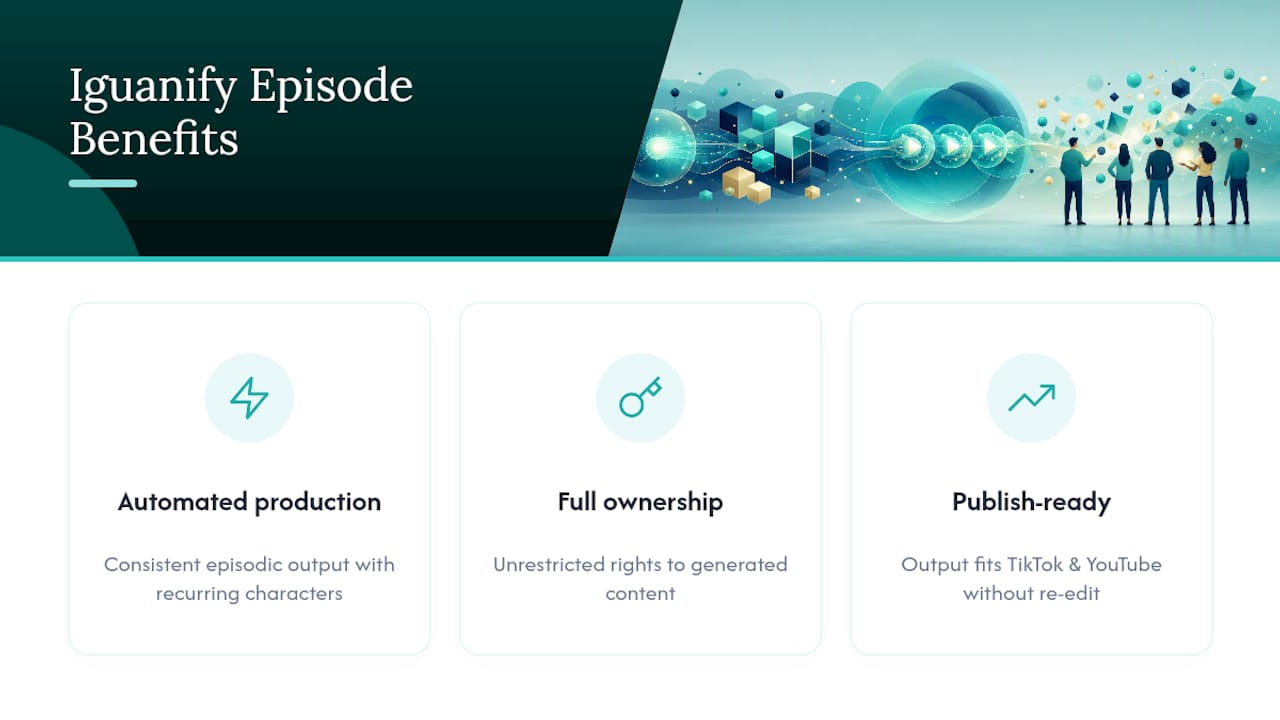
Iguanify’s blog on realistic AI video cost math breaks down the same budgeting logic covered here, written for creators who need dollar figures before they buy. The platform’s core claim is straightforward: automated episodic production with consistent recurring characters across episodes, full ownership of everything generated, and output ready to publish on TikTok and YouTube without a second editing pass.
That ownership piece deserves attention. Not every AI video provider hands over unrestricted rights to what you generate, so confirming this before you buy protects your ability to monetize later. (Editorial note: case studies, Leonard’s production background, and internal performance benchmarks to be added by the Iguanify team.)
Why Most Pricing Advice Undersells Iteration Costs
Most guides treat episode pack pricing like a vending machine transaction: pick a tier, pay the price, get your episode. That framing misses the part that actually determines whether a creator overspends. Iteration, not runtime, is where budgets blow up.
A platform’s advertised per-episode rate assumes a clean first pass. Real production rarely works that way. A character’s expression looks wrong, a scene’s pacing drags, a voice reading feels flat, and you regenerate. That’s normal, and it’s exactly why the 2 to 4x multiplier matters more than any sticker price on a pricing page.

The conventional advice to “compare per-episode rates across platforms” isn’t wrong, but it’s incomplete without asking how each platform handles regeneration. A slightly higher base price with generous re-run policies often beats a cheaper rate that charges full price for every retry. Creators who skip this comparison usually find out the hard way, mid-season, when their credit balance runs dry three episodes early.
Prioritize the iteration question before the sticker price. Everything else in this article follows from that one habit.
— Leonard
Get an Episode Pack Quote From Iguanify
Iguanify is the alternative to hiring an editor or production team for serialized video: You buy production credits once, generate episodes from script, and own the output. There’s no subscription lock-in and no recurring bill to track. The lineup covers a Standard episode and Pilot at $34.99 one-off per episode, plus Creator, Season, and Commissioned production options for creators scaling beyond a single test.
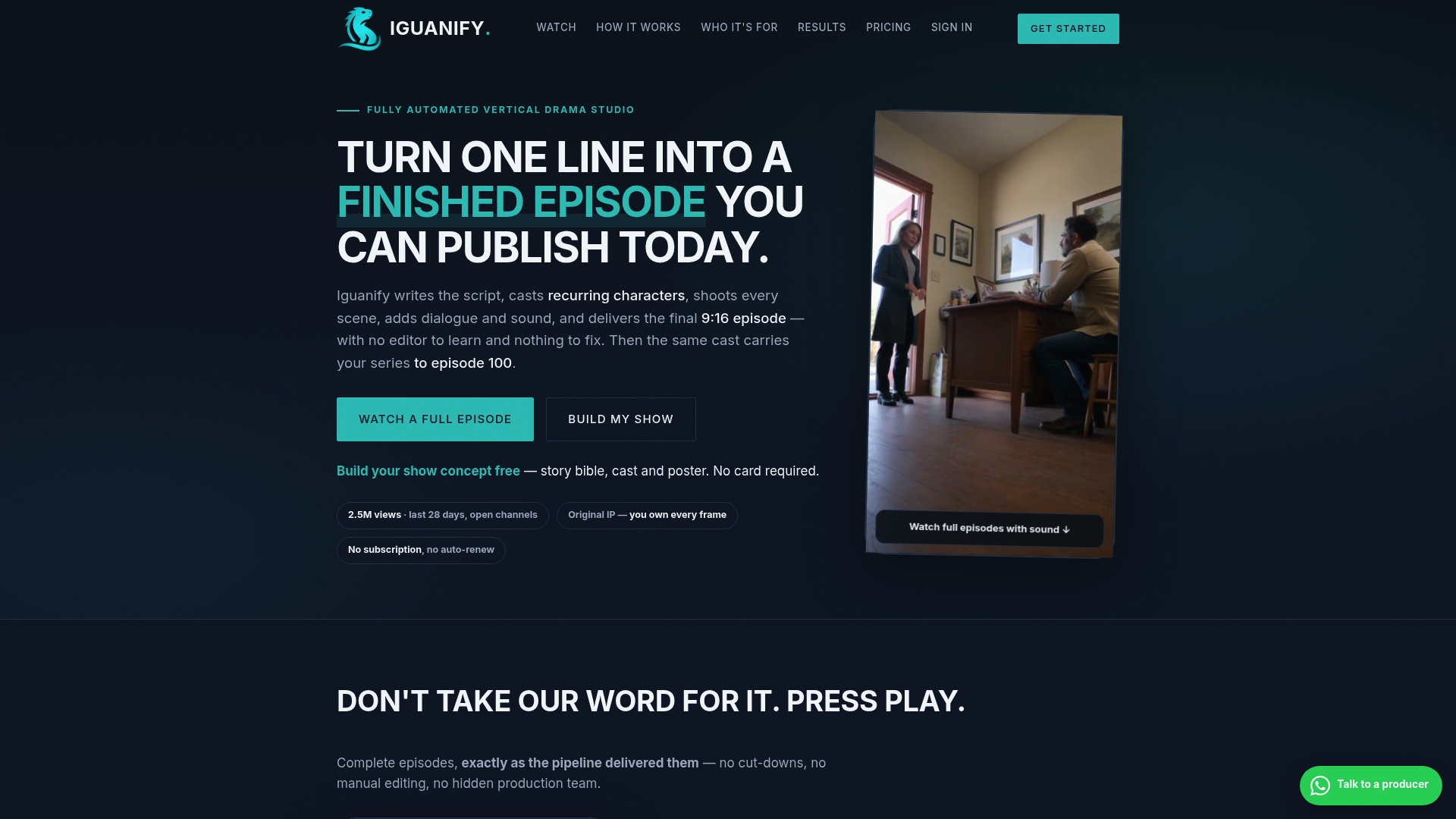
Some platforms produce episodes that come out platform-ready for popular social media, featuring recurring characters that stay consistent from one episode to the next, addressing continuity problems common in generic AI video tools. If you’re testing a concept, start with a Pilot to see the workflow firsthand. If you’re ready to commit to a run, check the Iguana Engine for self-serve episodic production, or reach out through Iguanify’s site for a Commissioned production quote built around your specific series.
Sources
- AI Video Generator Pricing Per Second | CreateVision AI
- One-time vs recurring payments (Switcher Studio blog)
FAQ
What Is the Typical Cost of an Episode Pack?
A single short episode commonly costs $30 to $100 depending on complexity, while season packs covering six to twelve episodes run into the hundreds. Iguanify prices its Standard episode and Pilot at $34.99 one-off per episode, which gives a fixed reference point for budgeting.
How Much Should I Budget for Iteration?
Budget two to four times your platform’s raw credit estimate, since first-pass generations rarely come out publish-ready. Documented projects have burned 3,000 to 30,000 credits depending on revision volume, which reflects how much iteration actually costs.
Do Episode Packs Expire?
Expiration policies vary by provider, so confirm this before buying rather than assuming credits roll over indefinitely. Some platforms also refund credits for failed generations, per CreateVision’s pricing details, which can offset expiration risk.
Who Owns the Episodes I Generate?
Ownership depends entirely on the provider’s terms, and creators should verify this before purchasing any pack. Ownership policies vary by provider; some platforms grant full ownership of generated episodes, allowing creators to publish and monetize across platforms without licensing restrictions.
Should I Buy a Subscription or a One-Time Pack?
One-time packs suit a finite launch or a single test episode, while subscriptions suit creators publishing continuously and needing predictable monthly capacity. Many creators combine both, using a one-time pack to launch and a subscription once the series proves itself, a pattern Switcher Studio documents across creator businesses generally.