 IGUANIFY
$3,200 Clearance: Background Music Rights for Short Video Creators
You need a synchronization license to pair music with your visuals, and if you use an existing recording, you almost certainly need a master use license too. For most independent creators, the fastest low-risk path is a pre-cleared royalty-free library or a direct license, since clearing a commercial track from scratch takes time and money. Platform audio libraries help, but they carry commercial limits you have to check before you monetize.
TL;DR:
- Using pre-cleared royalty-free libraries or direct licenses is the easiest way for creators to avoid costly clearance delays.
- Both synchronization and master use licenses are required for each song, and failing to clear either can result in copyright infringement.
- License details such as usage scope, territories, and duration must be carefully documented and stored with your project files for proof.
- International distribution complicates licensing, so securing worldwide rights upfront prevents legal issues across different markets.
- Automated workflows that embed license metadata and link to rights documentation help prevent repeated clearance mistakes at scale.
Table of Contents
- The Two Rights Behind Background Music Rights for Short Video
- Safe, Fast Options: Libraries, Creative Commons, and Platform Audio
- How to Clear a Commercial Track Step by Step
- What Music Clearance Actually Costs
- Myths That Get Creators Sued
- The Paperwork You Actually Need to Keep
- Scaling Music Rights Across Automated Production Workflows
- User-Generated Content, Remixes, and Where Liability Lands
- Why International Distribution Changes Your Music Rights
- A Short Priority List for Tight Budgets
- A Production Workflow Built Around Traceable Music Rights
- Sources
The Two Rights Behind Background Music Rights for Short Video
Every recorded song carries two separate copyrights, and both usually need clearing before you publish. The first is the composition, owned by the songwriter or their publisher. The second is the master recording, owned by the label or whoever paid for that specific recording session.
A sync license clears the right to pair that composition with your visuals. A master use license clears the specific recording you’re actually using in the edit. You can license the composition and still be infringing if you don’t also license the master, and vice versa. ASCAP’s guidance on acquiring music for films lays this out clearly: both licenses are normally required to use a pre-recorded song in a film or video.
Here’s where the performing rights organizations fit in:
- ASCAP, BMI, and SESAC each maintain repertory databases you can search to find who publishes a given song.
- These PROs primarily license public performance rights, not sync rights directly, but their databases are the fastest way to identify the publisher you need to contact.
- Once you know the publisher, you request sync terms from their business affairs or licensing department, and you request the master from whoever owns that recording, often a label.
Safe, Fast Options: Libraries, Creative Commons, and Platform Audio
Not every project needs a full clearance negotiation. “Royalty-free” means you pay once (or subscribe) instead of paying per play, but it doesn’t mean unconditional. “Direct license” services grant you a specific set of rights up front, tied to a subscription or one-time fee. Platform-provided sounds are a third category entirely, governed by the platform’s own terms rather than a license you hold.
Reputable pre-cleared libraries like Soundstripe and Epidemic Sound sell licensing models built for creators who publish across social platforms without running a clearance process for every track. Free Music Archive takes a different approach, hosting tracks under explicit Creative Commons or public-domain labels rather than a paid subscription.
Before you rely on any of these, check three things:
- Does the plan cover commercial and monetized use, not just personal projects?
- Does it cover client work, paid ad placements, and channel transfers if you sell the video later?
- What happens if you cancel a subscription? Some services revoke rights to tracks used after cancellation.
YouTube’s Shorts audio library has its own wrinkle. Certain sounds carry partner agreements and territory restrictions, meaning access to a sound inside the app doesn’t automatically clear it for every commercial use or every market. Royalty-free doesn’t mean free of concern; you still have to read what the license actually covers before you publish.
Pro Tip: Screenshot or PDF the license terms the day you download a track. Libraries update their plans, and the terms you agreed to may not match what’s posted a year later.
How to Clear a Commercial Track Step by Step
If the track you want isn’t pre-cleared, here’s the sequence that works.
-
Identify both rights holders. Search ASCAP, BMI, or SESAC’s repertory database for the publisher. For the master, check the liner notes, the label’s website, or a database like the label’s own catalog listing to find who owns the specific recording.
-
Send a detailed clearance request. Include your project title, a short synopsis, the exact clip start and end times, how the music will be used (background, opening, end titles), the territories you plan to distribute in, the platforms involved, your budget, and how long you need the rights.
-
Ask about festival-only licenses or a step deal if your budget is tight. A festival-only license lets you screen the film at festivals for a low flat fee, with the option to expand to wider distribution once you sell the project or raise more money. Negotiate sync and master fees at the same time, and insist on contingency language stating you don’t owe anything until both sides are confirmed. Tools for Film’s licensing cost guidance recommends exactly this approach, and describes an indie short that cleared two tracks for around $3,200 total, including a clearance consultant’s fee.
-
Get everything signed before you lock picture. Once terms are agreed, get a written license from the publisher and a separate written license from the master owner. Record the license ID number from each agreement and store it with your project files.
Pro Tip: Never pay the sync fee before confirming the master fee is affordable. Publishers and labels negotiate separately, and a locked sync deal with no matching master rights leaves you stuck paying for a clearance you can’t use.
What Music Clearance Actually Costs
Costs swing hard depending on how the track is used. Background music in a scene costs less than a featured needle-drop where the song is clearly recognizable, and end-title placement often costs more than either because it’s prime real estate for the artist’s brand. “Limited” rights (a specific festival run, a set territory, a defined term) cost less than “all media, worldwide, in perpetuity” rights, which is what a distributor will eventually want if your project gets picked up.
Territory, platform scope, and license length all push the fee up. A one-year web-only license costs less than a five-year license covering broadcast, streaming, and theatrical. If you sign a limited deal and later expand distribution, budget for re-clearance instead of assuming your original license stretches to cover it.
Response times vary widely. Some publishers reply within days; others take weeks, especially around major labels’ busy licensing seasons. If your project has real festival or distribution ambitions and more than one or two tracks to clear, a clearance consultant earns their fee by chasing down rights holders and drafting language you’d otherwise get wrong.
Myths That Get Creators Sued
A few beliefs keep circulating that don’t hold up.
- “Short clips are automatically fine.” Using 10 or 30 seconds of a song doesn’t remove the licensing requirement. There’s no duration threshold that makes an unlicensed clip safe.
- “Fair use covers background music.” Fair use is a narrow legal defense built for commentary, criticism, and parody, not for entertainment content that simply wants a good soundtrack. Courts weigh it case by case, and creators lose this argument often.
- “Crediting the artist is enough.” Attribution isn’t a license. Neither is a platform’s Content ID system clearing you for anything beyond that specific platform’s terms; Content ID matches audio, it doesn’t grant rights.
The Paperwork You Actually Need to Keep
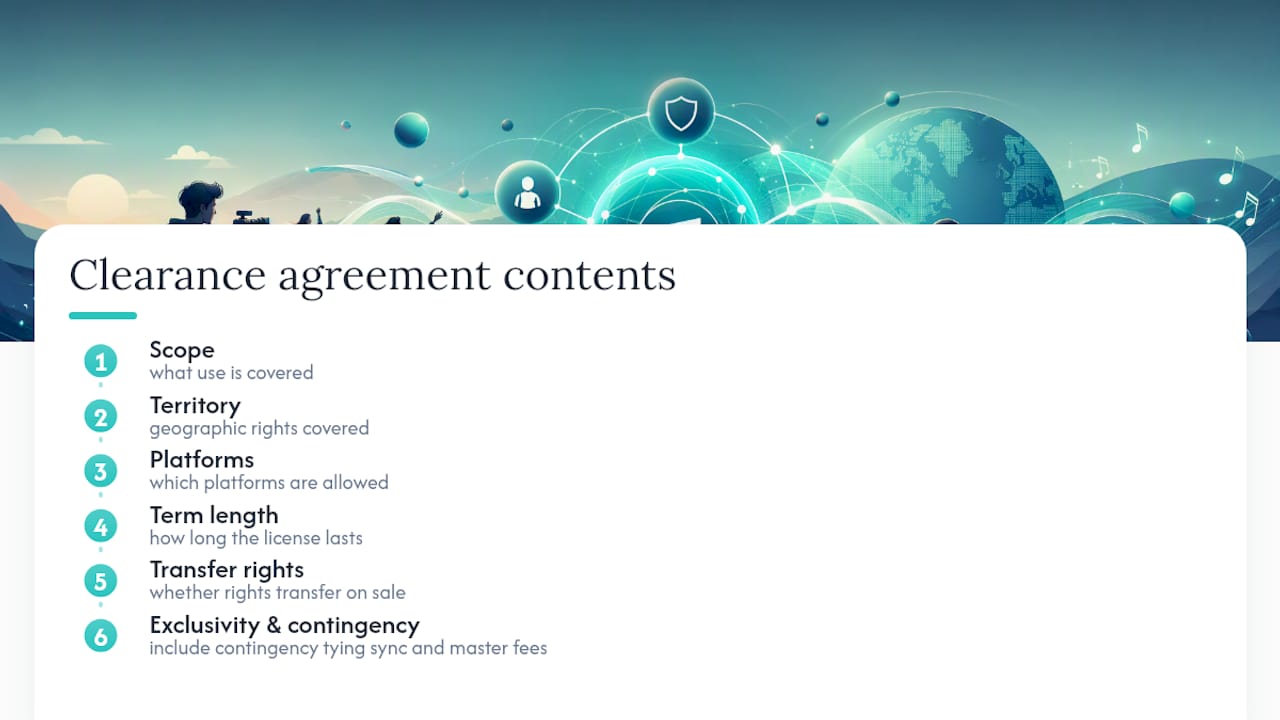
A clearance is only as good as your ability to prove it exists. Every agreement should spell out scope (what use is covered), territory, platforms, term length, whether the rights transfer if you sell the project, exclusivity, and contingency language tying sync and master fees together.
Save the signed agreement, the invoice, the license ID number, the track’s metadata (title, artist, ISRC code if available), the date you downloaded or licensed it, and which account or subscription held the license. Embed that metadata directly into each exported file’s properties, and keep one license folder per video rather than one giant folder for the whole project. When a platform flags your audio or a rights holder sends a claim, that folder is your entire defense.
Scaling Music Rights Across Automated Production Workflows
Automated video production multiplies the risk of repeating an unlicensed track across dozens of episodes before anyone notices. If one clip in your library isn’t cleared, an automated export pipeline will happily bake it into every episode you publish until someone flags it. That’s why pairing automated workflows with pre-cleared libraries and embedded license metadata matters more, not less, as your output scales.
Some automated production platforms keep produced-asset metadata attached to each episode generated, so creators can link license documentation directly to the file it belongs to. For creators building a consistent audio identity across episodes, Iguanify’s guide to sound design for shorts and its Shorts monetization guide cover how to keep audio choices consistent without repeating clearance mistakes.
User-Generated Content, Remixes, and Where Liability Lands
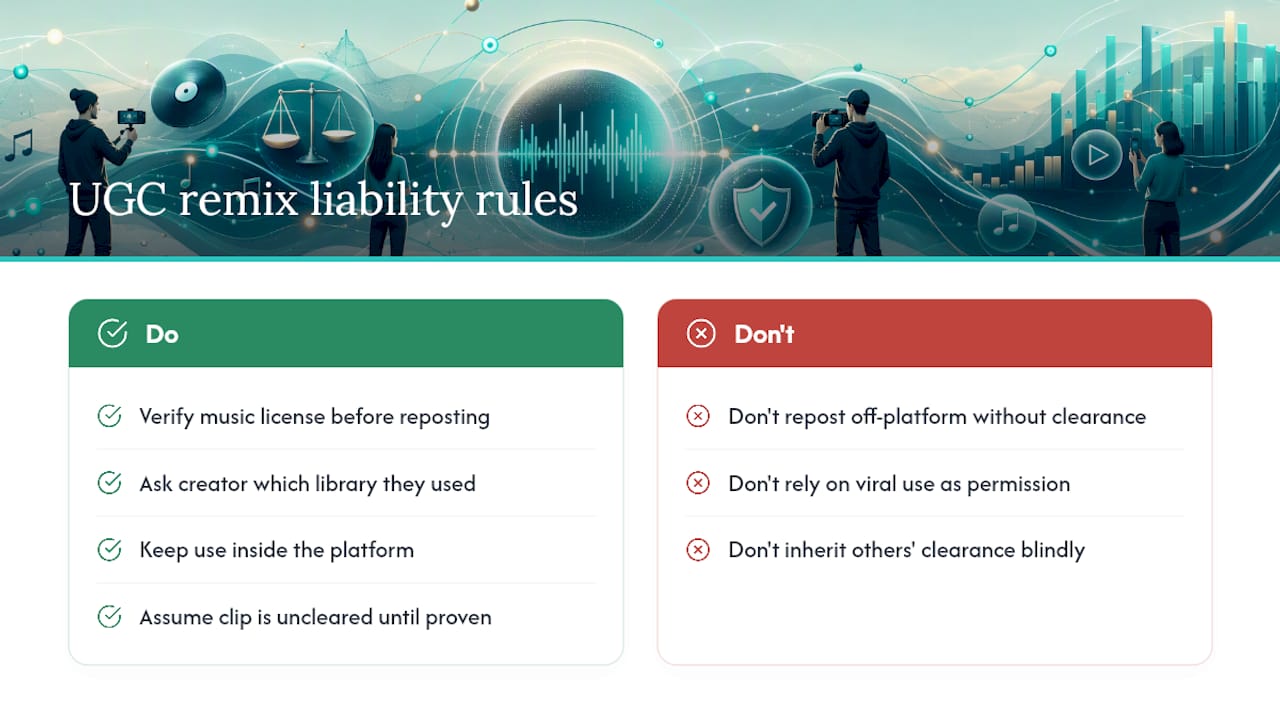
Remixing someone else’s video, using a viral sound, or building on user-generated content adds a layer most creators don’t think through. When you remix a clip that itself contains licensed or unlicensed music, you inherit whatever rights problems existed in the original, plus whatever platform terms govern remix features.
Platforms like TikTok and YouTube grant limited licenses for users to remix content within their own apps, but that permission usually stops at the platform’s edge. Download that remixed video and repost it somewhere else, and you’ve stepped outside the license that made the remix legal in the first place. The same logic applies to trending sounds: using a sound because “everyone else is using it” only works while you stay inside the platform and use case that sound’s license was built for.
User-generated content also raises attribution questions that get murky fast. If a fan account edits your show’s footage with a licensed track and tags you, and you then repost their edit to your own channel, you’re now distributing a video whose music clearance you never personally verified. Before reposting fan content, ask what music library or platform tool they used and whether that clearance extends to your channel’s use case, especially if your channel is monetized differently than theirs.
The safest practice for any UGC or remix workflow is treating every third-party clip the same way you’d treat a stranger’s song: assume it isn’t cleared for your specific use until you can point to the license that says otherwise.
Why International Distribution Changes Your Music Rights
Copyright law isn’t uniform once your short video crosses borders, and short-form platforms make that crossing automatic. A license scoped to “United States, web only” technically doesn’t cover a viewer in Germany streaming your video, even though the platform itself operates globally.
Most reputable licensing services and libraries structure their commercial terms to cover worldwide digital distribution precisely because platforms like YouTube and TikTok don’t respect borders. But not every license does this by default, and cheaper or narrower deals sometimes carve out specific territories to keep costs down. If you’re negotiating directly with a publisher or label rather than using a pre-cleared library, confirm the territory language explicitly. “Worldwide” needs to appear in writing, not just be assumed because the platform happens to be global.
International treaties like the Berne Convention mean most countries recognize copyright protection reciprocally, so a work protected in one member country is generally protected in others too. That reciprocity cuts against creators as often as it protects them: a track cleared under one country’s fair dealing or fair use standard may not enjoy the same protection once your video is viewed in a jurisdiction with narrower exceptions. Practically, that means the safest posture for any creator planning global distribution is licensing for worldwide rights up front, even if it costs slightly more, rather than gambling on inconsistent enforcement across markets you can’t control.
A Short Priority List for Tight Budgets
If you post often, commit to one reputable pre-cleared library and stick with it. Planning a festival run first? Lock in festival-only rights while you negotiate broader distribution. And keep every license file attached to its exported video, always.
— Leonard
A Production Workflow Built Around Traceable Music Rights
If clearance paperwork and manual tracking are the parts of production you dread, an automated workflow like Evolve Commerce’s digital growth agency solutions changes what “keeping records” actually requires. Instead of juggling spreadsheets of which license covers which file, Iguanify ties audio assets directly to each exported episode, so the track and its documentation travel together from the start.
You still make the licensing decisions, but the platform reduces how much of that record-keeping falls on memory. Episodes are generated from a single script, and you retain full ownership of what gets produced, meaning license documents you attach to a project stay attached to the actual files you publish, not a folder you have to remember to update. For creators scaling past a handful of videos a month, that traceability is what prevents an old clearance mistake from quietly repeating across a season.
If you’re building a serialized short-form show and want the production side handled while you focus on rights and story, see how Iguanify’s automated episode production works and check whether your current concept is ready for a season-length run.
Sources
- How To Acquire Music For Films — ASCAP
- Music Licensing for Indie Films: How Much It Costs and How to Negotiate — Tools for Film
- YouTube Shorts audio policies — Google Support
- Free Music Archive