 IGUANIFY
YouTube Shorts Monetization for Creators: 2026 Guide

Yes, you can earn money from YouTube Shorts right now — but only after you meet the YouTube Partner Program (YPP) thresholds and actively opt into the Shorts Monetization Module. Views you rack up before accepting that module don’t count toward your earnings, so timing your opt-in matters.
Here’s what you need to qualify for Shorts ad revenue:
- Full YPP (Shorts ad revenue + all features): requires 1,000 subscribers plus either a large number of valid Shorts views in the past 90 days or sufficient valid public watch hours in the past 12 months, with a linked Google AdSense account and no active policy strikes.vidIQ’s 2026 YPP summary
- Expanded YPP (fan funding only, no AdSense): 500 subscribers plus either 3 million Shorts views in 90 days or 3,000 watch hours in 12 months.
- Immediate next step: Confirm your country is eligible, link your AdSense account in YouTube Studio, and apply to YPP once you hit the thresholds.
One critical detail many creators miss: Shorts views do not count toward the 4,000 long-form watch-hour requirement. If you post only Shorts, your path to full monetization runs through the 10 million views in 90 days route.
Table of Contents
- How YouTube Shorts monetization eligibility works
- What you can realistically expect to earn from Shorts
- Which Shorts views are eligible and which aren’t
- How to convert Shorts into real income beyond ad revenue
- Policy red flags that block Shorts monetization
- Where to find your Shorts revenue in YouTube Studio
- Iguanify helps you scale serialized Shorts production
- The creator’s perspective on Shorts as a growth engine
- What most creators get wrong about Shorts revenue
- Key Takeaways
- Useful sources and official documentation
How YouTube Shorts monetization eligibility works
The two YPP paths serve different channel types, and choosing the right one to target can save you months of effort. Here’s a direct comparison:
| Criteria | Path A: Long-form watch hours | Path B: Shorts views |
|---|---|---|
| Subscribers required | 1,000 | 1,000 |
| Primary threshold | 4,000 public watch hours / 12 months | 10M valid Shorts views / 90 days |
| Shorts views count? | No | Yes |
| Best for | Channels mixing long-form and Shorts | Shorts-only or Shorts-first channels |
| Revenue unlocked | AdSense + all YPP features | AdSense + all YPP features |
| Expanded tier (fan funding) | 3,000 watch hours + 500 subs | 3M Shorts views / 90 days + 500 subs |
The expanded tier at 500 subscribers unlocks fan-funding tools like Super Thanks and channel memberships, but it does not include AdSense ad revenue. You need the full YPP tier for that. According to vidIQ’s 2026 YPP summary, these thresholds are current as of this year, and YouTube evaluates them on a rolling basis.
A few policy preconditions apply regardless of which path you take: your channel must have no active Community Guidelines strikes, your AdSense account must be linked and verified, and your channel must be based in a country where YPP is available. The Shorts Monetization Module becomes available to accept once YouTube approves your YPP application.
What you can realistically expect to earn from Shorts
Shorts RPM is low compared to long-form. YouTube does not publish official Shorts RPM figures, so the numbers below are creator-reported estimates compiled from multiple sources. Use them for planning, not as guarantees.
YTCalculators’ Shorts earnings data puts US creator RPM in the range of $0.03–$0.08 per 1,000 views after YouTube’s cut, with India estimates around $0.01–$0.03 per 1,000 views. The gap reflects advertiser demand by geography: US audiences command higher ad rates.
| Views | US earnings (low: $0.03/1K) | US earnings (high: $0.08/1K) | India earnings (low: $0.01/1K) |
|---|---|---|---|
| 1,000 | $0.03 | $0.08 | $0.01 |
A few factors move your actual number within and beyond this range. Niche matters: finance and business Shorts attract higher advertiser bids than general entertainment. Q4 consistently delivers higher ad rates as brands spend end-of-year budgets. Audience geography is the biggest single variable — a channel with primarily US viewers earns more per view than one with a global mix skewed toward lower-CPM markets.
The AdSense payment threshold is $100 (US). If your monthly earnings don’t reach that, the balance rolls forward to the next month. Payments are credited monthly, typically between the 21st and 26th of the following month, once your AdSense account is in good standing and tax forms are submitted.
Which Shorts views are eligible and which aren’t
Not every view on your Shorts counts toward your monetization pool allocation. Understanding the difference between total views and eligible engaged views is one of the most practical things you can do to protect your revenue.
Eligible views generally require:
- Content that meets YouTube’s advertiser-friendly content guidelines (no excessive violence, adult themes, or controversial subjects without appropriate context)
- Full commercial rights to all audio and visual elements, including any AI-generated assets
- No active copyright claims that block monetization (as opposed to claims that track or share revenue)
- Real, organic traffic — purchased or artificially inflated views are excluded
Common ineligible cases:
- Reuploaded clips from other creators without transformation
- Unedited or minimally edited stock footage compilations
- Mass-produced templated content with no original creative contribution
- Shorts with active policy strikes or restricted monetization notices
- Views generated by bots or click farms
Music usage deserves a specific note. Using a popular licensed track in your Short doesn’t make the view ineligible, but it does reduce your effective payout because music licensing costs come out of the Creator Pool before your 45% is calculated. Shorts with original audio or royalty-free tracks keep the full allocation.
Pro Tip: Document the license for every third-party audio or visual asset you use in a Short. Keep a simple spreadsheet with the asset name, source, and license type. If a copyright claim appears, you’ll resolve it faster with documentation in hand. When possible, use original audio or tracks you’ve licensed for commercial use — it protects both eligibility and your effective RPM.
How to convert Shorts into real income beyond ad revenue
At $0.03–$0.08 per 1,000 views, Shorts ad revenue alone won’t sustain most creators. The creators who make Shorts financially worthwhile treat them as a top-of-funnel growth engine, not a primary revenue source.
The core strategy: use Shorts for reach, long-form for revenue.
Shorts grow your subscriber count faster than most other formats because the algorithm surfaces them to non-subscribers. Each subscriber you gain through Shorts is a potential viewer for your long-form content, where CPMs run significantly higher. A viewer who watches a 12-minute video generates more ad revenue than the same person watching 50 Shorts.
Tactical moves that compound this effect:
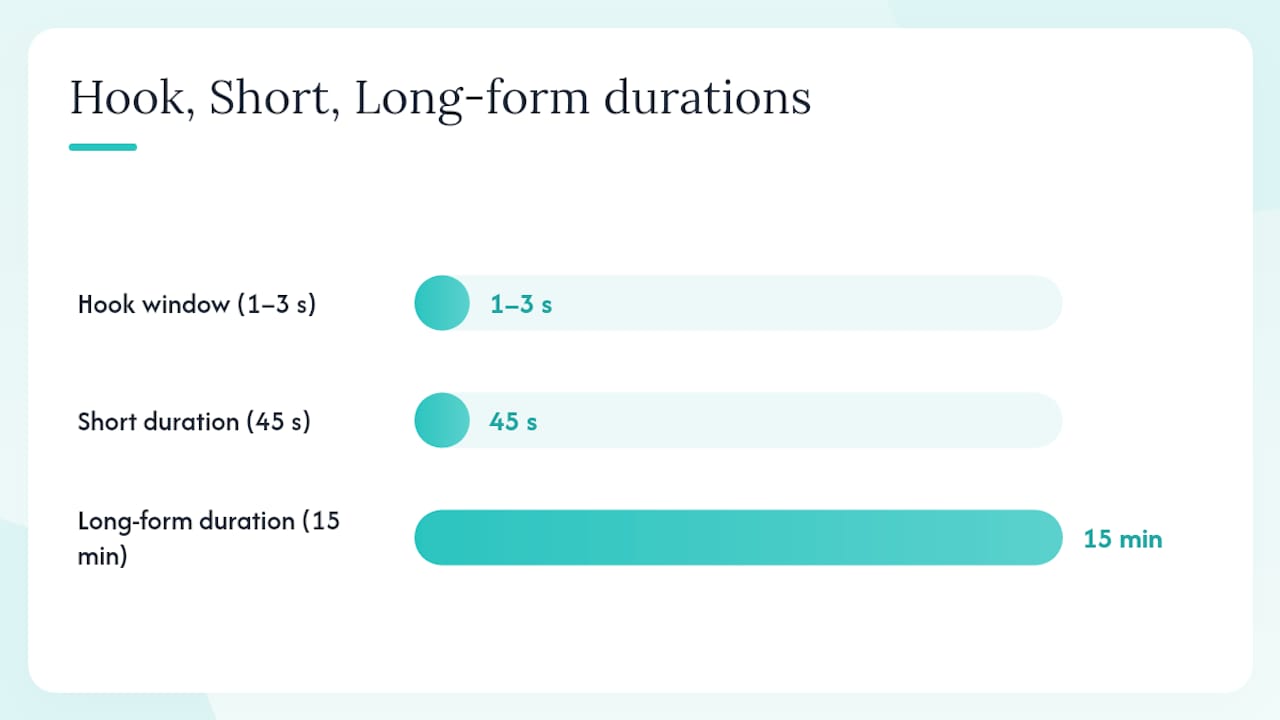
- Hook viewers in the first 1–3 seconds with a specific promise or question. Retention in those opening seconds determines whether the algorithm keeps distributing your Short.
- Add a verbal or on-screen CTA pointing to a related long-form video or playlist. “Watch the full breakdown on my channel” is simple and effective.
- Use pinned comments to link to your long-form content, affiliate products, or a lead magnet.
- Where YouTube Shopping is available, tag products directly in your Shorts for affiliate or merch revenue.
- Enable Super Thanks on your Shorts — viewers can tip directly on individual videos once you’re in YPP.
A practical funnel looks like this: a creator posts a 45-second Short teasing a topic, gains 200,000 views, and converts 2–3% of viewers into channel subscribers. Those subscribers then watch a 15-minute deep-dive video on the same topic, generating long-form ad revenue at a much higher CPM. The Short earned only a few dollars in ad revenue at typical RPM rates. The long-form video, watched by a fraction of those subscribers, earns multiples of that.
Sponsorships and affiliate deals scale this further. Brands pay for access to your audience, not your RPM. A Short with 500,000 views is a credible pitch for a mid-tier sponsorship regardless of what AdSense paid you. Understanding how creator fund agreements work helps you structure those deals properly from the start.
Policy red flags that block Shorts monetization
YouTube’s enforcement has sharpened in 2026, particularly around AI-generated and repetitive content. These are the patterns most likely to get your Shorts demonetized or excluded from YPP entirely.
- Repetitive or mass-produced content. Channels that churn out templated videos with minimal variation are being actively excluded from YPP. TechCrunch reported on YouTube’s 2026 policy clarifications targeting this category specifically. Remediation: add distinct human commentary, original narration, or creative framing to each video before uploading.
- Missing commercial rights for AI outputs. Free-tier AI tools often produce outputs under non-commercial licenses. Using those outputs in monetized content violates YouTube’s policies. Remediation: verify the commercial license terms of every AI tool you use and upgrade to a paid tier if needed.
- Active policy strikes. A Community Guidelines strike puts your monetization on hold. Remediation: resolve or appeal the strike through YouTube Studio before reapplying to YPP.
- Undisclosed realistic synthetic content. YouTube requires creators to use the “Altered or synthetic content” label for AI-generated media that could be mistaken for real footage or real people. Skipping this label on qualifying content risks demonetization. Remediation: apply the label in YouTube Studio’s upload settings for any realistic AI-generated video or audio.
- Manipulated or distressing content. Graphic, shocking, or emotionally manipulative content that lacks clear editorial context is flagged for limited or no ads. Remediation: add context, narration, or editorial framing that clarifies the purpose.
- Artificial or purchased traffic. Views from click farms or paid traffic services are stripped from your eligible engaged view count and can trigger a channel review. Remediation: remove any third-party traffic services immediately and file an appeal if your channel was flagged.
On AI specifically: using AI tools is allowed when you add clear human value and hold commercial rights to the outputs. The policy targets low-effort, high-volume content factories, not creators who use AI as a production tool with genuine creative direction. FluxNote’s 2026 guide on monetizing AI videos covers the disclosure and licensing requirements in detail.
Where to find your Shorts revenue in YouTube Studio
Knowing where to look saves you from guessing whether your monetization is working.
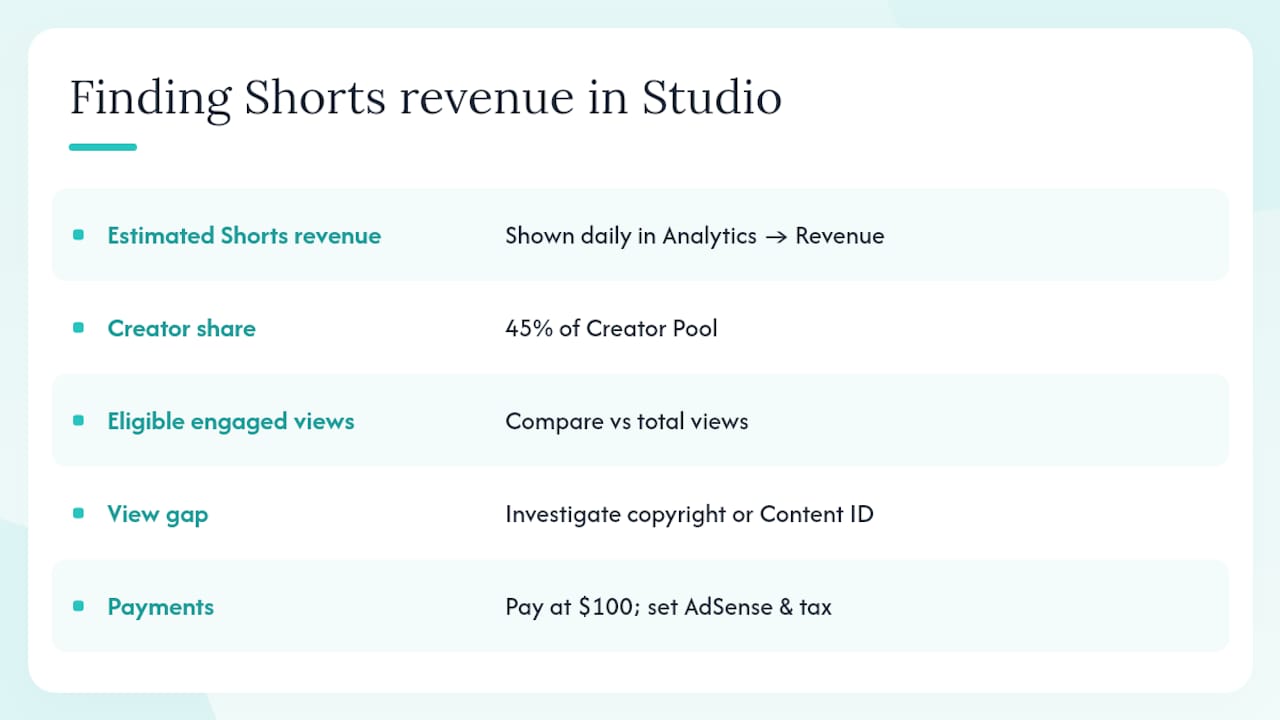
In YouTube Studio, go to Analytics → Revenue. Once your Shorts Monetization Module is active and you have eligible views, you’ll see a line for “Estimated Shorts Feed ad revenue” broken down by day. This figure updates with a short delay and reflects your 45% share of your allocated Creator Pool revenue.
The metric to watch alongside total views is eligible engaged views. You’ll find this in the Revenue tab as well. A significant gap between your total Shorts views and your eligible engaged views signals a problem worth investigating. Common causes include copyright claims on audio or visuals, Content ID matches that redirect revenue to a rights holder, or monetization notices on specific Shorts. Check each Short’s monetization status individually in the Content tab.
Payment mechanics: your Shorts earnings accumulate in your linked AdSense account. Once your balance reaches $100, AdSense processes payment in the following payment cycle. If you don’t hit $100 in a given month, the balance carries forward. Make sure your AdSense payment method is set up and your tax forms (W-9 for US creators) are submitted, or payments will be held regardless of your balance.
If your estimated revenue looks unusually low relative to your view count, cross-reference with the YouTube Help Center’s Shorts monetization documentation to confirm your module acceptance date and check for any account-level monetization holds.
Iguanify helps you scale serialized Shorts production
Producing Shorts consistently is where most solo creators stall. Writing scripts, maintaining character continuity across episodes, editing, and formatting for vertical output takes hours per video — and the economics only work if you can publish at volume.
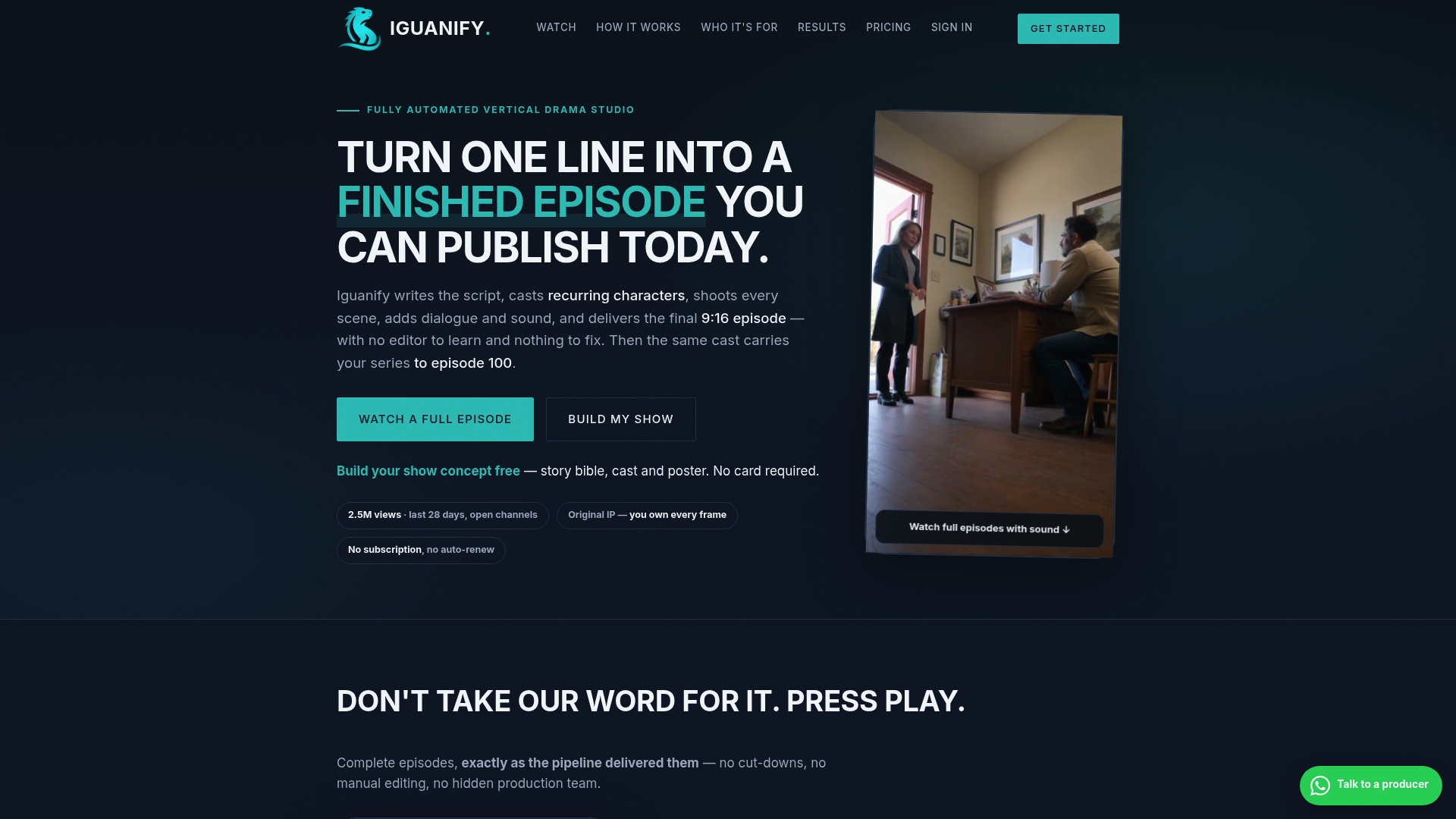
Iguanify automates the full production pipeline for serialized, vertically-formatted drama episodes. From a single premise, it generates a series bible, recurring cast, dialogue, sound, and a finished episode ready for YouTube Shorts, TikTok, or Instagram. You own the IP outright. There’s no subscription — you purchase episode or season credits when you need them, and your first show concept and cast are free to generate before you commit.
For creators building a faceless drama channel or anyone who wants to post serialized Shorts without a production team, Iguanify cuts the per-episode cost and time dramatically. You keep the rights, you control the cadence, and you feed both your Shorts funnel and your long-form library from the same production run. See what a finished episode looks like at the Iguanify AI drama generator — no commitment required to explore.
The creator’s perspective on Shorts as a growth engine
What most creators get wrong about Shorts revenue
The biggest mistake I see creators make is treating Shorts ad revenue as the goal. It isn’t. At $0.03–$0.08 per 1,000 views, you’d need tens of millions of monthly views just to cover a modest income from AdSense alone. That’s a ceiling most channels won’t reach, and chasing it at the expense of long-form content is a losing strategy.
What Shorts actually give you is distribution. The algorithm surfaces Shorts to people who’ve never heard of your channel. Every subscriber you earn through a Short is a potential long-form viewer, a potential member, a potential buyer of whatever you’re selling or recommending. That’s where the real money is.
The creators who thrive on Shorts aren’t the ones with the highest Shorts RPM. They’re the ones who treat each Short as a trailer for something bigger — a long-form video, a course, a product, a community. The Short is the hook. Everything else is the payoff.
One more thing worth saying plainly: if you’re using AI tools to produce Shorts at scale, the question isn’t whether AI is allowed. It is, with the right licenses and disclosure. The question is whether your content has a genuine creative identity. YouTube’s 2026 enforcement is specifically targeting channels that mass-produce templated content with no distinguishable voice or value. Owning your content rights and building a consistent serialized format — the kind Iguanify is built to produce — is exactly the approach that holds up under that scrutiny.
Key Takeaways
YouTube Shorts monetization requires meeting YPP thresholds, actively accepting the Shorts Monetization Module, and stacking revenue streams beyond AdSense to build sustainable income.
| Point | Details |
|---|---|
| Meet the right threshold | Shorts-only creators need 1,000 subs and 10M Shorts views in 90 days; Shorts views don’t count toward the 4,000 watch-hour path. |
| Opt in to the module | Accept the Shorts Monetization Module in YouTube Studio; views before acceptance earn nothing. |
| Understand the 45% share | Revenue is pooled, allocated by eligible engaged views, and you keep 45% of your share after music licensing costs. |
| Stack revenue beyond AdSense | US Shorts RPM runs $0.03–$0.08 per 1,000 views; sponsorships, affiliates, and fan funding make Shorts financially viable. |
| Iguanify for serialized production | Iguanify automates episodic Shorts production with full IP ownership, lowering per-episode cost for creators building consistent channels. |
Useful sources and official documentation
These are the primary sources to verify policies, check thresholds, and set up your monetization correctly:
- Shorts monetization module - YouTube Help
- YouTube Shorts Monetization: Requirements & Pay (2026) - vidIQ
- Monetize AI Videos: 2026 Guide for YouTube - FluxNote
- YouTube Shorts Monetization - YTCalculators
- YouTube clarifies policies around AI slop and upsetting videos - TechCrunch
- How much does YouTube Shorts pay? - CreatiCalc
This article provides general information about YouTube’s monetization policies and is not a substitute for YouTube’s official Help Center documentation or professional legal and financial advice. Policies and thresholds can change; always verify current rules directly with YouTube Support before making monetization decisions.