 IGUANIFY
8 Step AI Video Rights Checklist Creators Need Before Publishing

Copyright protects the human-authored parts of an AI-assisted video, not the parts a machine generated on its own. If you wrote the script, directed the edits, or made creative choices about arrangement and sequence, you can claim copyright in that contribution. Right now, save your prompts and edit history, clear any third-party material you used, and be ready to disclose the AI-generated portions when you register.
TL;DR:
- Human creative control must be clearly demonstrated, with recorded prompts, edits, and decision logs showing how you shaped the final work.
- When registering, only claim the expressive elements you created, such as editing or arrangement, and explicitly exclude AI-generated parts.
- Automated Content ID and takedown systems do not assess fair use; disputes should be managed proactively with proper evidence and responses.
- Securing rights involves obtaining clear licenses for third-party music, visuals, and likenesses before publication, especially for commercial use.
- Disclosing AI involvement and maintaining organized documentation from the start is essential to defend ownership and navigate platform or legal claims successfully.
Table of Contents
- Human Authorship and Copyrightability: What the Copyright Office Requires
- Registering Works That Include AI Material: How to Fill the Form
- Platform Enforcement and Takedowns: Content ID, Claims, and DMCA Basics
- Clearing Third-Party Rights: Music, Voice, Trademarks, and Stock Assets
- Practical Rights Checklist You Can Use Now
- When You Get a Claim: Dispute Options and Remediation Paths
- International Perspectives and Variations in AI Video Rights
- Implications of AI-Generated Deepfake Videos and Related Rights Concerns
- Licensing Models and Contracts Specific to AI-Generated Video Content
- Ethical Considerations and Emerging Industry Standards in AI Video Rights
- Why Rights Hygiene Belongs in Your Production Process, Not After It
- How Iguanify Keeps Ownership Simple While You Scale Production
- Sources
- FAQ
Human Authorship and Copyrightability: What the Copyright Office Requires
The U.S. Copyright Office’s guidance on AI-generated material puts human creative control at the center of the analysis. When the expressive elements of a work, the specific words, images, or sounds, are determined by a machine rather than a person, those elements are not protectable. A prompt alone, however detailed, usually is not treated as the kind of creative control that produces authorship, because the AI system is still the one making the expressive choices in response to it.
The Office has drawn a useful distinction in practice: a graphic novel combining AI-generated images with human-written text and human-arranged panels was registerable as a whole, but the individual AI images inside it were not. That same logic applies to video. Your edited sequence, added dialogue, and directed choices are yours; a shot the AI produced from a bare prompt is not.
To support a claim, keep records that show your hand in the work:
- Prompt and revision logs, including how you refined outputs over multiple attempts.
- Timestamps and version history for edits made after AI generation.
- Notes on selection and arrangement decisions, such as which takes made the final cut.
Registering Works That Include AI Material: How to Fill the Form
When you file with the Copyright Office, accuracy in the application matters more than optimism about what will pass. The NewsNet Issue 1060 report confirms that AI outputs can be covered by registration only when a human author determined enough of the expressive elements, so the paperwork has to reflect that split honestly.
- Use the “Author Created” field to describe only your human contribution, such as “editing, arrangement, and dialogue.”
- Use the “Material Excluded” or limitation of claim section to name the AI-generated elements you are not claiming.
- Add a “Note to Copyright Office” if your case needs context, such as which scenes were AI-generated versus shot or edited by you.
Pro Tip: Write your human-contribution description before you start the form. A tight two-sentence summary of what you selected, arranged, or edited will save you from vague language that raises questions during examination.
Keep your prompt and edit histories on file even after submission. If the Office follows up, having a dated, organized record beats trying to reconstruct your process weeks later. Iguanify’s 8-step legal checklist for AI video ownership walks through this documentation habit in more detail.
Platform Enforcement and Takedowns: Content ID, Claims, and DMCA Basics
Platforms do not decide legal ownership, they decide whether your video stays up, gets monetized, or gets pulled. YouTube’s fair use guidance states plainly that automated systems like Content ID cannot determine fair use. These systems match audio and video fingerprints against a rights-holder database and act on the match, regardless of whether your use would hold up as fair use in court.
- A Content ID claim usually means monetization shifts to the rights holder or your video gets tracked, but it stays up.
- A DMCA takedown is a formal legal notice that removes the video and can result in a copyright strike.
- Repeated strikes can lead to channel termination, separate from any claim dispute you might win later.
Automated content matching systems flag video and audio at scale and cannot weigh context like parody or commentary, according to YouTube’s own guidance, which means a legitimate fair use case can still trigger a claim.
Under 17 U.S.C. § 512, platforms follow notice-and-takedown procedures to keep their own liability limited, which is why the process feels mechanical: the platform is complying with the statute, not judging your case. If you get a takedown notice, respond within the platform’s stated window and gather your evidence of rights or fair use before you file a counter-notice.
Clearing Third-Party Rights: Music, Voice, Trademarks, and Stock Assets
Video almost always layers in material you did not create yourself, and each layer carries its own rights question. Music alone splits into two separate rights: the composition (the song itself) and the master recording (the specific version you used), and video needs a synchronization license covering both before you publish.
- Composition and master rights are held separately, often by a publisher and a label, and you typically need both.
- An AI voice or likeness that resembles a real, identifiable person can trigger publicity rights claims even without using their actual audio or image.
- Stock assets from a platform library carry their own terms, and commercial use limits vary by license tier.
Pro Tip: When in doubt, commission custom music or use a platform-approved library instead of an AI-generated voice trained to sound like someone recognizable. Iguanify’s guide to clearing background music rights for short-form video breaks down what a synchronization license actually needs to cover.
A licensing overview from Kinter Media lays out the five license types marketers typically need to define for video, which is a useful checklist even outside a marketing context.
Practical Rights Checklist You Can Use Now
Rights management works best when it is a routine, not a scramble after something goes wrong. This adapted version of Iguanify’s 8-step checklist gives you a repeatable process for episodic or short-form AI video.
- Log every prompt, iteration, and human edit in a dated ledger you can produce later.
- Track asset provenance: where each visual, voice, and music clip came from.
- Get written licenses for any music, voice likeness, or third-party visual before you publish, not after.
- Register your human-authored contributions and disclose AI-generated portions on the application.
- Save copies of platform correspondence, license terms, and any claim notices you receive.
The difference between a defensible claim and a costly dispute often comes down to whether you can produce a dated record of what you did and when.
Iguanify’s overview of keeping content ownership while scaling production covers how this ledger habit holds up once you are producing at volume rather than one video at a time.
When You Get a Claim: Dispute Options and Remediation Paths
The first move after any claim is triage, not panic. Identify who filed it, what type of claim it is, and what evidence they attached, because that determines your next step.
- Check whether it is a Content ID claim (affects monetization or tracking) or a formal DMCA takedown (removes the video and can add a strike).
- Gather your own evidence: license files, prompt logs, or a fair use argument grounded in transformation or commentary.
- Dispute a Content ID claim through the platform’s built-in tool; reserve a DMCA counter-notice for takedowns where you genuinely believe you have rights or a fair use defense, and get a lawyer’s read before you file one, since a counter-notice can expose you to a lawsuit if you are wrong.
- If the claim is valid, consider re-editing to remove the flagged element or negotiating a retroactive license instead of fighting it.
Iguanify’s breakdown of platform AI content policy rules walks through how to read a claim notice and decide which path fits your situation.
International Perspectives and Variations in AI Video Rights
Copyright rules for AI-generated material are not uniform once you look past domestic law. Different countries are converging on the same core question, whether human authorship is required, but reaching different answers about how much human input counts.
Some jurisdictions have signaled openness to protecting AI-assisted works where a human made meaningful creative decisions, similar to the standard the Copyright Office applies. Others are more restrictive about what counts as an “author” at all, particularly where national law was written with only human creators in mind and has not been updated for generative tools. A few markets are actively drafting new rules specifically for AI-generated content, which means the standard in any given country can shift within a short window.
For a creator distributing on platforms like TikTok, YouTube, or Instagram, the practical risk is less about which country’s court might hear a dispute and more about the platform’s own global enforcement, which tends to apply one policy regardless of where the claim originates. Your safest posture is the same one that protects you domestically: document your human contribution, clear third-party rights in writing, and treat any claim about foreign law affecting your specific case as a question for a qualified attorney rather than a general assumption. Nothing here should be read as a statement of any other country’s copyright law, since that varies by jurisdiction and changes over time.
Implications of AI-Generated Deepfake Videos and Related Rights Concerns
Deepfake technology raises a rights question separate from copyright entirely: whose face or voice is being used, and did they agree to it. Even a video with clean copyright paperwork can create serious liability if it simulates a real, identifiable person without consent, because that touches publicity and likeness rights rather than authorship.
The risk splits into two categories. Simulating a public figure for parody or commentary sits closer to protected speech in some contexts, though platforms often act on complaints regardless of the underlying legal merits. Simulating a private individual, or a public figure in a way that implies they said or did something they did not, carries much higher legal exposure and reputational risk for the creator who published it.
If your AI video workflow generates a voice or face resembling a specific real person, treat that the same way you would treat using their name in an advertisement: get a release, or avoid the resemblance entirely. This matters even when the person is a public figure whose image seems freely available online, because publicity rights typically exist independently of whether a photo or clip is easy to find. Platforms are also building their own deepfake disclosure requirements, separate from copyright takedowns, so a video that clears rights review can still face removal or labeling under a platform’s synthetic media policy. Building a release-first habit into your production process avoids most of this risk before it becomes a dispute.

Licensing Models and Contracts Specific to AI-Generated Video Content
AI video production is pushing licensing into some unfamiliar territory, since traditional media contracts were not written with generative tools in mind. A few models have started to take shape.
Some AI tools offer broad usage rights to whatever you generate on their platform as part of the terms of service, but a tool’s terms of service granting you usage rights is not the same as a federal copyright claim, since the underlying authorship question is decided by law, not by a company’s contract language. Read the platform’s terms carefully to understand what you are actually being granted, commercial use permission versus copyright ownership are two different things.
For third-party assets, sync licenses for music, model releases for likeness, and stock licenses for visuals each come with their own scope limits, covering things like duration, territory, and platform. A license that covers a YouTube upload might not cover a paid ad campaign built from the same clip, so check the specific use case against the license terms rather than assuming broad coverage.

Commissioned production contracts, where you pay a service or studio to generate episodes or series for you, should spell out ownership transfer explicitly rather than leaving it implied. A contract that is silent on IP ownership is a contract that will need a lawyer to interpret later, which is more expensive than getting the clause right at signing.
Ethical Considerations and Emerging Industry Standards in AI Video Rights
Beyond what the law currently requires, a set of informal industry norms is forming around AI video, largely because audiences and platforms are moving faster than statutes can.
Disclosure is becoming an expectation rather than just a registration requirement. Viewers increasingly want to know when a video used AI generation, particularly for anything resembling news, documentary, or a real person’s likeness, and platforms are building labeling systems to surface that.
Attribution norms for training data are still unsettled, and that uncertainty sits upstream of your video rights: if the AI tool you used was trained on unlicensed material, that controversy can attach to your output even if your own use was responsible. Choosing tools that are transparent about their training practices and licensing is a reasonable precaution, not a legal guarantee.
Fair compensation for human contributors, voice actors, background performers, and writers whose work trains or resembles AI output, is becoming a labor and ethics conversation running parallel to the copyright one. None of this is settled law, but it shapes how platforms, unions, and audiences respond to AI video, which affects your practical risk even where the letter of the law is silent.
Why Rights Hygiene Belongs in Your Production Process, Not After It
Most creators treat rights clearance as a legal chore to handle if something goes wrong. That backwards order is the actual risk. Baking documentation and clearance into your workflow from the first prompt costs you a few minutes per episode. Reconstructing it after a claim or a registration question costs you days, and sometimes the episode itself.
The evidence trail is often the whole case. A saved prompt log or edit history has settled more registration questions and platform disputes than any argument made after the fact. Automation should make production faster without making your ownership murkier, and that only holds if you build the habit early.
— Leonard
How Iguanify Keeps Ownership Simple While You Scale Production
The platform produces fully realized, serialized episodes from a single line of script, with consistent recurring characters across episodes to avoid rebuilding continuity manually. Users retain rights to their produced content, which means the documentation habits in this guide apply cleanly to the output rather than fighting an unclear ownership structure.
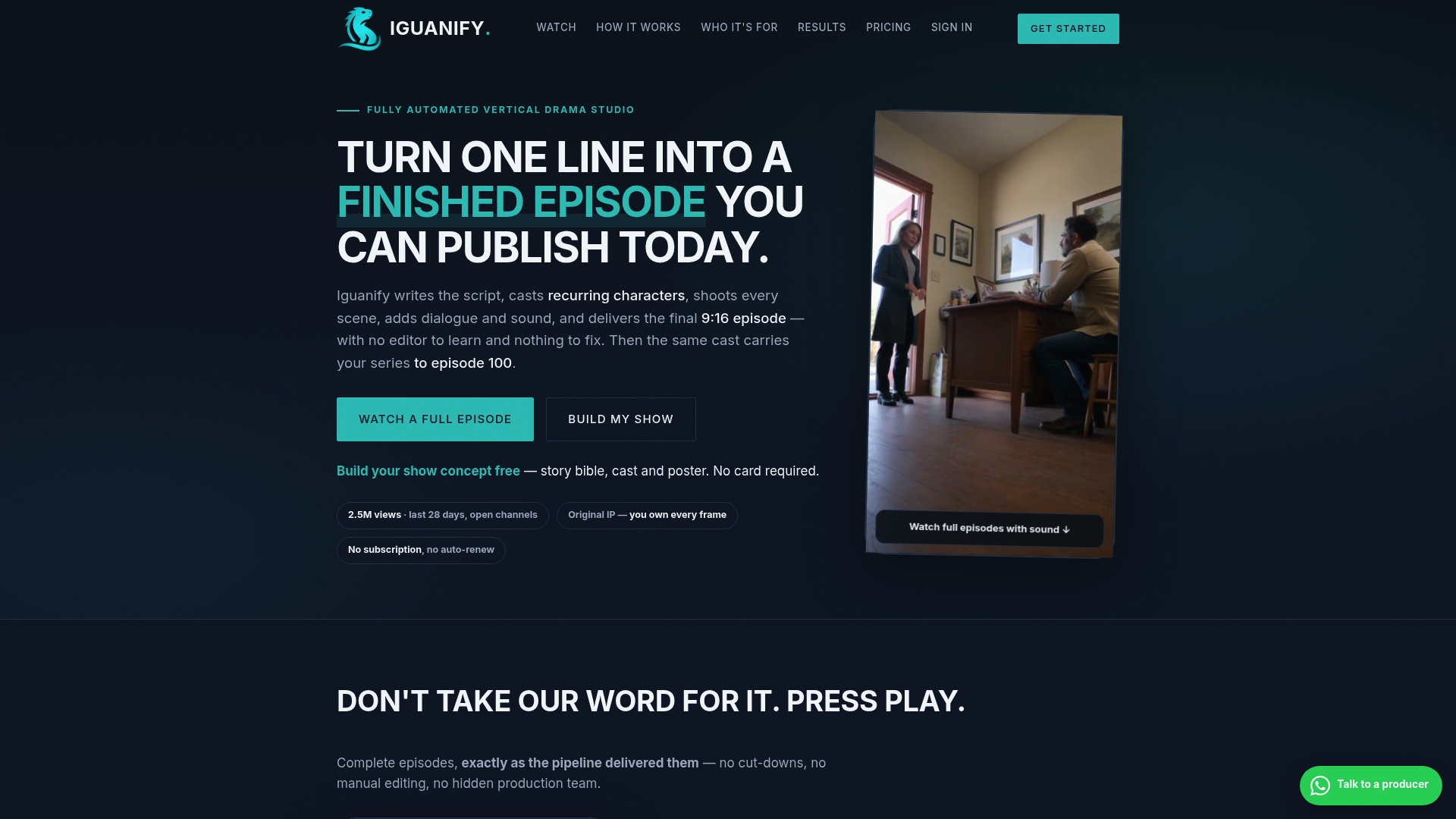
If you want to see how episode and season packages work, the AI Drama Generator page provides details on the available package options, including Standard episode and Pilot packages, as well as Creator, Season, Studio, and Slate packages.
Sources
- NewsNet Issue 1060 | U.S. Copyright Office
- 17 U.S. Code § 512 - Limitations on liability relating to material online
- Fair use on YouTube - YouTube Help
This article is general information, not a substitute for advice from a qualified lawyer. Consult a qualified legal professional about your own circumstances before acting on anything here.
FAQ
Are AI Videos Legal?
Producing and publishing AI-generated videos is legal in general, but specific uses can raise separate issues around copyright, likeness, or platform policy. The legality of any particular video depends on whether you have cleared third-party rights and whether it violates platform rules or another person’s publicity rights, not on AI use itself.
Can ChatGPT Content Be Copyrighted?
Text or other output generated purely by an AI tool like ChatGPT is not copyrightable on its own, according to the Copyright Office’s guidance. If you substantially edit, arrange, or add original creative material on top of that output, your human contribution can be protected even though the raw AI text is not.
Does AI Violate Copyrights?
An AI tool can produce output that infringes existing copyrights if it reproduces protected material too closely, and using that output could expose you to a claim regardless of your intent. Separately, whether training an AI model on copyrighted material without permission is itself infringement is an unsettled legal question still being litigated.
How Do I Avoid Copyright Issues on Videos?
Clear music, voice, and visual rights in writing before you publish, and avoid using AI to simulate a real person’s face or voice without their consent. Document your own creative contributions as you go, since a clear record of your human edits is your strongest defense if a claim or dispute comes up later.