 IGUANIFY
Best Descript Alternatives for Creators in 2026

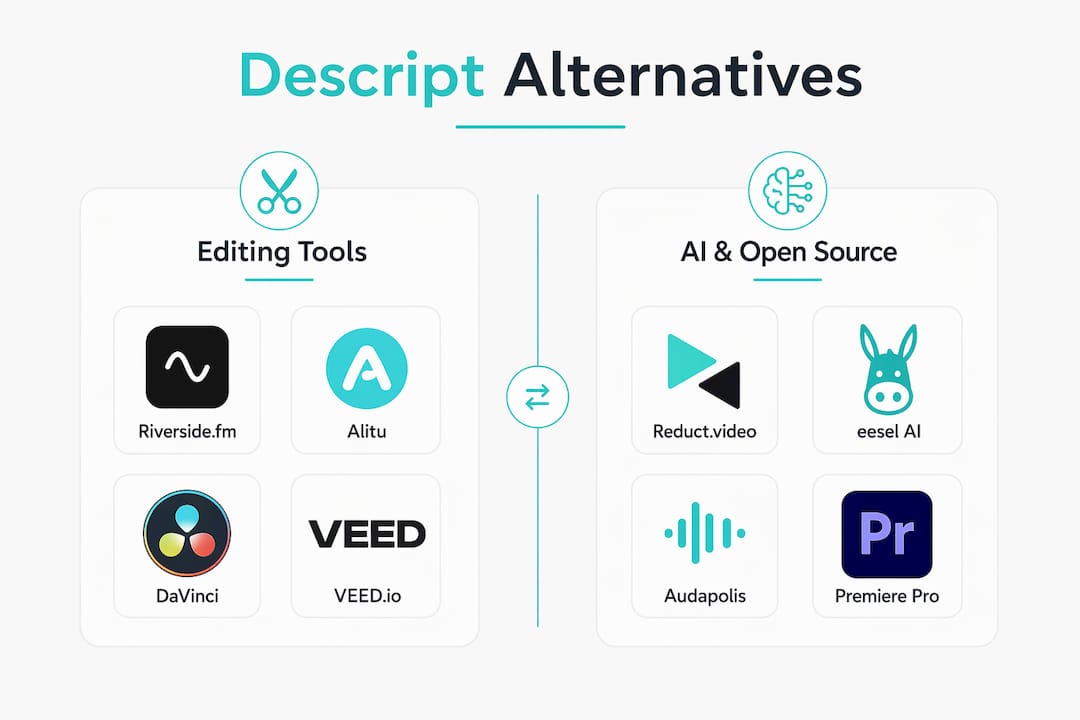
The best Descript alternatives in 2026 are not clones. They are specialized tools built for the specific job Descript does only partially well. Here is the quick verdict:
- Riverside.fm — Best for podcasters and remote interviewers needing studio-quality audio and video. Local per-participant recording at high video and audio quality. Pricing varies by plan.
- Reduct.video — Best for researchers and documentary makers handling large footage libraries. Conceptual search across massive video datasets. Starts at $12/editor/month.
- Alitu — Best for beginner podcasters who want automated audio cleanup and a simple text editor. Starts at $38/month ($32 billed annually).
- DaVinci Resolve — Best for professional editors needing Hollywood-level post-production with AI-assisted transcript editing via IntelliScript. Free version available.
- VEED.io — Best for social media marketers creating fast, template-driven clips for TikTok, Reels, and Shorts. Starts at $12/month (Creator plan).
- eesel AI — Best for customer support teams automating knowledge bases from existing content. Usage-based pricing, approximately $0.40/task.
- Audapolis — Best for privacy-conscious creators who want open-source, local text-based audio editing with no subscription.
- Premiere Pro — Best for experienced editors inside the Adobe ecosystem who need full post-production control with AI transcript editing.
What are the best Descript alternatives compared side by side?
Descript alternatives are best segmented by workflow, not by a single ranked list. The right tool depends entirely on what your raw input looks like and what your finished output needs to be.
| Tool | Best For | Unique Feature | Starting Price |
|---|---|---|---|
| Riverside.fm | Podcasters and remote interviewers | Local recording per participant | Pricing varies by plan |
| Reduct.video | Researchers and documentary makers | Conceptual search across large video datasets | $12/editor/month |
| Alitu | Beginner podcasters | Auto audio leveling and noise removal | $38/month |
| DaVinci Resolve | Professional video editors | IntelliScript transcript-based rough cuts | Free (paid Studio version available) |
| VEED.io | Social media marketers | AI clip generation with subtitle templates | Starts at $12/month (Creator plan) |
| eesel AI | Customer support teams | Auto-drafts help articles from existing content | ~$0.40/task |
| Audapolis | Privacy-first creators | Fully open source, no cloud uploads | Free |
| Premiere Pro | Experienced editors in Adobe ecosystem | AI transcript editing plus full NLE suite | Creative Cloud subscription |
Riverside.fm records locally on each participant’s device, then uploads in the background. That means you keep consistent studio-quality files even when someone’s internet drops mid-session. The built-in transcript editor also lets you generate short social clips in one click, so it covers more of the podcast production pipeline than Descript does for remote recording.
Reduct.video takes a different angle entirely. It is built for creators drowning in hours of footage, letting you search across video libraries by concept rather than scrubbing timelines manually. Documentary makers and UX researchers find it far more practical than Descript when the job is synthesizing large volumes of recorded material.
Alitu is the most approachable option on this list. It handles audio cleanup, leveling, and editing in a single workflow with almost no learning curve, making it the go-to for first-time podcasters who want a finished episode without touching a timeline.

DaVinci Resolve sits at the opposite end of the complexity scale. Its IntelliScript feature lets you make rough cuts by editing a transcript, then refine the project with industry-leading color grading and audio tools. The free version covers most creators’ needs, and the depth available for professional productions is unmatched by any other tool here.
VEED.io is purpose-built for speed. Its AI identifies high-impact moments, generates captions, and packages clips for social platforms in a few clicks. It is not trying to replace a full editing suite; it is trying to get your content posted faster.

eesel AI is the outlier on this list. It is not a media editor at all. It connects to your existing knowledge sources, such as help centers, Confluence, and past support conversations, and auto-drafts help articles while powering AI chat agents. If you use Descript primarily to produce support or training content, eesel AI approaches that job from a completely different direction.
Audapolis is free, open source, and processes everything locally. No subscription, no cloud uploads, no data leaving your machine. For creators who prioritize privacy or simply want a no-cost text-based audio editor, it covers the basics cleanly.
Premiere Pro brings the full Adobe ecosystem to transcript-based editing. AI-powered transcript cuts, auto-reframe for aspect ratio changes, audio enhancement, and generative extend for filling footage gaps are all built in. For editors already working inside Creative Cloud, it is the most natural upgrade path from Descript.
How to choose the right Descript alternative for your editing workflow
The most effective approach separates your tools by production stage rather than looking for one platform to do everything. Recording, editing, and transcription each have specialized tools that outperform any all-in-one suite at their specific job.
Ask yourself these questions before you commit to anything:
- What does your raw input look like? A recorded remote conversation points to Riverside.fm. Hours of research footage points to Reduct.video. A screen recording of software points elsewhere entirely.
- What is your primary output? A polished podcast episode, a social clip, a help article, or a professional film edit each call for a different tool.
- How much do you actually use Descript’s full feature set? If you only use it for transcription, a focused tool like Otter.ai or Wave (which offers 30 free minutes of monthly recording with paid plans from $11.67/month) will cost less and do that one job better.
- Do you work with a team? Collaboration features, permissions, and shared workspaces vary significantly across these tools. VEED.io and Premiere Pro handle team workflows well; Audapolis does not.
- What is your real budget? DaVinci Resolve and Audapolis are free. Alitu and Riverside.fm are mid-range subscriptions. Premiere Pro requires a Creative Cloud plan.
Pro Tip: Avoid the trap of choosing the tool with the most features. A creator who needs fast social clips will be slower on DaVinci Resolve than on VEED.io, even though DaVinci Resolve is technically more powerful. Match the tool to the job, not to an abstract sense of capability.
Matching your software to the primary job significantly increases workflow efficiency. The creators who get the most out of these tools are not the ones who found the best all-in-one replacement for Descript. They are the ones who identified the single most important stage of their production and picked the specialist built for it.
What is text-based video editing and why do creators seek alternatives to Descript?
Text-based video and audio editing means you edit your media by editing its transcript. Delete a sentence from the text, and the corresponding audio or video clip disappears from the timeline. It is faster than scrubbing a waveform, and it makes spoken-word content much easier to restructure.
Descript popularized this approach for podcasters and video creators, and it remains genuinely strong for transcript-based editing of interviews and talking-head video. The friction appears when creators push it beyond that core use case.
Common reasons creators look for Descript alternatives in 2026:
- Pricing unpredictability. AI credits, media hours, and subscription tiers can push costs up unexpectedly as project volume grows.
- Feature bloat. Paying for a full suite when you only need transcription, or only need social clip creation, rarely makes financial sense.
- Workflow mismatch. Descript does not auto-generate narration from screen recordings, making it a poor fit for tutorial and documentation teams.
- Scale limitations. Descript’s transcript-based editing becomes harder to manage on complex, multi-track projects where professional NLE tools like Premiere Pro or DaVinci Resolve have a clear advantage.
- Privacy concerns. Cloud-based processing is a non-starter for some creators, which is exactly why Audapolis exists.
The market for text-based media editing has fragmented into specialized tools optimized for distinct workflows rather than all-in-one solutions. That fragmentation is a feature, not a problem. You now have a genuinely better option for every specific job Descript does.
Iguanify takes a different path to video production
If the tools above solve the editing problem, Iguanify solves a different one entirely: getting from idea to finished episode without editing anything at all.
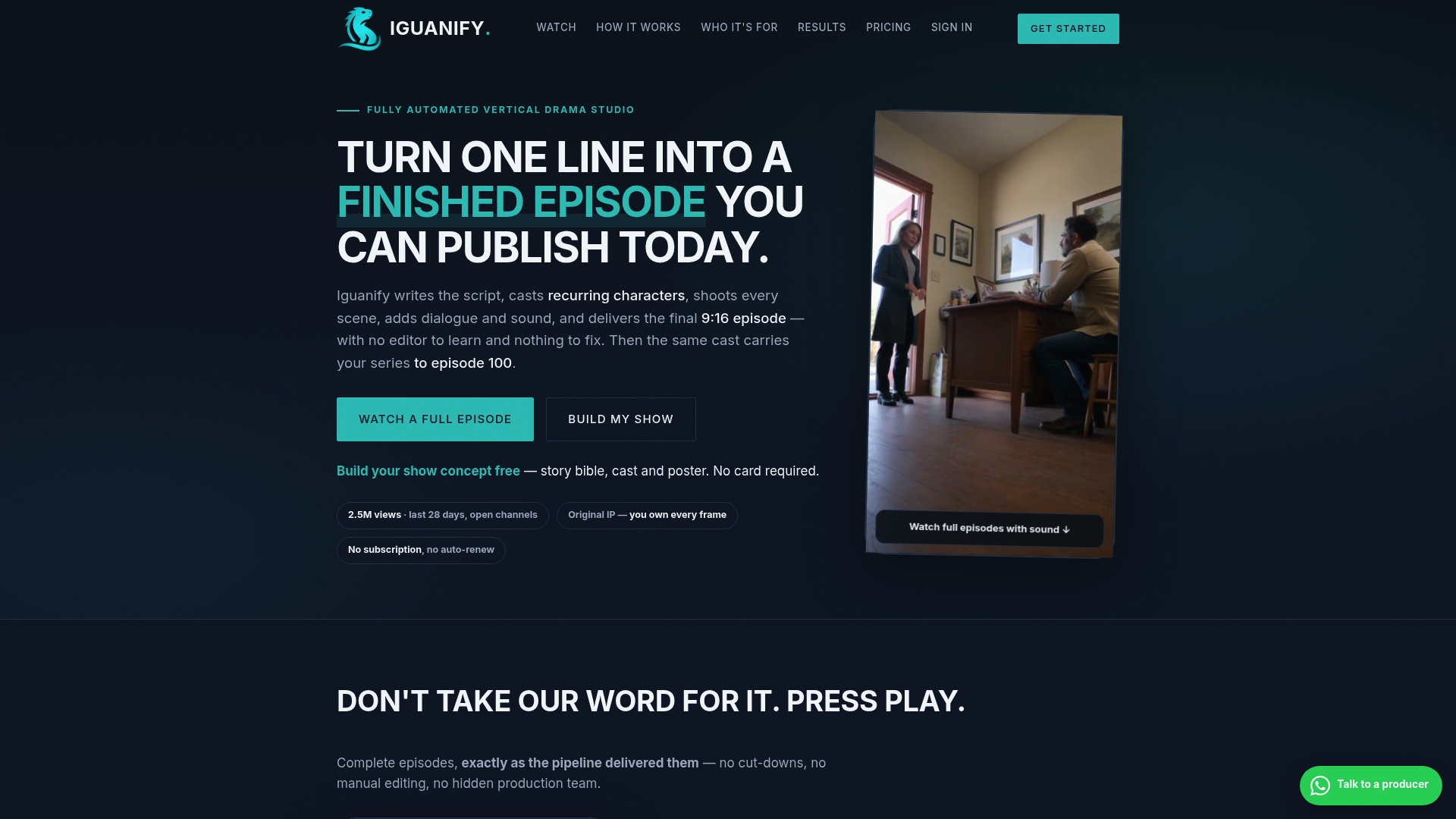
Iguanify automates the full production of serialized drama episodes from a single premise. You provide the concept; Iguanify handles scriptwriting, character generation, dialogue, sound, and final output ready for TikTok, YouTube, or Instagram. Characters stay consistent across every episode, which is the continuity problem that trips up most AI video tools. You own the IP outright, with no subscription or recurring fees. It is a one-time credit purchase per episode or season pack.
For creators who want to build an original series without a production team or a timeline to cut, the AI drama generator at Iguanify is worth a look before you commit to any of the editing tools above.
Key Takeaways
The strongest Descript alternative is always the one built for your specific production stage, not the one with the longest feature list.
| Point | Details |
|---|---|
| Segment by workflow | Riverside.fm excels at high-fidelity remote recording; DaVinci Resolve offers professional-grade post-production; VEED.io suits fast social clip creation. |
| Free options exist | DaVinci Resolve and Audapolis are both free; Audapolis adds full local processing for privacy-first creators. |
| Pricing varies widely | Alitu starts at $38/month; Reduct.video at $12/editor/month; eesel AI charges approximately $0.40/task. |
| Specialization beats all-in-one | Separating recording, editing, and transcription tools by stage outperforms any single all-in-one platform at scale. |
| Iguanify for original series | Iguanify produces fully realized episodic drama from a single premise with no editing required and full creator ownership. |